Why I keep going back
CES 2027 will be my fourth CES. I went in 2024, 2025 and 2026, every time as an attendee, never with a booth, and I'm going back this January as media for Fello Foundry.
Here's the thing nobody tells you about CES: I don't go to close deals. I go to learn, and to see the people I've met along the way. If you're in a business where you have to be at the top of your game, there is nowhere else on earth where all of tech shows up at once, from the chip to the software to the partner to the consumer device on the shelf. Everyone at CES has something to do with connecting, and you will learn something there whether you plan to or not.
My first year I treated it like a sales trip. That was a mistake, and I'll explain why later. By year three I understood what the show actually is: a celebration of the people you meet on your journey. I know which events to go to. I know who to talk to. I get to sit down with people I work with every day over email and actually shake their hand.
So this is not a listicle written by someone who skimmed the CES press kit. It's everything I know after four years on the floor, organized so you can find the answer you came for fast, with my own opinions underneath each one. Searched questions first. My tips second. A list of 30 things I wish I'd known at the end.
If you're going to CES to sell, read the part about why that doesn't work. If you're going to learn, keep reading.

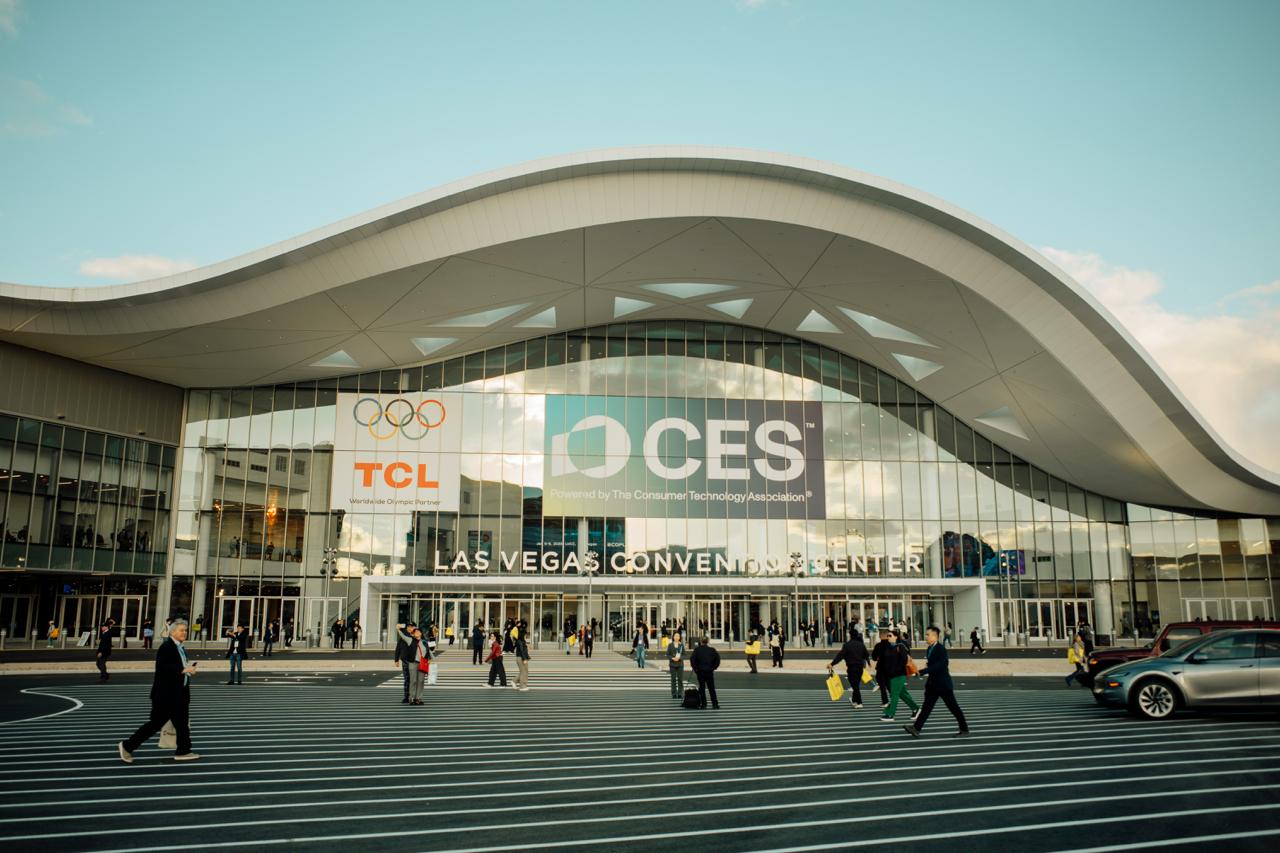
The LVCC on opening morning. Halls C1-C2, S1-S4, N1-N4 and West Hall all branch from here. Photo by Florian Schindler on Unsplash.
What is CES?
CES is the largest technology trade show in the world, held every January in Las Vegas and run by the Consumer Technology Association (CTA). It is a trade-only event: you need to prove you work in or around the tech industry to get a badge, and it is not open to the general public.
The name used to stand for Consumer Electronics Show. Today it's just CES, because the show stopped being about consumer electronics a long time ago. In the same building you'll find Qualcomm and Intel showing silicon, Hyundai and Boston Dynamics showing humanoid robots, and a thousand startups in Eureka Park showing things that may or may not exist in two years. Defense, space, robotics, health, automotive, chips, software, and yes, TVs.
My definition, after four years: CES is the one week a year when the entire tech industry is in the same city at the same time and willing to talk. That's the whole value. Treat it that way.
When is CES 2027? Dates, hours and venues
CES 2027 runs Wednesday January 6 to Saturday January 9, 2027, in Las Vegas. Media Days are Monday January 4 and Tuesday January 5 at Mandalay Bay and are media-only. This is the 60th CES.
Official exhibit hours from ces.tech:
Day | Exhibit hours | What else is on |
|---|---|---|
Mon Jan 4 | Closed | Media Day 1 at Mandalay Bay, CES Unveiled (media only) |
Tue Jan 5 | Closed | Media Day 2 at Mandalay Bay (media only). Conference 10 AM to 5 PM |
Wed Jan 6 | 10 AM to 6 PM | Show floor press conferences. Conference 9 AM to 5 PM |
Thu Jan 7 | 9 AM to 6 PM | Show floor press conferences. Conference 9 AM to 5 PM |
Fri Jan 8 | 9 AM to 6 PM | Conference 9 AM to 5 PM |
Sat Jan 9 | 9 AM to 4 PM | Final day, no conference |
The main venues:
Las Vegas Convention Center (LVCC): the big one. Central, North, South and West Halls. This is where Qualcomm, Intel, Samsung, LG, Hyundai, Sony and the rest of the heavyweights live.
Venetian Expo: home of Eureka Park, the startup zone, plus a lot of health, wellness and smaller-brand exhibits.
Mandalay Bay: Media Days and some keynotes.
ARIA: C Space, the marketing and media side of the show.
My take on timing: fly in the day before the floor opens. For 2027 that means Tuesday January 5. The floor is closed, which makes it the perfect day to pick up your badge, walk the Strip, and sleep. You don't need Saturday. By the fourth day everyone is tired and half the exhibitors are packing up in their heads.
For hall-by-hall detail, use the official CES maps and locations page. It has every venue, hall and shuttle stop, and it gets updated right up to the show.
Who can attend CES, and how do you register?
Anyone 18 or older who works in or around the tech industry can attend CES. You register at ces.tech, upload proof that you're affiliated with the industry, and CES reviews it within about five business days. There are three badge types: industry attendee, media, and exhibitor personnel.
Industry attendee (most people)
This is the badge for founders, engineers, investors, consultants and anyone attending on behalf of a company. For CES 2027 the official pricing is:
Standard Pass: $149 USD through November 30, 2026, then $349 from December 1 to January 9. Includes the exhibit floor, keynotes, Great Minds sessions and select conference sessions.
Premium Pass: $1,450 USD through November 30, then $1,750. Everything in Standard plus all conference sessions and tracks.
Media: free. Floor, keynotes, Media Days and press conferences.
You need two things to get approved: one proof of business affiliation (a company website that clearly lists your company, a business license, a recent invoice, or proof of corporate standing) and one proof of employment (your LinkedIn profile, a business card, a pay stub, or an employment letter). Plus a headshot and your date of birth.
The Standard Pass is enough for almost everyone. Unless you are specifically there for the conference tracks, don't pay for Premium.
Media
If you write, publish, podcast or create content about tech, register as media and the badge is free. Media registration goes to working journalists, industry analysts and content creators. You need three bylined tech articles from the past nine months, an assignment letter, or a masthead that lists you.
I registered as media for the first time this year, for Fello Foundry, a publication we had only just launched. I submitted our URL and what we'd published so far, and I was approved in two days. The bar is lower than people assume, but it is real: you need an actual publication with actual articles on it. A LinkedIn newsletter with four posts won't cut it. Note that CES explicitly excludes publishers, sales, PR and marketing people from media badges, so register as an industry attendee if that's your role.
Exhibitor personnel
If your company has a booth, you don't buy a pass. The company's registration coordinator invites you through the Exhibitor Dashboard and you get an exhibitor badge, which also gets you onto the floor during move-in. Exhibitors also get customer invitation codes worth $149 off a Standard Pass to hand to guests. If you're connected to a company that exhibits, ask. That's how I got in some years.
The mistake I made my first year
I waited. I registered late, booked flights late, booked the hotel late, and paid rack rate for all three. Registration opens in the fall, early pricing ends November 30, and CES hotel blocks sell out. Every year the people who get the most out of the show are the ones who booked in September. There is no reason to be the person paying $349 for a badge that was $149 two weeks earlier.
One more thing: badges are never mailed. You pick yours up in person at a remote badge location with government ID, and nobody can pick it up for you. Do it the day before the floor opens.
How much does it cost to attend CES?
A realistic all-in cost for CES, flying in from North America and staying three nights, is $1,500 to $3,000 USD. The badge is the cheapest part. Hotels and food are what get you.
Here's what I've actually spent, year by year, including flights, hotel and food:
2024, The STRAT: about $1,000 to $2,000.
2025, Circus Circus: about $1,500 to $2,300.
2026, Circus Circus: about $2,000 to $2,300.
2027, Flamingo (planned): about $2,500.
Every year I've spent a little more, because every year the business has grown and I can afford to stay a little closer to the action. But my first year I did it on a very tight budget and it was still worth every dollar.
A rough budget for a three-night trip, if you book early. Cheap versus realistic:
Standard Pass before Nov 30: $149 either way.
Flights from North America, booked early: $300 to $600.
Hotel, three nights, off-Strip versus mid-Strip: $450 to $1,200.
Food: $200 to $400.
Ubers and getting around: $50 to $150.
Total: roughly $1,150 on the cheap end, $2,500 realistic.
The cost that surprised me most: food
Nobody warned me about this. A simple lunch in Vegas can run $60 to $70 USD. Not a nice lunch. A sandwich-and-coffee lunch. Over four days that adds up faster than the hotel.
I'm pretty health and fitness conscious, so I've developed a system for eating well in Vegas without spending a fortune. Breakfast at Denny's: egg whites, fruit, dark toast. If you need to hit protein targets, a CVS on the Strip has what you need. Tacos El Gordo, across the Strip from Circus Circus at 3041 S Las Vegas Blvd, is my lunch spot: you get in the line for the meat you want, grab your tacos, pay at the cashier, and you're out for under $15. There's also a solid pho place where a bowl of broth, beef and herbs gets you back to the floor without the food coma. And if you want to indulge, Vegas obviously has incredible restaurants. Just don't do it three meals a day on a work trip.

Tacos El Gordo. Three tacos, a block from Circus Circus, under $15.

Pho is the other cheap, clean lunch in Vegas.
If you're budget-constrained, the single biggest lever is the hotel. The second is flights. Everything else is noise.
How much does it cost to exhibit at CES?
Exhibiting at CES costs anywhere from a few thousand dollars for a startup spot in Eureka Park to well into six figures for a custom booth at the LVCC. Booth space is sold by CTA sales reps, not listed publicly, so you have to contact them for a quote.
I've never exhibited myself, so I'm not going to make up booth numbers here. But Fello has launched a client on the floor. At CES 2026 we took The Haptics Company from no identity and an early proof of concept to a first-time exhibitor with a full brand, a launch website and cinematic CGI of The Wheel Thing, their haptic dial, because the hardware wasn't ready to demo at scale. That's the deep-tech exhibitor problem in one sentence: you have to make something invisible feel credible to engineers and investors walking past at speed. We've written about the same problem from the fundraising side in how much of your seed round should go to brand and go-to-market.

The Haptics Company at CES 2026, their first show. Brand, site and CGI by Fello.

The Wheel Thing. One dial, total control.
What I can tell you is how the floor is structured and who should be where:
Eureka Park (Venetian Expo) is the startup zone. Small turnkey booths, hundreds of early-stage companies, the highest density of founders anywhere at the show. If you're pre-Series A and want to meet investors, press and partners, this is where you go. It's where I start every year when I want to find people.
The main halls (LVCC) are where the big players spend big. Custom builds, hourly demos, private meeting rooms. If you're an established company with a product to launch, that's your zone.
Everything in between depends on your category. Health is at the Venetian. Vehicle tech is in West Hall. Robotics and AI are everywhere now.
My honest advice for a deep-tech or B2B startup: before you spend on a booth, go as an attendee once. Walk Eureka Park. See who's there, who's getting traffic, who's standing alone. Then decide. A lot of companies exhibit at CES because they feel they should, not because their buyer is there. And if you do exhibit, the booth is the least of it. The 90 seconds someone spends at your stand is the same 90 seconds we wrote about in why technical founders lose investors in the first 90 seconds. If your story isn't clear by then, the booth doesn't matter.
Where to stay for CES: honest hotel reviews
The best place to stay for CES is anywhere on the north end of the Strip, within walking distance of the Las Vegas Convention Center, booked before November. CES runs an official hotel block through onPeak, and rates go up every week you wait.
I've stayed at three hotels across four CESs. Here's the truth about each.
The STRAT (2024)
Budget, clean, the rooms are actually nice, and waking up to the desert and the mountains out the window was incredible. The problem is location. The STRAT is at the very north end of the Strip and it's far from everything. My first year I didn't know anyone or where to go, so I went to bed early every night and the distance didn't matter. If you're a first-timer on a budget and plan to be in bed by 10, it's fine. If you want to be out at events, it's a trek.
Circus Circus (2025 and 2026)
Smelly. Old. Sketchy area. Also iconic, full of Vegas history, and I had a good night's sleep every single night. Book the renovated tower and it's really not bad. I stayed there twice, and the second time was a choice, not a budget decision. I'd built my company from that hotel. There's something about the hustle of coming back up every morning and getting to work. I wasn't ready to let it go yet.
That said, I'm not going back. It's time.

Two years at Circus Circus. I wasn't ready to let it go yet.
Flamingo (2027)
This is where I'm staying this year. It's mid-Strip, closer to everything, and it's a step up. The Flamingo was one of the first hotels in Las Vegas and they did a massive overhaul on the rooms. I love history and nostalgia, and I love animals, so the wildlife habitat on the property is a bonus. I'll report back.
If money is no object
It depends on who's paying. If your company sent you, stay somewhere nice and close: the Encore or Wynn are the obvious picks, right next to the LVCC. If it's your own company and your own money, be honest about how much time you'll spend in the room. I'm barely in mine. For me the dream would be Caesars or a suite at one of the historic properties, because I'm into the iconic Vegas thing. Vegas has an era of themed hotels from the 2000s, the pyramid, the castle, the pirate ship, that's worth appreciating even if you don't stay there.
The practical answer
Book in September or October, stay as close to the LVCC as your budget allows, and don't spend on a room you'll only sleep in. Work your way up each year. That's what I did, and the progression from STRAT to Circus Circus to Flamingo is its own kind of scoreboard.
How to get around Las Vegas during CES
The fastest way to get around during CES is to walk if you're close, Uber if you're not, and try the robotaxis because Vegas has them now. The CES shuttle and the Las Vegas Monorail both exist, and I've used neither in four years.
The thing about Vegas: everything looks close and nothing is. Every walk takes 30 minutes longer than you think. The pedestrian bridges, the detours through casinos, the sheer scale of the buildings. Budget for it.
Walking
I walk everywhere. I'm from Toronto, it's freezing in January, and getting to walk outside in the desert for a week is a gift. If you're coming from a cold country you'll feel the same. Vegas is stimulating, the Strip is a show in itself, and there's history everywhere once you know to look for it.
Safety: I was worried about it my first year. Toronto is a safe city and Vegas has a reputation. The answer is that you have to be smart, and no, I wouldn't walk everywhere. But I walked from the Strip all the way to Fremont Street last year, stayed on the main path with everyone else, and felt completely fine.
Uber and Lyft
This is how I get to evening events. Surge pricing during CES is real, especially at 6 PM outside the LVCC. If you can walk 10 minutes away from the convention center before you call a car, you'll save money and time.
Robotaxis
Vegas is one of the only cities where you can ride two different driverless robotaxis in the same week. Zoox, Amazon's purpose-built robotaxi with no steering wheel, has been running public rides on the Strip since September 2025, with pickup and dropoff at designated spots like Resorts World, AREA15 and Luxor. Waymo opened its Las Vegas service in September 2026 and is scaling up. If you're at a tech show and you haven't tried one, you're doing it wrong.
Monorail and shuttle
The Las Vegas Monorail runs from MGM Grand up to the LVCC and you can add a discounted pass to your CES badge at registration. CES also runs free shuttles between official hotels and venues. I've seen people take both and I may try the monorail this year. But four years in, I've never needed either. You can walk or Uber almost anywhere.
Between venues
The LVCC and the Venetian Expo are the two you'll bounce between. It's about a 20 to 25 minute walk, or a short Uber. I do the LVCC in the morning and the Venetian in the afternoon, or split them across days, rather than bouncing back and forth.
How to plan your days at CES
Plan CES by venue, not by exhibitor. Give the LVCC a full day, give Eureka Park at the Venetian its own morning, and stop walking the floor by 2 PM so you have energy for the evening, which is where the real conversations happen.
Here's my actual sequence.
The day before (Tuesday January 5)
Fly in. Pick up your badge at a remote badge location, it's fast if you get there early. Keep in mind a huge share of attendees are flying in from Asia, so the lines move differently than you'd expect. Walk the Strip. Eat well. Sleep. There is always a feeling of excitement arriving in Vegas for CES, especially when you've worked hard to afford the trip. Enjoy that.
Day one (Wednesday January 6): LVCC
Coffee. Then straight to the LVCC Central Hall, because I like to see the craziest stuff first. The big players put their most ambitious demos here, and it's the fastest way to get inspired and calibrated on what the year is going to be about. Samsung, LG, Sony, Qualcomm, Intel, Hyundai.
Push hard until about 2 PM. Then stop. Go back to the hotel, go for a walk, get something to eat, rest. A lot of the best of CES happens at the evening events, and if you've spent eight hours on your feet you'll have nothing left for them. People who try to do the floor from open to close and then go out are wrecked by Thursday.
Day two (Thursday January 7): Eureka Park, then West Hall
Eureka Park at the Venetian Expo is a whole other beast. Hundreds of startups in small booths, founders standing right there, the highest density of real conversations at the entire show. Go in the morning when it's fresh and less crowded. This is where I've met some of my best allies. Interview people, shake hands, ask what they're building.
In the afternoon, if you're in vehicle tech, mobility or anything adjacent, the LVCC West Hall is worth the trip. Thursday night is when the best side events land, so the 2 PM rule still applies.

LEO Flight in the LVCC West Hall. This is the mobility hall, and it's where the wildest hardware lives.
Day three (Friday January 8): go back to what mattered
Friday is a half day for me. By then you know what you want to see again, so go back for the second conversation with the two or three people who were most interesting. Second conversations are worth ten first ones. Then head to the airport.
Why three nights
I fly in Tuesday and leave Friday. Three nights, two and a half days on the floor, and I skip Saturday entirely. The honest reason: business is good, but go home and spend time with your family. There's nothing on the last day that's worth more than that. By Friday afternoon the floor is thinning out anyway. If you want to extend, extend for Vegas, not for CES. Hoover Dam is 45 minutes away.

Battlefield Vegas, 10 minutes from the Strip. If you're in defense and you have a spare afternoon, go.
For deep tech, defense, robotics and chips specifically
The halls that matter for my world: LVCC Central for the chip and platform companies, LVCC West for vehicle tech and autonomy, Eureka Park for the robotics and hardware startups, and the Hyundai and Boston Dynamics showcase for where humanoid robotics actually is. There's also a growing space and quantum presence in the conference tracks. Skip the smart home and TV halls unless you're in that business. You can see a very thin TV on YouTube.
How to actually talk to people on the floor
The way to get a real conversation at CES is to be genuinely interested in what someone built. Not pretend-interested. Actually interested. People at CES love talking about their own thing, and they can tell in five seconds whether you want to learn or whether you want to sell.
Last year I went to the Hyundai showcase to see Boston Dynamics' Atlas, the humanoid robot, do tasks. I was genuinely excited. I thought it was incredible. And because I was excited, I had real conversations with people there. That's the whole trick. There's no technique.

Atlas at the Hyundai Motor Group showcase, CES 2026. This is the photo I'd use to explain why I go.
My first year I tried to make money. My firm hadn't yet focused on what we do best, so I didn't really know the industry I was in, I didn't know the people, and I was on the floor trying to sell. It didn't work, and I could feel people getting irritated. Nobody at CES wants to be sold to. They're there to show something, and the people they want to talk to are the people who care about it.
Someone in the defense world told me something I think about all the time. He said you don't show up to one of these conferences and close a deal in a minute. You show up for ten years. That's how trust gets built. The biggest companies in the world play in that space and nobody closes on a handshake at a booth.
So here's what works:
Know your industry first. When your company has a real focus, you know the players, you've read their stuff, and you have something to say. Generalists bounce off.
Ask about the thing, not about the deal. What's the hardest part of making this work? What changed since last year? Who's using it?
Give them something. An observation, a connection, a question they haven't been asked. Most people walking up to a booth are either collecting swag or pitching.
Be fine with no outcome. The outcome is that you learned something and they remember you. The deal, if there ever is one, is three CESs away.
Quality over quantity. In tech, people want to work with the best partners, and the way you become the best is by learning. CES is the best classroom in the industry if you treat it like one.
Find your country's pavilion
One of the most underrated moves at CES: go find your own country's pavilion. I'm Canadian, so for me that's the Ontario Pavilion, a cluster of Ontario startups and the OVIN mobility network all in one block at the Venetian Expo. It's the easiest networking at the whole show. You already share a home base, the people there want to meet other Canadians, and half the conversations end with "let's grab coffee back in Toronto." Every big exporting country has one: Korea, France, Italy, Japan, Israel, the Netherlands, Taiwan. If you're coming from outside the US, it's a cheat code for turning a trade show into a community.

The Ontario Pavilion at the Venetian Expo. Find yours.
Keynotes and side events worth your time
The keynotes at CES are worth lining up for once, because being in the room is part of why you came. The side events are where the actual networking happens, and the best ones for hardware and deep-tech people are free, invite-based, and run by the community rather than by CES.
Keynotes: go once, stream the rest
Last year I went to see Jensen Huang give the opening keynote for CES 2026 at the Fontainebleau. NVIDIA took over the whole place with demos. Was it worth the time? Yes, once. Whether you work for someone else or you're building your own company, you're growing as a person, and being able to say you were in the room when Jensen showed off the latest NVIDIA tech is part of that. I thought it was awesome.

The Fontainebleau the morning of the NVIDIA keynote, CES 2026.
But I wouldn't do it every day. Keynotes are streamed. Pick the one that matters for your industry, go in person, and watch the others later.
Side events: the three I actually recommend
I'm not a big party guy. The official after-parties exist and if you're high energy, go. What I go to are the lower-key community events where the hardware and deep-tech crowd ends up. These three have been consistently good, with a great crowd of people in the space:
Founders + Friends by MistyWest, Thursday January 7. A one-night incubator-meets-networking event, now in its tenth year, hosted with Fictiv and Arduino. MistyWest is a Vancouver hardware engineering firm, and as a Canadian I'm biased, but this one is the real deal. It's free, but you need an access code from a partner or you request an invite. Request early.
Global Hardware Festival by Hardware Meetup. This started as a house party at Caesars Palace during CES 2024 that expected 500 people and got 2,000. For 2027 they're going bigger: demos, talks, workshops, and the whole 50-city Hardware Meetup community. Over a thousand registered already. Tickets require approval.
An informal party to rock CES, by Nate Padgett and the informal collective, at the Punk Rock Museum. They take over the whole museum, bar, house band and tattoo artist included, and there are hardware demos scattered through it. Invite only, approval required.
How to get in: register early, use a partner code if you have one, and if you're in the space, say so in your request. These organizers want builders in the room.
How I think about events
The events are the reason for the 2 PM rule. If you've got nothing left by 7 PM, you'll skip the one thing that was worth the trip. Pick two, maybe three across the week. Don't try to hit six.
What to bring to CES: the survival kit
You need four things for CES: real walking shoes, a backpack, a water bottle and a battery bank. Everything else is optional.
Walking shoes. I bought new ones specifically for CES. Not dress shoes, not the sneakers you think are comfortable. You will walk 20,000 steps a day between the halls and the Strip. This is the number one thing.
A backpack. You'll pick up swag, printed material and the occasional cardboard battery prototype. A bag that sits on both shoulders beats a tote by day two.
A water bottle. Vegas is dry, the halls are dry, and a bottle of water inside the LVCC is a crime.
A battery bank. Massively underrated. You're on your phone all day for the app, for maps, for photos, for the Uber at the end of the night. Nothing kills a CES day like 8% at 3 PM.
Eating healthy in Vegas on a work trip
This could be its own article, but here's the short version. Vegas restaurant food is expensive and heavy, and four days of it will wreck you. My routine:
Breakfast at Denny's. Egg whites, fruit, dark toast. Cheap, consistent, open early.
Protein from CVS. If you're tracking macros, the Strip CVS locations carry what you need.
Tacos El Gordo for lunch. Across from Circus Circus, lines by meat type, under $15, open till 2 AM.
One real dinner. Pick a night, pick a great restaurant, indulge properly. Then go back to the routine.
Lessons learned the hard way
I remember my first CES being so tired that by the end I could barely think. Not from the walking. From trying to do everything. The kit matters, but the real survival tool is a plan that leaves room to rest.
30 things I wish I knew before my first CES
Don't go to sell. Go to learn. If you're trying to close deals on the floor, you're the person everyone is trying to get away from.
Register before November 30. The Standard Pass doubles on December 1.
Book your hotel in September. The official block sells out and prices climb every week.
Fly in the day before the floor opens. Badge pickup, a walk, a real sleep.
Nobody can pick up your badge for you. Bring government ID.
If you publish anything about tech, apply as media. The badge is free and the bar is lower than you think.
If you know someone who exhibits, ask for a customer invitation code. It's $149 off.
Everything in Vegas looks close. Add 30 minutes to every walk.
Buy real walking shoes before you go, not during.
Battery bank. Not optional.
Water bottle. The halls are dry and bottled water inside costs a fortune.
Lunch in Vegas can cost $60 to $70. Budget for food like it's a second hotel.
Denny's for breakfast, CVS for protein, Tacos El Gordo for lunch, one great dinner.
Start at LVCC Central. See the craziest stuff first and get calibrated.
Give Eureka Park its own morning. It's a different show.
Stop walking the floor at 2 PM. The evening is where the conversations are.
Pick two or three side events for the whole week. Not six.
The best side events are free, community-run, and invite only. Request early.
Go to one keynote in person. Stream the rest.
Be genuinely interested or don't walk up to the booth.
Ask about the thing, not about the deal.
Second conversations are worth ten first ones. Go back on day three.
You don't close a deal in a minute. You show up for ten years.
Know your own industry cold before you go. Generalists bounce off.
Try the robotaxis. You're at a tech show. Zoox and Waymo both run in Vegas.
The STRAT is far. Circus Circus is old. Both are fine if you know what you're getting.
Walk your way up. A better hotel each year is a good scoreboard.
Vegas is safer than its reputation if you stay on the main paths and use your head.
Three nights is enough. Go home to your family.
Don't try to do everything. Have a plan, stick to it, and don't be hard on yourself. The dumbest thing you can say is "I'm going to CES to close five deals." Meet people, learn, partner with great people, travel safe, and take care of yourself. Life goes by quickly.
Where CES is going
CES is becoming less of a consumer electronics show and more of a B2B technology show, and AI has gone from a category to the water everyone is swimming in.
I got to see CES before AI and after AI. In 2024 AI was a theme with its own corner. By 2026 every company at CES was an AI company, which is funny, because most of them were the same companies doing the same things with a new word on the banner. That won't last. By 2028 saying you do AI will sound like saying you have a website.
What's actually changing is who shows up. More B2B. More robotics that does real work, not dance routines. Hyundai and Boston Dynamics showed Atlas at CES 2026 as a product for factories, not a research demo. More defense-adjacent companies, more space (we wrote about how those companies sell in space tech marketing: winning contracts before you've flown), more quantum in the conference tracks. The consumer gadget part of the show is still there, but it's no longer the point.
My wish, which will never happen: I'd love to see CES somewhere other than Vegas for a year. Different city, different energy. Vegas is iconic and I've come to love it, but the show has outgrown the idea that it's about consumer electronics, and it would be interesting to see if it has outgrown the Strip too.
Frequently Asked Questions
When is CES 2027?
Wednesday January 6 to Saturday January 9, 2027, in Las Vegas. Media Days are January 4 and 5 at Mandalay Bay and are media-only.
Can anyone go to CES?
No. CES is trade-only and 18+. You need to prove you work in or around the tech industry. The general public can't buy tickets.
How much are CES tickets?
A Standard Pass is $149 USD through November 30, 2026, and $349 from December 1. The Premium Pass with full conference access is $1,450, then $1,750. Media badges are free for approved journalists, analysts and creators.
How do I attend CES for free?
Register as media if you publish tech content, get an exhibitor to add you as personnel, or get a customer invitation code from an exhibiting company, which takes $149 off a Standard Pass.
How much does it cost to attend CES all-in?
Budget $1,500 to $3,000 USD for three nights from North America, including badge, flights, hotel and food. I've done it for around $1,000 to $2,000 on a tight budget.
Where is CES held?
Mainly at the Las Vegas Convention Center, with Eureka Park and more at the Venetian Expo, plus Mandalay Bay, Fontainebleau, ARIA and other venues across the city.
What is Eureka Park?
The startup zone at the Venetian Expo. Hundreds of early-stage companies in small booths. The best place at CES to meet founders.
Is CES worth it?
If you go to learn and meet people in your industry, yes, every year. If you go to close deals on the floor, probably not.
How many days should I spend at CES?
Three nights. Fly in Tuesday, do Wednesday and Thursday in full, half of Friday, and fly home Friday. Skip Saturday.
Is Las Vegas safe during CES?
Yes, if you stay on the main paths and use common sense. I walk everywhere and have never had a problem.
Where should I stay for CES?
Close to the LVCC if you can afford it: Wynn, Encore, or anything on the north-central Strip. Book through the official onPeak block in September or October.
See you on the floor
I'll be at CES 2027 from January 5 to 8 as media for Fello Foundry, hunting for conversations with the highest-level tech companies in the world. If you're building something in deep tech, defense, robotics, space or chips and you want to do an interview with our publication, reach out. I'll be the one in the good walking shoes.
Published in Fello Foundry by Fello