


‘We already believe the technology works.’ Three funds passed on the same company with a version of that sentence, and each time the founder heard a compliment.
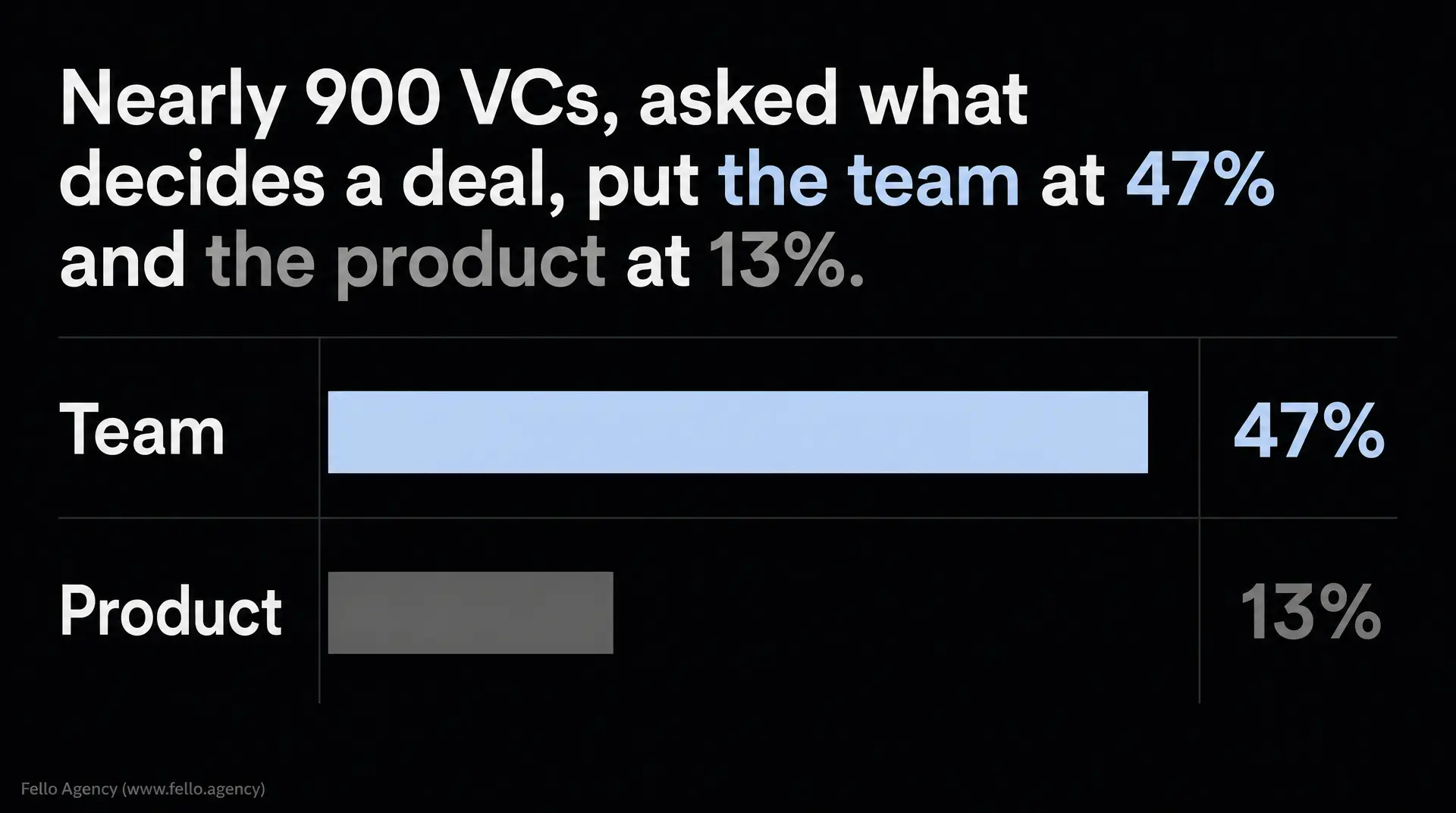
He had spent two years retiring the technology risk in the lab, then built his entire homepage around it - the sensor diagram, the physics, the founders’ PhDs above the fold. Nearly 900 VCs, asked what decides a deal, put the team at 47% and the product at 13, so he had staked the round on the one thing the room was never going to buy.
The technology risk had died in the lab two years earlier. It just never died in public, and the money reads only what you publish.

Key Takeaways
Carta Q1 2026 data shows median Series A valuations of $300 million for foundational AI companies versus $55 million for non-AI companies, demonstrating that homepage category positioning directly dictates venture capital comparables.
Venture capital associates evaluating 200 companies a year require a three-sentence summary defining what the product is, who is paying for it, and why it exists now to advance a Series A memo.
Deep tech startups should publish a public traction counter, such as customer parts processed or cumulative flight hours, allowing Series A partners to model demand independently from an observable growth slope.
Displaying customer pilot programs over a year old without conversion rates signals failure to venture capital funds, requiring founders to present pilots as an active pipeline rather than a static wall of logos.
Deep tech startups with NDA-protected customers should secure written approval to publish the count, tier, and jurisdiction of their clients to establish commercial trust prior to data room access.
Because venture capital diligence averages 73 days and 81 hours of work, founders must freeze all website changes three months before a Series A pitch to prevent narrative inconsistencies during evaluation.
Why Does a Deep Tech Startup Homepage Become Outdated Before a Series A Round?
A deep tech homepage is usually a fossil of the seed round. I’ve said this enough times that founders quote it back to me, and they still haven’t checked their own site.
The way it happens is boring. The company is heads down building, which is totally fine, and nobody is managing the website. I’ve seen enterprise companies doing incredibly well look like a four-person lab because nobody touched a page in two years. And two years is about right. Carta reported that at the end of 2024 the median company raising a Series A had waited 774 days between rounds. So the homepage the associate is reading was written for a seed investor, by a founder who has changed their mind about the business at least twice since.
There was a quantum sensing company. Strong seed. The seed pitch was the physics and the team, which is correct, because that’s what you sell at seed. Two years later they had two paying customers, real ones, and they went out for the A. The homepage still had a big diagram of the sensor, a paragraph on the physics I needed a whiteboard to follow, and the founders’ PhDs above the fold. Not one word about who was paying them.
We told them the buyer had changed. The seed investor wanted to know if it works. The Series A investor already believes it works, that’s why they took the meeting. What they need is who paid. The founder pushed back hard. His line was, “The science is the moat. If we take it off the page we look like every other sensor company.” Which, to be fair, is not a crazy thing to believe. It’s just wrong about who’s reading.
Three funds. Three passes. Every pass was a version of the same sentence: “We already believe the technology works.” That sounds like a compliment. It’s the worst thing you can hear at an A, because it means they’re asking a question you never answered. The technology risk had been retired in the lab two years earlier. It just never got retired in public.
The funds were behaving exactly like the data says they behave. When Gompers and his co-authors surveyed nearly 900 VCs, team was the single most important factor for 47% of them. Product was the answer for 13%. This founder had built his entire homepage around the thing they weight least.
After the third pass he called me. We didn’t take the physics off the site. We moved it. The homepage became what it does, who’s paying for it in the words those customers use, and the number that goes up every quarter. The physics went one click down for the engineer who actually needs it. Same company. Same science. Different reader.
One nuance, because I’ve done the opposite and it was right. For a pre-revenue quantum company we led with the scientists, because at seed the biography is the case study. The day someone pays you, the customer becomes the case study and the biography moves down the page.
What Three Sentences Do Venture Capital Associates Need to Evaluate a Series A Startup?
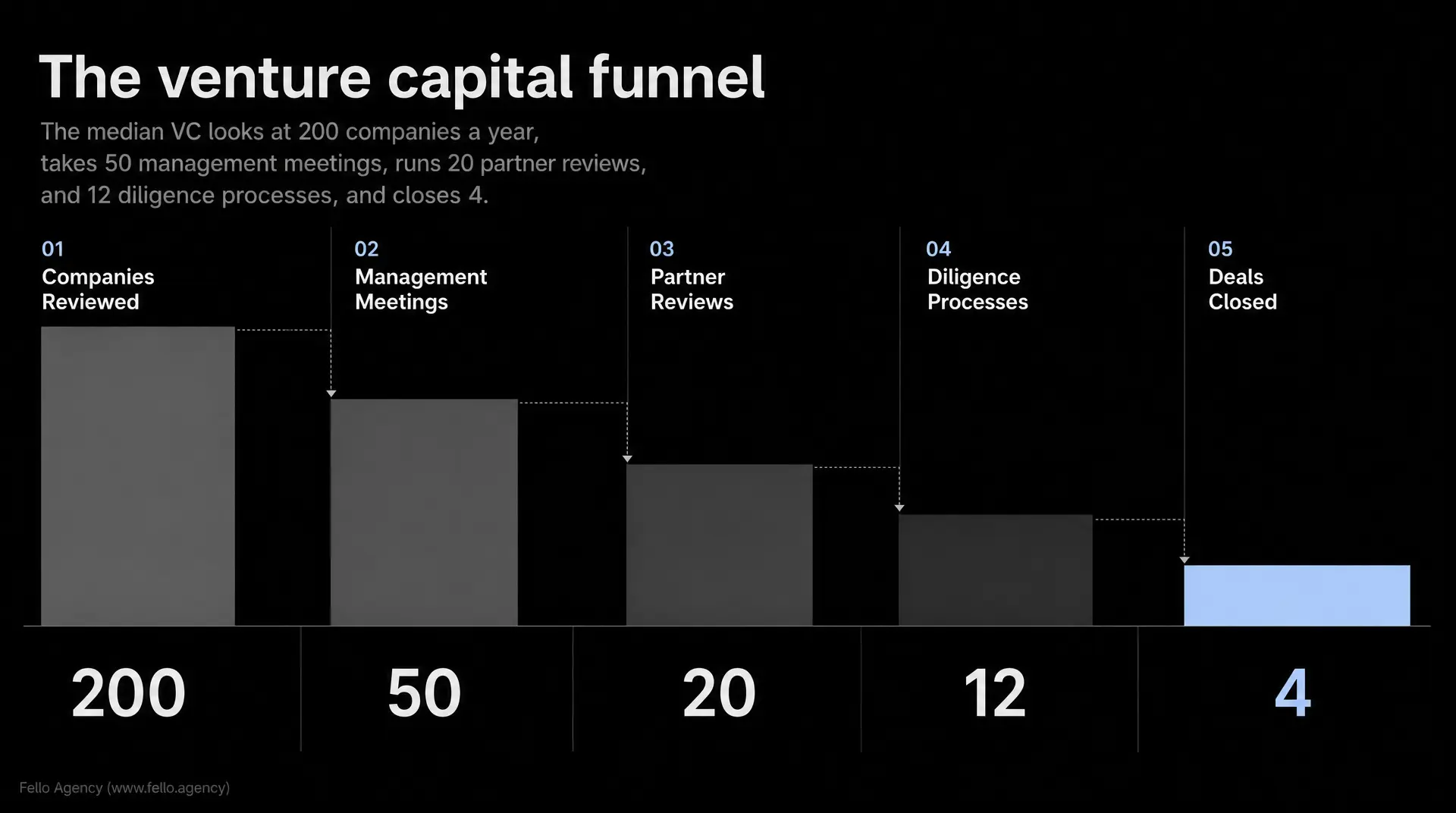
The inside of a fund is not glamorous. The same survey found the median VC looks at 200 companies a year, takes 50 management meetings, runs 20 partner reviews and 12 diligence processes, and closes 4. The cut from 200 to 50 is the memo. An associate writes it. A partner reads it, usually at night, usually on a phone. If you can’t be summarized in three sentences on a Sunday night, you don’t get to Monday.
Technical founders write those three sentences about the product. The associate needs three sentences about the company. Those are two completely different things. Every instinct a founder has points at the thing they built, how it works, what makes it novel, why the approach beats the incumbent. So you get an abstract. Accurate, dense, and useless to the person reading it, because the associate isn’t writing a memo about your sensor. They’re writing a memo about whether this is a business.
A medtech company learned this the expensive way. They were a workflow platform. Their technology touched diagnosis, so the word “diagnostic” was sitting right there on the page, and that’s the word the associate grabbed. The associate is hunting for a category. The founder didn’t hand them one, so they picked their own. The partnership passed on a diagnostics company. The actual business was never evaluated at all.
The three sentences the memo needs come in a specific order. What it is, in words a smart non-specialist can repeat. Who’s paying for it. Why now, meaning why does this exist this year and not five years ago. That’s the whole screen.
Founders think three sentences are a description. They’re actually a decision. You’re deciding what category you’re in, what you’ll be compared to, and what question the fund asks first. If you don’t make that decision on the page, a 26-year-old makes it for you on a Sunday night, with whatever word jumped out at them.
There’s a very human reason that 26-year-old won’t fight for you. Years ago a client of ours lost a deal with one of the biggest retailers on earth because their visuals made them look like a joke. The manager on the other side wouldn’t put a company that looked like that in front of his boss, because his name was going on it. An associate’s name goes on the memo. If the site looks like a science project, the safest memo to write is a pass.
The test we run is dumb simple, and we make our own team pass it before anything ships. Show the homepage to someone smart who has never heard of you. Give them 60 seconds. Take it away and ask them what the company does. If they describe the product, you’ve written an abstract. If they describe the business, you’ve passed. Most deep tech companies fail this the first time, and they fail because the founder wrote the page for a reader who already understood it.
Why Should Deep Tech Startups Publish a Monthly Traction Metric for Series A Investors?

Investors buy a slope, not a snapshot. A revenue figure on a slide is a dot. A number that has moved every month for a year, in public, is a line, and a partner can extend a line without asking you a single question.
So put a counter on your homepage. Flight hours, units shipped, test cycles completed, data collected. Revenue is optional. Three things are not optional. It has to be honest, it has to be yours, and it has to move.
The one I think about most belonged to a company that had nothing to ship. Advanced materials, a coating process, pre-revenue, about 18 months from the A. The founder’s instinct was the same one every deep tech founder has. The number that matters is the performance number, how much better the coating is than the incumbent. But that’s a lab result. You get it once and it sits there.
So I asked him a different question. What’s the thing that only happens when a customer wants you? The answer was parts. To evaluate a coating, a customer has to pull a real part off their production line and ship it to you. An engineer fills in an export form. A manager approves it. Somebody pays for the courier. Nobody does that for a science project.
The counter became customer parts processed. Not our parts, theirs. Underneath it sat the number of companies those parts came from. The day it went live it read something like 40 parts from six companies. A year later it was a few hundred parts from about 30. Still no revenue. Still no product on a shelf. But every increment meant a stranger had done paperwork to get there.
When the A conversations started, one partner said something I’ve repeated ever since. “You’ve got 30 companies doing free diligence for you, and I can watch it happen.” He’d been checking the counter. He modelled demand off it before the first call. A drone company did the same thing with cumulative flight hours on the homepage, and a partner told them he’d modelled the round from the counter before anyone shook hands.
Two things I pull out of that. The number that works is almost never the number the founder is proud of. It’s the one that costs the customer something to make go up. And the counter changed how the company behaved. Once it was public they had to keep it moving, so every prospect call ended with “send us a part.” It stopped being a widget and became the sales process.
If I had a magic wand I’d make every deep tech company obsessed with going to market like it’s life or death. Well-funded companies move slowly because nothing forces them to. A public counter forces them.
How Do Startup Update Emails Drive Series A Introductions Through Seed Investors?
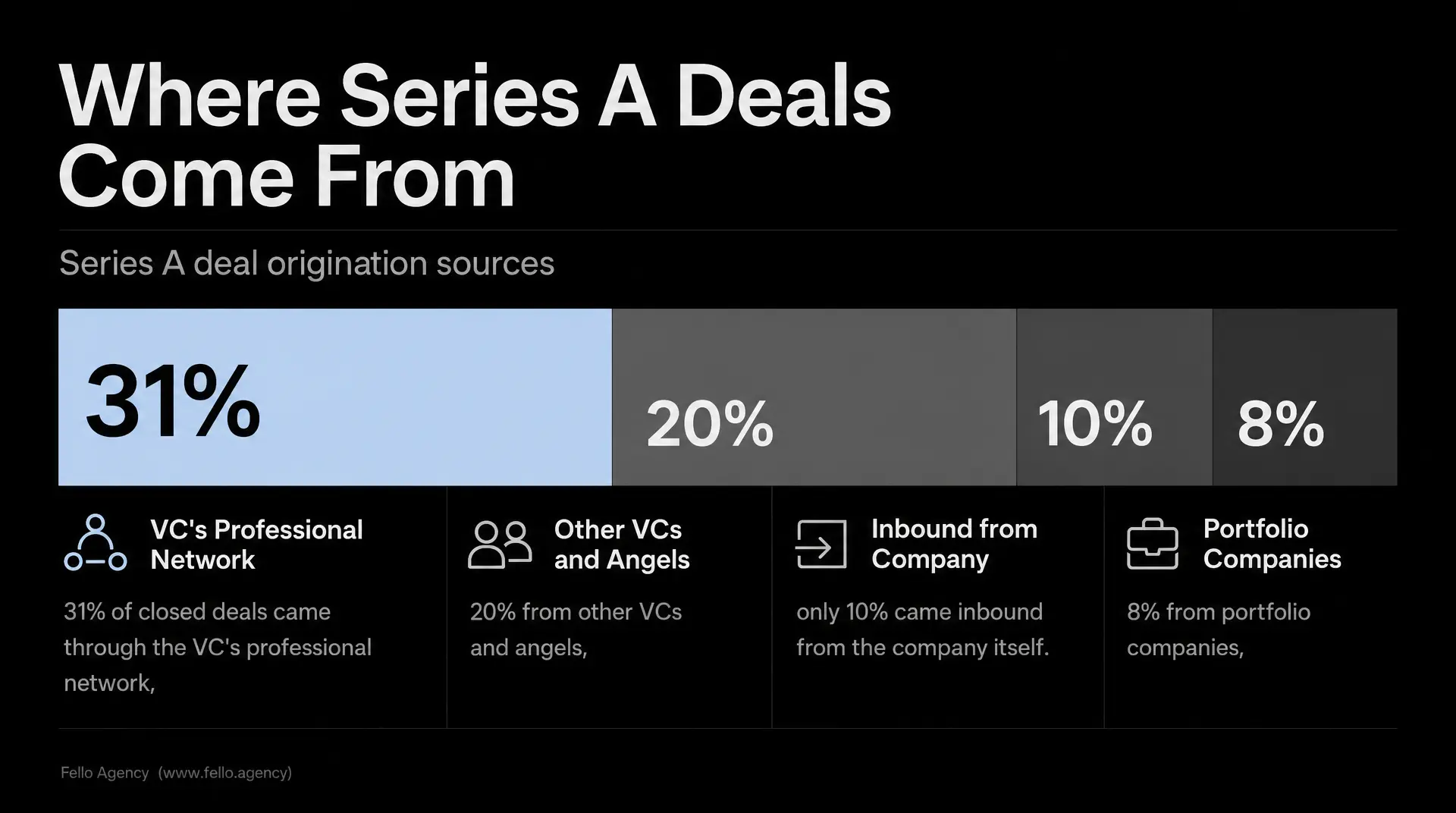
The A meeting almost never starts on your website. In the Gompers survey, 31% of closed deals came through the VC’s professional network, 20% from other VCs and angels, 8% from portfolio companies, and only 10% came inbound from the company itself. So your first impression on a fund is an email you didn’t write, forwarded by a seed investor who skimmed your last update. The website comes second, as verification. I’ve always said LinkedIn is a verification tool rather than a lead tool, and at the A your homepage plays the same role.
Which means the quality of the intro is decided by the quality of your updates. Nothing else.
I watched one seed investor make three intros for the same founder. Two were a single line, roughly “you should meet these guys, they’re doing cool stuff in sensing.” The third was four sentences lifted almost word for word from the founder’s quarterly update. What it is, who’s paying, the number that moved this quarter, what the A is for. That intro closed. The other two never got past a first call.
The founder didn’t write a better pitch for the third fund. He wrote a better update, and the investor had something worth copying.
So format the update like you’re writing the intro yourself, because you are. Top of the email, the three sentences that pass the associate test. Then the number and how it moved since last time. Then the one thing that changed, a customer, a hire, a milestone with a name. Then the ask. The technical progress goes below the fold, where the one investor who actually cares about your error rates can find it. Most of them won’t read that far, and that’s fine, because the update’s job is to get forwarded.
And write it yourself. I’ve said for years that passion beats hardcore planning on LinkedIn. Same rule here. A seed investor can tell when an update was written by the founder at 11 at night, and that’s the one they paste into an intro. Nobody forwards a build log.
Why Is the Second Customer More Valuable Than the First for Series A Marketing?
The first customer proves someone would pay. The second proves it wasn’t a favour. Funds know this, which is why your first customer gets discounted the moment they hear how you got it.
A robotics company had a first pilot with the founder’s former employer. Real deployment, real money, great relationship. The fund discounted it entirely. Of course your old boss gave you a pilot. Fair or not, that’s how it reads.
The second customer had no connection to anyone on the team. Different industry, found them cold, real contract. It was the single most important commercial fact about the company and it appeared nowhere. Not on the homepage, not in the deck, not in the update. The founder mentioned it on a call like a footnote.
This happens because founders think chronologically. First customer, then second customer, two logos on a slide in the order they arrived. Funds think about independence. Did anyone who owed you nothing decide to pay? That’s the customer you lead with. If you have one, it’s the most valuable sentence you can put on your site this year, and I’d bet money it isn’t there.
How Do Expired Customer Pilots Negatively Impact Series A Venture Capital Evaluation?
A pilot is a promise with a clock on it. A pilot more than a year old with no conversion reads worse than no pilot at all, because it answers the one question you least want answered. They tried it. They didn’t buy.
I’ve watched this on a homepage. Seven pilot logos, nicely arranged, all over a year old, none converted. The founder saw seven validations. The associate saw seven customers who tried it and walked. Same wall of logos, opposite memo.
Robotics has a name for this, pilot purgatory, and everyone in the sector treats it as a technology problem. In my experience it’s a trust problem. The champion inside the customer loved the robot and had no boardroom-ready story to take to their VP of operations, so scaling never got approved. A stale pilot on your homepage tells a fund two things at once. The customer didn’t convert, and you never armed the person who could have made them.
So stop presenting pilots as a trophy case and present them as a pipeline. Started, in evaluation, expanded, converted to contract, with dates and the conversion between stages. If two of seven converted, say so. Two of seven is a rate, and a fund can model a rate. Seven logos with nothing behind them is something a fund has to guess about, and they will guess the worst.
If a pilot is dead, take it down. You’re presenting the company as it was. The investor is buying the company as it is.
How Should Deep Tech Startups Market NDA-Protected Customers to Series A Investors?
Most of my clients can’t put a logo on the homepage. Defence, medtech, enterprise contracts with confidentiality clauses that make the legal team twitch. Founders treat that as a wall. In my experience it’s a vocabulary job.
Build the language that stands in for the customer. Count, tier and jurisdiction. How many, how big, where. Agree the exact phrasing with the customer, get it signed off in writing, and use it everywhere. The real logos go in the data room, where the fund will see them under NDA anyway.
One company was under contract with a major prime and had nothing public to show for it. With the customer’s sign-off they published a single line: “under contract with a top-five US defence prime.” No logo. No program name. The next investor conversation started in a completely different place, because the opening question stopped being “has anyone paid” and became “how big is the next one.”
Same absence of information, completely different trust signal. “This engagement is under NDA at the client’s request” reads like a serious company doing serious work. “We can’t name our clients” reads like you don’t have any. And “detailed case studies available upon request under NDA” turns the restriction into the reason a fund gets on the phone. What looks like a disclaimer is actually a sales tool. Make the NDA a reason to get the call.
How Can Founders Prepare Customers for Series A Venture Capital Reference Calls?
Strip diligence down and it’s reference calls. The Gompers survey put early-stage diligence at eight reference calls on average, and your enterprise customers do the same thing to you. TrustRadius found 71% of enterprise buyers spoke with an existing user before purchasing. Somebody phones your customer and asks what you do for them. The customer answers with whatever words they have, which are usually the words you gave them, or the gap where those words should have been.
A reference once described a company’s product as “a nice tool the engineers like.” The round died on that sentence. The product was saving that customer a six-figure line item, and nobody had ever said so to the customer in plain words. The engineers loved it. The person on the reference call had never been told why the CFO should.
So write it for them. Every reference customer gets a one-page version of the story in their own vocabulary, not yours. What was frustrating before. What changed. What it’s worth to them, in their own numbers. Walk them through it before the fund calls. You’re just making sure the person about to decide your round describes the same company you pitched.
This is literally how we start every brand project at Fello. We interview the client’s customers first, before sales, before marketing, before the founder. I want to know what pissed them off before the product showed up and what they’d lose if it disappeared tomorrow. Then the case study gets written entirely from their side, no specs, no company voice. A reference call is a case study you don’t get to edit. So do the interview yourself, a year early, and hand your customer the version you’d want them to say.
How Does Startup Category Positioning Determine Valuation Comparables for a Series A Round?

At seed nobody runs comparables. At A everyone does. In the same VC survey, 80% said comparable companies are an important factor in valuation, and 29% said comps are the most important factor. And the spread between categories right now is brutal. Carta’s Q1 2026 data put the median Series A valuation for a foundational-model AI company at $300 million, against $55 million for a non-AI Series A. So before your partner meeting, someone pulls the list of companies you look like and the multiples they raised at. Your category picks that list. And you picked your category on your homepage, whether you meant to or not.
An inspection robotics company positioned itself as hardware. Robots, sensors, ruggedised platforms, all the right words for an engineer. Their comp set became hardware companies, with hardware margins and hardware multiples. Then they repositioned as inspection data, with robots as the collection method. Same robots, same software, same customers. Different comparable set, and a completely different conversation about what the company was worth.
Pick the category you actually are, even when a prettier multiple is sitting one category over. In that case the customer was paying for the data and the robot was a means to it. The hardware positioning was a fossil from the years when building the robot was the hard part. The hard part had moved. The homepage hadn’t.
And please don’t bolt “AI” onto a materials company because you saw the Carta number. We can spot bullshit a mile away at our agency, and a partner who has looked at 200 companies this year can spot it faster. Ask what your customer would say they’re paying for, then check whether your category matches. If it doesn’t, the fund runs comps on the wrong company and you spend the meeting arguing with a spreadsheet you’ve never seen.
Why Do Series A Investors Evaluate a Startup Careers Page as a Cash Flow Statement?
Nobody thinks of the careers page as marketing. Funds read it more carefully than your about page. Every open role is a statement about where the money is going and whether there’s a plan behind it.
Fourteen open roles at seed reads as burn without a plan. A VP Sales opening posted six months before an A reads as a founder who knows what the A is for. One is spraying capital. The other is telling the fund which chapter of the business comes next, in a language funds trust more than a slide, because a job posting costs you something.
Then there’s the worst version. Roles left up from a hiring freeze. The fund notices the posting date, or a candidate they know mentions the role went quiet months ago, and now you’re either careless or lying. Both are a pass.
The careers page has a second reader too, and this is the part founders miss. I’ve said for a while that a deep tech company’s first customers are its hires. The senior engineer you’re trying to pull out of a big lab is reading the same page as the associate, doing the same pattern-matching for stability. One aerospace and defence founder came to us for concept renders of a counter-drone platform and told us afterward, “These images helped me attract engineers to join my team!” The same asset that convinces an engineer you’re real convinces a fund you’re real.
So treat the careers page like the counter. Honest and current. Post the role that tells the story of the round you’re raising. Take down anything you’re not actively hiring for this week. And write the description in business language, because the same associate who read your homepage is reading this too, checking whether the company hiring is the same company selling.
What Is the 12-Month Series A Marketing Campaign Timeline for Tech Startups?
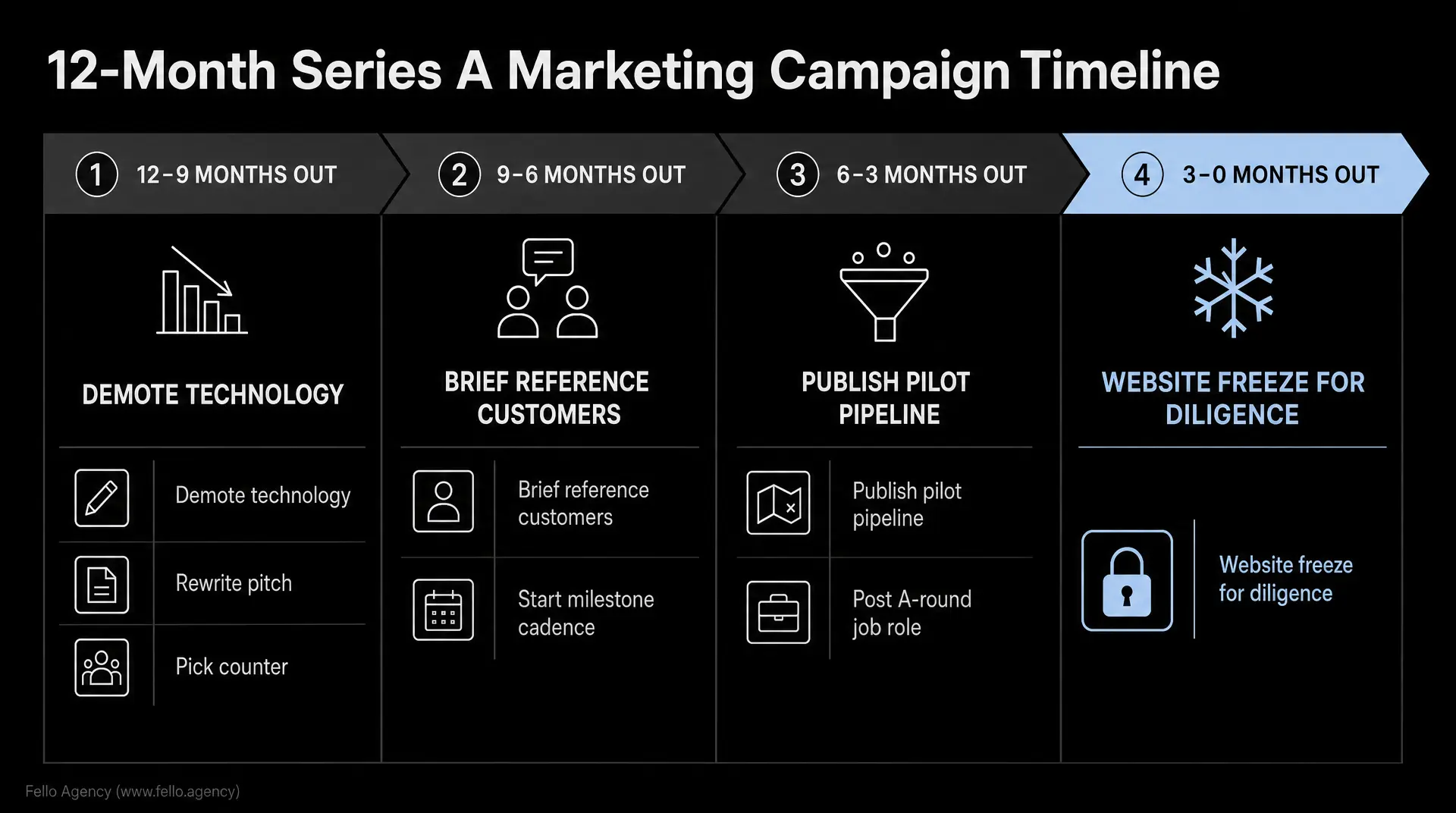
This is how the pieces line up on a calendar. Twelve months out, not three, because by three you’re supposed to be done. And a word to the founders I meet here in Toronto. You will want to run each of these steps in months. Run them in weeks. In America they ask why not. Here we ask why. You don’t wanna be moving slow in tech, you’re gonna get killed.
What Series A Marketing Campaign Actions Must Startups Take 12 to 9 Months Out?

Demote the technology one click down. Rewrite the first three sentences until a stranger passes the associate test. Decide your category on purpose. Start the update list and pick your public counter, the one that costs the customer something to make it move.
This is also when you fix how you look, and I’ll give you the numbers I give every founder. A Series A company should budget $50,000 to $150,000 for a proper rebrand, with roughly half going into strategy and research and the rest into the visual work. Spend meaningfully more than $100,000 at this stage and technical buyers get suspicious, because too much polish looks like vaporware. Spend nothing and you’re believing in your product without authenticating it. Dress for the client you need.
If the product doesn’t physically exist still, this is the quarter you get the renders and the lab footage done, not three weeks before the meeting. We built renders for a Canadian counter-drone company that had no physical prototype, and those renders carried them through a funding round. But renders on their own scream “this doesn’t exist still.” Pair them with real footage of your team in the lab so the future looks grounded in something that exists today.
And if nobody inside the company can translate PhD-level specs into a sentence a board member can repeat, bring in someone who already speaks your industry. You should not burn the first month of a 12-month clock teaching a marketing partner what quantum error correction is.
How Should Tech Startups Execute Series A Marketing Campaigns 9 to 6 Months Out?
Sit down with every NDA’d customer and agree the count, tier and jurisdiction language. Brief every reference customer with their one-pager. Start the founder’s milestone cadence, a steady public rhythm that shows the pattern forming. Give the milestones real names people can repeat instead of internal alphanumeric codes. Your technical milestones are brand moments, and one press release when the whole thing is finished is the least interesting way to tell that story.
What Key Series A Marketing Deliverables Must Startups Publish 6 to 3 Months Out?
Put the independent customer on the site. Publish the pilot pipeline with its stages and conversions. Post the role that says what the A is for. Land one press piece written for investors, meaning it talks about who’s paying and why now rather than the physics. This is the stretch where the site starts to look like its own Series B.
Why Must Startups Freeze Their Website 3 Months Before a Series A Campaign Pitch?

Stop touching it. The same VC survey put early-stage diligence at 73 days and 81 hours of work. That’s 81 hours of someone reading everything you’ve ever published. A moving target during that window reads as chaos. The counter keeps ticking because it’s supposed to. Everything else stays still. If a fund reads your site on Monday and it’s different on Thursday, they read that as a founder who doesn’t know what they’re selling, and no amount of “we’re agile” fixes it.
What Are the Best Practices and Minimum Requirements for Series A Startup Marketing?
Should Tech Startups Include a Dedicated Investors Page for Series A Marketing?
No. An investors page on a Series A company is the same move as a space company selling merch before it’s launched a rocket, and I’ve been pitched by those companies. It tells the fund you’re marketing to the wrong buyer in public. A real news page, yes. Announcements, milestones, customers, hires, all dated and all current. That’s the evidence. Let the investor find the pattern themselves.
Should Founders Modify Their Startup Website During an Active Series A Raise?
Freeze it. The counter moves and nothing else does. Every change mid-raise is a new question in diligence and a new version of the company someone at the fund has to reconcile with the one already in the memo.
Does Announcing a Seed Funding Round Improve Series A Marketing Outcomes?

Yes. The seed announcement is Series A marketing. It’s the first dated point on the pattern, it makes your update cadence credible, and it’s the article an associate finds first when they search you. Write it for the next round, not the last one.
What Are the Minimum Series A Marketing Requirements Without a Dedicated Marketing Team?
The update email and the public counter. One person can run both in a few hours a month. If you do nothing else in this guide, do those two. Honestly, I’d rather see a founder with a moving counter and a good update than a founder with a big marketing team and a 40-page website that says everyone and lands nowhere.
Why Does Published Business Evidence Outweigh Raw Technology in Series A Venture Capital Decisions?

I’ll leave you with the line I opened with, because it’s the one that stings. Series A investors don’t fund the best technology in the round. They fund the company that already looks like its own Series B.
The best technology in the round loses to the second-best technology with a number the fund watched go up for a year, a category they can run comps on, and a customer who can explain it on a reference call. Nothing in your lab changes that. Everything you publish can.
Pivot to an ROI narrative or you’re gonna stay in the lab. Create a business, not a research problem. Start 12 months out.
Frequently Asked Questions
How much dilution should founders expect when successfully pitching a Series A?
Expect around 18%. According to a Carta benchmark of over 1,000 rounds, the median Series A dilution is exactly 18% on an $80M valuation. Your marketing’s job is to defend that valuation by proving commercial traction, not just lab results.
Should we rebrand our deep tech startup as an AI company to boost our Series A valuation?
Absolutely not, unless it is true. While foundational AI companies see a reported $300M median valuation compared to $55M for others, bolting on AI ruins your comps. A partner will spot the bullshit immediately. Pick the category your customers actually pay for.
Should our Series A marketing rely on a highly technical product demo?
No. A brilliant demo doesn’t close enterprise deals or venture rounds. Research from TrustRadius shows only 13% of buyers care if a demo blew them away. What matters is pragmatic business fit. Pitch ROI, not your features.
Can our website actually replace a founder-led technical sales pitch before the A round?
Yes, and it has to. Gartner found that 75% of B2B buyers prefer a rep-free sales experience. Your website must explain the commercial value clearly without you needing to be in the room to draw on a whiteboard. Building that site is the core of our deep tech marketing agency‘s web work.
How do we market our founding team to VCs without looking like an academic research lab?
Frame your bios around commercial execution. VCs weight the team as the most important factor 47% of the time. They want to see leaders transitioning from chief scientist to chief executive. Highlight industry experience and an obsession with going to market.
Your Creative Partner for Innovation That Matters
From advanced tech to transformative healthcare, Fello helps visionary teams shape perception, launch products, and lead industries.


Let’s keep in touch.
Discover more about high-performance web design. Follow us on Linkedin and Instagram.

