


The most expensive stretch of any rebrand is the one where nothing gets made.
Design runs on a calendar. It is the one part of this I can promise to the day. A project that drags to nine months almost never held nine months of work - three went to design, and six went to a company waiting for one person to choose direction A over direction B.
The real number is set the moment you decide how many people sit between a designer and a decision, and no agency will ever print that line on your quote.
Key Takeaways
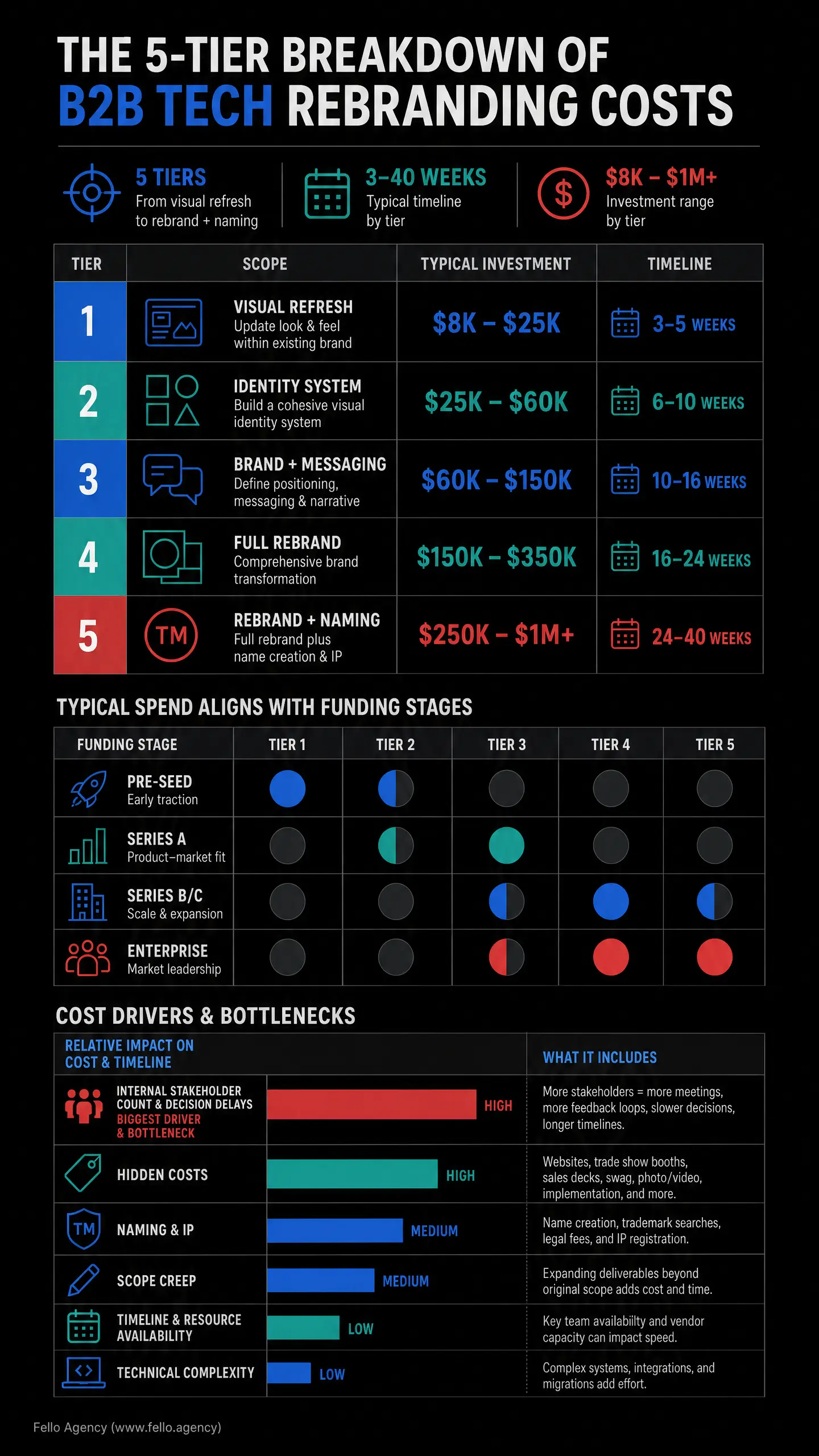
Website development typically consumes 30 to 50% of a total B2B tech rebranding budget and is frequently omitted from initial low-cost agency quotes.
Specialist branding agencies allocate approximately half of a $60,000 to $150,000 Tier 3 rebranding budget toward messaging strategy and audience research before executing visual design.
Adding naming services to a B2B tech rebrand extends project timelines by six to ten weeks due to domain negotiation and an 11-month USPTO trademark pendency target.
Spending dramatically over $100,000 on a brand redesign at the Series A funding stage can cause technical buyers to question the underlying substance of the product.
Internal stakeholder headcount acts as the primary cost and timeline driver for rebrands, mirroring Gartner data that shows 74% of B2B committees experience unhealthy decision-making conflict.
Medical technology rebranding timelines must account for regulatory review cycles because FDA guidance dictates that specific labeling modifications can trigger a new 510(k) approval process.
Stanford University research indicates that 46.1% of user comments evaluating the credibility of a website focus directly on its visual design.
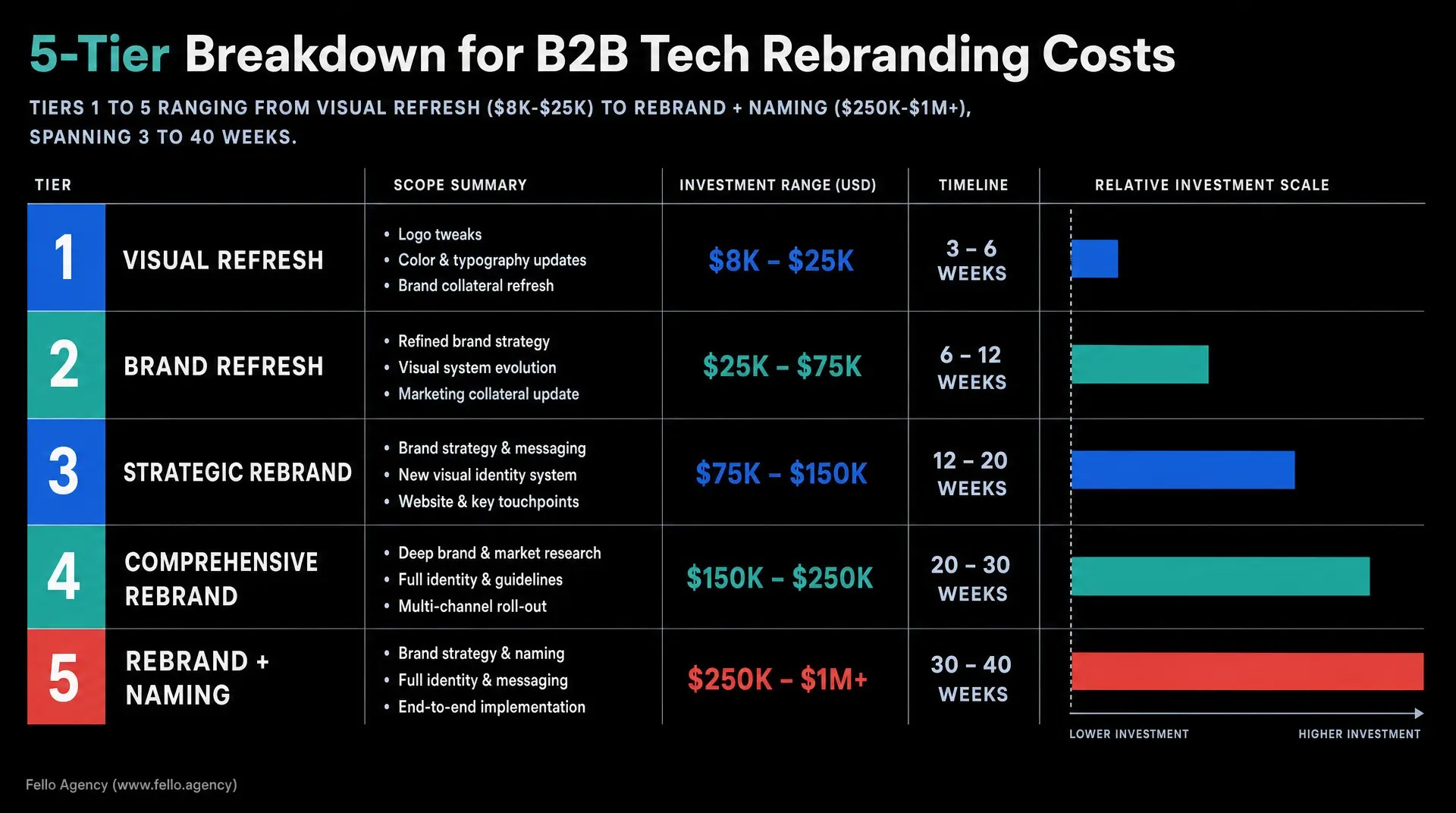
What Are the Five Tiers of B2B Tech Rebranding Costs?
These are market ranges for a specialist agency. A generalist shop in a cheaper market quotes lower. A global consultancy quotes double. Region and agency tier move the numbers. The structure never moves, and the structure is the part nobody explains to you.
What Is the Difference Between a B2B Brand Refresh and a Full Rebrand?

Tiers 1 and 2 are a brand refresh. The look changes and the story stays. The brand refresh vs rebrand line sits at Tier 3, because that's where you start rewriting what the company says, not just how it dresses. It's also where the money starts going to work you can't see. At Fello we put roughly half of a Tier 3 budget into strategy and research before anyone touches a pixel. That half is what saves you when a board member asks why the new direction looks the way it does. You answer with research instead of taste.
The jump from Tier 3 to Tier 4 is the website, which eats 30 to 50% of total spend on almost every project I run. It's also the item most likely to be quoted separately. When a rebrand quote looks suspiciously cheap, the site usually isn't in it. Check before you sign.
Why Do B2B Tech Companies Frequently Underestimate Their Required Rebranding Scope?

We did work with a company chasing government proposals. Ten-million-dollar proposals. They came in wanting a simple rebrand to look more competitive. What they actually needed was a whole new communication plan just to articulate why they should win over the incumbents. Then a visual upgrade so they looked as serious as the companies they were bidding against. Then the UX. Then all of it applied to the website, because evaluators go there to check whether you're real before they read a word of your proposal. We identified all of that together before work started, which is what any decent firm should do. They walked in asking for Tier 2 and left with a Tier 4 scope, and it made them credible in rooms they couldn't enter before.
I tell clients that scoping a rebrand is almost as complicated as planning an apartment building. You don't pour concrete and figure out the floor plan later. You get crystal clear on scope at the start, or you pay for it in change orders forever.
How Much Does a B2B Tech Rebrand Cost by Company Funding Stage?
Tech leaders budget in funding rounds, so here's the same math the way you actually think.
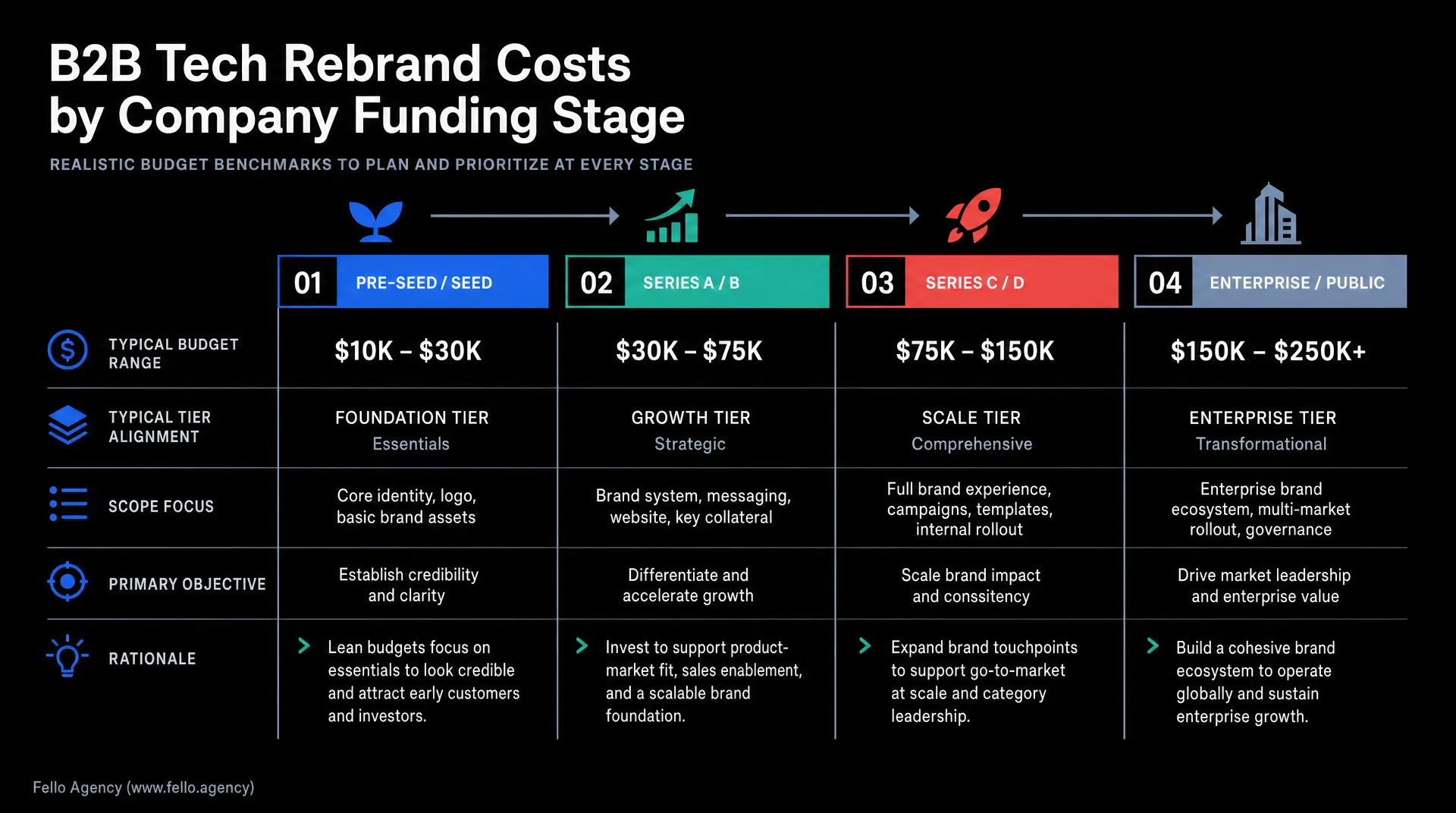
The Series A row is the one I see most. You raised on a story your public-facing brand can't tell still, and every enterprise prospect who Googles you finds the company you were two years ago. The pitch deck outgrew the website. In deep tech, that's the single most common engagement we take.
Two warnings on this table. Don't overbuild before product-market fit, because your brand will change when your company does. And watch the ceiling, because it surprises people: at Series A, spending dramatically over $100K on brand can actually read as suspicious to technical buyers. Engineers know what substance looks like. When the polish runs far ahead of the proof, they start asking what you're covering for.
At the enterprise end, the asset list expands past anything a startup pictures. Legal documentation templates. Email sign-offs. Proposal templates, investor materials, compliance review, rollout to thousands of employees. When we rebuilt Revanesse for Prollenium Medical Technologies, the job was moving an entire dermal filler brand from beauty marketing to science-driven positioning. Custom CGI, macro photography, global guidelines that had to hold up in clinics across multiple markets at once. "Fello delivered smart, strategic creative that elevated our brand," is how their CMO, Kaitlin Daley, put it. At that tier you're building something that outlasts everyone currently working on it.
How Should Marketing Leaders Justify B2B Rebranding Costs to the CFO?
Early in my career I thought I'd always have to argue the case. You need a good logo because of this, a strong identity because of that. I don't make that argument anymore. When a marketing leader asks me to justify $100,000, my honest answer is that I'm not justifying $100,000. I'm looking at what we can do with $100,000. Sometimes a client doesn't need the full budget and we lower it, because that's the right thing to do. Sometimes we phase the work. But the clients we work with generally know what this costs and are fair about spending it.
I'll be blunt about the other side. If a client is pushing numbers and pinching pennies, we walk away. I learned that pitching a board of Canadian business leaders who spent the entire meeting bringing us down. It was the last board pitch I ever did. Meanwhile, some of the most advanced tech companies in the world name their price and push forward. That contrast taught me more about who to work with than anything else in this business.
If you're the CMO carrying the number upstairs, this is what works. Stop calling it branding. Call it communication strategy and lead generation infrastructure, because that's what you're buying. Then put your current site next to the competitor who just landed the Microsoft or Amazon partnership and let the board draw the line themselves. The instinct has data behind it: Stanford's credibility research found that 46.1% of the comments people make when judging a website's credibility are about design. I watched a company lose an Amazon deal because their visuals made them look like a joke. The Amazon manager wasn't going to walk an illegitimate-looking vendor into his boss's office and stake his own reputation on it. Nobody sends a rejection letter for that. You lose in silence.
When the CFO asks about payback, give two honest answers. The first shows up in days. Strong branding moves sales velocity almost immediately: faster email replies, easier first calls, prospects arriving at the demo already convinced you're real. It lets your sales team skip a level in the sales cycle because the vetting happened before anyone spoke. The second answer takes longer, and say so out loud. LinkedIn's B2B Institute estimates 95% of your potential buyers are out-market at any given moment. Brand is how that 95% remembers you when their budget finally opens. I describe it to clients as building a highway. The collector lanes get you fast wins. The express lanes carry the buyers who drive past you for two years before they take your exit.
What Are the Most Common Hidden Costs in a B2B Tech Rebrand Budget?
Every tier above gets blown up by line items that never make the first quote. Walk through these with your finance partner before kickoff, not after.
Start with the website, since it runs 30 to 50% of spend and is frequently quoted separately. Photography and video come right behind it. A new identity sitting on old photography looks half-finished, and everyone in the room feels it even when nobody can name it. For hardware companies this one is brutal, because product imagery carries the whole brand.
Sales collateral is sneakier, because your reps touch it every day. Decks, one-pagers, case studies, proposal templates. On launch morning every one of them is suddenly wrong, and your sellers notice before anyone else does.
Then the two that hurt the most, and interviewers ask me about this exact thing. The trade show booth is the most painful hidden cost I see, every single time. It surfaces late, it's always the last-minute panic, and it has to get pushed impossibly fast in industries like defense and manufacturing where booth production carries long lead times and serious money. CEIR's exhibit-spend benchmark shows 24% of the average exhibitor budget goes to exhibit design, production and refurbishing, with another 18% just for shipping. The other repeat offender is the technical three-pager, those dense product documents your sales engineers hand out at every meeting. Companies forget them until three weeks before launch, then scramble.
Product UI is an engineering ticket. If your logo lives inside the app, someone has to put your rebrand onto a sprint board that already has a roadmap on it, and engineering did not plan for you. Get on their calendar early or launch with a product that contradicts your website.
Domain acquisition deserves its own warning, because the right domain can quietly cost more than the entire design budget. Price the domain before you fall in love with the name. Trademark and legal work becomes mandatory the moment naming enters the picture, and I'll put numbers on that below.
Internal rollout is dozens of small items: email signatures, document templates, LinkedIn banners, badges, signage. Small money, but it's what your own employees judge the rebrand by. And if you're in medtech or defense, add regulated re-approval, because customer-facing material may need to go back through review. On the medtech side, FDA guidance is explicit that certain labeling changes can trigger a new 510(k). Those weeks have nothing to do with design and everything to do with your launch date.
One more that technical companies always miss: the developer surface. API documentation, SDKs, developer portals, changelogs, your listings on G2 and Crunchbase. We build these into scope at Fello, because a rebrand that engineers and search engines can't find is half a rebrand.
How Long Does a B2B Tech Rebrand Take and Why Use Design Sprints?
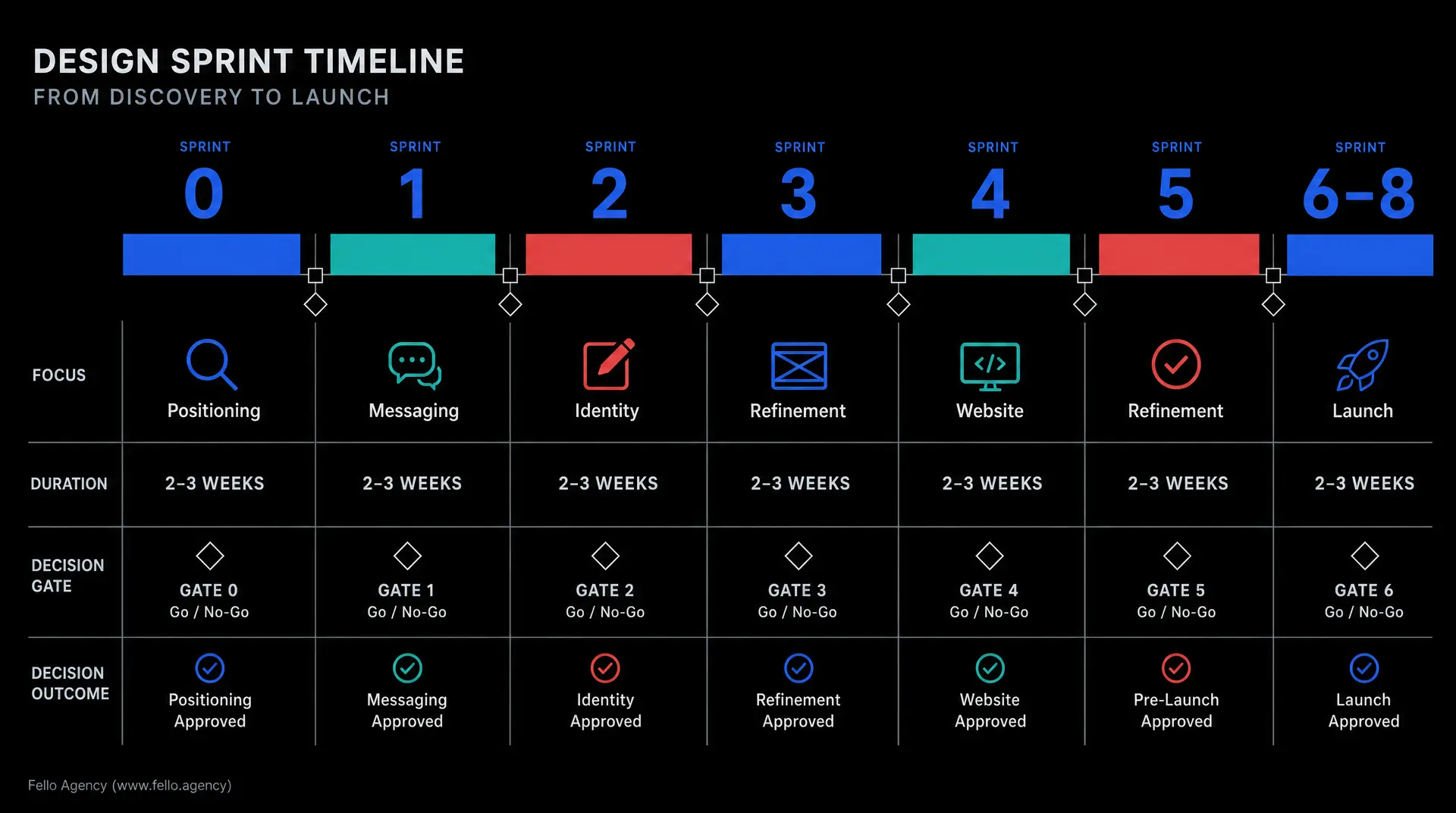
Agencies won't say this part out loud, so I will. Sprints exist because the client is the bottleneck, not the agency. My team's design capacity is a known quantity. Your decision speed isn't. So we structure the entire rebranding process to force choices onto a calendar. Read the right-hand column of this table carefully. Every sprint ends with a decision. Deliverables are my problem. Decisions are yours.
Add the website sprints and a Tier 4 lands at 16 to 24 weeks, which matches the 20-week engagements we run at Fello. You can compress that hard, but understand what compression costs. A 10-week sprint means explicitly sacrificing revision cycles, and I don't see that as skimping on quality. It's skimping on deliverables. We once ran a complete brand and website sprint for a haptics company in 14 days. That was possible for exactly one reason: they let us make the internal calls, and we templated what could be templated. Take the waiting out and the work itself is fast.
The reverse story is why we changed our contracts. A construction technology client once disappeared for months mid-project, then came back expecting to resume like nothing happened. We now charge fees when clients stall revisions or go dark mid-sprint. That sounds harsh until you see the economics from my side. We're booked, and we charge for your time as much as ours. When your team vanishes for three weeks, you're paying a booked team to wait for you.
Why Is Defining Decision-Makers Critical Before Starting Rebranding Design Sprints?
The fix costs nothing, which is why it baffles me that almost nobody does it. At kickoff, write three things down. Nine people can give input. Two people decide. One person breaks ties. Names, on paper, before discovery starts.
The data on committees is grim. Gartner's 2025 sales survey found that 74% of B2B buying teams show unhealthy conflict during decisions, in groups running 5 to 16 people, and teams that reach consensus are 2.5x more likely to report a high-quality deal. Your internal rebrand committee behaves exactly like those buying groups. It's why the first real question I ask in scoping is how many decision-makers will be at the table. The more decision-makers at the table, the longer the project is going to be. I've priced enough of these to trust that headcount as a better rebranding timeline predictor than page count.
Leadership genuinely needs to be in the room at three moments. The positioning decision. The identity direction choice. The final yes. Everything else runs without them. When a CEO insists on reviewing every intermediate step, the timeline doesn't stretch by their calendar availability. It stretches by their calendar availability squared, because every delayed review delays the review after it.
What Factors Are the Biggest Drivers of B2B Tech Rebranding Costs?
If you take one pricing lesson from this article, take the order of this section.
Stakeholder count is the single biggest cost driver in any rebrand, and almost nobody prices it honestly. Not page count. Decision-makers. I watched a massive pharmaceutical company stall its own marketing for two years through pure internal gridlock, until the private equity firm behind them took the product offline entirely. Two years of work, gone, and the market never got a vote. I also worked on an aesthetic technology company where the whole leadership team got fired mid-project, and the rebrand died with them. Some of that you can't control. I couldn't. What you can control is refusing to put nine reviewers between a designer and a decision, because with too many cooks in the kitchen, nothing really happens.
Naming is second, and it costs you before a single pixel moves. A new name adds six to ten weeks of trademark screening, domain negotiation, and the political grind of getting a whole company to agree on one word. The legal layer alone means real money and real waiting: trademark filing starts at $350 per class at the USPTO, and the office's own dashboard puts its total pendency target around 11 months. And don't hand the problem to a prompt. I watched a company delay its naming exercise for months because they kept feeding AI generators instead of doing the strategic work. A name is a decision, and AI doesn't make decisions for you. Then there's everything the name touches. When holo|one became Sphere, we rebuilt all of it: brand templates, tradeshow booths, the full website, a launch film with CGI. That's the real footprint of Tier 5, and done right it pays. "The new website has more than tripled our lead generation efforts," is how Alexandra Corey, Sphere's Head of Marketing, described it afterward.
Website scope is third. Five pages or 40 is a completely different project. A fully autonomous, editable site for a startup runs $30,000 to $60,000 because of the custom templating, and I hold one hard benchmark on the output: your marketing team should be able to launch a blog post in three minutes, or the CMS has failed you. I had a client whose legacy backend, built by a developer they'd already fired, took three months to publish one guest blog post. That's a 10-minute task. And treat the site as the sales floor it now is. McKinsey found one in five B2B decision-makers will spend $500,000 to $5 million in a single remote or self-service interaction. Big buying decisions are computer buys, and your website is where they happen.
Applications are fourth, and this is where two companies with identical revenue get wildly different quotes. A SaaS company needs a deck, templates and a social kit. A defense manufacturer needs a booth, capability briefs, quad charts and 60-page proposal templates. We build both scopes. On the defense side the stakes are simple: for contracts running $10 million to $100 million, if you can't visually propose the technical aspects of what you're building through professional decks and video, you are not getting the contract.
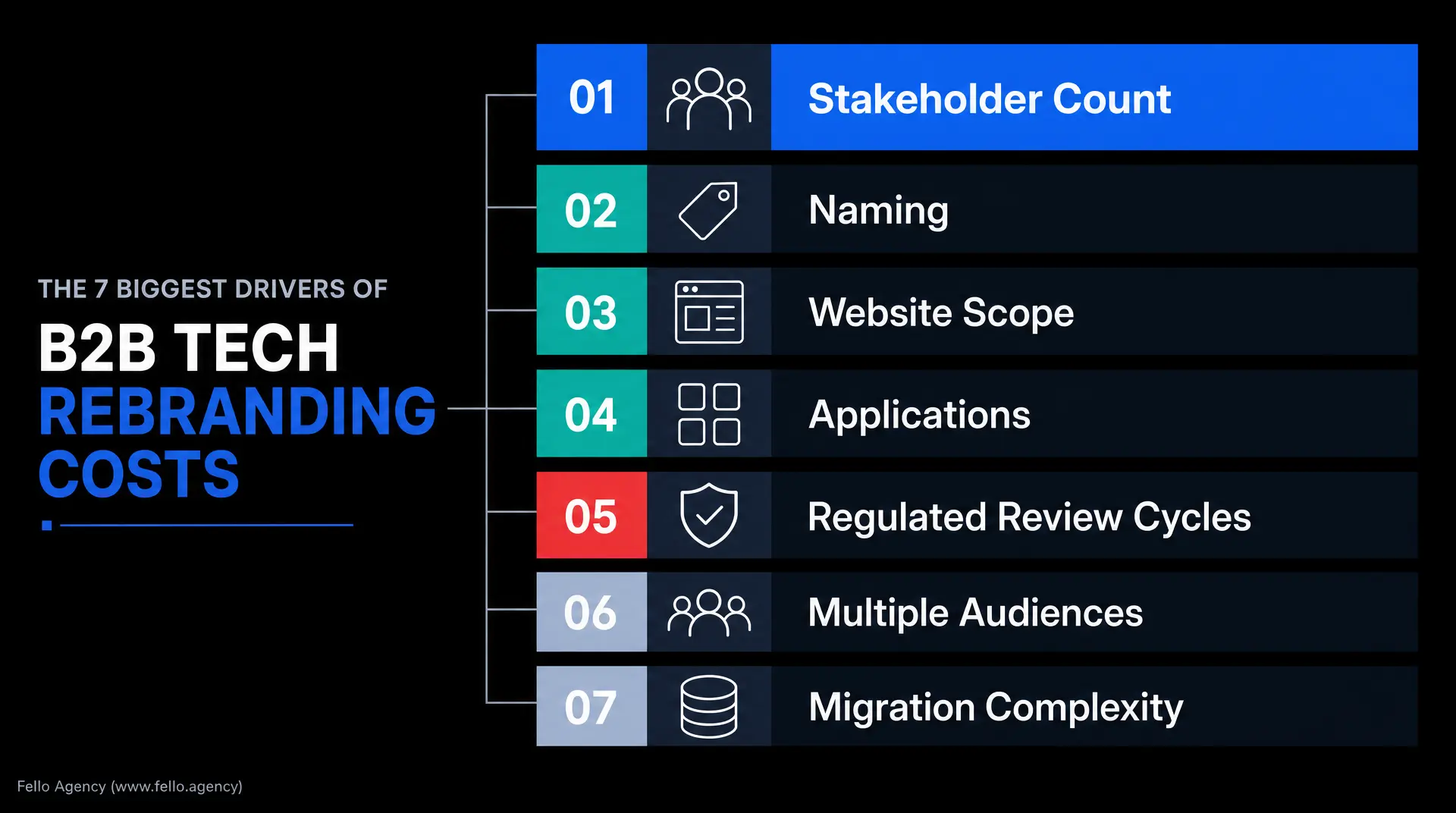
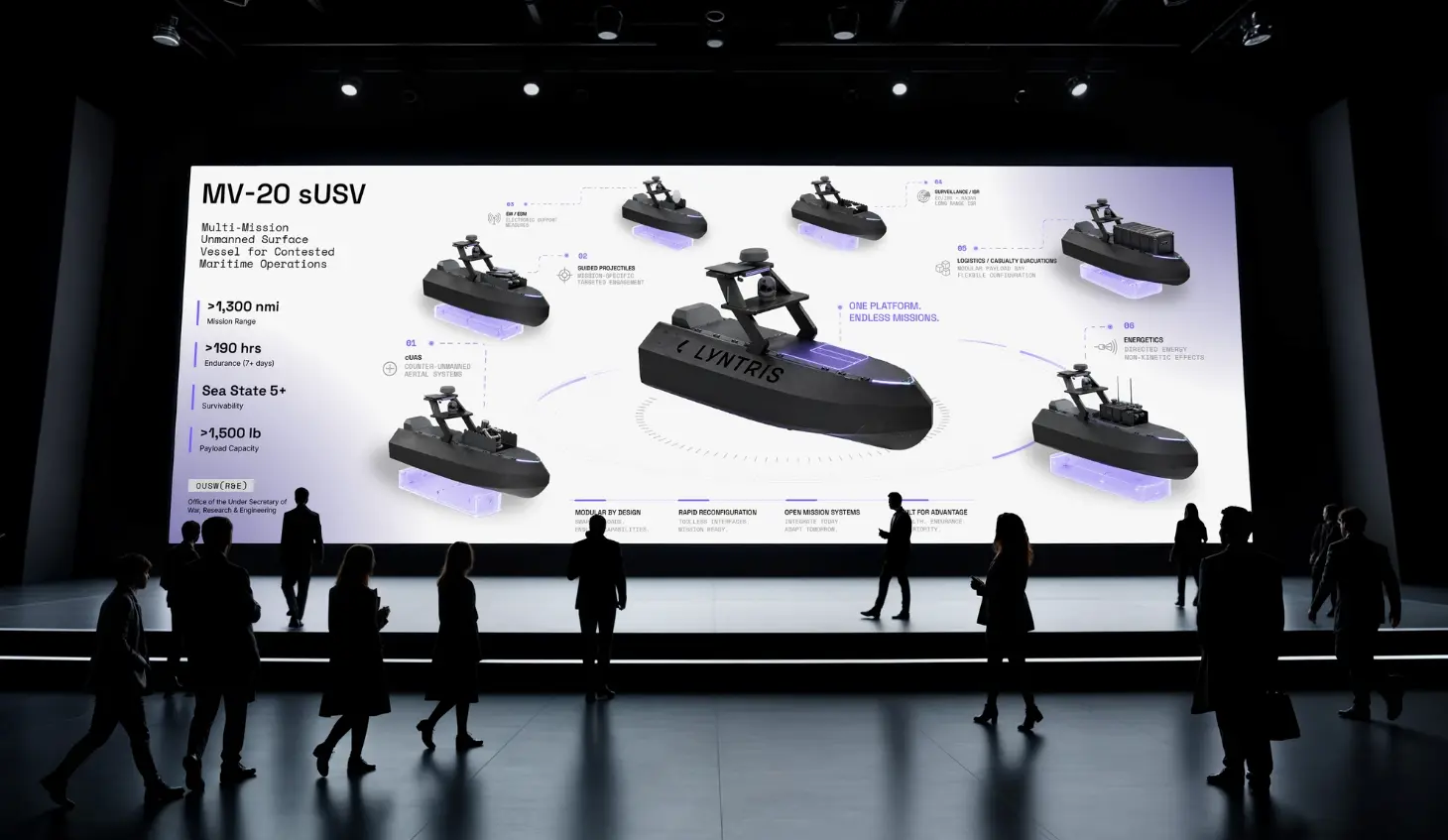
Regulated review cycles are fifth. Medtech claims review. Defense security review of anything that shows hardware, where one marketing render of an integration can raise export-control questions before it generates a single lead. These cycles add weeks that have nothing to do with design, and no agency on earth compresses them. Plan around them or watch them blow up the launch date.
Multiple audiences are sixth. Dual-use companies, defense plus commercial, are genuinely two brand systems wearing one logo. We design those homepages so a farmer and a procurement officer split into separate journeys within the first scroll, because one blended message dilutes both. Budget for two communication strategies, since that's what you're actually building.
Migration complexity is last on the list, but it decides whether the rebrand actually ships. Domain, product UI, legal entity, existing contracts, redirects, directory listings. Google's own site-move guidance says to keep 301 redirects live for at least a year so your search equity actually transfers. On every engagement we write a brand kill list, a documented record of every legacy asset that dies in the transition, because the asset you forget to kill is the one a prospect finds 18 months later.
When Should a B2B Tech Company Avoid Executing a Rebrand?

I lose money telling you this part. I'm telling you anyway, because the fastest way to waste six figures is to rebrand for the wrong reason.
Don't rebrand pre-product-market-fit if the brand isn't what's broken. If nobody wants the product, a better logo buys you a better-looking failure. Don't rebrand mid-fundraise either. Do it before the raise or after the close, never during, because a brand changing under diligence reads as instability and your leadership can't run two existential projects at once.
Don't rebrand to settle an argument about what the company is. I've watched founders stall for nearly two years across four separate communication strategy workshops, because the real disagreement was never about messaging. It was about the company. A rebrand won't end that fight. It just gives the fight a budget. Have the fight first, then call an agency.
Don't rebrand because you're bored of the logo. You look at it every day. Your buyers see it for a few minutes a year. And don't rebrand because sales is struggling until somebody checks whether it's actually a brand problem. Sometimes it is. If deals die during vetting, if your internal champions won't forward your deck upstairs, that's a trust gap and brand closes it. If you're losing on price, product, or the wrong ICP, no identity system saves you. We can spot bullshit a mile away at our agency, and an honest one will tell you before taking your money.
Why Are Client Approval Delays the Biggest Bottleneck in B2B Tech Rebranding?

Run the math on any rebrand horror story you've heard. The nine-month project that went sideways. Count the actual working weeks and you'll find three months of real work. The rest was waiting. Waiting for the CEO to read the positioning. Waiting for the next board meeting. Waiting for someone to pick direction A or direction B out loud.
The tables tell you what a rebrand costs in dollars. The gap between a three-month rebrand and a nine-month one is decisions, full stop. Name your deciders before kickoff. Protect the three moments that need leadership in the room. Make choices out loud, in writing, on schedule.
I push clients to run rebrands in two to three months when the standard here in Canada is six, because you don't want to be moving slow in tech. You're going to get killed. Your competitors aren't waiting on your fourth round of stakeholder feedback, and they take this stuff seriously. Pick your tier. Budget the hidden lines. Decide fast. The price of the work is on the table now. The price of not deciding is the one nobody quotes you.
Frequently Asked Questions
Does a rebrand directly improve our multi-channel GTM strategy?
Yes, if you don't cheap out on the rollout. Buyers average 10 channels per journey. McKinsey found 72% of B2B companies selling through seven or more channels gained market share. If your rebrand doesn't unify all of them, your buyers will notice the disconnect.
Should we allocate rebrand budget to update third-party review platforms?
Absolutely. Don't stop at your homepage. G2 data shows 31% of B2B buyers consult public review sites first when planning purchases. If your G2 or Crunchbase profiles still look like the company you were three years ago, you lose prospects before they ever hit your URL.
How do we justify the cost of rebranding our thought leadership assets?
By tying it directly to premium pricing. The Edelman-LinkedIn report found 60% of buyers are willing to pay a premium for companies producing high-quality thought leadership. It's not just a PDF redesign. It's your most lethal weapon for proving capability and protecting your margins.
How much should we invest in digital sales tools during a rebrand?
More than you think. Gartner notes 75% of B2B buyers prefer a rep-free experience. But when they use supplier-provided digital tools alongside sales, they are 1.8x more likely to close a high-quality deal. Build interactive tools into your scope, or your sales team will suffer.
Will a rebrand fix our stalled enterprise buying committees?
Only if your messaging actively resolves internal friction. Gartner found buying-group relevance in content drives a 20% positive impact on consensus. If your new brand only speaks to the end-user and ignores procurement or IT, you are just painting a fresh coat of gloss on a broken sales cycle.
Your Creative Partner for Innovation That Matters
From advanced tech to transformative healthcare, Fello helps visionary teams shape perception, launch products, and lead industries.
Let’s keep in touch.
Discover more about high-performance web design. Follow us on Linkedin and Instagram.

