

A technical founder loses the room for being good at their job. Every instinct that earned the PhD - the hedging, the completeness, the honest accounting of what she doesn't still know - is the same instinct burying the raise.
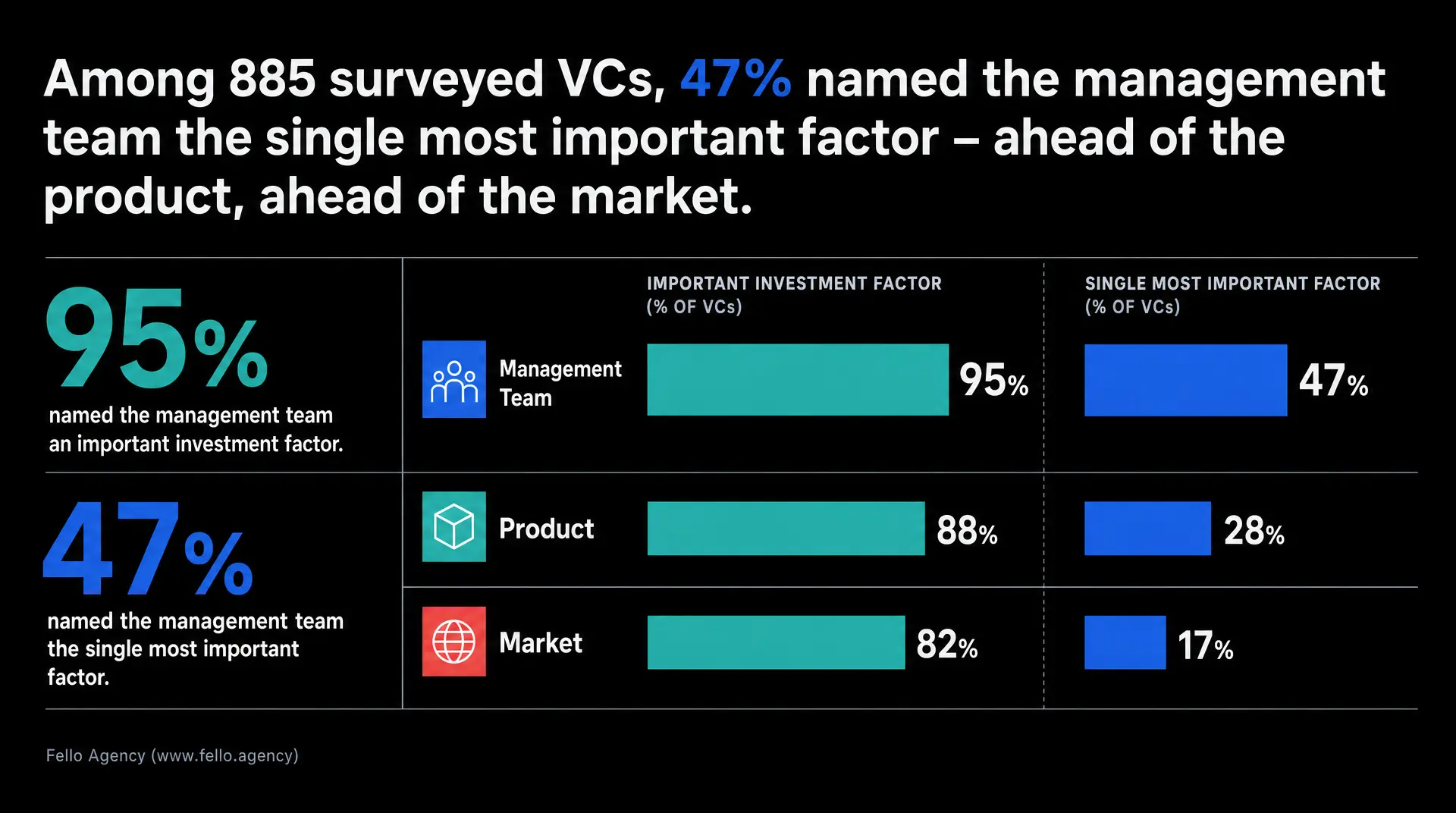
None of that rigor is on trial. The investor decided whether to keep listening before she reached her point, and among 885 surveyed VCs, 47% named the management team the single most important factor - ahead of the product, ahead of the market.
Ninety seconds of careful hedging answers the only question in the room, and the answer it gives is that she cannot still see her own business.
Key Takeaways
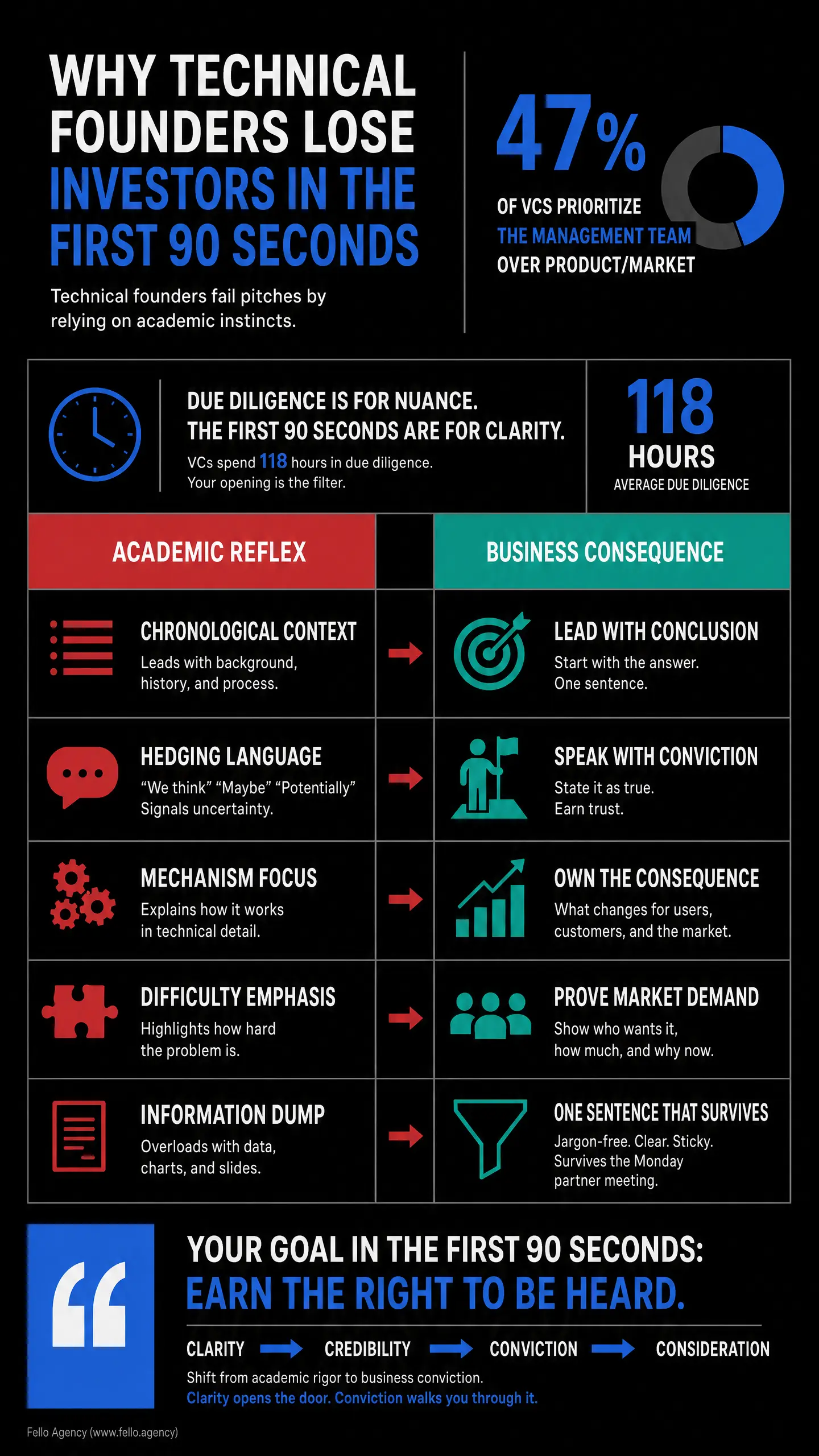
In a survey of 885 venture capitalists, 47% named the management team as the single most important investment factor, outweighing both the product and the market.
Gecko Robotics secured a $71 million Navy contract by opening pitches with business consequences rather than chronological engineering constraints.
Technical founders should drop excessive precision in initial pitches, as venture capital deals involve an average of 118 hours of due diligence over 83 days to evaluate technical nuances.
CB Insights data reveals that 35% of startup failures stem from lacking market need, proving technical founders must prioritize customer demand over engineering difficulty during pitches.
McKinsey research indicates European deep-tech ventures require 40% more capital and run 12 months longer, meaning founders must pitch bold long-term visions rather than aggressive production timelines.
Technical founders must condense their value proposition into a single jargon-free sentence to survive venture capital partner meetings where the founder is absent.
Why Must Technical Founders Present Business Conclusions Before Technical Context in Investor Pitches?

Engineers explain chronologically. Foundations, context, conclusion. For teaching, that's right - the student needs the base layer first.
An investor pitch runs in reverse. Conclusion first. Context on request.
Until the investor knows what they're listening to, nothing you say gets filed. The history of the field, the limits of current approaches - it slides off, because there's no shelf to put it on. Every second before the point is dead information.
The before: "The fundamental challenge in industrial inspection is that access to confined spaces has historically required..."
The after, and Gecko Robotics earned the right to say it: we put robots on the walls of ships and power plants so nobody has to climb them. The Navy just signed a five-year deal with a $71 million ceiling.
Now go back and explain everything you wanted to explain. Same material, same depth. Every detail lands on a shelf that exists.
You think you're giving them what they need to understand this properly. They're sitting there thinking, "I don't know what I'm listening to still."
Why Do Excessive Precision and Hedging Hurt Technical Founders During Initial Venture Capital Pitches?
Your reflex to qualify comes from a good place. "In most cases." "Approximately." "We believe." Among peers, overstating results is how you torch your credibility. Hedging is professional integrity.
In a pitch, every qualifier stretches the sentence and shrinks the claim. Nobody in that room is grading your rigour. They're deciding whether you get another 10 minutes.
"We can reduce inspection time by, in some deployments, up to around 60%, though it varies significantly by asset type." Honest. Careful. Forgettable.
"We cut inspection time by more than half." Also honest. And it lands.
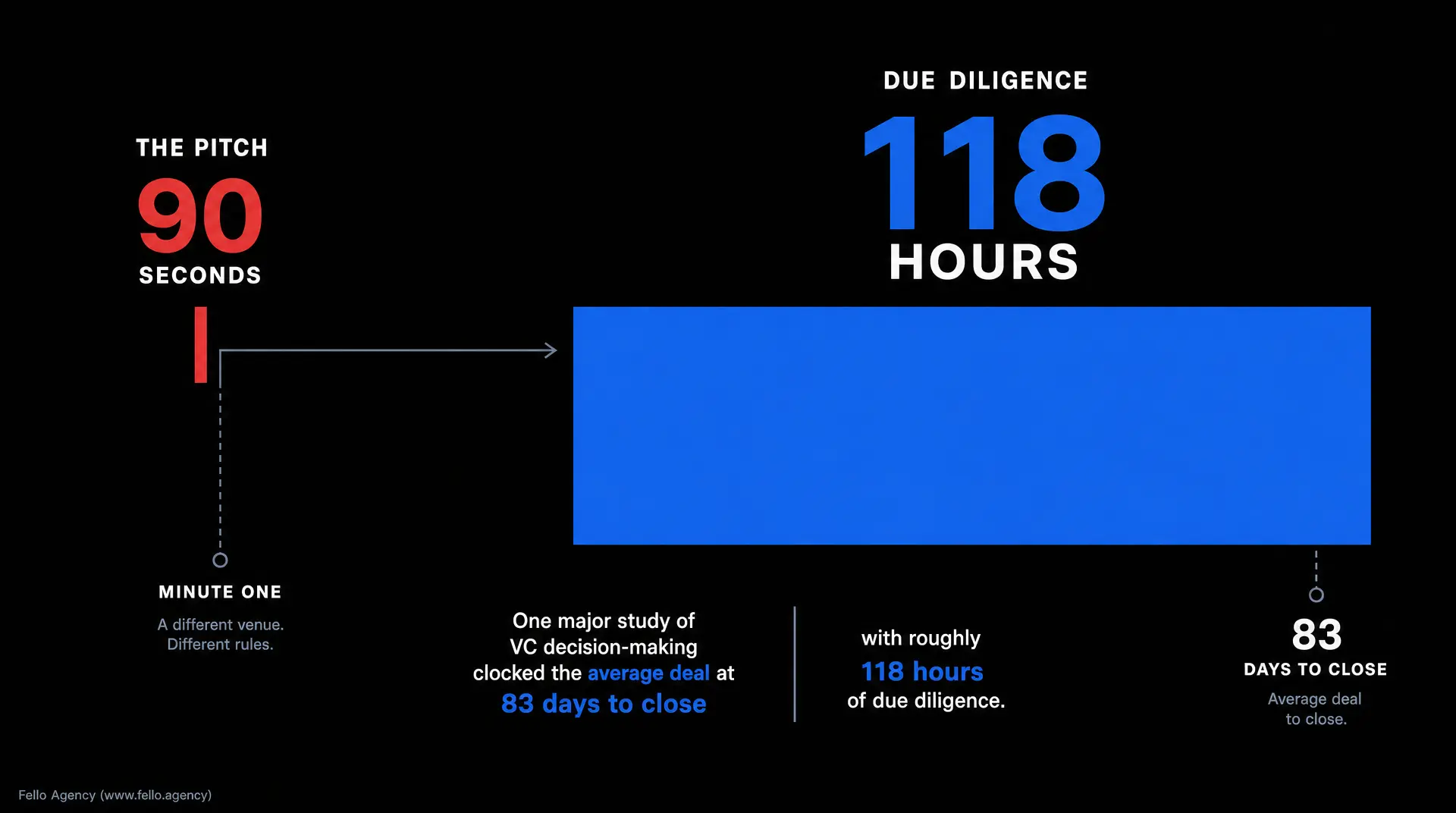
You didn't lie. You compressed. And the nuance has a home - one major study of VC decision-making clocked the average deal at 83 days to close with roughly 118 hours of due diligence. That's where your asset-type variance gets litigated. Minute one is a different venue with different rules.
Look, everyone tells technical founders to simplify, and I think that's lazy advice. The real move is conviction. Say the true thing in its strongest honest form and hold the caveats until somebody asks. Somebody will ask. That's the good outcome.
Why Do Deep Tech Investors Evaluate Business Consequences Over Engineering Mechanisms?

This is the most common failure I see in deep tech fundraising, and it happens for an understandable reason: the technology genuinely is the interesting part. To you.
"We use bosonic error-correcting codes to achieve a one-to-one logical-to-physical qubit ratio."
"Everyone else needs a warehouse. Ours fits in a data centre."
Same fact. One is a capability, the other a consequence, and investors buy consequences. Open with what the machine changes. Keep the mechanism for the room that asks.
Defining your terms won't rescue the first version, either. A study that ran 650 readers through science writing found jargon wrecks comprehension even when definitions are provided. The definition costs you seconds and buys you nothing.
Too much on the features and not the benefit. I say it to founders weekly, and it's almost always this exact part of the pitch.
Why Must Technical Founders Prioritize Market Demand Over Technical Difficulty in Startup Pitches?
Technical founders love to lead with difficulty. Nobody has solved this. Three funded teams tried and failed. You think you're building a moat. The investor hears a list of reasons your thing might not work either.
Hard compared to what? Everything in your category is hard. Quantum is hard. Autonomy is hard. Announcing that your problem is difficult separates you from nobody in this week's pipeline.
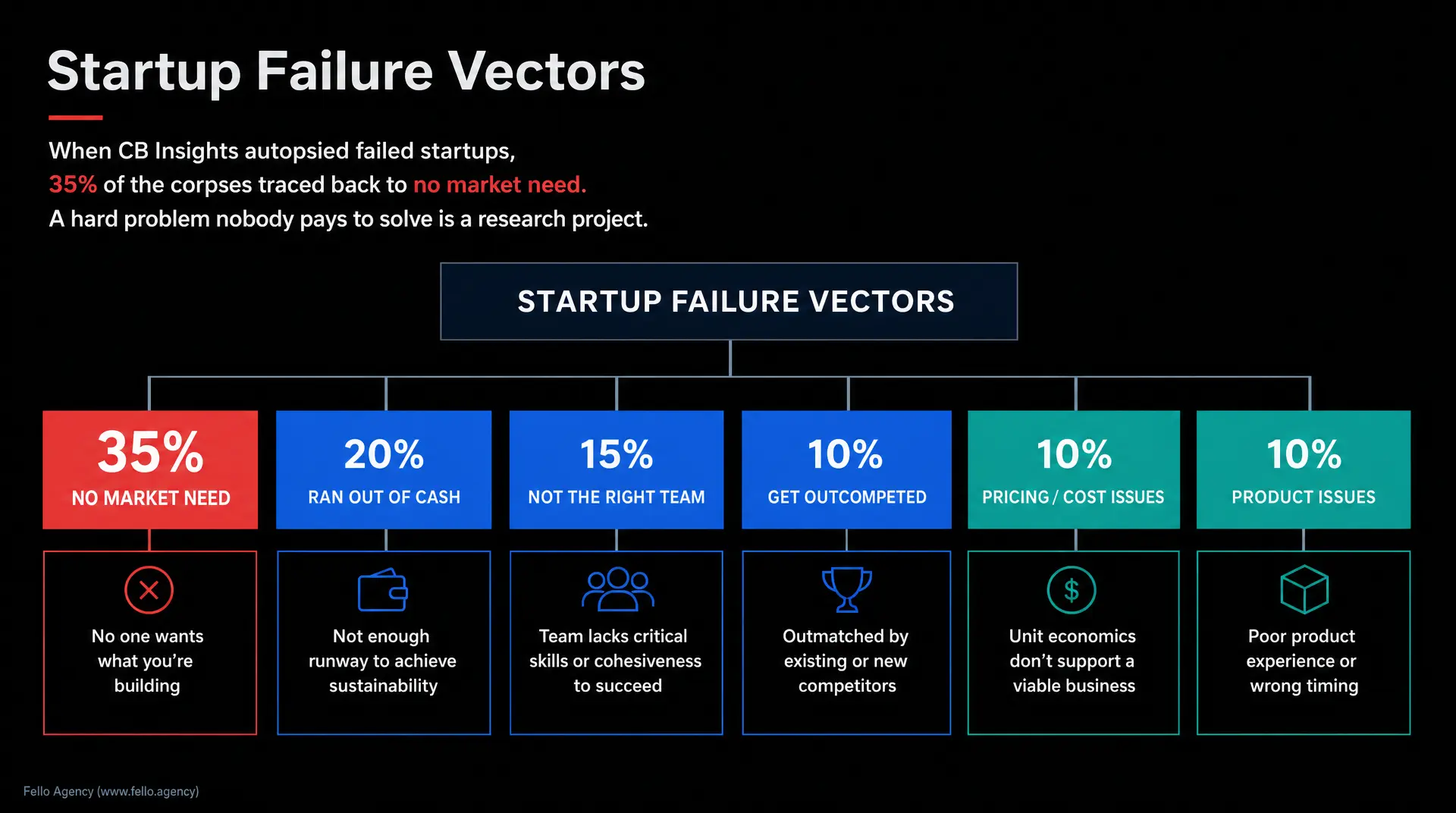
Whether it's hard was settled the day you picked the field. The open question is whether anyone wants it badly enough to pay. When CB Insights autopsied failed startups, 35% of the corpses traced back to no market need. A hard problem nobody pays to solve is a research project, and every investor you'll meet has funded one by accident. They remember. Leading with difficulty walks you straight into the "science project" box you'll spend the rest of the year fighting out of.
A better product is not a go-to-market strategy, and a harder problem is not a business. Lead with demand - who is desperate, what they do today instead, what that costs them. Then difficulty becomes the moat you mention after they already want it to be true.
How Should Deep Tech Founders Frame Product Vision and Hardware Production Timelines for Investors?

This one is nearly universal, and it's precisely inverted.
"We think this could eventually improve throughput meaningfully." Modest. Hedged. Small.
"We'll be in production by Q3." Confident. Specific. Almost certainly wrong.
Investors discount both statements, but they discount the timeline far harder, because they've watched every hardware timeline in their portfolio slip. McKinsey's deep-tech research backs their scar tissue: these ventures run about 12 months longer from seed to Series A and need up to 40% more capital to reach revenue. Your confident Q3 is arguing against their entire portfolio history. So the bold claim earns nothing and the modest one excites nobody, and you've spent your credibility on the statement least likely to survive.
Flip it. Bold about where this goes. Conservative about when. "This eventually replaces the entire category, and realistically that's eight years." That sentence sounds like someone who has thought about it. The reverse sounds like someone who hasn't.
Position on the endgame and the payoff compounds, because setbacks get reframed as milestones toward the destination instead of broken promises. We built the 3D renders and pitch deck that carried a counter-drone defense client through a significant funding round before they had a physical product to show. Nobody wrote that cheque for a ship date. The materials sold where the technology ends up.
Why Is Dodging Commercial Questions With Technical Architecture Explanations Fatal in Investor Meetings?

An investor asks, "Who's buying this?" The founder delivers four brilliant minutes on why the architecture is superior.
Most founders aren't dodging on purpose. Under pressure, the pull toward the thing you know cold is enormous - especially when the real question has an uncomfortable answer. You have a genuinely better answer to a different question, so you give it.
They notice instantly. A survey of 885 VCs found the average firm screens about 200 companies a year and invests in four. These are people who sit through dodges for a living. They spot bullshit a mile away, and the conclusion lands in one second: he doesn't know, and he's covering.
What technical founders consistently underestimate is the price gap. A weak, honest answer to a commercial question costs almost nothing in minute one. A dodge costs the meeting. "Three customers today, and here's how we're finding the next 10" beats a brilliant tangent every single time. Even "two pilots and a conversion problem we're working through" holds up. What they're actually grading is whether you can see your own commercial picture clearly, finished or not.
Why Must Technical Founders Create a Single Jargon-Free Value Proposition Sentence for Investors?

The most expensive mistake on the list, and nobody sees it happen - it happens after you leave.
Most technical founders have a paragraph. Sometimes three, shifting depending on who's asking. What they don't have is one line that survives being repeated by somebody who was half-listening.
The investor you pitched is almost never the person who decides. Monday morning, they walk into a partner meeting - a room you will never enter - and describe your company in roughly one sentence. That sentence is the company to everyone at the table, and you're not there to correct it. If you didn't hand them the line, they'll improvise one, and it will be less accurate, less specific, and less compelling than anything you would have written. Your pitch has to survive a game of telephone you're not playing in.
I've watched the same mechanic outside fundraising. A client of ours was in talks with Amazon, and the people inside who liked the product couldn't get champions to push it upstairs - the material they'd have to attach their own names to wasn't strong enough to carry. The person who signs is almost never the person who found you. Everything you hand over has to travel without you.
The founders who break through drop the hedge and the jargon completely. "We've developed a solid-state electrolyte architecture" gets replaced in the retelling. "We make batteries that last forever" gets repeated word for word.
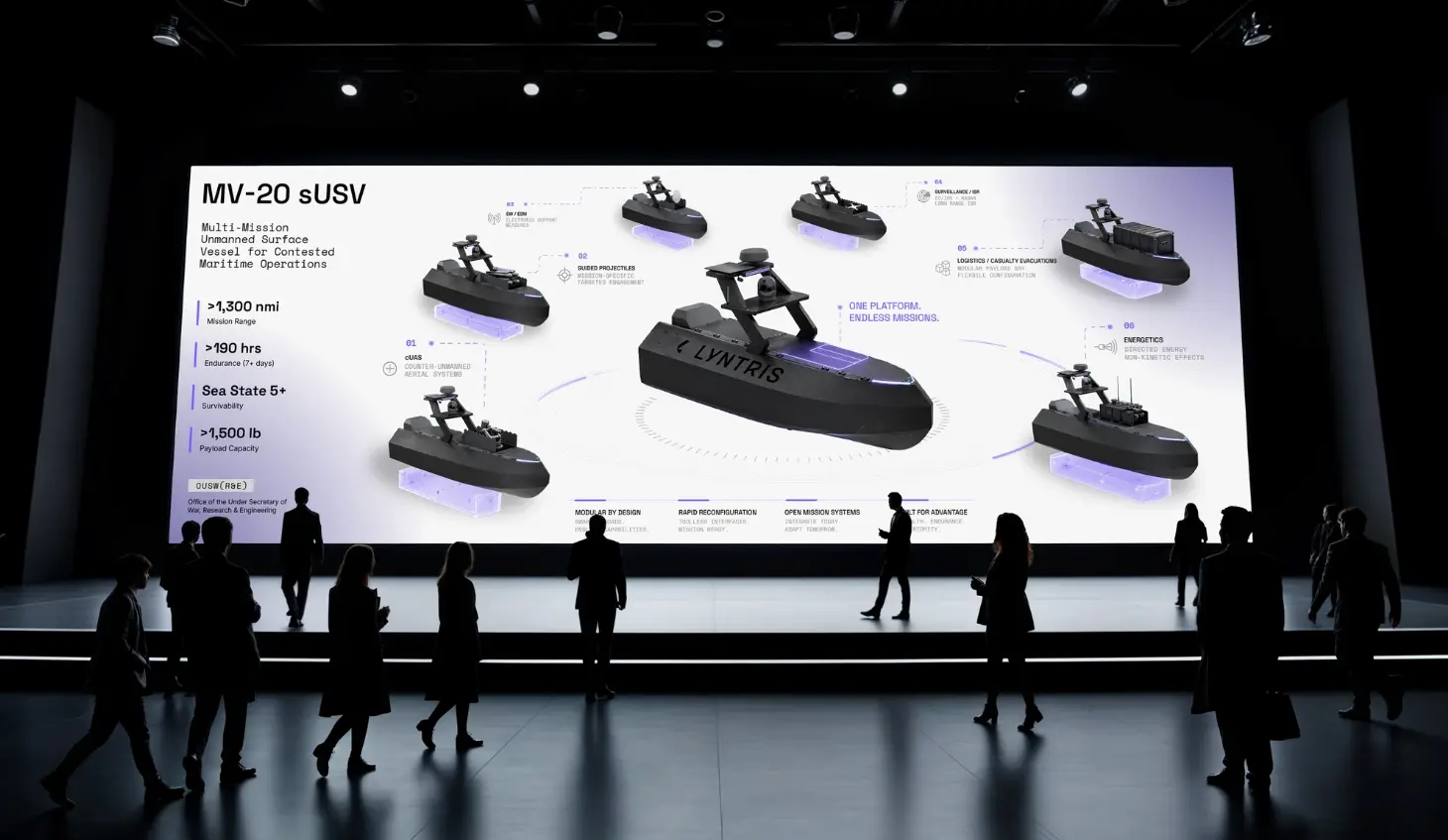
Lyntris is a great example, a defense company: "the quiet layer of modern defense," with "from sensing to certainty" on the homepage. Both lines name the transformation, not the technology - and that was the entire design constraint, because a program manager has to carry them upstream with nobody from the company in the room.
So write the sentence. Test it on someone outside your field, and if they can repeat it back a day later, it works. Say it first, every time.
What Is the Core Communication Error Technical Founders Make During Venture Capital Pitches?
Run back through the list and it's the same mistake wearing seven hats: optimising for the person who already understands instead of the person who doesn't.
Chronology serves a listener who already cares. Qualifiers serve a listener who already believes. Mechanism serves a listener who already knows why the mechanism matters. Difficulty impresses someone who already wants the problem solved. And the missing sentence assumes the room that decides heard the full pitch. It heard one line, secondhand.
In the lab, your audience shares your context, and every habit on this list is exactly right there. Across the table in a first meeting, they share almost none of it. The partner meeting after that shares even less.
At the end of the day, they're reading you as hard as the technology. In the same 885-VC survey, 95% named the management team an important investment factor and 47% called it the most important - ahead of product, ahead of market. Ninety seconds of hedged chronology tells them something about the team. So does one clean sentence said with conviction.
I define a brand as the feeling somebody gets when they think about your company, and a pitch is that feeling compressed into 90 seconds. Deep tech fundraising doesn't reward the founder who proves they're the smartest person in the room. It rewards the founder who makes the person across the table smart enough to repeat the idea on Monday.
The first 90 seconds was never the place to prove the science. It's where you earn the next 10 minutes. Spend it on the person who doesn't understand still.
Frequently Asked Questions
How much time do VCs actually spend reviewing a deep tech pitch deck before the meeting?
Almost none. You have roughly two minutes. According to DocSend's June 2024 data, investors review decks in as little as 2 minutes, 18 seconds. If your opening slides are buried in scientific context rather than commercial consequences, they close the file before ever reaching your breakthrough.
Should we rely on inbound applications or cold outreach to secure partner meetings?
Absolutely not. Cold outreach is a losing game. A survey of 885 VCs shows only 10% of deal flow comes inbound. Over 50% arrives through professional networks and other investors. Stop emailing partner inboxes and start working your existing cap table to engineer warm introductions.
How do investors weigh our scientific IP against the commercial management team?
They bet on the team, period. You think the patents are the moat, but VCs attribute outcomes to people. Research shows the team contributed to investment successes for 96% of surveyed VCs and to failures for 92%. Brilliant science won't save a team that cannot execute commercially.
How should we justify the massive capital required before reaching actual hardware revenue?
Own the reality upfront. Deep tech simply costs more. McKinsey reports these ventures take 12 months longer from seed to Series A and need up to 40% more funding. Don't hide the burn rate. Frame the capital as necessary fuel to build an insurmountable category monopoly.
What specific personal traits drive successful venture capital funding in the first impression?
Competence and controlled aggression. A study analyzing the first 10 seconds of pitches found perceived competence and aggressiveness directly predict funding success. Investors don't want a timid academic. They want a relentless executive who understands the market and possesses the sheer will to commercialize it.
Your Creative Partner for Innovation That Matters
From advanced tech to transformative healthcare, Fello helps visionary teams shape perception, launch products, and lead industries.

Let’s keep in touch.
Discover more about high-performance web design. Follow us on Linkedin and Instagram.