

Founders believe stealth protects the work. It mostly spares them a decision, because no one ever chooses to stay in stealth - they only fail to leave.
The reasons sound like discipline - the website isn't done, the messaging isn't sharp, the product could be a little better - still each is fear in a strategy costume, and every month raises the bar for what 'ready' has to look like.
The robotics company that hid for four years came out only when a competitor forced its hand, then spent 18 months being described as 'similar to' a company it was four years ahead of.
Key Takeaways
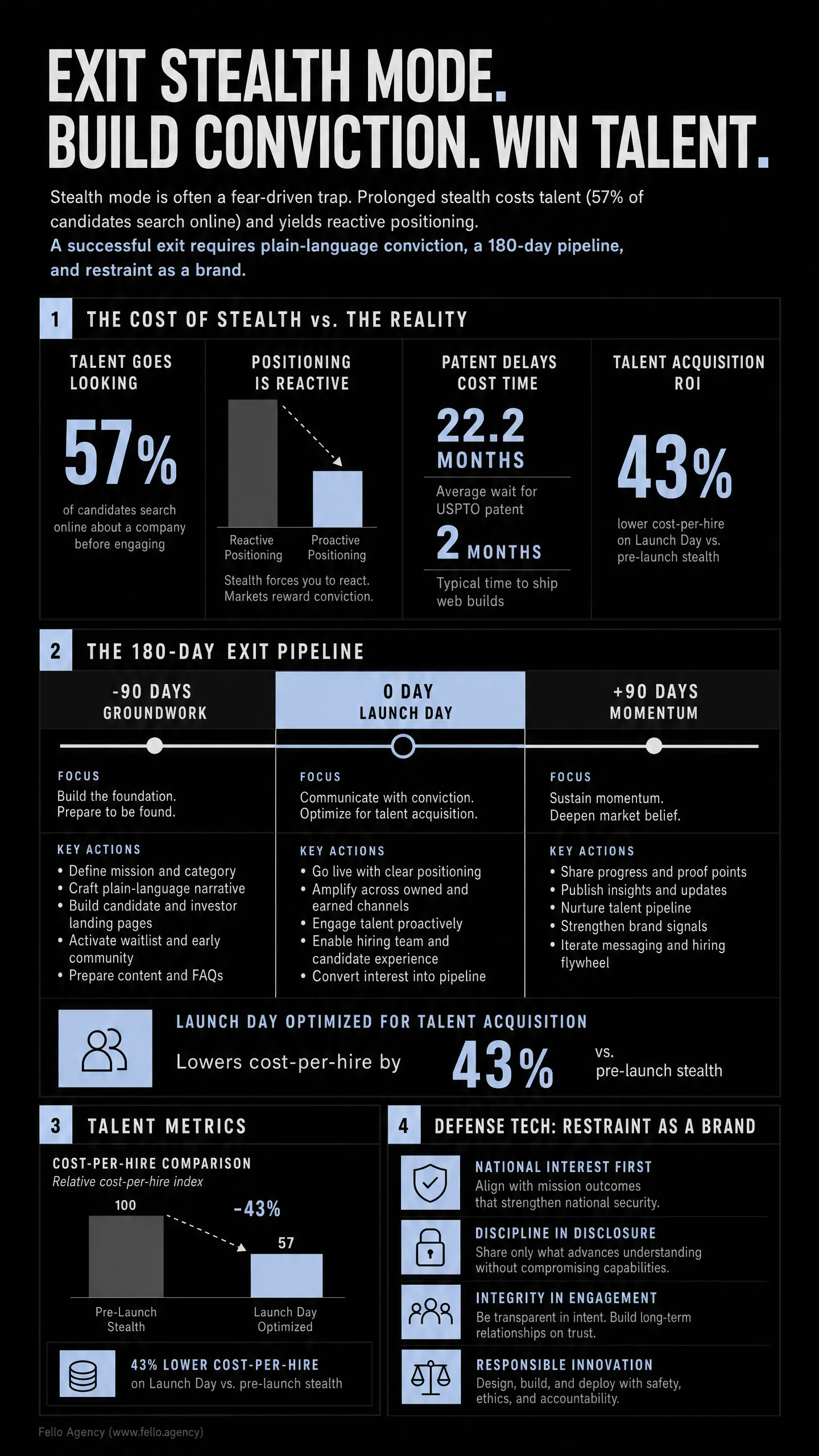
Waiting for patent issuance is not a viable stealth strategy because the USPTO average wait time for a first office action reached 22.2 months in February 2026.
The primary opportunity cost of stealth mode is lost engineering talent, as 57% of professionals research employers online and will abandon parked domains for visible companies like OpenAI or Palantir.
One robotics startup that remained in stealth for four years launched reactively and spent 18 months being described as a clone of a competitor they were technically ahead of.
Replacing academic hedging with a single plain-language positioning sentence prevents journalists and investors from inventing inaccurate descriptions when a startup exits stealth.
Startups exiting stealth should initiate unpitched relationship-building emails 60 to 90 days before launch, as Cision data shows 85% of journalists prefer this introduction method.
Deep tech stealth launches should prioritize talent acquisition over customer pipelines, because LinkedIn data reveals strong talent brands attract 2.5 times more applicants and reduce cost-per-hire by 43%.
Defense technology startups managing classified constraints must market their team backgrounds and operational convictions instead of product specifications to secure credibility with military program managers.
How Can Tech Founders Determine if Staying in Stealth Mode Is a Valid Strategy?

Most companies aren't in stealth strategically. They're in it because nobody decided to leave, and "we're not ready still" is an easy sentence to say for two years running.
The real reasons are short, and every one of them expires. Classification or export control. A customer under NDA who'd be exposed. A raise in progress with a story that changes every partner meeting. Leadership honestly hasn't decided what the company is. And patents, with a caveat. A U.S. provisional is never examined and gets abandoned after 12 months unless you file the nonprovisional. If you're waiting for the patent to issue, the USPTO's average wait for a first office action hit 22.2 months in February 2026. You'd still be in stealth at your Series C.
One of my clients is running stealth as an actual strategy - call it chemistry or biotech. There are maybe a hundred real experts in their field on the planet, and they're quietly hiring 60 or 80 of them before anyone knows the company exists. Nobody catches up to that.
Then there are the fake reasons. The website isn't done. We haven't nailed the messaging. We want the product a little better first. We don't want to overpromise. Fear wearing a strategy costume, and it feeds itself, because every month you wait raises the bar for what "ready" has to look like.
Look, this is a speed problem, and a smaller one than founders think. We built a complete brand and website for a haptics company in a month and a half so they could launch at CES, and they walked out with OEM meetings. "The website isn't done" is a two-month problem pretending to be a two-year one.
What Are the Hidden Opportunity Costs of Keeping a Tech Startup in Stealth Mode?

Nobody prices the other side of the trade. Start with recruiting, because in deep tech that's the binding constraint, not customers. LinkedIn's research found 57% of professionals search the company or role online before applying. The engineer at a national lab who would have loved your problem runs that search, gets a parked domain, and moves on. Your search presence and brand recognition sit at zero the whole time.
I've sat on the call where the founder wants more time and the CTO cuts across him: I need talent, I need to move. The fake reasons come from the top. The real constraint comes out of the CTO's mouth. Another founder took eight meetings to sign with us and four more months to launch, while the best AI talent on the market walked into Anthropic, OpenAI, Palantir and Rocket Lab.
Then there's the robotics company that stayed in stealth four years. Every quarter someone raised coming out. Every quarter there was a reason - a pending patent, then a pilot, then a raise, then the website. They finally emerged because a competitor launched first and forced their hand. They went out reactively, in someone else's news cycle, and spent 18 months being described as "similar to" a company they were four years ahead of.
I actually argue this differently. I don't lose sleep over who names the category first, because every company can highlight something it does better, smarter, stronger. Going out on somebody else's terms with no sentence of your own is the real loss. Nobody ever decided to stay in stealth. They just never decided to leave.
Why Is a Plain-Language Positioning Sentence Critical for Tech Startups Exiting Stealth Mode?

Before anything else gets built, one sentence has to make a stranger understand what you are and why it matters. Plain language, and it has to survive being repeated by someone who was half-listening.
You are not in the room when your company gets described. The journalist you brief doesn't write the headline. The investor you pitch isn't the one describing you in the partner meeting. If you didn't hand them the line, they'll invent one, and it'll be worse.
A dual-use company emerged with a 900-word release covering technology, round, team, market and vision. Comprehensive and unquotable. A competitor came out the same month with nine words, plain and slightly bold. That line ended up in three articles, two newsletters and a partner's investor update. Same size round, same quality of technology.
What stops technical founders from writing nine words is what I call the PhD curse. Academic training rewards hedging. The sentence needs conviction. "Solid-state electrolyte architecture" is a paragraph nobody repeats. "We make batteries that last forever" travels. Everyone tells STEM founders to simplify, and I think that's lazy advice. Elevate instead, so the person repeating your line feels smart for knowing it.
Write what I call the Founder's Thesis: an actual essay on why what you're building matters. The sentence falls out of it. Put it in your homepage H1 and roll with it. Walk into Xanadu's office and the mission is on the wall - build quantum computers that are useful, more or less. It rallies employees, recruits and investors.
What Pre-Launch Groundwork Should Tech Startups Complete 60 to 90 Days Before Exiting Stealth?
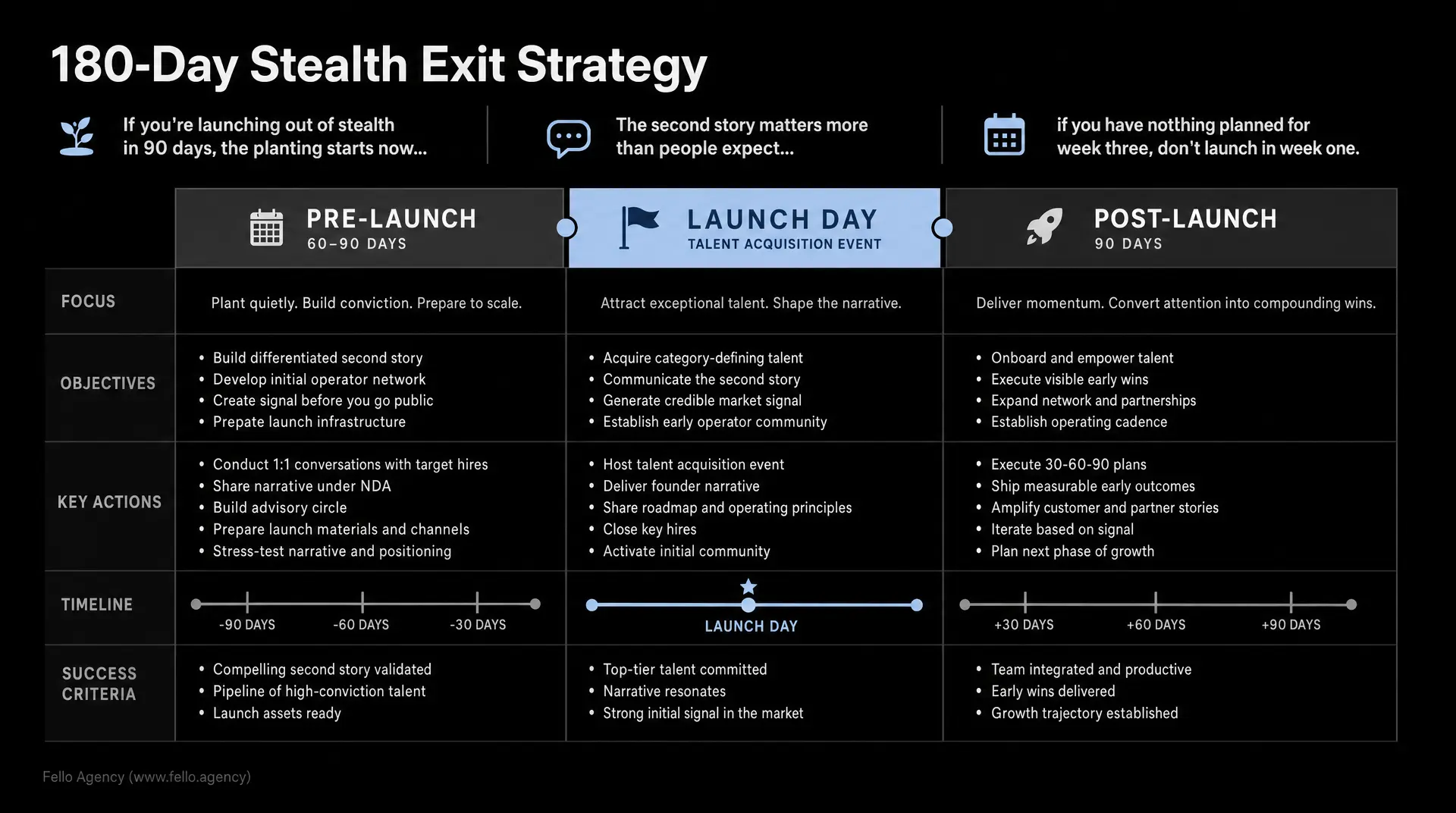
Launch day is a harvest. If you didn't plant anything, there's nothing to collect. If you're launching out of stealth in 90 days, the planting starts now, and none of it requires revealing what you're building.
Build the problem narrative first, so the market already agrees the problem is real before you show up with an answer. Publish it from the CEO's personal LinkedIn, because the algorithm buries company pages and rewards people. Warm three or four journalists who cover your beat - coffee, context, no ask. Cision found 85% of journalists say the best way to build a relationship is an email introducing yourself, even with nothing to pitch. Line up the customer or partner who'll say something on the record. Brief the investors who'll amplify. Get your vocabulary circulating so nothing sounds brand new on the day.
A defense autonomy company planned for months and executed flawlessly. Release, new site, founder video, the whole shebang. It landed in total silence. No journalist had heard of them, no analyst had context, nobody had a reason to care on that particular Tuesday. Their nearest competitor emerged four months later with worse technology and got triple the coverage, because that CEO had been quietly having coffee with the same four reporters since the previous spring. You launch to the relationships you built while you were still invisible.
What Are the Core Objectives for a Tech Startup's Stealth Mode Launch Day?

Why Is Exiting Stealth Mode Primarily a Talent Acquisition Event for Deep Tech Startups?
In deep tech your customers are 200 companies you can name and probably already know. A meeting reaches them. The launch is for the engineer at a national lab or the bored program manager at a prime who will never find you unless you exist publicly.
A photonics company built its entire launch for buyers. Capability-led, spec-heavy, technically dense. It converted fine, and pipeline was never their bottleneck. They needed 11 engineers in nine months and were losing every candidate to companies with better stories. I don't give a shit how tight the spec sheet is when 11 engineers walk. They optimized their one moment of attention for the constraint they didn't have.
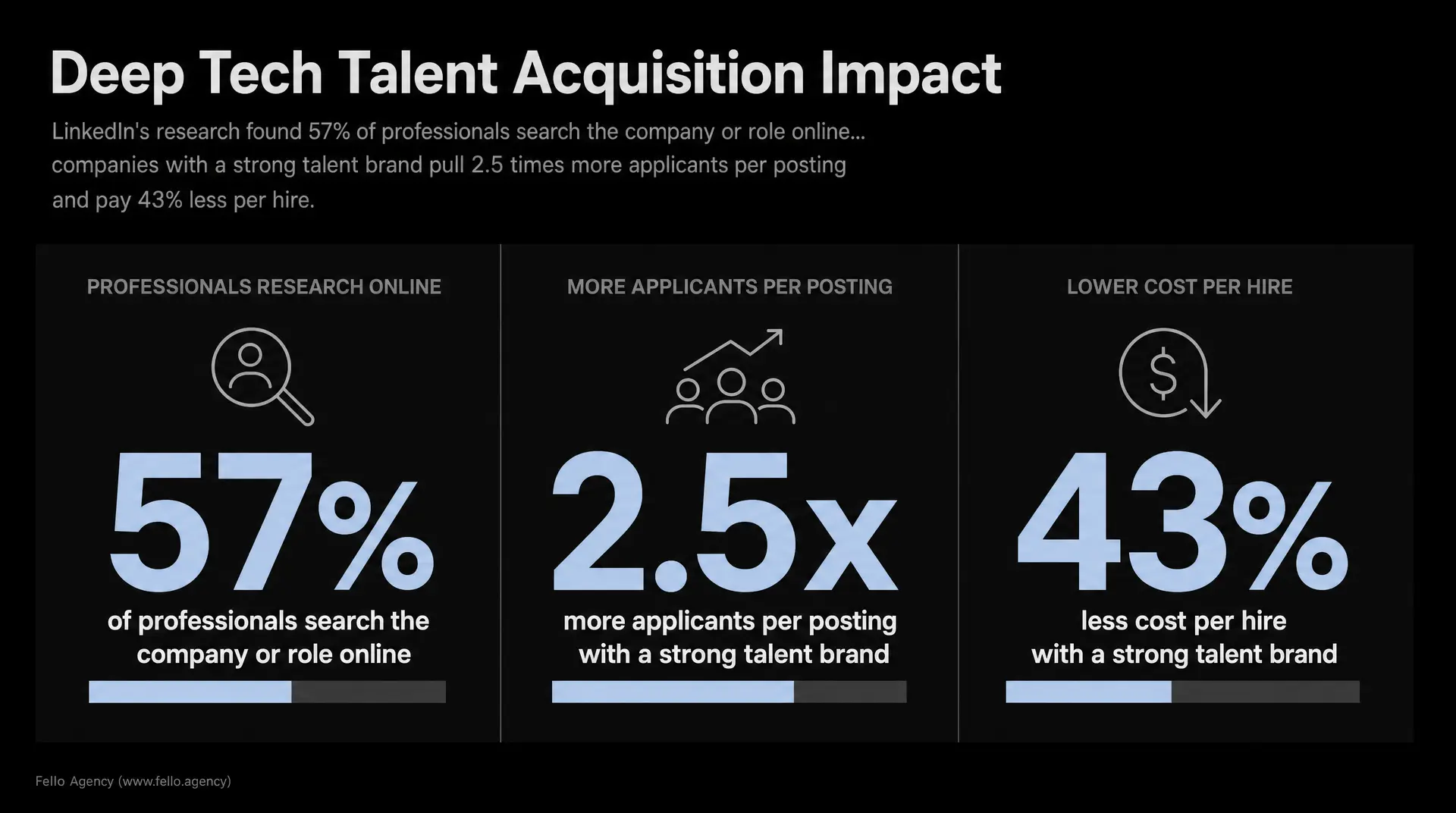
The talent war is won on brand before it's won on compensation. LinkedIn's own numbers show companies with a strong talent brand pull 2.5 times more applicants per posting and pay 43% less per hire. Anduril understood that with "Don't work at Anduril if you're lazy."
How Should Deep Tech Startups Optimize Stealth Launch Assets for Cold Forwarding?
Your launch gets sent to people with no context. A partner who wasn't in the room. A VP who got it from an engineer. An editor deciding whether this is a story. The person who signs the contract isn't always the person who found you, and almost no launch survives being forwarded cold.
A medtech company's launch page opened with a section on their proprietary sensing architecture. Their clinical champion forwarded it to a hospital procurement lead, who opened it on a phone, understood nothing, and closed it. Everything right except the first hundred words.
I'm on record telling deep tech clients to design mobile last, because our traffic runs 80/20 desktop and nobody signs a seven-figure contract from a phone. Launch day is the exception. Forwarded links get opened in hallways, so test it cold, on a phone, by someone who didn't ask. Explanation isn't attention, either. A journalist who accurately describes your technology has done you a small favour. One who writes something people forward has done you an enormous one. Accuracy is the floor.
What Post-Launch Strategy Should Tech Startups Execute in the 90 Days After Exiting Stealth?
This is where most emergences quietly die. The company launches, gets a spike, and goes silent two weeks later. That silence teaches the market the launch was an event rather than a change.
The second story matters more than people expect, because it decides whether the first one was a fluke or a position. Rocket Lab ships serious content every week and engineers show up because of it. Someone has to own the inbound you weren't set up for - who answers, how fast, what happens next - because in deep tech a lead opens a six-to-12-month cycle. The earliest sign it's working is sales velocity: emails get answered faster, conversations get easier within days, and sales skips a level. Keep feeding the hiring pipeline while attention is warm. One announcement is not a position.
The blunt version: if you have nothing planned for week three, don't launch in week one.
How Should Defense and Dual-Use Tech Startups Adjust Their Strategy for Exiting Stealth Mode?
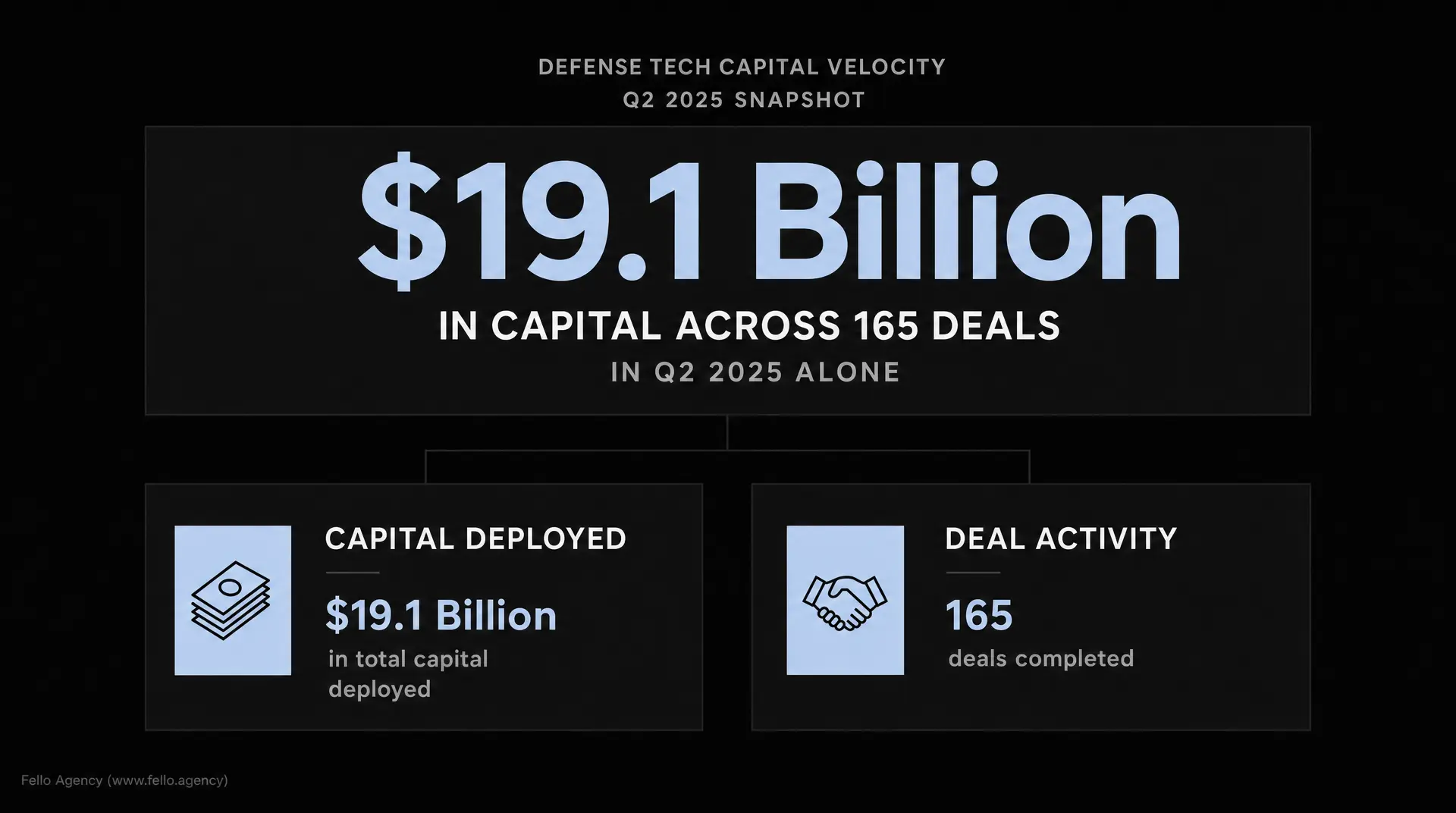
Defense tech pulled in $19.1 billion across 165 deals in Q2 2025 alone, so the category is loud. You can't match the noise when half your work is classified, the customer can't be named, and overclaiming costs credibility with the only buyers who matter. So invert it. Stop describing what you do and describe who you are and what you believe. Capability without specifics, conviction without hype.
A defense company came out of stealth with almost nothing quotable about its product. No customer names, no contract values, no specifics. What it had was a clear position on how modern defense software should work and a visible team with real backgrounds. Program offices understood exactly what that meant. It was quiet, and it was the loudest thing in its category that quarter, because everyone else was shouting.
We did this with Lintris, a defense company building autonomous systems. The positioning became "the quiet layer of modern defense." The homepage line: "from sensing to certainty." Both name the transformation a program manager is actually buying without saying a word about the technology. When you can't talk about the work, turn the secrecy into the product.
In markets where discretion is the norm, restraint reads as competence. Being unable to say much is a constraint. Being deliberate about it is a brand.
Coming out of stealth isn't an announcement. It's the first day anyone can find you - and the only day they'll all be looking at once.
Frequently Asked Questions
How heavily does a stealth lack of employer branding hurt our hiring economics?
It destroys your hiring efficiency. Without a public employer brand, you pay a severe obscurity tax. LinkedIn data shows visible companies with strong talent brands spend 43% less per hire. Staying invisible burns your runway by forcing you to overpay for every critical early hire.
Does waiting on a patent justify delaying a Series B launch?
No, it is a multi-year trap. If you delay your market debut for intellectual property, you will stall your momentum. The USPTO average wait for a first office action reached 22.2 months in early 2026. By the time that patent issues, competitors will own your category.
Can we rely on a single launch event to secure our category leadership?
Absolutely not. Launch day is a fleeting window, not a durable market position. According to Chartbeat, an article receives 80% of its traffic in the first 24 hours. To claim the category, your launch must immediately transition into an aggressive, sustained content velocity.
How do we validate B2B SaaS pricing while operating under the radar?
You run targeted, closed-door pilot programs under strict NDAs. Find five to ten design partners who share your exact pain point. Price the product on the value it delivers, not the feature set. If they hesitate to sign, your stealth mode isn't the problem - your product's perceived ROI is.
Will international engineering talent take a risk on a stealth startup?
Only if you prove immediate legitimacy. Visa holders earn 61% of U.S. computer science doctorates. These candidates face severe immigration risks if a company folds. If they cannot publicly verify your funding and leadership, they will safely default to established tech giants. Stealth makes you a liability.
Your Creative Partner for Innovation That Matters
From advanced tech to transformative healthcare, Fello helps visionary teams shape perception, launch products, and lead industries.


Let’s keep in touch.
Discover more about high-performance web design. Follow us on Linkedin and Instagram.