


No buyer can verify your engineering on first contact. They read your visuals instead, as the measure of whether you believe your own claim enough to prove it.
One of our clients lost a deal to Amazon with better engineering and a price that worked. The visuals looked weak, and the room quietly decided the entire company was unfinished.
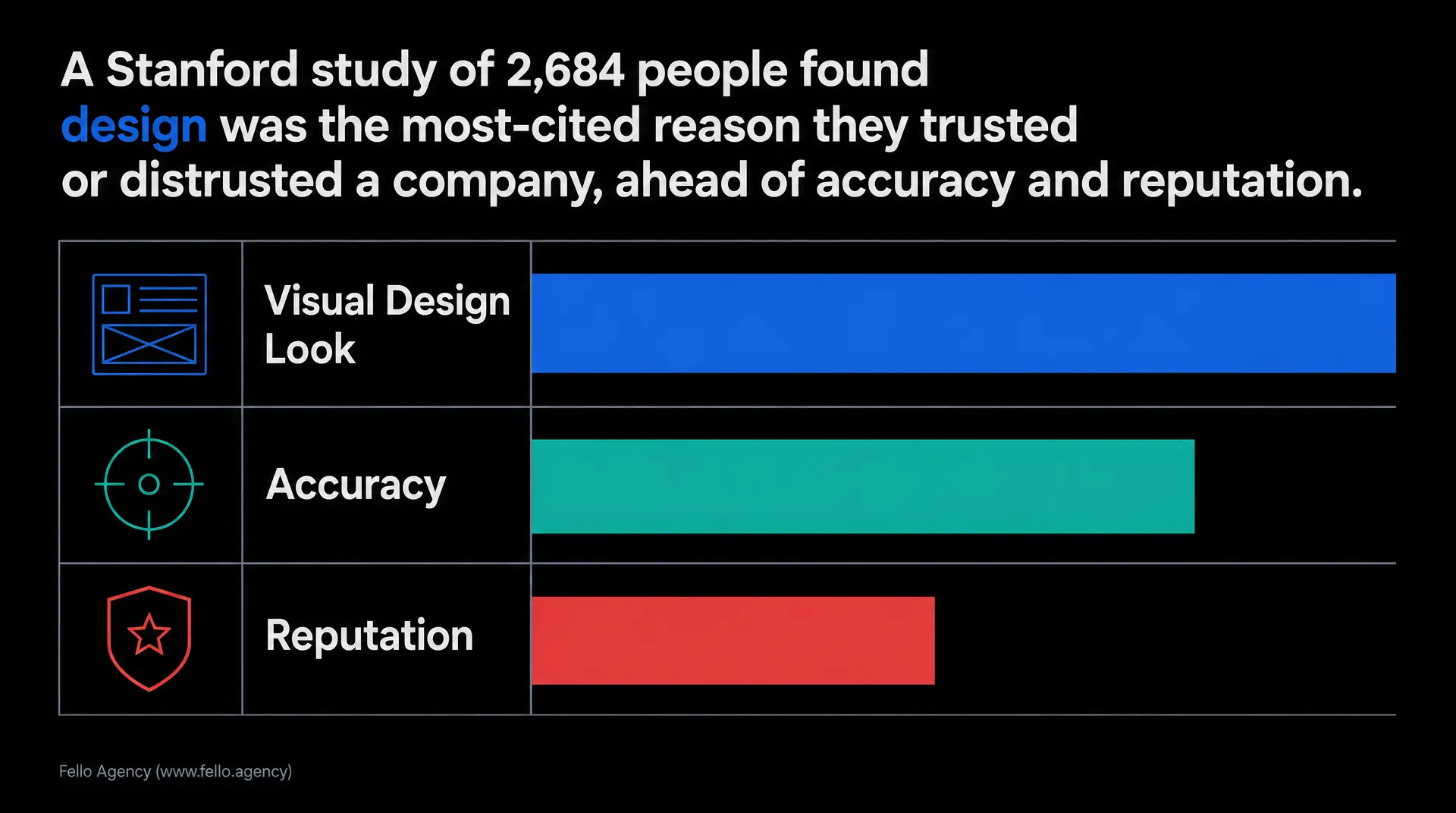
A Stanford study of 2,684 people found design was the most-cited reason they trusted or distrusted a company, ahead of accuracy and reputation alike. Your buyer reaches a verdict by eye, and gets to your technical claim too late to revise it.
Key Takeaways
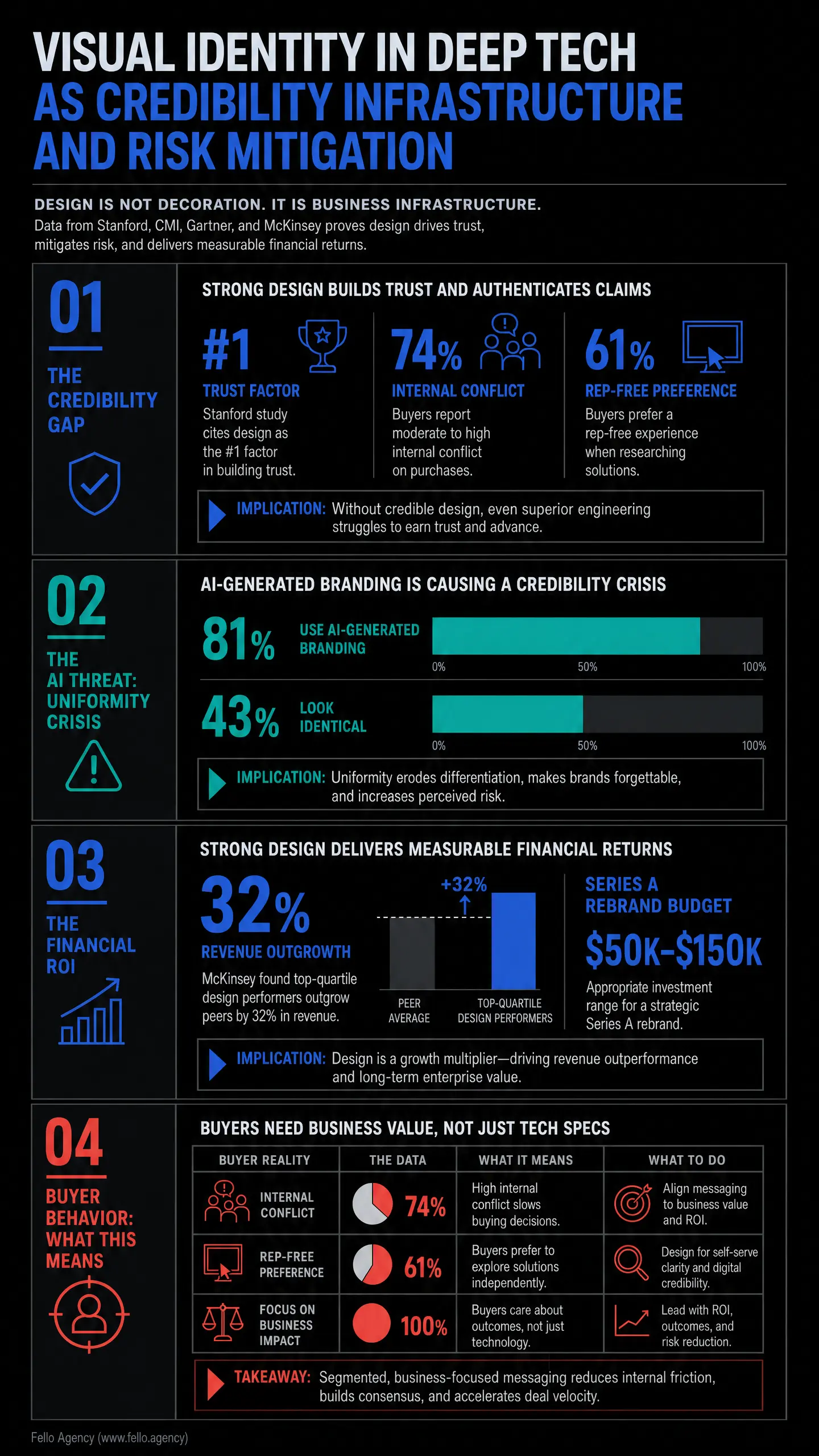
Adopting a neutral deep tech blue enables dual-use technology companies to sell simultaneously into agriculture and defense without alienating either sector through conflicting color palettes.
Selecting specific typography like Space Grotesk for AI or JetBrains Mono for developer tools establishes subconscious legitimacy before technical buyers read a single specification.
Pre-product deep tech companies must pair high-fidelity 3D renders with actual lab footage of the scientific team to prove physical development and avoid vaporware assumptions.
A Series A deep tech rebranding budget should remain between $50,000 and $150,000, as excessive spending on visual polish causes technical buyers to suspect vaporware.
A deep tech company requires a complete visual rebrand the moment sales representatives begin spending initial call time correcting prospect misconceptions about the core product positioning.
Deep tech marketing teams must measure visual branding ROI through sales velocity and demo requests rather than evaluating traditional software metrics like monthly customer acquisition costs.
How Does Visual Branding Authenticate Deep Tech Claims and Build Buyer Trust?
Here's how I define branding, and it's not what most agencies sell. Branding is the act of authenticating your claims. You're telling the market you have superior technology. Your brand is the evidence that you believe it enough to validate it professionally.
When the visuals are weak, you send a quiet message. You believe in the product, but you never bothered to prove it. Technical buyers read that instantly. They don't think "nice engineering, shame about the website." They decide the whole company is unfinished.
This isn't a soft opinion. A Stanford web-credibility study had 2,684 people review live sites, and "design look" came out as the most-cited credibility factor, ahead of accuracy, usefulness, and reputation. People decide whether to trust you by looking, long before they read.
We lived this with Prollenium, the medical device company behind Revanesse. Top-tier engineering, wrapped in beauty-product marketing that buried the science. We replaced it with a science-first identity, custom CGI, and macro photography. The "In the Lab" series ran clean black-and-white clinical visuals with deliberate orange light in the molecular shots, so it read as serious science without going cold and sterile. The goal was to make the brand finally match what was underneath it.
Why Is AI-Generated Visual Branding a Critical Mistake for Deep Tech Companies?

"If everybody's super, then nobody is." That's the villain's line from The Incredibles, and it's a perfect description of B2B content in 2026.
Every founder with a credit card now spins up a website in two days using AI. VCs brag about it on LinkedIn like it's an achievement. Content Marketing Institute found that 81% of B2B teams now use generative AI, while 43% admit they can't differentiate their content from competitors. Everyone pulls from the same models, so everyone ships the same gradients, the same hero shots, the same nothing.
A technical buyer who lands on AI-generated slop doesn't just judge the design. They infer the product. Your stuff looks the same as everyone else's, so they assume your services are the same too. You've argued against yourself before you said a word.
So my hard line is simple. If your company can afford a CMO, you should never let AI generate your brand. AI is excellent for research, ICP matrices, and ideation. We use Perplexity and ChatGPT to build industrial matrices every week. As your actual identity, it's poison. The buyers feel it too: Adobe found only 27% of B2B tech teams use generative AI for end-to-end content, and 55% name content quality and trust as a top challenge.
Don't forget who else reads your brand before they ever talk to you: the engineers you want to hire. LinkedIn's research found that 57% of a candidate's decision happens before they speak to anyone, and 75% weigh employer brand before applying. Your first customers in deep tech are your hires. Top talent picks the competitor with the sharper visual story and leaves you the leftovers.
What Are the Most Effective Visual Branding Aesthetics for Deep Tech in 2026?

Most "look more innovative" advice is useless. Let me give you what's working right now.
In 2026, the most valuable look for an industry-leading deep tech brand is a strict black-and-white palette. It reads as innovative and informative at the same time. We rebranded our own agency out of a purple-and-black scheme into black-and-white with light accents, and trust from prospects jumped right away. Same company, fewer costumes.
For hardware and climate plays, I push hard tech brutalism. High-contrast type. Blueprint aesthetics. Raw material textures. Design that carries the physical weight of real-world technology instead of pretending to be a cheerful consumer app. A robotics company selling six-figure machines should not look like a meditation startup.
Dual-use companies have a specific color problem. When you sell into agriculture and defense at the same time, agriculture's green and defense's black fight each other, and picking one alienates the other audience. We solve it with a neutral deep tech blue that lets both sides feel at home under a single identity.
Then typography, which CMOs underrate constantly. Font choice sets your subconscious legitimacy before a word is read. We map it on purpose: Inter for SaaS clarity, IBM Plex when enterprise needs engineering logic with human warmth, Space Grotesk to signal innovation in AI and crypto, JetBrains Mono for developer tools. We once broke a months-long branding deadlock for a confidential manufacturing and medical device client just by moving them to IBM Plex. It instantly matched the high-tier professionalism they'd been failing to project.
Inconsistent fonts that drift off the brand guide are the fastest way to look like a science project instead of a business. Type that wanders screams "lab," and labs don't win nine-figure contracts.
Why Must Deep Tech Homepages Prioritize Business ROI Over Technical Specifications?
The biggest mistake brilliant technical teams make is leading with features and burying the benefit. Sell the sizzle, not the steak. Not how smart the device is, but how much smarter the buyer gets by using it.
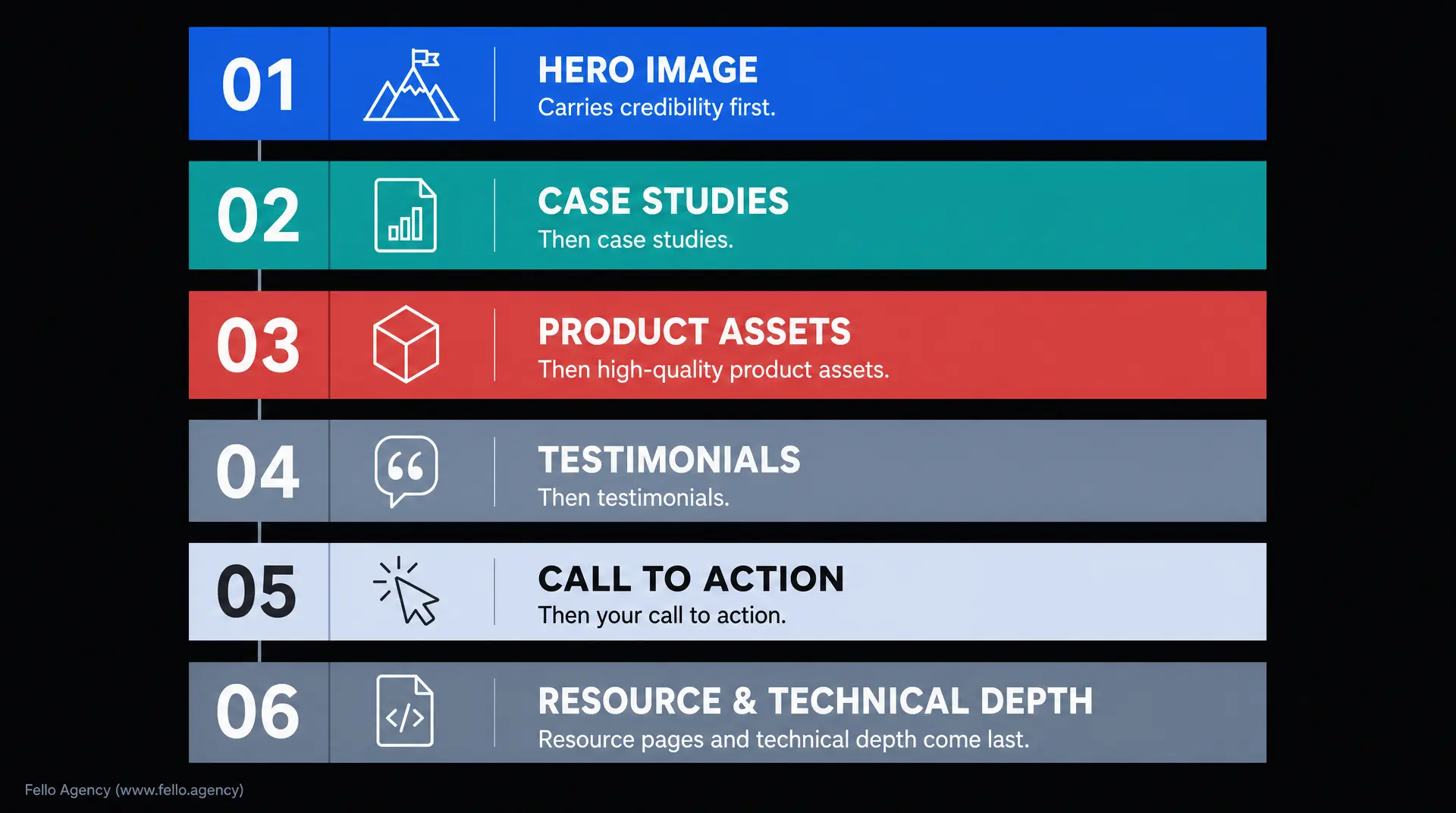
I run a strict content hierarchy on deep tech sites. The hero image carries credibility first. Then case studies. Then high-quality product assets. Then testimonials. Then your call to action. Resource pages and technical depth come last. Specs do not belong at the top, because the person who falls in love with specs usually can't sign the check.
This matters more than ever, because buyers are doing the work alone. Gartner found that 61% of B2B buyers prefer a rep-free buying experience, and 73% actively avoid suppliers who send irrelevant outreach. They're judging you on the site before you know they exist. If the page talks specs, you're talking to an engineer who then has to go sell you internally with zero help.
We rebuilt exactly this for Sphere, an XR company selling into factories, medtech, and defense all at once. Instead of one generic "innovation" story, we built separate industry landing pages so each buyer saw their own ROI numbers up front. Their leads tripled. Same technology, translated into business language for three different rooms.
Segmented messaging isn't a nice-to-have. In Gartner's buying-group research, 74% of buyer teams showed unhealthy conflict during the decision, and groups that reached consensus were 2.5 times more likely to call it a high-quality deal. When your CFO, your end user, and your integrator all land on the same generic page, you leave them to fight it out alone.
The cost of inconsistency is brutal too. Gartner also found that 69% of buyers report inconsistencies between a vendor's website and what its reps say. That mismatch quietly kills trust. So your decks have to clear the same bar as your homepage. We once had a logistics client nearly thrown out of a meeting with a major Canadian enterprise because their decks weren't cutting it. The product was fine. The slides cost them the seat.
Why Does Overly Polished Visual Branding Signal Vaporware to Deep Tech Buyers?

Deep tech breaks a rule you live by in SaaS. In SaaS you can launch ugly and iterate. Ship the MVP, patch it Tuesday. Hardware and deep tech don't forgive like that. There's no silent hot fix for a product sitting on a shelf, so your brand has to be flawless at launch. But it also can't look too finished, because too much polish reads as vaporware.
Watch what happens when an early company drops a Hollywood-grade CGI film of a product that doesn't physically exist still. To a procurement officer or a staff engineer, that's a red flag, not a flex. High-budget CGI of imaginary hardware screams "this isn't real." These buyers have watched plenty of startups promise the stars and deliver nothing, and they pattern-match you to that graveyard in seconds. Overselling and under-delivering is exactly how you lose all your credibility at once.
So we show the technology as it is. For pre-product clients, we pair high-fidelity 3D renders with real lab footage of the actual team and the actual bench. The renders show the vision. The lab footage proves there are humans in a room building it. For Nord Quantique, a pre-revenue quantum company, we didn't fake a finished machine. We built the story around the real scientists and inventors behind the error-correction work, because in pre-revenue deep tech the reputation of the people is the product.
The budget math is counterintuitive for the same reason. A Series A rebrand should land between $50,000 and $150,000, and roughly half of that belongs to strategy and research, not just visuals. Push much past $100,000 at that stage and technical buyers get suspicious. They start wondering what you're papering over with all that gloss. Overspending on shine too early signals the exact vaporware you're trying to avoid.
What Sales Signal Indicates a Deep Tech Company Needs a Complete Visual Rebrand?

Let me give you a specific signal to watch, because most teams wait far too long.
Listen to your own sales calls. The moment your reps start spending their time correcting misconceptions and explaining what your company is not, you have a positioning failure baked into your identity. The brand is actively working against the sale.
It happens in a predictable way. A deep tech company raises on an investor-focused brand. Then the product pivots, or they shift from selling investors to selling enterprise procurement teams, but they keep the original wrapper. Now there's a widening gap between what they can actually do and what they appear to do, and the sales team pays the tax on every single call.
A logo, three colors, and one font will not save you here. A growing company needs an identity that holds across trade show booths, technical briefs, co-branded assets with partners, and video templates. BCG reports that more than 80% of deep-tech ventures build physical products, which means your brand has to live on a chassis, a booth, a spec sheet, and a render all at once. A logo doodle can't stretch that far.
How Can CMOs Justify Visual Branding Budgets to Deep Tech CFOs and Boards?
Now the real battle: budget. Stop walking into that room saying "branding." Reframe it as communication strategy. Credibility infrastructure. Risk mitigation for the entire go-to-market. A consistent brand system shortens procurement and lowers how risky you look to a buying committee. That $50,000 website is a lead-generation asset with measurable ROI, so name it that way.
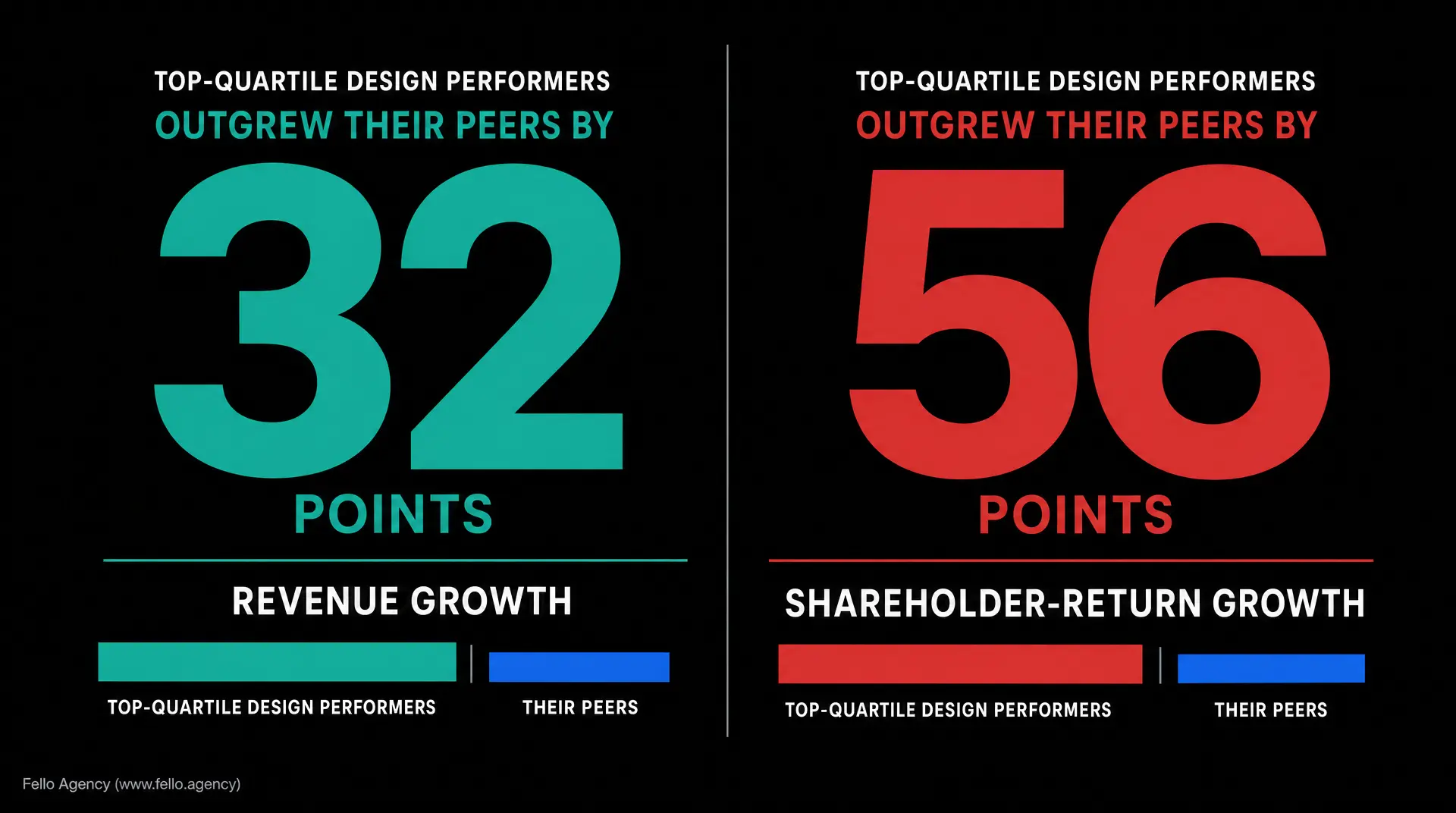
You have the data on your side now, so use it. McKinsey studied 300 public companies and found that top-quartile design performers outgrew their peers by 32 percentage points in revenue growth and 56 points in shareholder-return growth over five years. It held in medical technology, not just consumer brands. That's the number you put in front of a skeptical board.
When they still push back, run a direct competitor analysis. Pull the five companies in your space that just landed partnerships with Microsoft or Amazon and put their visuals beside yours. The correlation argues for you. I'll say it the way I say it to CFOs: if you want million-dollar contracts but won't spend $100,000 to look the part, you don't deserve the business. Dress for the client you need.
There's a credibility angle that closes the case. Edelman and LinkedIn found that 73% of decision-makers trust an organization's thought leadership over its marketing materials, and 86% would invite a company that consistently produces strong thought leadership into an RFP. Your brand system is what makes that thought leadership look like it came from a market leader instead of a side project.
Which Metrics Should Deep Tech Companies Use to Measure Visual Branding ROI?

This is where SaaS-trained CMOs blow it. You'll reach for MQLs and monthly CAC, and on a 16-to-18-month deep tech cycle those numbers are close to meaningless. McKinsey notes deep-tech ventures take about 12 months longer than traditional tech just to get from seed to Series A. You can't judge a brand investment on a SaaS clock.
Strong branding shows up qualitatively, and fast. Within days of a launch you see faster email responses, smoother conversions, and reps who skip the part where the prospect quietly verifies you're a real company. That's sales velocity, and it's the metric that matters. Strong B2B branding is the last moat standing, and it lets your team skip a level in the cycle by establishing legitimacy on contact.
So track sales velocity. Track demo requests and how far technical briefs travel inside an account. Stop reporting raw website traffic to your board like it's a result.
Why Is a Distinct Visual Identity a Critical Commercial Weapon in 2026?

Treat your visual identity as a commercial weapon, because that's what it is. It authenticates everything you claim. It opens rooms your spec sheet never could. And it's the line between looking like a research problem and looking like a business that's going to win.
Move fast on it. In tech, if you're moving slow, you're getting killed. And take it seriously, because your competitors will, and they'll take the deal while you're still debating whether the logo matters. It always mattered. With AI flattening everyone into the same forgettable look, in 2026 it matters more than it ever has.
Frequently Asked Questions
How does visual identity branding sustain credibility across complex B2B buying journeys?
It acts as your anchor. Buyers don't just visit your homepage and convert. McKinsey found buyers average 10 touchpoints across digital, remote, and in-person channels. If your visual identity fluctuates between that first ad and the final sales deck, you bleed trust at every step. Consistency proves operational maturity.
How should our visual identity adapt for account-based marketing and personalization?
Your core identity stays rigid, but the messaging wrapper flexes. Don't rely on one generic story. Adobe reports only 38% of B2B tech brands personalize interactions. Build a visual system modular enough to speak directly to specific verticals without breaking the overarching brand guidelines.
Can a premium visual identity directly increase our pricing power?
Yes, by elevating how your expertise is perceived. When visuals make your insights look authoritative rather than cheap, buyers pay up. An Edelman-LinkedIn study found 60% of buyers will pay a premium for high-quality thought leadership. World-class branding authenticates that premium price tag.
How do we prevent our visual identity from fracturing across distributed sales teams?
You stop letting reps build their own decks. Rogue slide formatting actively kills pipeline. Gartner found 69% of B2B buyers notice inconsistencies between a vendor's website and their reps. Build an idiot-proof, locked-down asset library. If the visuals don't match, buyers assume the technology won't either.
How does a unified visual identity accelerate consensus within the buying committee?
It acts as a translator. Gartner reports 74% of buyer teams experience unhealthy conflict. When your CFO, IT lead, and end-user all see a cohesive, professional visual narrative, they stop fighting. Visual alignment forces internal alignment, making them 2.5 times more likely to close a high-quality deal.
Your Creative Partner for Innovation That Matters
From advanced tech to transformative healthcare, Fello helps visionary teams shape perception, launch products, and lead industries.

Let’s keep in touch.
Discover more about high-performance web design. Follow us on Linkedin and Instagram.

