


If you lead marketing at a dual-use tech company, you’re managing two trust systems at once.
Government buyers want one set of signals. Enterprise buyers want another. Investors want a clean story. Sales wants shorter cycles. Recruiting wants the company to look like a place serious people should join. A lot of teams throw all of that onto one website and hope it sorts itself out.
It doesn’t.
For me, brand is simple. It’s a feeling that somebody thinks about when they see your brand. In dual-use, that feeling needs to land fast. It needs to create trust, interest, and curiosity before your team ever gets a real shot at the deal.
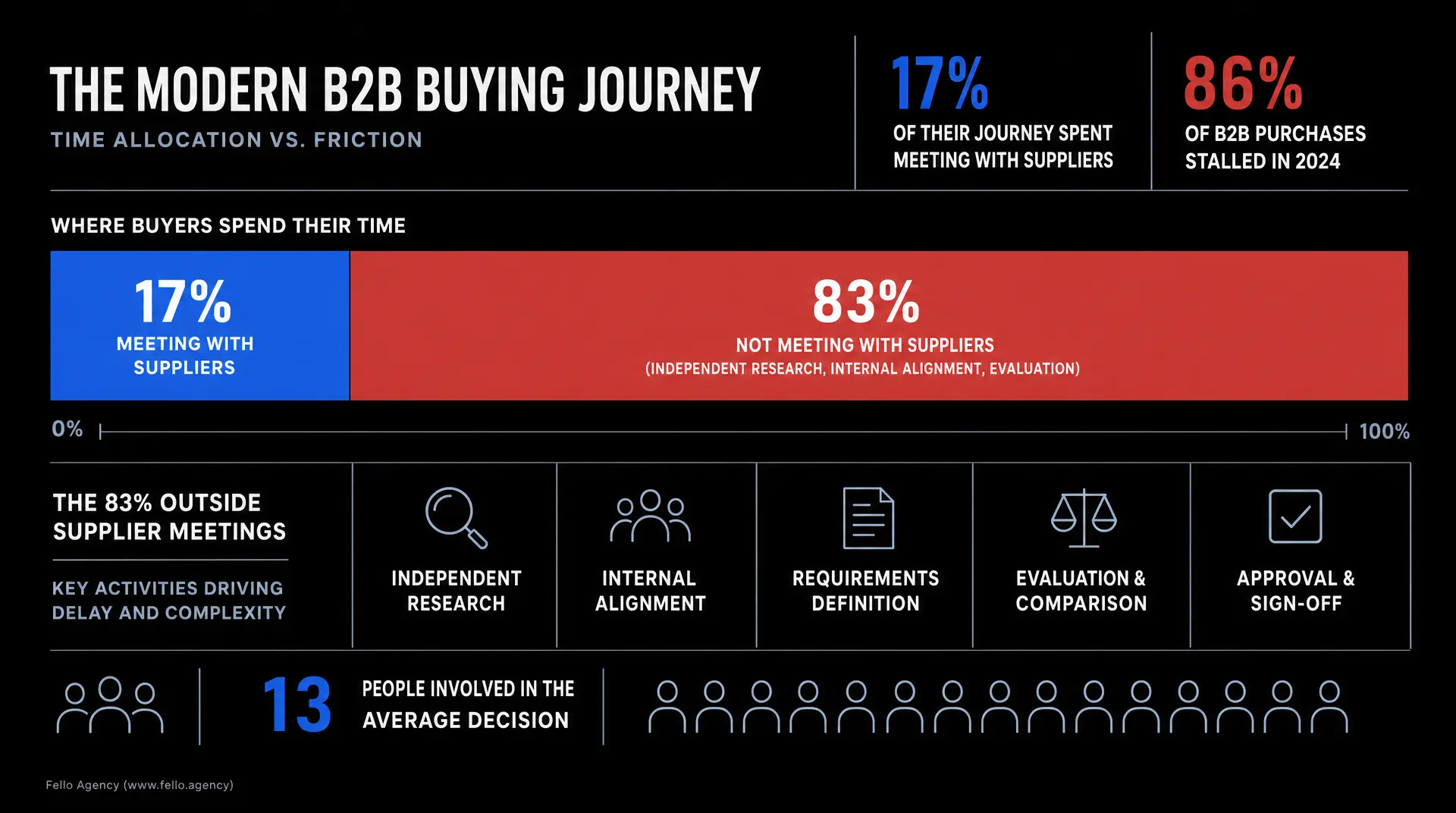
That matters more now than ever. B2B buyers spend only 17% of their purchase journey meeting with suppliers. Most of the heavy stuff happens before sales gets meaningful time with the account. And Forrester reports that 86% of B2B purchases stalled in 2024, with 13 people involved in the average decision and two or more departments tied into almost every deal.
So yes, brand matters. A lot.
I run brand strategy at Fello, and we work with companies in AI, robotics, quantum, advanced manufacturing, medtech, defense, XR, and a whole slew of other deep-tech spaces. I keep seeing the same thing. The product is real. The team is sharp. The market still hesitates.
That gap is trust.
And if you don’t have a brand, then you’re going to be forgotten.
Key Takeaways
Dual-use technology companies face a trust inversion where government buyers value opaque, controlled messaging while enterprise buyers demand visible case studies, integrations, and quantifiable metrics.
Because 69% of software buyers engage sales only after making a decision, dual-use company homepages must immediately route government and commercial traffic into distinct narrative tracks.
Government procurement teams treat vendor websites as formal past performance evaluations required under FAR 15.304 during negotiated competitive acquisitions.
Dual-use tech companies with classified contracts overcome public credibility asymmetry by publishing adjacent proof like mission-specific capability overviews, high-fidelity renders, and named engineering experts.
Business-to-business brand redesign research must prioritize customers and sales teams over leadership to prevent wrapping a new visual identity around inaccurate executive assumptions.
Establishing baseline professional brand credibility costs early deep-tech teams between $15,000 and $30,000, while comprehensive Series A or B rebrands typically require $50,000 to $150,000.
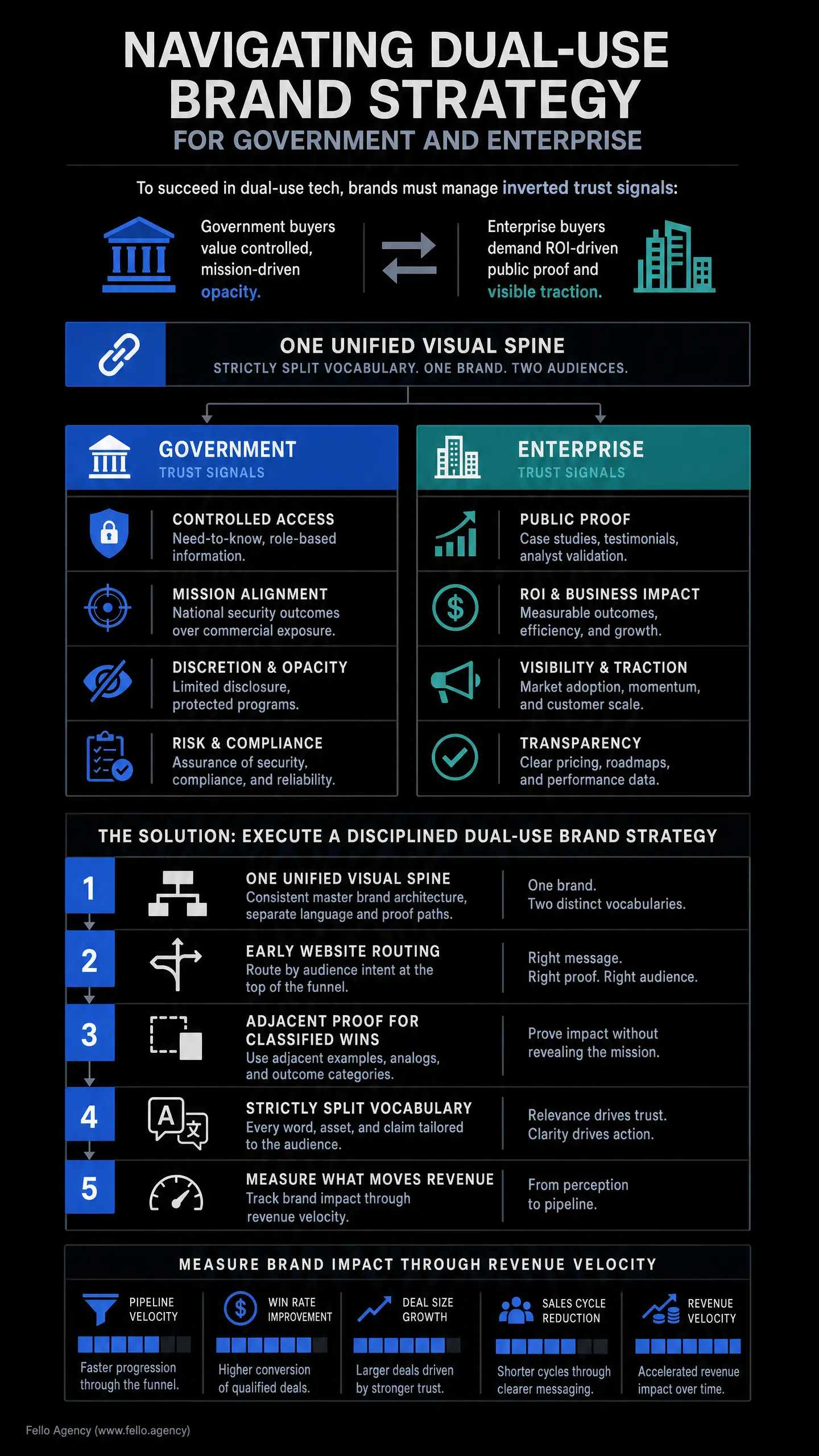
Step 1: Map the Trust Inversion
Government and Enterprise Do Not Trust the Same Signals
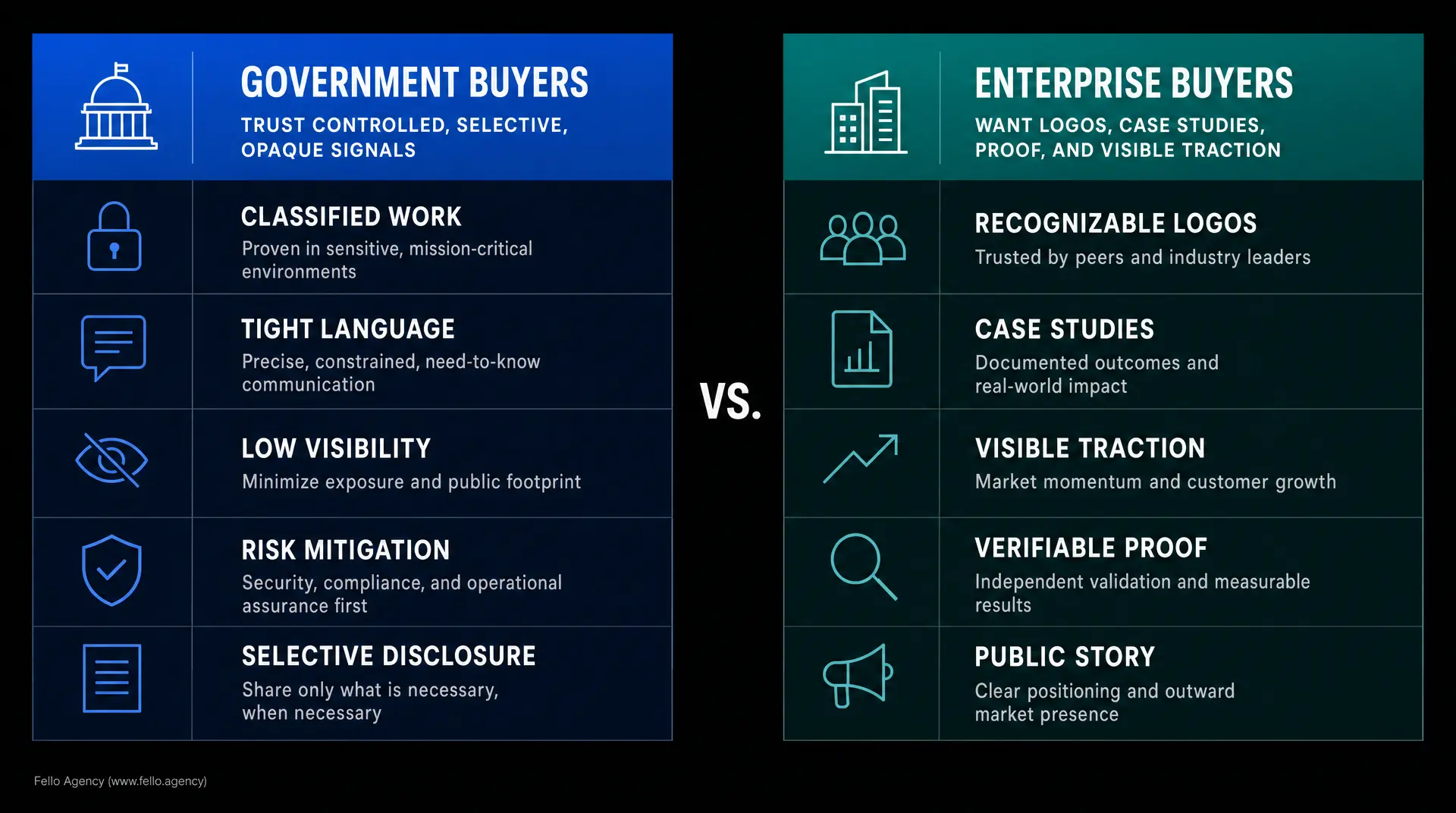
This is the first thing I tell people. Trust signals are inverted across these audiences.
A lot of the time, government buyers trust you more when you are controlled, selective, and a bit opaque. Classified work. Tight language. Fewer public details. That can actually feel more credible in that world.
Commercial buyers want the opposite. They want logos, case studies, proof, integrations, numbers, and visible traction. They want to do their own homework and feel safe bringing you into a buying committee.
These signals pull in opposite directions.
Most dual-use companies try to split the difference and end up trusted by neither. The commercial side feels too secretive. The government side feels too loud. The whole thing gets muddy.
Look, the opportunity is there. The Department of Defense is asking for $179.1 billion in RDT&E authority. Smaller firms still matter too. DoD says 73% of companies doing business with it are small businesses. You can absolutely win in this space.
You just need to respect how each room decides who feels legitimate.
Keep the Buyer at the Center
Brand serves the buyer. It does not serve the founder’s ego.
That sounds obvious, but people miss it all the time. They pick colors they like. They write language that flatters the team. They build a homepage that tries to prove how smart they are. Meanwhile the buyer is sitting there asking one thing: can I trust this company enough to bring them into the next conversation?
That question should shape everything.
Step 2: Research Before You Redesign
I always start in the same order. First customers. Then sales. Then marketing. Then leadership.
Customers tell you where the confusion is. Sales tells you where deals slow down. Marketing shows you what gets attention. Leadership usually tells you the story they want to be true.
That order matters. If you start with leadership, you often end up wrapping a beautiful brand around bad assumptions.
I also use a simple test with my team. If we cannot explain the product to a stranger in 60 seconds, every piece of content after that is going to feel shallow. Deep-tech buyers spot bullshit a mile away. They know when the people writing the story still do not understand the heavy stuff.
Then I look for the real trigger. Is sales spending half the call correcting bad assumptions? Are they explaining what the company is not? Is the team dragging around old decks, stale one-pagers, or investor language that no longer fits enterprise procurement?
If yes, I start cutting.
I build a brand kill list. Old phrases go. Weak product names go. Legacy PDFs go. Any message that creates drag goes. You need to remove what is making the company harder to buy.
A lot of teams wait too long. They hit the “we’ll brand it after Series B” graveyard. By then the cleanup is slower, more political, and more expensive.
Step 3: Build One Visual Spine
One System Has to Carry Everything
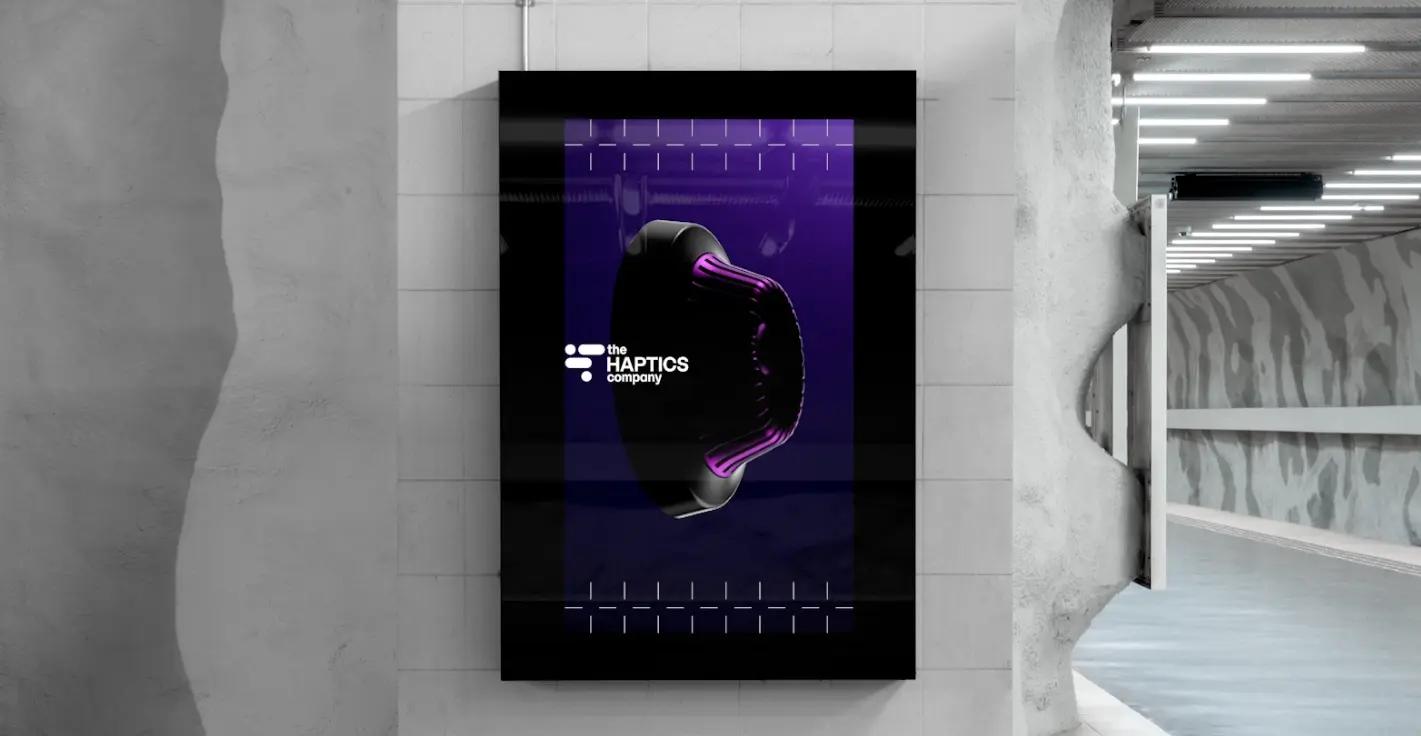
Dual-use companies do not need two brands. They need one strong system.
Typography stays consistent. Color stays consistent. Imagery rules stay consistent. Then you use those fixed pieces to tell different stories to different audiences.
Palantir does this well. You can look at how they speak to government and how they speak to enterprise. Same institutional spine. Different narrative application. Anduril does a version of this too. The core brand stays disciplined, then specific campaigns can get louder when the moment calls for it.
That is the move.
A logo, two colors, and one font won’t carry a dual-use company through trade-show booths, technical briefs, partner pages, proposal templates, product UI, and investor decks. You need a system that can hold the next 20 touchpoints without wobbling.
B2B buyers now want in-person, remote, and digital self-service in roughly equal measure. So your brand has to work on the website, on the call, in the booth, in the deck, and inside the product. Same company. Same energy and vibes. No personality split.
Design Is a Commercial Gatekeeper

People still treat design like the soft part. I don’t.
A Google-backed study found people react to site visuals in 17 to 50 milliseconds. They are subconsciously deciding whether you are legitimate before they fully read the copy. Design is a commercial gatekeeper.
So yes, I care about typography. I care about spacing. I care about the way the whole page breathes.
In high-tech branding, black works really well because it acts like an empty vessel that adapts. It feels premium. It feels stable. Right now, black and white does a lot of heavy lifting for brands wanting the signal to innovation. If I’m balancing conflicting sector codes, like agriculture green and defense black, I’ll usually move toward a neutral deep tech blue or a restrained black-and-white base.
Typography matters too. IBM Plex gives you engineering logic with human rhythm. Helvetica Now can blend institutional authority with modern precision. Inter is a clean workhorse. These choices are doing trust work before the headline gets a chance.
And look, in the new dawn age of AI, generic AI-generated layouts are already losing credibility. Buyers can tell. They’ve seen the same stock feeling five times this month. Use AI for ideation if you want. Human design credibility still has to finish the job.
Step 4: Split the Vocabulary
This is where dual-use brands usually blow it.
The vocabulary is a loyalty test.
Defense language is capability-driven and mission-driven. Commercial language is outcome-driven. When those two get mixed together, both audiences get uneasy. Government readers think you do not know the domain. Enterprise readers feel like the company is talking in code.
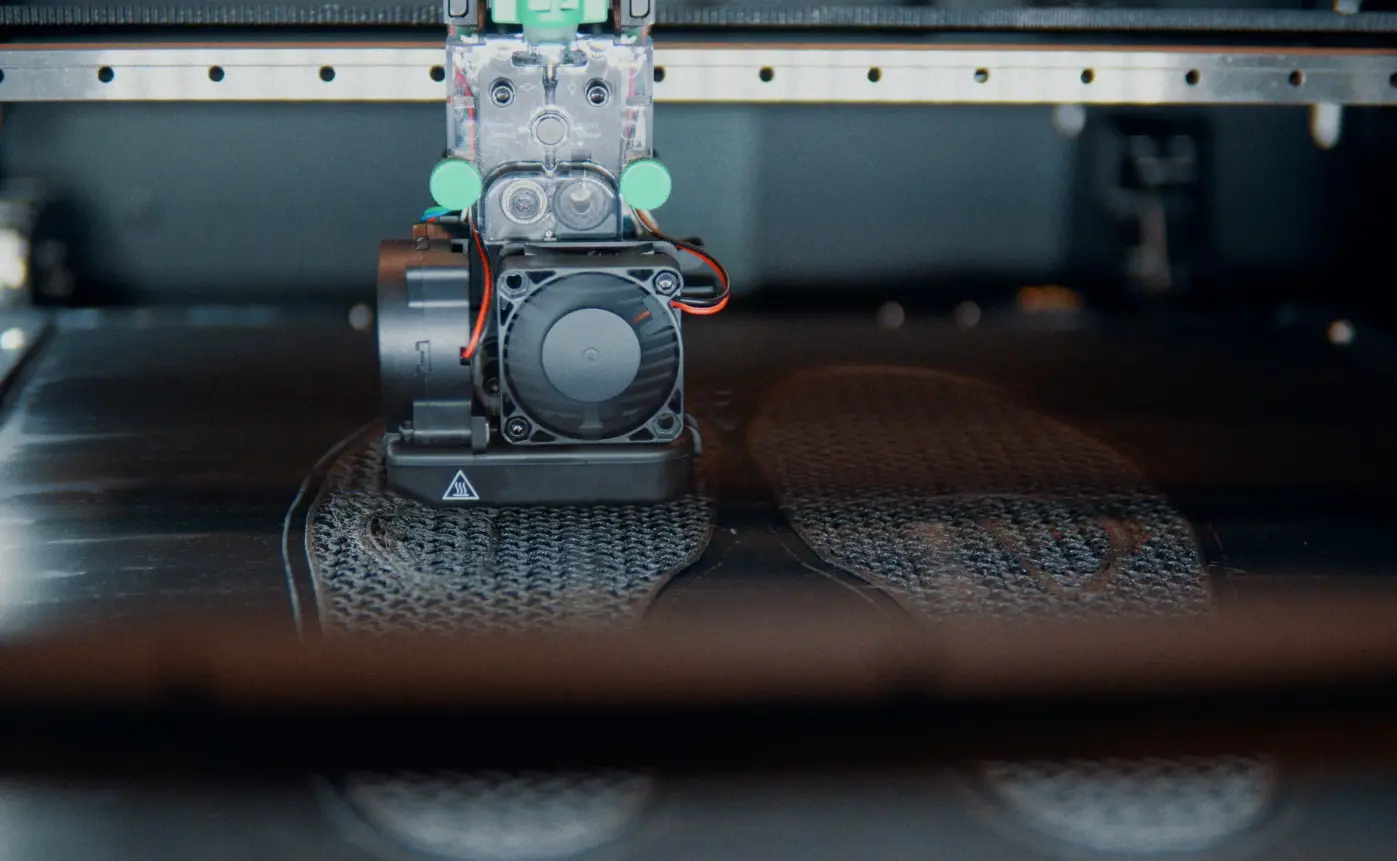
I had this exact moment with a client in additive manufacturing. They were pushing back on the brand strategy. I told them they were failing in two rooms at once because the same web copy was trying to do two different jobs. That landed immediately.
You can’t catch two rabbits with one paragraph of copy.
On defense pages, I want language around mission fit, reliability, readiness, force protection, and the real operating environment. On commercial pages, I want ROI, time-to-value, integration, scalability, and business impact. Same brand. Different language tracks. Clean separation.
A lot of technical founders struggle here because of what I call the PhD curse. They’ve been trained to hedge, qualify, and explain everything. Branding needs conviction. Everyone tells STEM founders to simplify. I think that advice is lazy. The real move is to elevate.
Make the audience feel smarter. Repackage complexity as status. Lead with the value. Bring in the proof right after.
If you’re selling an autonomous inspection drone, I do not want “SLAM algorithms” above the fold. I want “prevent pipeline shutdowns.” That is taking conversations out of the lab and going into the boardroom of value.
Step 5: Split the Website from the First Click
Route People Early
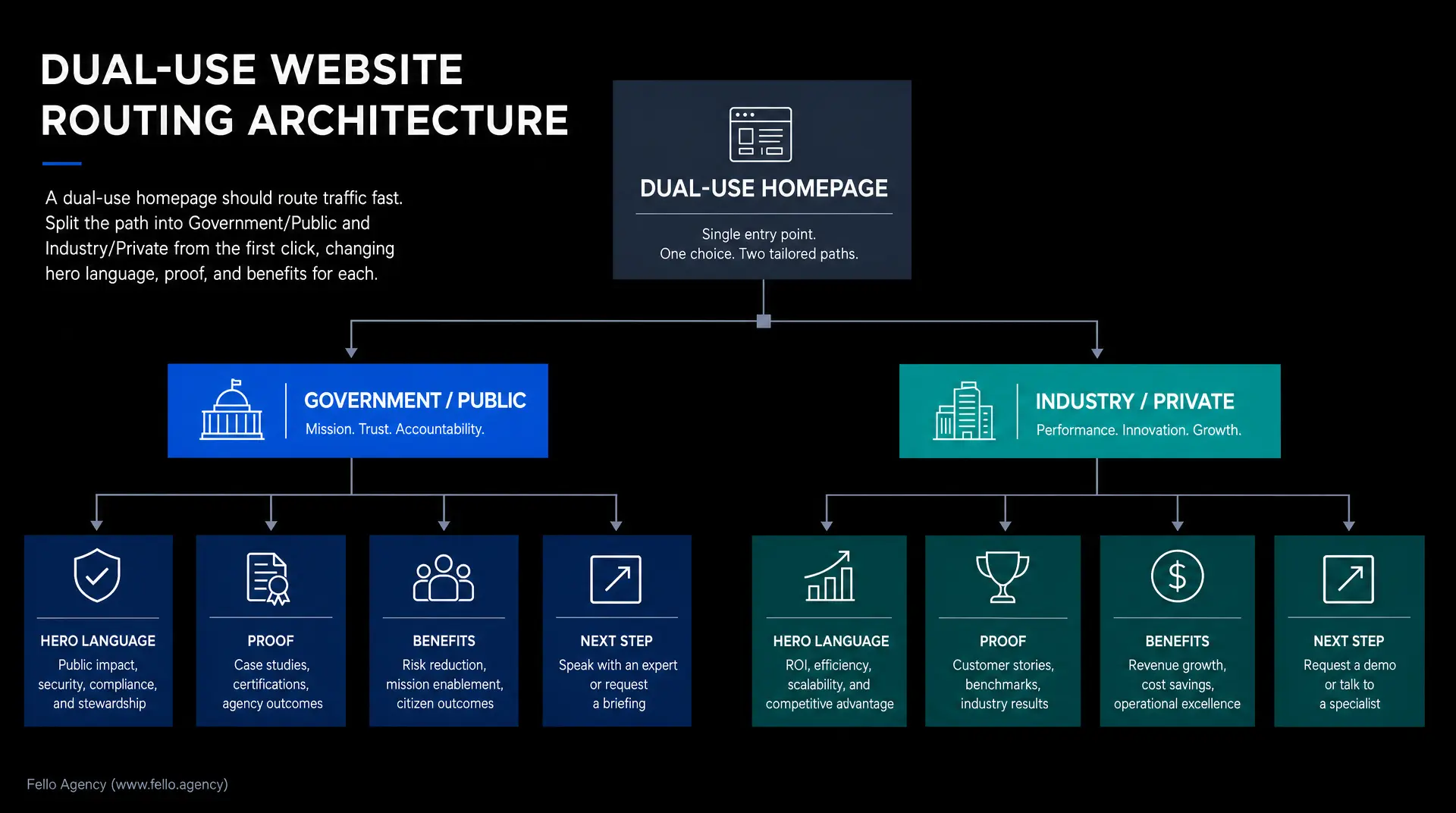
A dual-use homepage should route traffic fast.
I think about it like building the highway: the collectors and the express. Let people in, then move them to the right lane quickly. Don’t force one hero message to do the work of five different sales conversations.
We did this for a SaaS company that sold into government and private industry. Right on the homepage, we split the path into Government/Public and Industry/Private. From there, each audience landed on a page built for them.
The hero language changed. The proof changed. The benefits changed. Employee quotes stayed in because they matter a lot in B2B. The CTA changed too. A lot of the time, government users still want a direct demo path, so we built for that behavior.
That structure works because the person who signs the contract is not always the person who found you. A lot of the time it starts with an engineer or an operator who whispers your name upstream. Your site needs to help that person make the case internally.
Treat the Website Like Past Performance
Self-service now does a massive amount of the selling.
In G2’s buyer research, buyers preferred self-service across discovery, research, evaluation, decision, and implementation. On top of that, 69% of software buyers engage sales only after they have made their decision. TrustRadius found 78% of buyers had heard of the product before starting research, and for enterprise buyers that number climbed even higher.
So the website, the docs, the demos, the content, and the overall feel of the brand are doing the heavy stuff long before your AE gets the invite.
On the government side, proof has even more structure around it. FAR 15.304 requires past performance to be evaluated in negotiated competitive acquisitions above the threshold. Procurement teams do not buy vision. They buy credibility they can defend.
That is why I say your website is your past performance.
And the brand system has to hold far beyond the homepage. It needs to work inside capability briefs, 60-page proposals, partner assets, quad charts, and technical resources. If it breaks there, the system was weak from the start.
Step 6: Build Public Proof Around Private Wins
A lot of dual-use companies have a weird problem. Their best wins are classified. Their strongest proof sits behind closed doors. Publicly, they look lighter than they really are.
I call that credibility asymmetry. You’re over-credentialed in private and under-known in public.
You solve it by building adjacent proof.
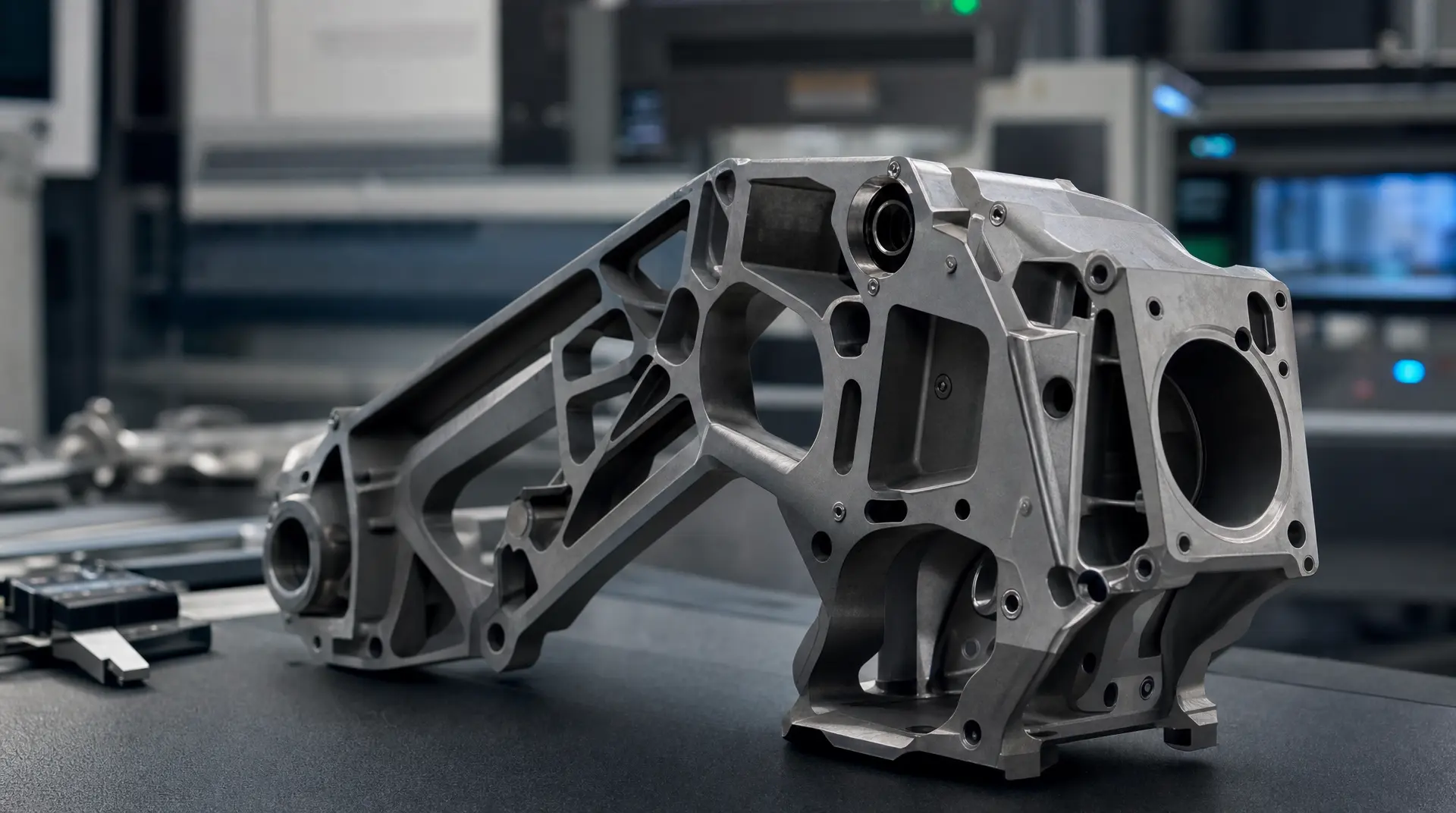
That means controlled case studies where you can use them. It means mission-specific capability overviews. It means high-fidelity renders when you cannot show footage. It means named engineers in webinars. It means employee quotes. It means moving dead technical PDFs onto trackable pages with clear calls to action.
I like this move a lot because it helps sales and it gives marketing data back. You can see what accounts care about. You can see what got shared. You can see where people drop.
I also like building a technical authority funnel around this. Teach the market the problem first. Then show the method. Then bring in the product. Put methodology front and center while the buyer is still trying to understand the category. That is how you earn trust before asking for the meeting.
And remember, buyers in this space are still human. Most B2B marketing treats them like rational robots. I don’t buy that. They carry their consumer habits to work. They scroll fast. They react to confidence. They respond to proof and status. They want to feel like the choice is safe and smart.
Demos are part of that too. TrustRadius found 71% of buyers who used demos said demos were the most influential resource. G2 found 57% expect positive ROI within three months, and 81% consider a vendor’s security history. Your proof stack needs to show speed-to-value and lower risk quickly.
This is also how you fix pilot purgatory. A lot of pilots stall because the internal champion has no boardroom-ready narrative. Without that, the pilot dies in committee.
Step 7: Keep Investors and Hires in Mind
Dual-use brands get messy in fundraising all the time.
If you pitch defense durability and commercial SaaS upside in the same breath, investors start discounting you from both directions. One side hears regulatory risk. The other hears lack of focus. The brand isn’t just shaping marketing. It’s shaping the cap table conversation.
Keep the identity stable. Split the narrative by audience. Let each investor hear the version that matches how they price risk and upside.
And while you’re doing that, remember this: your first customers are your hires. LinkedIn found 75% of job seekers consider employer brand before they apply. If the company looks like a grad school thesis defense or a weekend Figma project, top talent quietly moves on.
That war gets won on brand before compensation.
Step 8: Measure Brand Like a Revenue Engine
CMOs get stuck when brand gets framed as taste. I frame it around movement.
I care about sales velocity. I care about better inbound. I care about faster email replies, stronger demo requests, cleaner championing inside named accounts, and less time spent correcting bad assumptions on calls. In deep tech, where sales cycles often run six to twelve months, that compression matters a lot. Brand credibility is a go-to-market accelerant.
I also look at what changed in the operating system. Did direct traffic rise? Did brand search rise? Did content-engaged leads move faster? If the rebrand touched docs, APIs, or SDKs, did developer adoption move? Those are useful signals because they show whether the brand landed with the people who actually use the product.
And when I talk to CFOs, I do not pitch a prettier site. I pitch communication strategy, risk reduction, and a system that helps bring in better deals. That is the language they care about.
The market already supports that thinking. McKinsey found 20% of B2B buyers would spend more than $500,000 digitally, and 11% would spend more than $1 million. Your digital brand is already sitting inside serious buying decisions.
For early deep-tech teams, I usually say you can establish professional credibility with roughly $15,000 to $30,000. A stronger Series A or Series B rebrand often lands between $50,000 and $150,000. Dual-use companies usually need more care because you are resourcing two audience journeys under one system.
If budget gets tight, cut scope first. Keep the quality.
Step 9: Launch Fast and Govern After
Look, a product launch waits for no one’s creative review cycle.
Busy agencies are not the same as effective agencies. A lot of them optimize for their own workflow instead of the client’s timeline. That kills momentum.
When timelines compress, I protect the non-negotiables. The logo matters. The visual guide matters. Colors matter. Typography matters. The communication strategy matters. If those are solid, you can move 10 times faster than you think you do and still keep the brand clean.
On larger rebrands, I still use a structured process. I run discovery and audit. Then strategy. Then design and build. Then migration and launch. Then post-launch measurement and governance. I want direct C-suite sign-off on the narrative. I want third-party listings updated. I want the team trained so they can actually run the system after launch. Then I want an internal retro on what broke, what surprised us, and what should be repeated.
Brand never ends.
The companies that win are the ones that keep the system alive.
Final Thought

If you lead marketing at a dual-use tech company, you do not need a louder logo. You need a brand system that can serve government, commercial, and investor audiences without becoming a Frankenstein. You need language that passes the loyalty test. You need proof that works in public even when your best wins are private. And you need a website that helps buyers trust you before sales ever joins the room.
Do that well and you’re kind of skipping a level. Sales gets cleaner conversations. Recruiting gets easier. Investor messaging gets tighter. The experience becomes legitimate and absolutely won.
Ignore it, and the market fills in the blanks for you.
That never goes well. Getting a dual-use brand to work for both a venture investor and a program office is the core of our B2G marketing work.
Frequently Asked Questions
How do we prove the ROI of a dual-use brand overhaul to a skeptical board?
You frame brand as a pipeline accelerant, not an art project. Show them that 86% of B2B purchases stalled last year. A disciplined brand system reduces friction. Tie the investment directly to compressed sales cycles, inbound velocity, and higher lead-to-opportunity conversions. Brand is risk reduction.
Why is pre-market brand awareness critical for high-ticket enterprise and defense deals?
Because the shortlist is formed before you even know they are looking. TrustRadius found 86% of enterprise buyers already knew the product they purchased before starting research. If your brand isn’t establishing status in the dark funnel, your sales team is fighting a losing battle.
How can brand strategy directly mitigate procurement and legal delays?
By treating compliance and security as frontline brand pillars. G2 reports 61% of purchases are slowed by legal. Don’t hide certifications. Foreground your security history and compliance standards immediately to give internal champions the exact ammunition needed to clear procurement hurdles fast.
Where do self-serve product demos fit into a dual-use go-to-market motion?
They are your strongest trust asset. TrustRadius data shows 71% of buyers who use demos consider them their most influential resource. Government buyers want a direct path to see the tech, while enterprise buyers demand self-serve proof. Make them a core digital pillar.
How do we align dual-use messaging for massive, multi-department buying committees?
You build a narrative that defends itself. Forrester notes the average buying decision involves 13 people. Your messaging must arm the end-user with technical proof, the CFO with ROI data, and the CISO with security validation. One cohesive brand spine, modular arguments for every stakeholder.
Your Creative Partner for Innovation That Matters
From advanced tech to transformative healthcare, Fello helps visionary teams shape perception, launch products, and lead industries.

Let’s keep in touch.
Discover more about high-performance web design. Follow us on Linkedin and Instagram.

