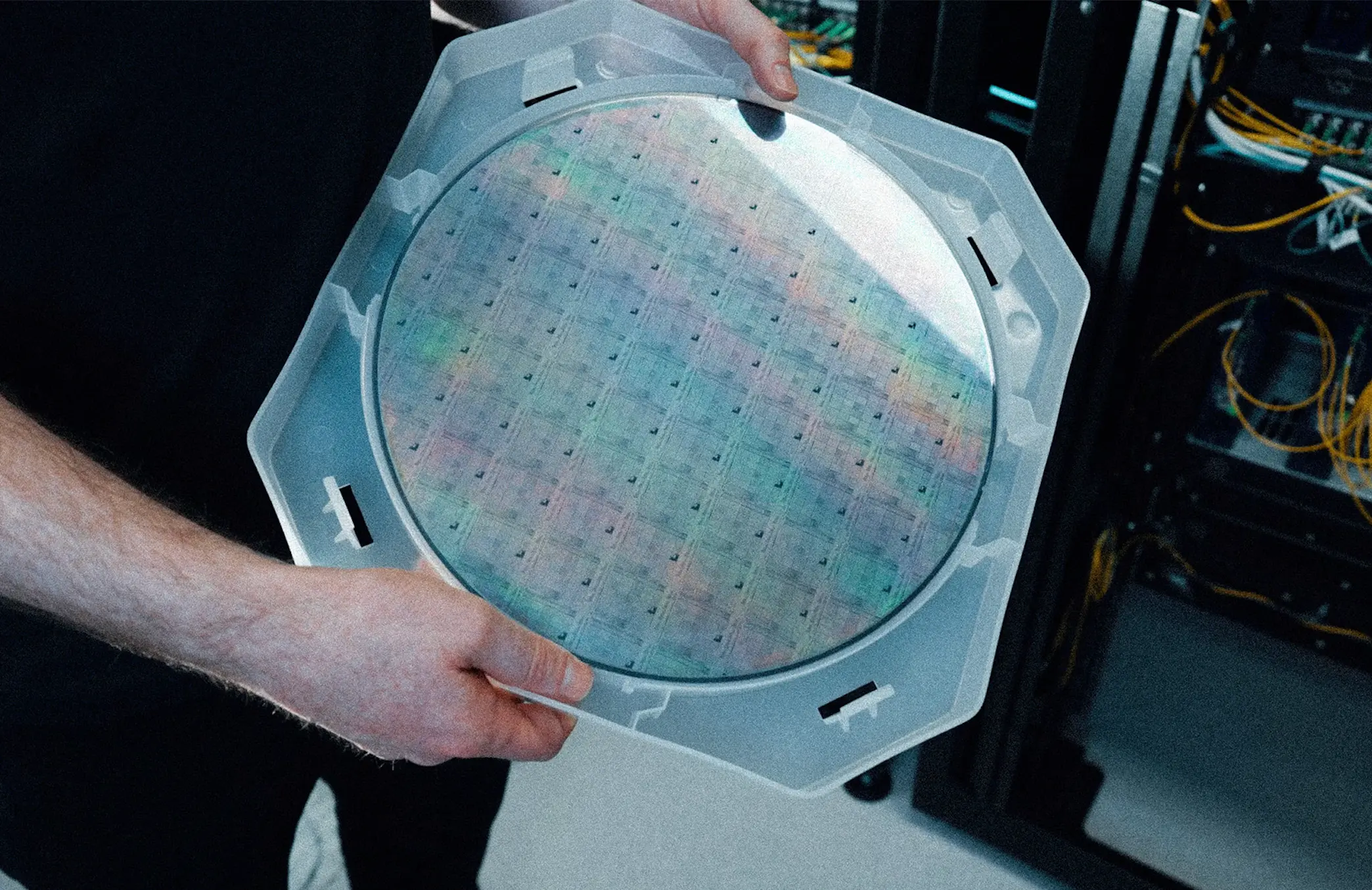


I work with companies in AI, robotics, quantum computing, advanced manufacturing, medtech, and defense. The heavy stuff. The kind of technology that can change an industry if it actually gets out of the lab.
And I keep seeing the same problem.
The technology is real. The team is brilliant. The market still does not get it. Or worse, it kind of gets it, but does not trust it enough to buy.
If you are a founder, that creates a brutal mix of pressure. You are carrying R&D, fundraising, hiring, and go-to-market at the same time. You are trying to land a flagship customer while the product is still maturing. You are trying to sound credible to enterprise buyers without overselling what is not fully there still.
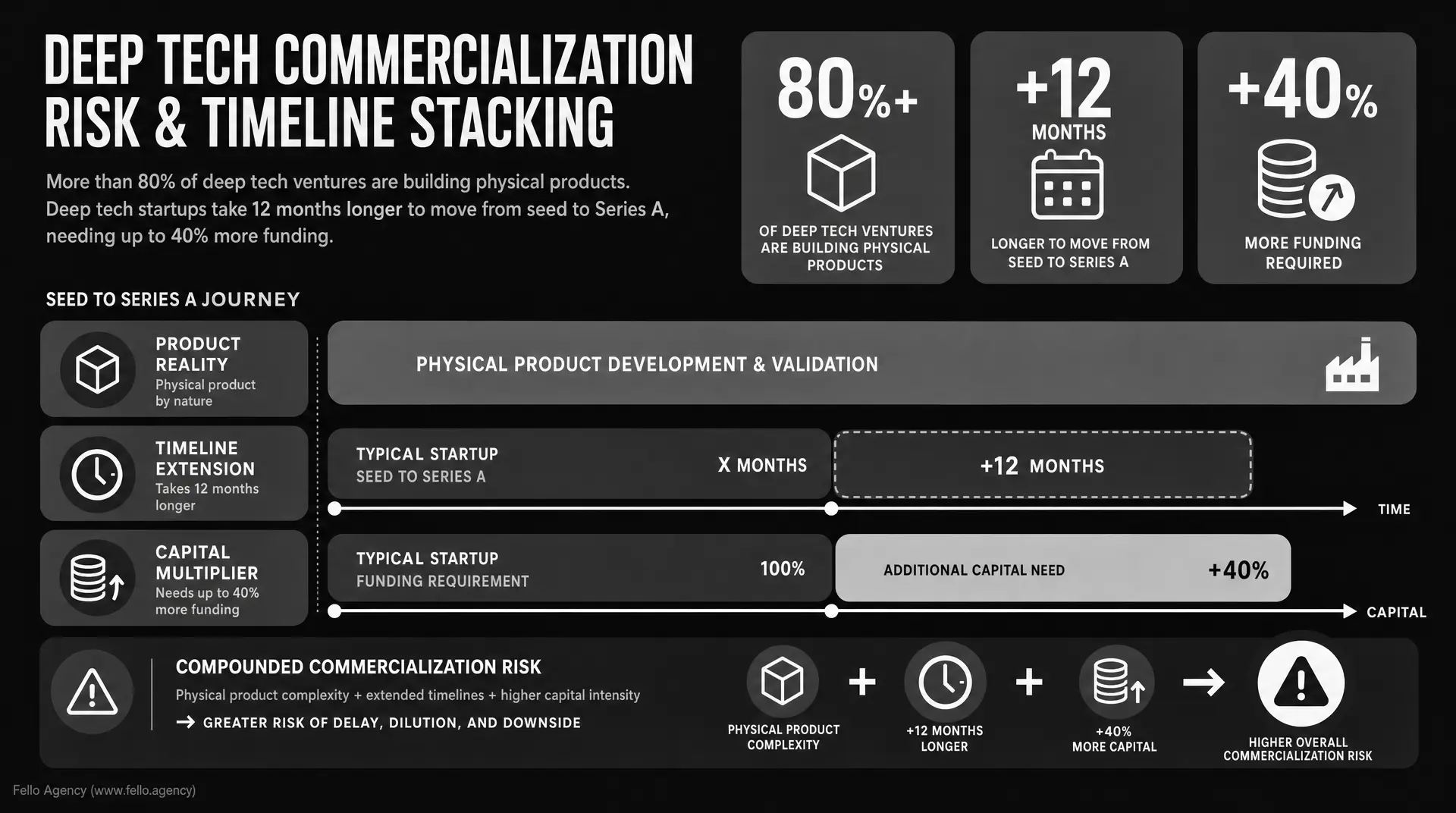
That pressure is not in your head. BCG points out that more than 80% of deep tech ventures are building physical products. That means engineering risk, commercialization risk, unit economics, and scale all stack on top of each other. McKinsey reports that deep tech startups often take 12 months longer than traditional startups to move from seed to Series A, and they can need up to 40% more funding before they reach revenue.
You do not get many wasted quarters in that kind of business.
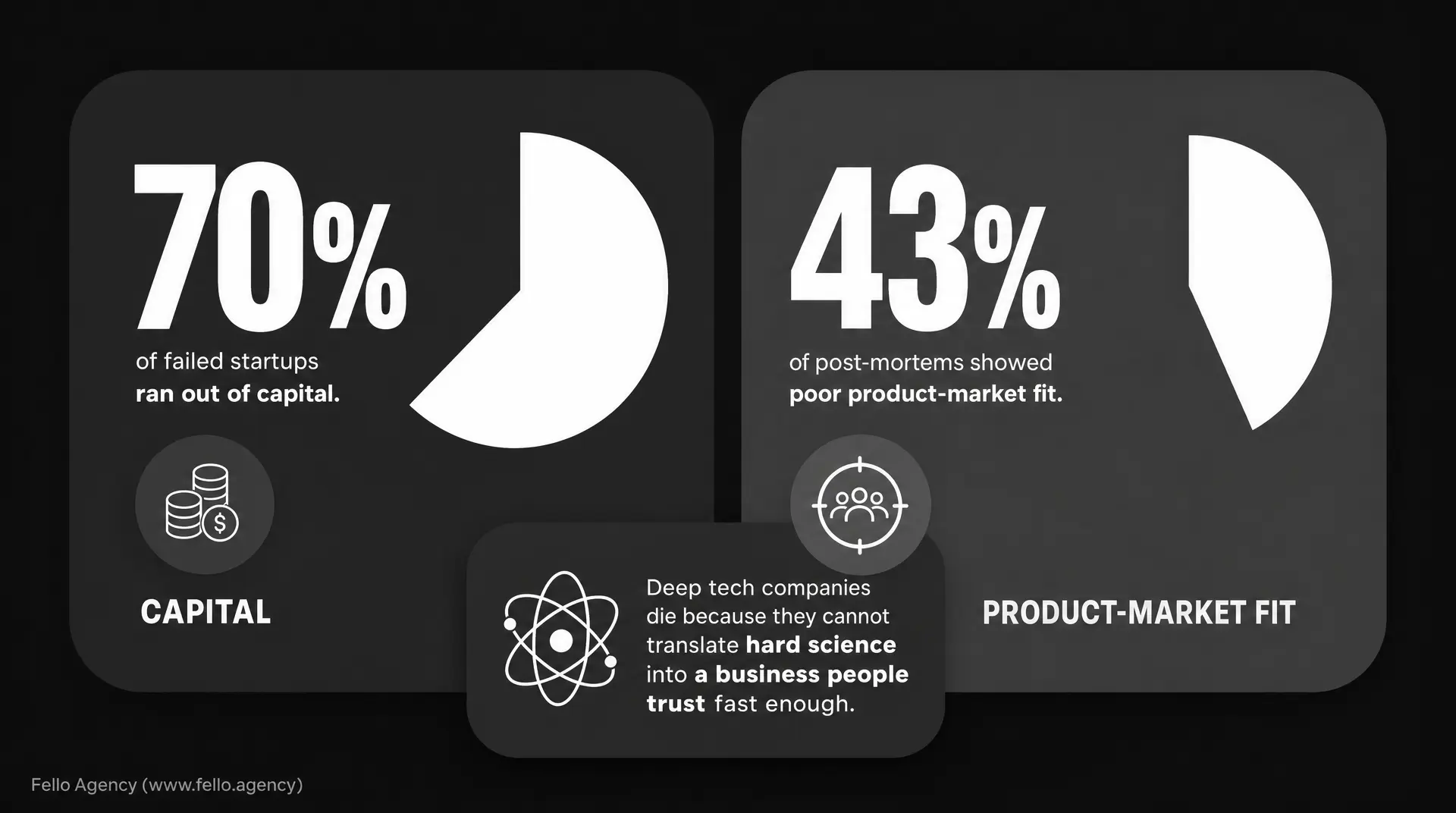
CB Insights says 70% of failed startups ran out of capital. It also found poor product-market fit showed up in 43% of post-mortems. A lot of deep tech companies do not die because the science was fake. They die because they could not translate hard science into a business people could understand and trust fast enough.
That is what this article is about.
Commercialization Is Bigger Than "Marketing"
A lot of founders hear "marketing" and think ads, social posts, or a nicer website. In deep tech, commercialization is much bigger than that. It is how you show up at trade shows. It is whether your deck can survive an enterprise meeting. It is whether your website can talk to a buyer, a technical evaluator, and an investor without confusing all three. It is whether your videos, landing pages, and sales materials all point in the same direction.
At Fello Agency, that is the work I care about most. We help companies turn complicated technology into a brand system, a message, and a go-to-market motion that can actually sell. Sometimes that means a rebrand. Sometimes it means a site rebuild. Sometimes it means case study videos, landing pages, decks, product visuals, or a whole communication strategy. Usually it is a whole slew of things.
Across all these categories, my clients share one basic challenge. They are trying to convince someone who has been doing something one way to change it. Maybe the new way saves money. Maybe it makes money. Maybe it lowers risk. Maybe it moves faster. Usually it touches all four.
That means your story has to do one very simple thing very well. It has to help the buyer justify change.
If your message cannot do that, you are making life harder for your own company.
Start with the Business Pain
Your Website Needs to Speak Business

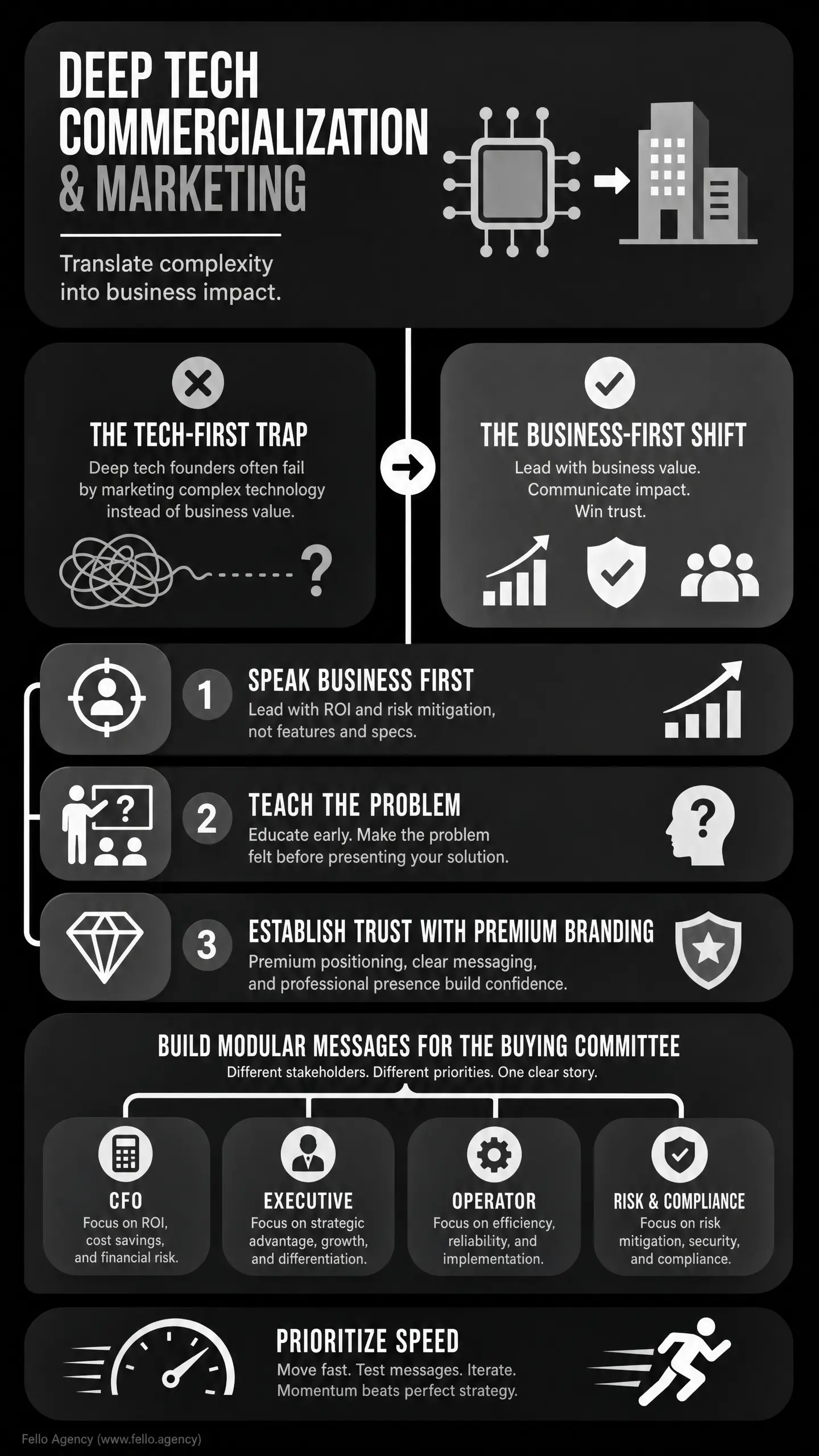
The biggest mistake technical founders make is leading with the technology itself.
I get why that happens. You built the thing. You know how hard it was. You know the architecture matters. You know the breakthrough is real. But your buyer is not making the decision in the order you built the product.
Your buyer is making the decision in the order risk gets removed.
That is why I keep saying the same sentence to founders: your website needs to speak business.
I do not want your homepage reading like a grant application. I do not want a hero section that explains the stack, the model, the process, or the hardware before it explains the value. I want the business case first. What gets faster? What gets cheaper? What gets safer? What gets easier to scale?
The market tells you this very clearly. Demand Gen found that anonymous research is usually the first step in the buying process. It also found that 72% of buyers want proof the solution solved a pain point on the vendor website. One stat matters even more to me: 67% said the winning vendor provided content that made ROI easier to show.
That is the whole game in enterprise. Your internal champion has to carry your story into the next room.
If your homepage is still trying to impress people with specs before it gives them a business reason to care, you are slowing yourself down. Pivot to an ROI narrative or you're gonna stay in the lab.
Teach the Problem Before the Product
I do not like the lazy advice to "dumb it down." Smart buyers hate that. Technical buyers hate it even more.
I want you to translate it. There is a huge difference.
The right move is usually to teach the bigger problem first. Show the bottleneck. Show the waste. Show the threat. Show the ugly old workflow that your buyer is still living with. Once they agree the problem is painful and expensive, they are ready to hear why your product matters.
That order works because it respects the buyer.
You are not hiding the complexity. You are staging it properly. You are giving someone a way into the story. You are helping them feel smarter as they move through it.
A lot of deep tech brands get stuck in an ugly middle ground. They are too technical for the executive buyer and too generic for the technical one. That is the uncanny valley of tech branding. The fix is not less substance. The fix is better sequencing.
Find Out What Pisses Off Your Clients the Most

When my team starts strategy, we do not begin with the founder's favorite slide. We start with the customer. Then we talk to sales. Then marketing. Then leadership. That order matters.
I always want the same answer.
What pisses off your clients the most?
Where are they losing time? Where are they wasting money? What old process makes them look bad internally? What are they doing manually that they should never have to do again? What part of their day feels broken, slow, risky, or embarrassing?
That is where your best messaging lives.
When I interview customers for case studies, I push hard on the "before" story. I want the frustrating times. I want the broken workflow. I want to hear where the pain showed up in real life. Without that, the story turns into a brochure.
And yes, emotion matters here. B2B buyers are still people. Google, CEB, and Motista found that buyers who see personal value in a business purchase are almost 50% more likely to buy and eight times more likely to pay a premium. In deep tech, that personal value often looks like relief. It looks like less career risk. It looks like finally solving a problem that has been pissing someone off for years.
This is why I say sell a lifestyle, even in technology.
I do not mean fake lifestyle marketing. I mean show the buyer who they become after your product is in place. Show the cleaner workflow. Show the faster operation. Show the confidence. Show the version of them that looks smarter, safer, and more effective because your technology exists.
That was a big part of our work with Mosaic Manufacturing. For their orthotics push, we built case study videos around the customer's point of view. We focused on the business owner, the workflow, and the operational benefit. We did not make the printer specs the hero. That helped them show product-market fit in a new market. Inbound leads jumped 25%, and booked meetings rose 15% within two months.
That is what happens when you stop making the market decode your product and start showing them why change is worth it.
Trust Gets You Into the Room
Branding Is Risk Mitigation
A lot of technical founders still treat branding like decoration. I never do. In deep tech, branding is a prerequisite for risk mitigation.
TrustRadius found that 78% of buyers shortlisted products they had heard of before research. So brand familiarity affects whether you even make the list.
After that, the visual layer starts doing serious work. People form stable judgments about web pages in as little as 50 milliseconds. Stanford found that design look was the top credibility factor when people judged a website.
That is why I define branding as authentication. You already believe in your product. Fine. The market still needs to see that belief validated professionally. If your visuals are weak, your fonts are all over the place, your deck looks stitched together, and your site feels like it is 2009 trying to sell really impressive materials, buyers start making ugly assumptions.
I have seen how direct the damage can be. I know of a client that lost a deal with Amazon because the visuals were poor. The engineering did not save them.
So when I tell founders to invest in the visual system, I am not talking about making things look trendy. I am talking about making the company look real enough to trust. Dress for the client that you need.
If you are trying to close high-six-figure or million-dollar contracts, your public materials need to look like they belong in that room. If it looks like bullshit, no one's gonna want to work with it.
Proof Beats Generic Content
Most deep tech companies do not need more content. They need better proof.
Content Marketing Institute found that videos were the most effective B2B content type, with case studies right behind them. That lines up exactly with what I see in deep tech. Buyers want proof assets. They want something they can forward internally. They want something that helps them build the case when you are not in the room.
That means you need real case studies. You need customer stories told from the customer's voice. You need testimonials that do more than flatter you. You need technical briefs that people can actually use. And if you are asking for serious money, you need visuals that match the seriousness of the ask.
One of the biggest red flags for me on a deep tech site is no real case study page. If the company says it does incredible work but has no proof section, people notice.
Use AI for research or ideation if you want. I do. It can be helpful. But if your public-facing brand turns into AI generated slop, you are teaching the market the wrong lesson. Your stuff starts looking like everyone else's stuff. Buyers make the natural leap. If the visuals are generic, maybe the service is generic too.
In hardware, this gets even more important. Your videos, renders, briefs, and decks are the demo for most of the pipeline. You are not shipping units to every prospect. You are not flying every buyer into the lab. Your assets do the heavy lifting.
If You're Early, Market Credibility

A lot of deep tech companies are still early when they need to start selling. Quantum is like that. Biotech is like that. Advanced hardware is like that. The product may be real, but the commercial proof is still catching up.
That does not mean you fill the gap with hype.
You market seriousness.
Show the inventors. Show the scientists. Show the founder. Show the lab. Show the process. Show the mission. Make the invisible visible.
That was the right move with Nord Quantique. They were pre-revenue, so we leaned into the credibility of the scientific team and the inventors behind the applied science. That gave the market something solid to trust. The result was strong. Website traffic climbed 80% in six weeks, social shares doubled, and five major industry publications covered the work.
This gets even sharper in biotech. BIO, QLS Advisors, and Informa found that the overall likelihood of FDA approval from Phase I is 7.9%, and the average path from Phase I to approval takes 10.5 years. That is a very long time to live on future value. In those markets, you really are marketing a pipeline, not a pill. Every campaign is also an investor relations exercise.
So be careful. Overselling and under delivering will crush trust fast.
I like a glass box strategy for early hard tech. Show the process. Show the build. Show enough of the real environment that buyers know the work is happening. Too much polish can look like vaporware. Real footage, real people, and real texture do a lot of heavy lifting.
The Founder Has to Become the Translator
This is where a lot of deep tech founders feel the identity shift.
You built the science. Now you have to help the market understand it.
That does not mean becoming fake, loud, or over-produced. It means becoming legible.
In a lot of deep tech categories, the brand is tied directly to founder credibility. Buyers look at the company and look at you. Hires do the same. I actually think your first customers are your hires. Great engineers, operators, and commercial people want to join a company that looks serious enough to win.
So show up.
Write the post. Record the short lab update. Put the named engineer on the webinar. Let people see the thought process. All companies are media companies now, whether they like it or not. And on platforms like LinkedIn, personal accounts usually carry more weight than company pages anyway.
Human selling still matters here. Older buyers are still making decisions. Long deal cycles still need trust and connection. AI can help you move faster. You still need a driver behind the car.
People can tell who cares. They can also tell when the mission is thin and the marketing is fucked. Connection matters with your team, your users, and your partners. If that connection is weak inside the company, it shows up outside the company too.
Build for the Committee
One Story for Everybody Slows the Deal Down
One of the fastest ways to stall deep tech growth is using one story for four different buyers.
I see this all the time. One deck for the user, the buyer, the integrator, the channel partner, the CFO, and the board. It never lands cleanly.
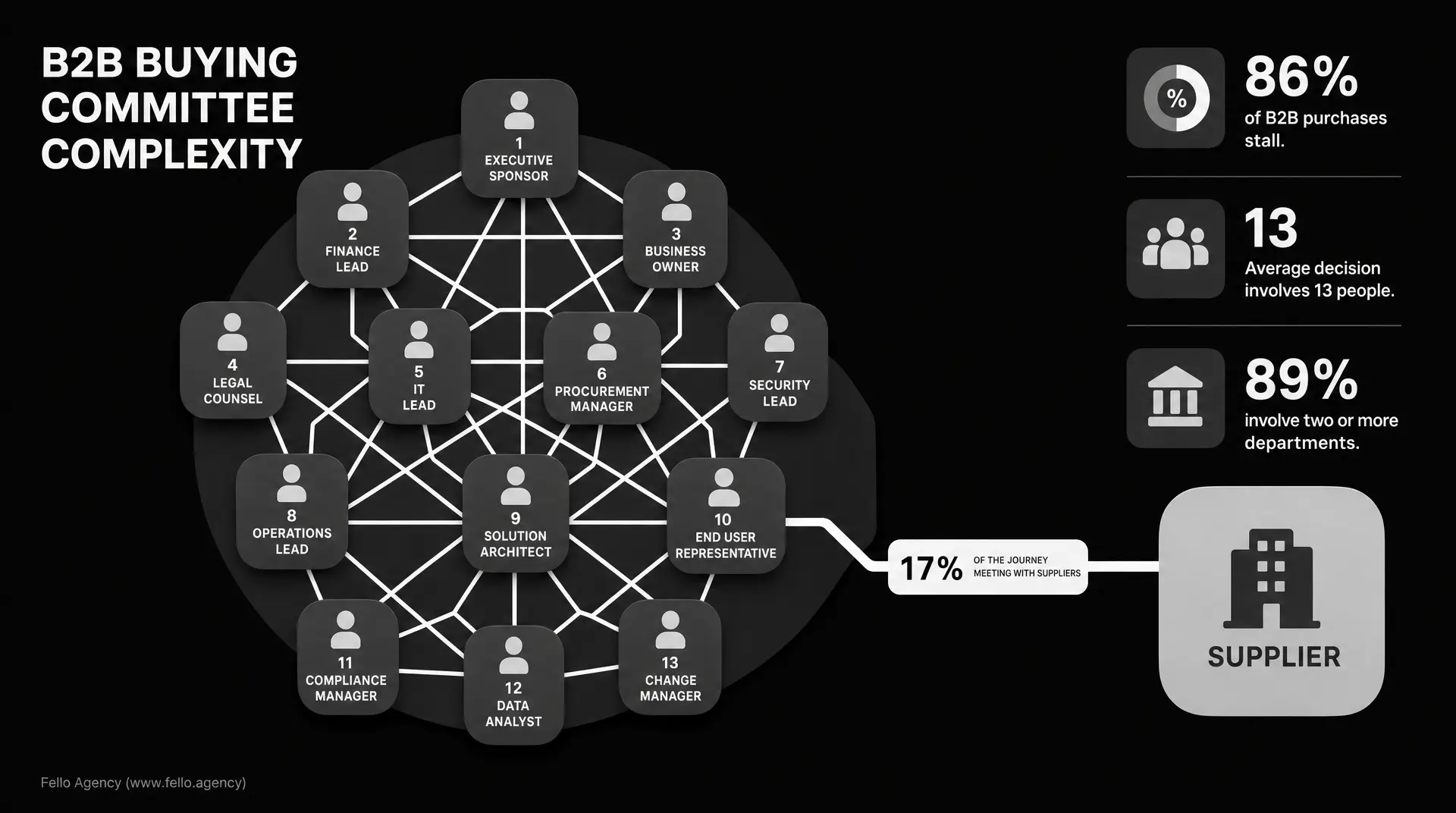
The buying reality is way messier than that. Forrester found that 86% of B2B purchases stall during the buying process, the average decision involves 13 people, and 89% involve two or more departments. Gartner says buyers spend only 17% of the purchase journey meeting with suppliers. That means your message has to survive without you in the room.
The operator wants to know how it works in real life. The executive sponsor wants the strategic upside. The CFO wants the financial return. The technical evaluator wants proof the thing is credible. Same company. Different fear.
So build paths.
If you sell into more than one market, make that clear immediately. Dual-use companies need this badly. The agriculture buyer and the defense buyer should not be trapped on the same scroll. If you serve two or three industries, build different landing pages for those ICPs and let them self-select.
I also separate landing pages from collector pages. Landing pages are there to drive action now. Collector pages are there to build loyalty, mission, and familiarity over time. Your team page, your about page, your partnership page, your behind-the-scenes content, all of that matters in deep tech because the cycle is long and skeptical.
Your Website Has to Carry the Sale
Buyers are doing a lot of private homework before they ever talk to you. Demand Gen found that web search is used by 66% of buyers early in the journey. McKinsey says buyers now use an average of 10 interaction channels. Your company website, live sales calls, and video meetings all matter. So does the handoff between them.
That is why I care so much about site structure.
I want a credibility-first hero at the top. Then I want case studies. Then high-quality product assets. Then testimonials, a clear CTA, and resources for the people who need more depth. I want the website to move a buyer from curiosity to trust to action without forcing them to dig through a maze.
And I want the thing to be editable.
I have seen companies get trapped by horrible backends. One client took three months to upload a single guest blog because a legacy developer had left them a mess. That task should take minutes. My benchmark is simple. If your team cannot launch a blog post in about three minutes once the content is ready, the system is broken.
If you don't have a proper CMS, there is no point of even having a website.
Video matters a lot. Good copy still matters too. Search still starts a lot of these journeys, and written content carries a huge amount of your authority. I also like technical downloads, brochures, and white papers in long sales cycles because they help buyers build the case internally. A strong white paper can help write their future RFPs.
And yes, LinkedIn matters. For me, it has always been more of a verification tool than a pure lead engine. People discover you somewhere, then check your legitimacy there and on your site. Passion will actually beat hardcore planning on that platform more often than founders think.
Move in Weeks, Not Months
I am deeply biased toward speed. Fello was built organically from the ground up, without venture capital, and that changes how I think. I have very little patience for bloated timelines, endless workshops, and strategy decks that sit around doing nothing.
Deep tech companies do not need more delay. They need movement.
I have seen founders stall themselves out for months by overthinking naming, messaging, positioning, and internal alignment. Meanwhile the market keeps moving, capital keeps burning, and the company still has not shipped a clear story.
This is why I hate the 90-day audit trap. Ninety days of diagnosis is eternity in tech. If someone needs three months before they can tell you what is broken, they do not have the playbook for your space still.
Go to market earlier than feels comfortable. Get the first real user. If you have to pay for the first use case, do it. There is huge value in the first case study, the first testimonial, the first clean story you can put in front of a serious buyer.
And track the right things. Results should not be measured by website traffic alone. I care about sales velocity. Are replies coming back faster? Are first meetings getting easier? Are your technical briefs getting downloaded? Is the sales team spending less time defending legitimacy and more time discussing the actual deal?
For long cycles, keep feeding the market. I like monthly video updates more than stale nurture emails. A short lab tour, a team update, or a product progress clip can keep people warm and show that the company is still moving.
You don't wanna be moving slow in tech. You're gonna get killed.
What I Would Do First

If I were in your seat, I would start with the homepage. I would rewrite the hero until a non-technical executive could repeat it cleanly after one read. Then I would make a magic list of every asset that still sounds like a lab. The deck, the website copy, the one-pager, the trade show booth, the founder bio, the product page. If it reads like a research problem, I would rewrite it or kill it.
Then I would build one serious proof asset that matches your stage. If you already have a pilot, I would turn it into a customer-led case study and make the "before" state painfully clear. If you are still pre-revenue, I would build credibility around the inventors, the team, the lab, and the real process. I would make sure the market can see the work behind the claim.
After that, I would split the site by buyer type and by market if needed. Give the executive one path, the technical evaluator another, and the operator another. Then I would put the founder and the engineers into the content machine, fix the CMS, and start shipping in weeks.
That is how you stop looking like a science project.
Final Thought
Marketing technology nobody understands still is a translation job. It is also a trust job.
Your buyer does not need the full dissertation on day one. They need enough clarity to care, enough proof to trust you, and enough confidence to carry your story into the next room.
Do that well and a lot of things get easier. Sales gets easier. Hiring gets easier. Fundraising gets easier. The company starts looking like a real commercial business instead of a cool lab with a logo.
Strong B2B branding is the last moat standing. It helps you skip a level in the sales cycle. It gives better technology a fair shot at winning.
So take this stuff seriously. Create a business, not a research problem. If you do that, you can win very heavily.
Frequently Asked Questions
How can deep tech marketing test product-market fit before we burn through our runway?
You must sell the problem before the product is finished. CB Insights found 43% of failed startups die from poor product-market fit. Build high-fidelity landing pages testing specific ROI propositions early. If enterprise buyers do not engage, your commercial thesis is wrong. You must pivot immediately.
How should our commercial strategy adapt to the extended timelines of deep tech R&D?
You must market your milestones, not just the final product. McKinsey notes deep tech startups take 12 months longer to reach Series A. Treat every technical validation and patent as a commercial asset. This keeps skeptical enterprise buyers and your investors warm while you burn cash building the actual solution.
How do we market a hardware solution when unit economics and scalability are still unproven?
You have to market a phased de-risking plan. BCG notes 80% of deep tech ventures build physical products, stacking massive scale risks. Do not pretend you can manufacture a million units today. Market your pilot success, showcase supply chain strategy, and sell future efficiency while proving the prototype works.
Should we hide pricing on our website if our deep tech deployments are highly customized?
Absolutely not. Hiding it creates immediate friction. Demand Gen Report found 86% of buyers look for pricing immediately. Even if deployments are highly bespoke, provide a baseline starting price. Obscuring costs makes you look like a naive lab project that does not understand business realities still.
What is the most effective commercial trigger to officially transition out of stealth mode?
Exiting stealth must be a strategic commercial event, not a vanity PR exercise. The right trigger is securing your first viable proof-of-concept. You do not leave stealth just to announce another funding round. You launch with a verified customer story proving your science solves an expensive enterprise pain point.
Your Creative Partner for Innovation That Matters
From advanced tech to transformative healthcare, Fello helps visionary teams shape perception, launch products, and lead industries.


Let’s keep in touch.
Discover more about high-performance web design. Follow us on Linkedin and Instagram.

