

Photo by Antonio Garcia on Unsplash
Most climate tech brands are still leading with virtue when they should be leading with readiness.
If you're trying to close a Power Purchase Agreement, win over a utility buyer, or calm down a finance team, soft ESG language is a weak first move. It sounds nice. It does not lower risk. It does not prove bankability. It does not help your buyer defend the decision internally.
At Fello Agency, I spend my time helping deep tech companies commercialize hard things. Quantum. Advanced manufacturing. MedTech. XR. Defense. Climate tech. We built Fello from the ground up with no VC money, so I have very little patience for branding that looks good and does nothing.
Your website needs to speak business. Your decks need to speak business. Your videos need to speak business. Then, once the buyer trusts you, you can layer in the technical proof.
You are mission control

I love mission-led companies. That's a huge part of why I do this. I want to be around companies building things that matter. But mission without commercial clarity gets ignored fast.
G2 found that the finance team holds the final call in 79% of planned enterprise purchases. The same report says 57% of global B2B buyers expect ROI within three months. So if your climate brand opens with vague lines about changing the world, you are skipping the real question in the room.
How do you save money? How do you make money? How do you reduce risk?
That's why I keep saying the save the planet narrative is dead.
I believe it's dead because it frames you like an outsider trying to fix a garden. In 2026, the stronger position is this: Earth is a closed-loop industrial system that is underoptimized. Your company is there to calibrate it. Your voice should sound like an architect, a systems manager, or a logistics giant.
This matters even more now because renewables are in a tougher commercial phase. Solar, storage, wind, green hydrogen, power software, all of it is being pushed into more mature buying environments. Margins are tighter. Buyers are more skeptical. Policy can open a door, sure. Policy does not close the contract for you.
Your brand still has to make the deal feel safe.
If your message is built around control, readiness, and economic logic, you sound bankable. If your message leans too hard on moral positioning, you sound soft in a room that is measuring downside.
Bankability has a visual language
A lot of marketers still underestimate how fast buyers judge visuals. It happens before they read your headline. Typography, page structure, photography, deck quality, motion, spacing, charts, all of it lands immediately.
And yes, it affects revenue.
I've seen companies lose real opportunities because the visuals weren't there. One client lost a deal with Amazon because their brand looked weak. I had a logistics client nearly blocked from a meeting with a major Canadian enterprise because their presentation deck was not cutting it. Climate buyers are every bit as unforgiving. The contracts are bigger, the diligence is longer, and the stakes are public.
We dealt with the same kind of trust gap on Revanesse for Prollenium Medical Technologies. Different industry. Same issue. The product quality was there. The engineering was there. But the visual system needed to catch up to the seriousness of the company. We shifted the brand toward a more science-driven identity with custom CGI, macro photography, and stronger global guidelines. The point was trust.
Climate companies need that same discipline.
Brand consistency is not some fluffy brand textbook idea. Companies with consistent branding across channels can see up to a 33% increase in revenue. At the same time, 81% of companies report off-brand content. In climate tech, that usually means one message for investors, another for policy, another for sales, and none of them feel like the same company.
I can usually spot the problem in 10 seconds. Wrong fonts. Random chart styles. A homepage that feels different from the deck. A trade show booth that feels different from the PDF. That's how a serious company starts looking like a science project.
And be careful with AI-generated slop. We use AI as an accelerator for research. Fine. But if the final face of your brand is generic AI imagery, buyers feel it immediately. Your stuff starts to look like everyone else's, and then they start asking themselves a brutal question: if your marketing is generic, are your services generic too? If you have a CMO, you never should be using AI generation as the final layer of the brand.
Dress for the client that you need. If you want enterprise energy buyers, utilities, infrastructure partners, and government stakeholders to trust you, your brand has to look like infrastructure.
Hard tech brutalism beats ESG wallpaper
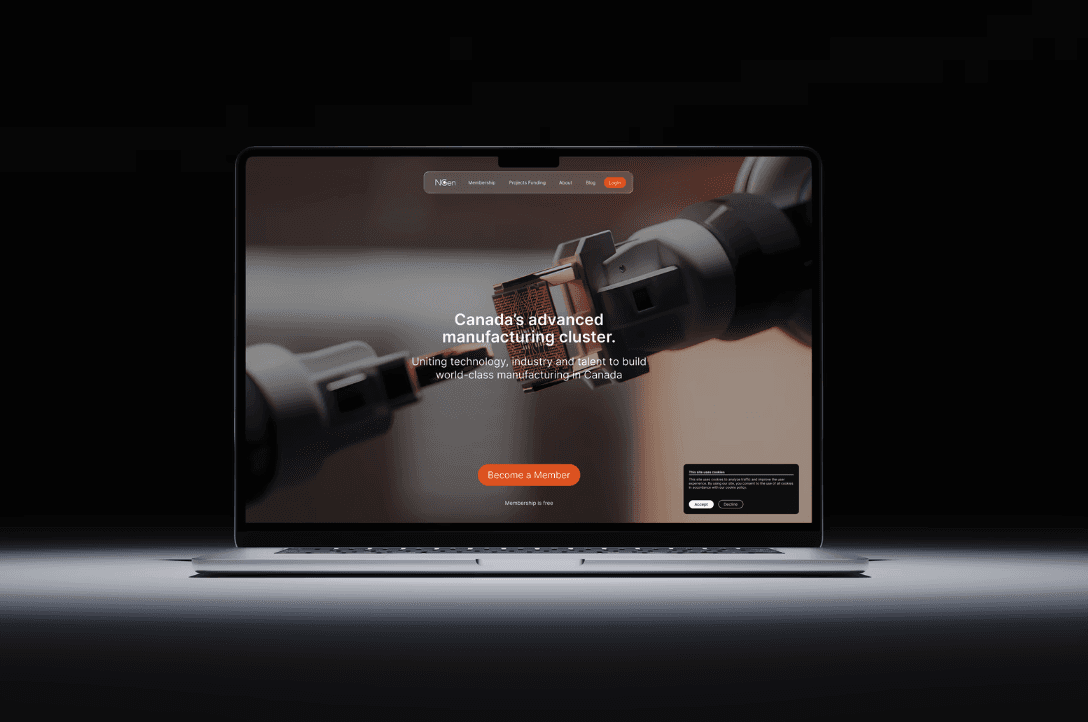
This is where hard tech brutalism comes in.
I like high-contrast typography. Blueprint aesthetics. Raw materials. Thin call-out lines. Data-rich captions. Visuals with physical weight. If your technology exists in the real world, your branding should look like it exists in the real world too.
Show the steel. Show the concrete. Show the weld. Show the lithium cell. Show the texture of low-carbon materials. Show the physical reality of the work.
Investors and buyers are tired of vague carbon offsets and soft stock photos of leaves. They want proof that your system is actually doing what you claim. That means abandoning decorative fluff.
There is also a balance here. Cheap content makes you look cheap. But insanely polished content can make you look fake.
I've watched that happen around a well-known Canadian space company. The market kept seeing renders and cinematic videos of incredibly hard achievements before a rocket had even launched. People in the community got cautious. Talk is cheap. The best operators in technical industries understand exactly how cheap talk is.
Climate buyers react the same way. If your battery company looks like a movie trailer, but the buyer cannot find field proof, operating footage, or clean evidence, they start filling in the blanks themselves. That story usually ends with the word vaporware.
Use the glass box strategy

That's why I push the glass box strategy so hard.
If you hide your process, the market will assume you're hiding a flaw.
Show the test environment. Show the line. Show the plant. Show the team. Show what failed and what changed. Let people see the work. Let them see that you are actually in the dirt doing the work.
I say this all the time: you aren't selling a solution, you're documenting the quest to find it.
That approach matters in climate tech because the category is hit from all sides. Policy risk. Public misinformation. Local opposition. Skeptical finance teams. Every claim gets challenged. A transparent brand gives your team something solid to point to when the pressure starts.
We use this logic in other hard-tech sectors too. For Nord Quantique, an early-stage quantum company, we did not pretend the finished product was already changing the world. We focused on the credibility of the scientists and inventors behind it. For a confidential Canadian drone company, we created high-fidelity renders that helped secure funding before a physical prototype was ready. But those visuals worked because they were grounded in real technical people and real technical effort.
Too much polish will look like vaporware. The work that goes behind the art matters.
Your website is your first carbon demo
I've always believed in radical functionalism for climate brands. Every pixel must justify its energy cost.
The digital sector now accounts for roughly 4% of global CO₂ emissions. So yes, your website is part of your climate story. Your website is really your first carbon demo.
That's why I like low-impact digital architecture. Dithered images. Smarter compression. Dark mode where it makes sense. Fewer bloated interactions. Faster load times. Cleaner layouts. The site should feel modern, but it should also feel efficient. You are showing the market how you think.
With a lean interface, the hero of the site can become raw, unified information. Live data. Clear economics. Real deployment proof. That is a much stronger opening than a stock image and a line about building a better tomorrow.
People notice digital waste too. 80% of consumers say they would be more loyal to a brand that reduces its digital carbon footprint. Even in B2B, that matters. It shapes reputation. It shapes public trust. It shapes how your company gets talked about by talent, communities, and partners.
And the site has to be usable by your team. I say this constantly: if you don't have a proper CMS, there is no point of even having a website. My benchmark is simple. Once the content is ready, your team should be able to publish it in about three minutes. Policy moves fast. Project news breaks fast. Partnership announcements happen fast. If your marketing team needs a developer bottleneck every time they want to update a page, you are moving too slow.
Lead with business language, then prove it
Deep tech founders love technical talk. I get it. The engineering is impressive. But a homepage full of specs makes you sound academic.
That is the moment a renewable company starts looking like a lab experiment instead of a bankable enterprise.
Your homepage and landing pages need to lead with ROI, proof, and case studies. Then you layer in the technical detail for the people who need it. Pivot to an ROI narrative or you're gonna stay in the lab.
This is one of the biggest mistakes I see in climate marketing. Teams lead with chemistry, architecture, mission, or process before they explain the business impact. The buyer is left doing the math alone. That's a terrible way to start a deal.
I saw the opposite playbook work with Mosaic Manufacturing. We also created case study content around the customer experience, not just the machine. That's the key. The strongest case studies are not you bragging about yourself. They are your customer talking about the frustrating times before your product and what changed after.
Climate tech needs more of that.
Sell a lifestyle, even in technology. I do not mean a consumer-style ad campaign. I mean show what life looks like when your system is in place. Show easier management. Show better visibility. Show cleaner reporting. Show faster decisions. Show more control. Make the buyer the hero.
That is the real story. Not how smart the device is, but how much smarter you're going to be.
White papers still matter. Good copy still matters. SEO still matters. But your white paper should be helping write their future RFPs. It should not just sit there like homework. And if you are asking for high-six-figure commitments, written testimonials alone are weak. Professional video helps authenticate the claim. Good copy carries the message the rest of the way. You need both.
One strong case study should do a lot of work. It should become a video, a PDF, blog content, short clips, sales slides, and landing page proof. That is how you get bang for your buck in long-cycle B2B marketing.
Build for the whole buying committee
A renewable energy sale is never one audience. Finance wants economic logic. Technical teams want proof. Operations wants confidence. Procurement wants stability. Policy people want a narrative that holds up in public.
One generic homepage cannot carry all of that.
That's why I push segmented journeys. We did this for Sphere Tech, where distinct industry pages spoke directly to buyers in factories, medical tech, and defense. That work helped drive a 3x increase in lead generation. Same platform. Same company. Different stories for different buyers.
Climate brands should do the same. If you sell to utilities, corporate offtakers, and government buyers, your site should let those people find their path fast. Give the CFO the economics. Give the technical evaluator the system details. Give the public-sector buyer the resilience story. Let each person feel like the company understands what they care about.
Proof also needs to sit high on the site. A missing case study or testimonial page is one of the biggest red flags in B2B. G2 found that 31% of B2B buyers now use public review sites as their primary information source. Buyers also prefer independent review sites over traditional analyst reports across the entire journey. Climate buyers may not always be checking software review sites, but the behavior is the same. Third-party proof beats self-congratulation every time.
And they care about the people behind the project. 69% of enterprise buyers factor the service provider or implementer into vendor selection. That's why team pages, founder visibility, lab tours, and ongoing updates matter during long sales cycles. Human selling still matters. You still need a driver behind the car.
Do not ignore LinkedIn either. LinkedIn for me has always been a verification tool more than a pure lead channel. Buyers find you somewhere else, then they check the people behind the brand. Let your executives post with actual passion. Push that traffic back to the website, where the deeper proof lives. All companies are media companies now, especially in long-cycle climate sales.
Speed is part of the brand
The last point is speed.
I think a lot of climate and deep tech companies want to move in months when they should be moving in weeks. Endless workshops. Naming loops. Too many opinions. Strategy sessions stacked on strategy sessions. I've seen companies stall themselves out doing this.
You don't wanna be moving slow in tech. You're gonna get killed.
At Fello, we keep things prescriptive because commercialization needs momentum. We talk to customers first, then sales, then marketing, then leadership. We benchmark competitors. We get clear on the communication strategy. Then we move. We built the agency lean on purpose because bloated process kills speed.
And if budgets get tight, cut deliverables before you cut quality. I don't think it's a matter of skimping out on quality. I think it's a matter of skimping out on deliverables. Climate buyers can smell cheapness. They can also smell fake polish. Your job is to land in the middle. Cinematic but clearly real. Strong enough to build trust. Honest enough to feel grounded.
This is why I look at branding as risk mitigation, not decoration. In climate tech, the brand is helping the whole company close a trust gap faster. It helps sales skip a level. It helps finance feel safer. It helps procurement feel less exposed. It helps the market understand that you are ready.
Sell readiness
Here's the chain I want you to remember.
Act like mission control. Use hard tech brutalism to show the physical truth of the work. Build a low-impact digital home that proves you believe in efficiency. Lead with business language. Put proof high on the page. Give each buyer a clear path. Keep the company human and visible during the long middle of the deal.
That is climate tech branding that wins.
Generic ESG fluff will not carry a PPA. It will not calm a CFO. It will not help a procurement team feel safe. If you can visually and verbally show the contract that you're trying to land, you give your sales team a real shot.
Take this stuff seriously because your competitors will. And they will win the deal if you don't.
Frequently Asked Questions
How do we adapt our brand messaging for CFOs who only care about margins, not emissions?
The finance team holds the final call in 79% of enterprise purchases. Stop pitching them ESG virtues. Pitch risk mitigation and yield. Frame your technology as a commercial optimization tool. Show exactly how you lower the levelized cost of energy and prove ROI fast. That is the only language they respect.
How can marketing sustain trust during a multi-year PPA sales cycle?
Focus heavily on the people deploying the project. Research shows 69% of enterprise buyers factor the implementer into their selection. During long diligence phases, continuously publish operational updates and engineering milestones. Let buyers see your team in the dirt, actively derisking the asset.
How do we prevent regional sales teams from diluting our brand with off-brand pitch decks?
Build a rigid, centralized asset library. Currently, 81% of companies struggle with off-brand content. That destroys credibility. Enforce strict visual guidelines because consistent branding can drive a 33% revenue increase. If a regional deck looks like a cheap science project, you lose the deal.
How should our communications tackle local community opposition to utility-scale projects?
Use the glass box strategy. Do not hide behind corporate speak or highly polished PR. Show the physical reality of your mitigation efforts. Document the actual community impact and environmental diligence raw and unedited. Transparency is your absolute strongest armor against misinformation and local policy friction.
Why does the carbon footprint of our corporate website actually matter to B2B energy buyers?
B2B buyers are still people. Data shows 80% of consumers are more loyal to brands actively reducing their digital carbon footprint. The internet generates 4% of global emissions. If you claim to fix the climate but run a bloated, high-emission website, buyers instantly smell the hypocrisy.
Your Creative Partner for Innovation That Matters
From advanced tech to transformative healthcare, Fello helps visionary teams shape perception, launch products, and lead industries.


Let’s keep in touch.
Discover more about high-performance web design. Follow us on Linkedin and Instagram.