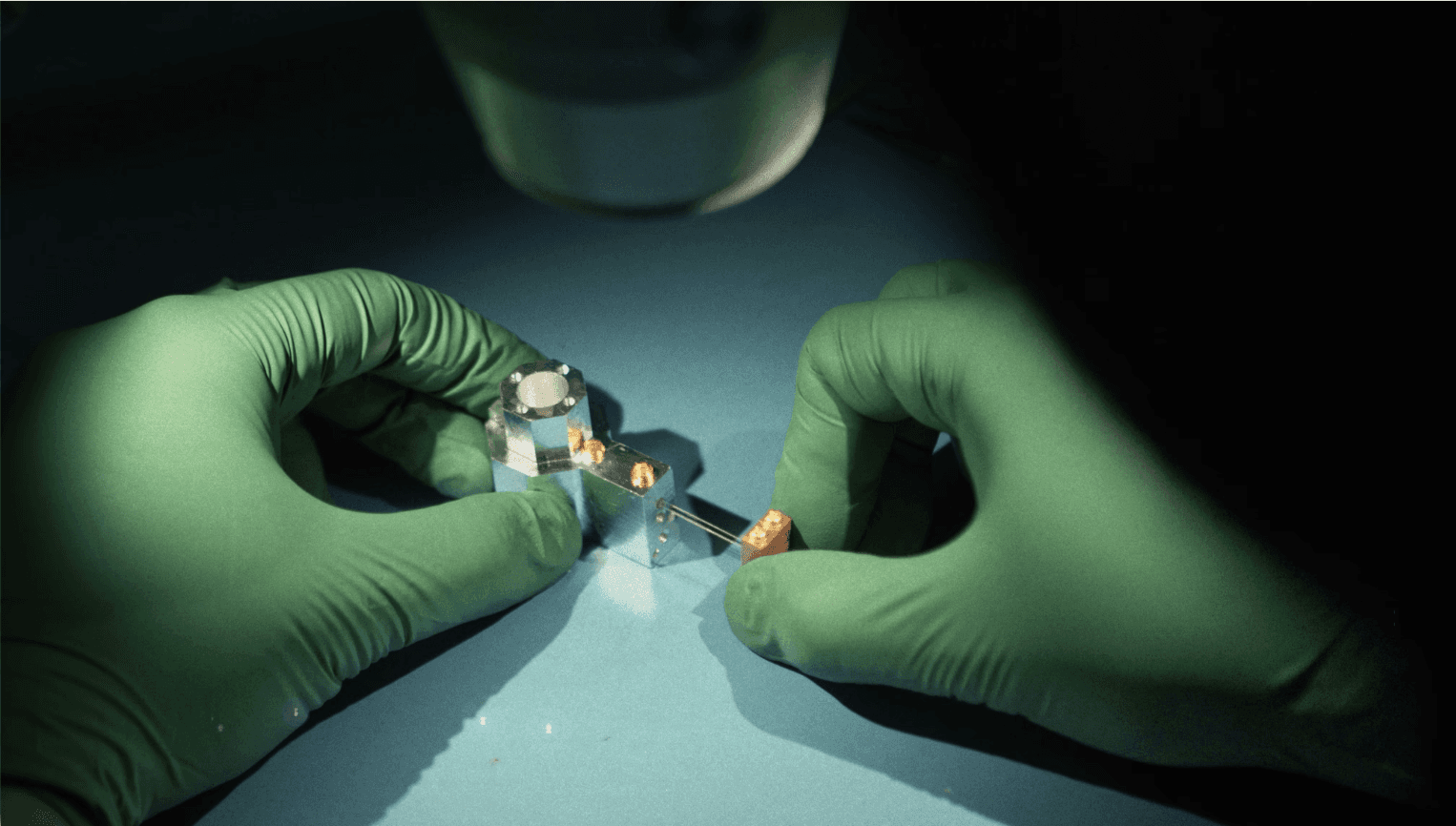


Hardware is hard. Everybody says it because it’s true.
But in 2026, the bigger issue is not the engineering. It’s the go-to-market model. Too many hardware startups still try to sell like SaaS companies. They borrow SaaS messaging. They borrow SaaS metrics. They borrow SaaS patience. Then they wonder why the deal stalls.
I spend my time around quantum computers, industrial 3D printers, medtech devices, XR systems, robotics, and defense tech. At Fello Agency, we help those companies commercialize. Different sectors. Same pressure. They need to convince people who already do things one way to change. Usually to save money. Sometimes to make more money. Always to reduce risk.
If you’re the CMO or VP carrying a revenue number, this is your fight. This is how marketing stops looking like support and starts acting like revenue infrastructure.
Hardware Gets One Clean Shot
SaaS can launch ugly and iterate. Hardware usually gets one shot at a first impression. I mean that literally.
There is no silent hot fix for a product sitting on a shelf. If the industrial design feels cheap, the packaging feels flimsy, the documentation is weak, or the website looks like 2009 trying to sell really impressive materials, buyers remember. Channel partners remember too.
We saw that during the Rabbit V1 hype cycle. Attention came fast. So did returns, bad reviews, and channel hesitation. Once a physical product feels half-baked, the market does not give you much grace.
That changes how you launch. The website matters more. The sales deck matters more. The unboxing matters more. The demo unit matters more. Your trade show presence matters more. All of it has to look commercial on day one.
Industrial buyers expect that level of seriousness now. Deloitte found that 86% of industrial executives want improved digital customer interfaces from suppliers. They are judging the digital experience right alongside the hardware.
Your Website Needs to Speak Business

The biggest mistake technical founders make is simple. Too much feature. Not enough benefit.
When I sit with a hardware company, I don’t start with the spec sheet. I start with the pain. Find out what pisses off your clients the most. Downtime. Scrap. Unsafe workflows. Slow installs. Training burden. Integration headaches. Missed output. Start there.
I still want to sell a lifestyle, even in technology. I want the buyer to see what their day looks like after the product is in place. I want them to feel not how smart the device is, but how much smarter they’re going to be with it.
If you sell into factories, lead with the business problem. Siemens estimates large industrial companies lose 11% of revenue to unplanned downtime. That is where the conversation starts. Now the buyer cares.
The same thing shows up in buying research. TrustRadius found that 47% of enterprise buyers wished it were easier to calculate ROI during the buying process. So help them do the math. Put ROI, before-and-after numbers, and case studies right up front.
That’s why I push homepages and landing pages to lead with value. Lead with proof. Lead with what changes for the buyer. Technical detail still matters. It just comes after the buyer understands why the conversation matters.
There’s another trust problem here. Gartner found that 69% of buyers report inconsistencies between a supplier’s website and its sales reps. If marketing sounds like a research lab and sales sounds like a pitch machine, trust drops fast. Your CRO, your reps, and your site need to tell the same story.
Build More Than One Story
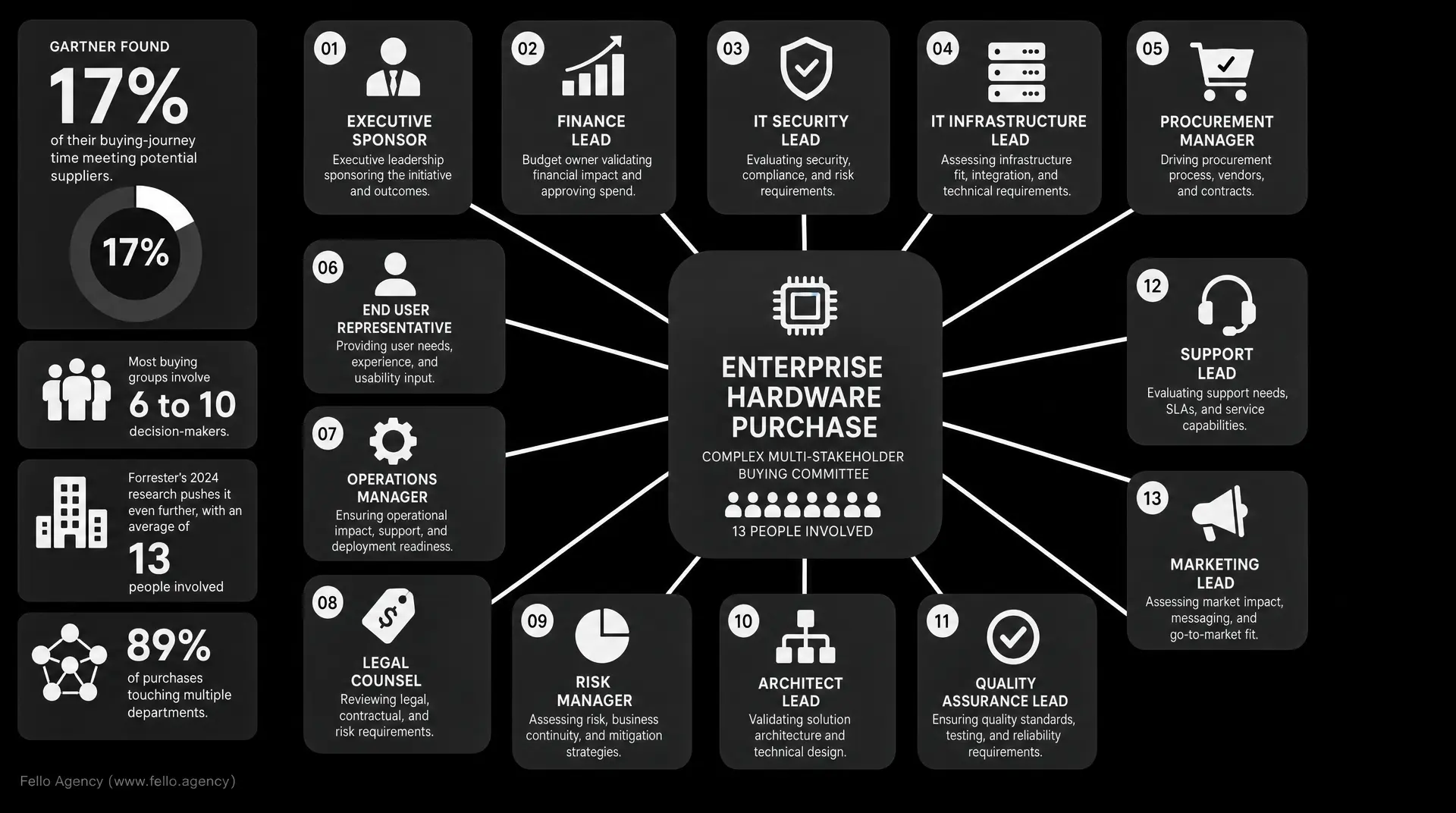
Hardware almost never sells to one person. You are usually selling to several people at once.
One person wants proof the product works. Another wants vendor reliability. Another needs to know it will integrate into existing systems. Another is deciding whether your product deserves channel space or internal support. Same product. Different fears.
This is where a lot of startups stall. They build one master deck and try to force it across every conversation. The result is generic outreach, weak follow-up, and confusion in the room.
Gartner found buyers spend only 17% of their buying-journey time meeting potential suppliers. The same research says most buying groups involve 6 to 10 decision-makers. Forrester’s 2024 research pushes it even further, with an average of 13 people involved and 89% of purchases touching multiple departments.
You do not have time to make each person translate your story for themselves.
That’s why I build separate paths. For Sphere, we created industry pages for factory, medical, and defense buyers. Same company. Different proof. Different language. Different business case. That work helped drive 3x lead growth because the site stopped speaking in generalities and started speaking directly to actual ICPs.
Gartner also found that 73% of buyers actively avoid suppliers that send irrelevant outreach. A one-size-fits-all deck creates that exact problem.
I also separate landing pages from collector pages. Landing pages are for deals. Collector pages build loyalty and belief over time. Your mission page, your partnership page, your about page, your team page. Those pieces help buyers verify that your company is real. And yes, do the same work internally. If the board, founder, sales team, and marketing team are not aligned on the same narrative, the market will feel that confusion.
In Hardware, Your Marketing Is the Demo
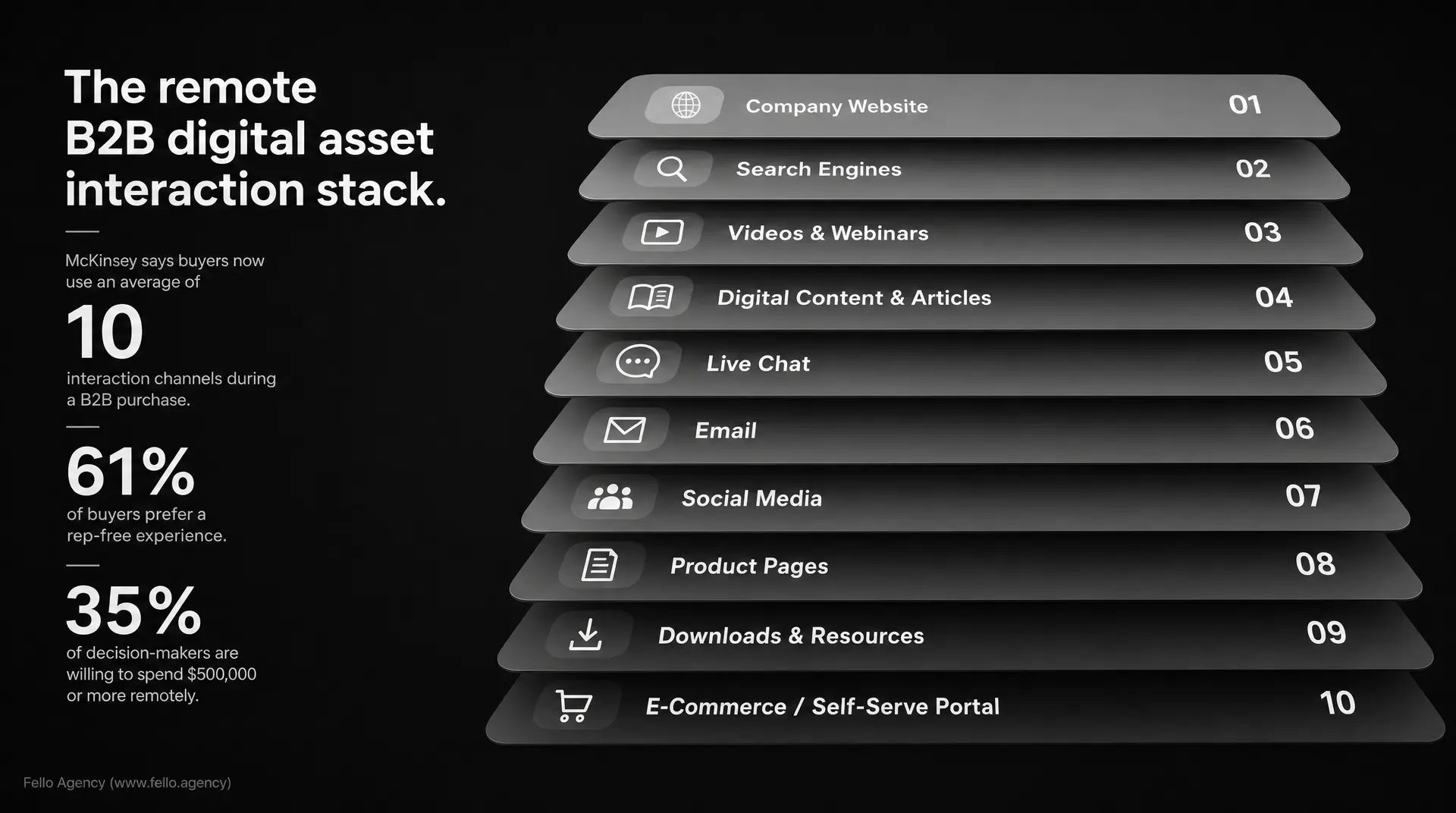
A lot of B2B buyers want room to learn before sales steps in. Gartner found that 61% of buyers prefer an overall rep-free buying experience. Read that carefully. Buyers want to educate themselves without getting chased by irrelevant outreach.
Hardware makes this harder because the product usually cannot be sampled in five minutes. In SaaS, the product is usually the demo. In hardware, the demo is a whole logistics operation. You may need to ship a unit, build a simulation environment, schedule a site visit, or involve engineers just to show the thing properly. Some products cannot even be demonstrated outside a controlled setting.
That means your asset stack has to do demo-level work. Your website. Your product visuals. Your case studies. Your technical briefs. Your videos. They are carrying the story long before a live demo happens.
TrustRadius found demos were the most influential resource for 71% of buyers who used them. For hardware, that influence starts before the physical product ever gets into the room.
McKinsey says buyers now use an average of 10 interaction channels during a B2B purchase. The website, in-person sales, and video calls sit right at the top. In separate McKinsey research, 35% of decision-makers were willing to spend $500,000 or more remotely. Later in the process, 59% said they would buy only from a supplier they had met in person at least once.
That’s the 2026 model right there. Give buyers serious self-serve proof early. Bring human selling in when the stakes rise. You still need a driver behind the car.
I also optimize for desktop first in deep tech. My own data keeps showing roughly an 80/20 desktop split. Big buying decisions are computer buys. People sit down, read, compare, forward links, and build the internal case. Mobile matters. Desktop closes enterprise deals.
And if you don’t have a proper CMS, there is no point of even having a website. I personally manage the Fello blog because I want to know the tools we recommend actually work. If your team cannot publish a new post within three minutes once the content is ready, the system is broken. Every website project we do includes training for the client’s marketing team for that reason. Autonomy is part of go-to-market.
Show Reality and Kill Vaporware
2026 is going to punish fake polish. Technical buyers know when a render is trying too hard. Too much polish will look like vaporware.
I like the glass box strategy. Show what is true. Show the lab. Show the field test. Show the failed run. Show the team working through the ugly part. Found-footage-style material can work really well because it shows you are actually in the dirt doing the work.
Visually, I think the market is rewarding hard tech brutalism and radical functionalism. Cleaner systems. Sharper type. Less fake futurism. More physical reality.
High-fidelity visuals still matter. They just need a job. They need to make the engineering legible. They cannot be there to hide the fact that the product is early. If it looks like bullshit, no one’s gonna want to work with it.
In hard tech, competence is the product. I have seen a 15-second shot of a machine holding tolerance build more confidence than a long explainer video. I’ve also recorded the real sound of quantum fridges for client content because that sensory detail creates trust. Stock music doesn’t.
I’ve seen the trust gap hit revenue in a very direct way. One client lost a deal with Amazon because the brand visuals were poor. Another client in logistics got warned that their presentation deck was not cutting it before a major enterprise meeting. Visual quality is not decoration. It authenticates the claim.
And once you land a real customer, get obsessed with proof. With Mosaic Manufacturing, we built case study videos for the orthotics market from the customer’s point of view, not from the printer spec sheet. We focused on the business owner, the workflow, and the operational upside. That helped prove product-market fit in a new segment. Inbound leads jumped 25%, and booked meetings rose 15% within two months.
This is why I see a missing case study page as a red flag. TrustRadius found that 86% of enterprise buyers shortlist products they had already heard of before they start serious research. The same report shows 71% of enterprise buyers seek peer conversations during the buying process. They want proof they can forward internally.
Useful thought leadership helps here too. The 2025 Edelman-LinkedIn report found that 71% of hidden decision-makers say thought leadership is more effective than standard marketing materials for showing a vendor’s value. For hardware, that means technical writing, lab updates, and white papers that help buyers write future RFPs. Put engineers in that content. Let them teach.
Measure Momentum on a Hardware Clock
One of the fastest ways to break a hardware go-to-market motion is to measure it with SaaS logic. Monthly MQL panic creates bad decisions.
A lot of hardware teams live in 16- to 18-month sales cycles. Medtech and defense can stretch even longer. The FDA’s FY2024 report shows an average of 104.08 days for reported 510(k) decisions. GAO says major defense acquisition programs still take almost 12 years to deliver even initial capability. You are not going to read truth from a monthly dashboard.
So what do I actually look at? I look at clicks on the right pages. I look at demo requests. I look at downloads of technical briefs. I look at requests for more information. I look at how serious the conversations feel. In hardware, excitement from the right account matters.
Forrester found that 86% of B2B purchases stall during the buying process. McKinsey found only 29% of companies piloting Industry 4.0 solutions were capturing value at scale. I see that same pilot purgatory all the time. The product may be solid. The boardroom story is weak.
That is why I care about sales velocity. Strong B2B branding is the last moat standing because it helps you skip a level in the sales cycle. You can feel it fast. Emails get answered sooner. The first call starts with less skepticism. Sales walks in with trust already built.
Move in Weeks, Not Quarters
I am aggressive on speed because I’ve seen companies stall themselves out. They want to move in months when they should be moving in weeks.
I’m based in Canada, and I love building here. We have great talent. We have strong programs. We are still terrible at going to market. Too much risk aversion. Too much waiting. Too much strategy theatre.
At Fello Agency, we built the business from the ground up without venture capital, and we keep it lean on purpose. No bloated account teams. Clients work with the people actually doing the work. That structure helps, but the bigger point is this: speed has to live inside the client too. Endless workshops kill momentum.
I believe in strategy. In a serious rebrand, about half the value is strategy and research. But I do not believe in the 90-day audit trap. If someone needs three months before they can tell you what is broken, they do not have the playbook for your space.
For most Series A and Series B hard-tech companies, a credible rebrand usually sits somewhere between $50,000 and $150,000. A fully editable website often lands between $30,000 and $60,000. When I need CFO buy-in, I do not pitch that as vanity. I frame it as communication strategy and credibility infrastructure. It shortens procurement, lowers perceived risk, and gives sales a cleaner path to revenue.
If budget gets tight, cut deliverables before you cut quality. Cheapening the work just creates a new trust problem.
At the same time, don’t drift into over-branding. Technical buyers can smell it when the brand budget starts outrunning product reality. You need polish. You also need substance. Believing in the product is not enough. You have to authenticate it.
And please stop using AI-generated slop as the face of your company. AI is useful for ideation and research. Fine. But if you have a CMO, you never should be using AI generation to build the public shell of the business. Buyers can spot bullshit a mile away. They see the generic website. They see the templated visuals. Then they start asking the worst question possible. If the marketing looks the same as everyone else, are the services the same too?
All companies are media companies now. Hardware included. Use LinkedIn as a verification tool. Let founders and engineers post with actual passion. Passion will actually beat hardcore planning more often than people think. Drive people to deeper content on the site. Give them technical briefs worth downloading. Give sales something useful to follow up on.
Final Thought
The 2026 model is simple on paper and hard in practice. Your website needs to speak business. Your story needs to shift by stakeholder. Your assets need to do demo-level work. Your proof needs to feel real. Your metrics need to match a hardware clock. And your team needs to move faster than it feels comfortable moving.
Ask yourself a few ugly questions. Can a nontechnical executive repeat your value prop in one sentence? Does your homepage lead with ROI, proof, and a clear reason to talk? Does each buyer type have a path that makes sense to them? Does your case study page sound like customers or like engineers? Can your team publish without a developer bottleneck? Do your sales reps sound like your website?
If too many of those answers are no, you found the bottleneck.
Fix that, and you stop looking like a research problem. You start looking like a company that knows how to win very heavily.
Frequently Asked Questions
How can marketing accelerate hardware deals stuck in pilot purgatory?
Stop marketing the tech and start marketing the rollout. McKinsey found only 29% of companies capture value from Industry 4.0 pilots at scale. Marketing must arm champions with operational integration plans, change management playbooks, and internal training materials. Build business cases that make scaling feel less risky than staying put.
Should hardware GTM strategies prioritize digital self-serve or in-person sales?
You need both working in lockstep. B2B buyers now use an average of 10 interaction channels. McKinsey notes 35% will spend $500,000+ remotely, still 59% demand an in-person meeting before buying. Build serious digital proof for the initial research phase, then deploy human sales for final trust verification and closing.
How do you disrupt a hardware procurement shortlist dominated by legacy incumbents?
Build brand familiarity before buyers identify a need. TrustRadius reports 86% of enterprise buyers shortlist products they already know. Waiting for an RFP guarantees a loss. Deploy engineer-focused thought leadership and peer-driven case studies to manufacture trust long before procurement officially builds their vendor list.
How can CMOs defend marketing spend during a multi-year hardware sales cycle?
Shift the boardroom focus from monthly MQLs to account momentum. Defense hardware can take almost 12 years to deliver. Defend your spend by tracking leading indicators instead. Measure targeted technical brief downloads, executive demo requests, and how marketing shortens the gap between initial contact and the first serious procurement conversation.
What digital experiences do industrial buyers actually expect from hardware suppliers?
Buyers want autonomous research tools, not digital brochures. Deloitte found 86% of industrial executives want improved digital interfaces. CMOs must deploy interactive ROI calculators, high-fidelity simulation environments, and self-serve technical docs. If your digital experience feels outdated or opaque, buyers will assume your physical hardware is equally flawed.
Your Creative Partner for Innovation That Matters
From advanced tech to transformative healthcare, Fello helps visionary teams shape perception, launch products, and lead industries.
Let’s keep in touch.
Discover more about high-performance web design. Follow us on Linkedin and Instagram.

