


I spend my time with companies in AI, robotics, quantum, medtech, manufacturing, and defense. The technology is usually impressive. The go-to-market usually needs work. At Fello, what we really do is help technical companies commercialize. We take something complex and turn it into a brand, a system, and traction. We built Fello from the ground up, without VC money, so I have very little patience for slow, fluffy marketing. Here's the line I keep coming back to. Most global marketing campaigns are North American campaigns with subtitles.
If you're a CMO or VP of Marketing in 2026, that should bother you. You're carrying pipeline pressure, board pressure, sales pressure, and market noise all at once. On top of that, McKinsey's 2026 Global B2B Pulse says buyers now use an average of 10 channels and move across in-person, remote, and digital touchpoints almost evenly. Your campaign has to do a lot more than look polished in English.
Key Takeaways
Fello prevents internal politics from polluting early product messaging by sequencing market research to interview customers and sales teams before consulting marketing and leadership.
Aligning global marketing campaigns with local procurement cycles, such as Japan's April 1 fiscal start or the UK's April-to-March public sector year, prevents launching during regional budget dead zones.
Effective localization requires adapting regional trust architecture, prioritizing ROI testimonials in North America, detailed engineering methodologies in Germany, and long-term relationship endorsements in Japan.
Deep tech companies navigating non-disclosure agreements can build serious buyer trust by publishing internal engineering methodologies, scientific partnerships, and founder biographies instead of confidential client outcomes.
Tracking international dark social influence requires direct regional feedback loops, as B2B purchasing conversations frequently occur within WhatsApp groups in Latin America and Line communities in Japan.
The First Mistake: Building from the Wrong Market

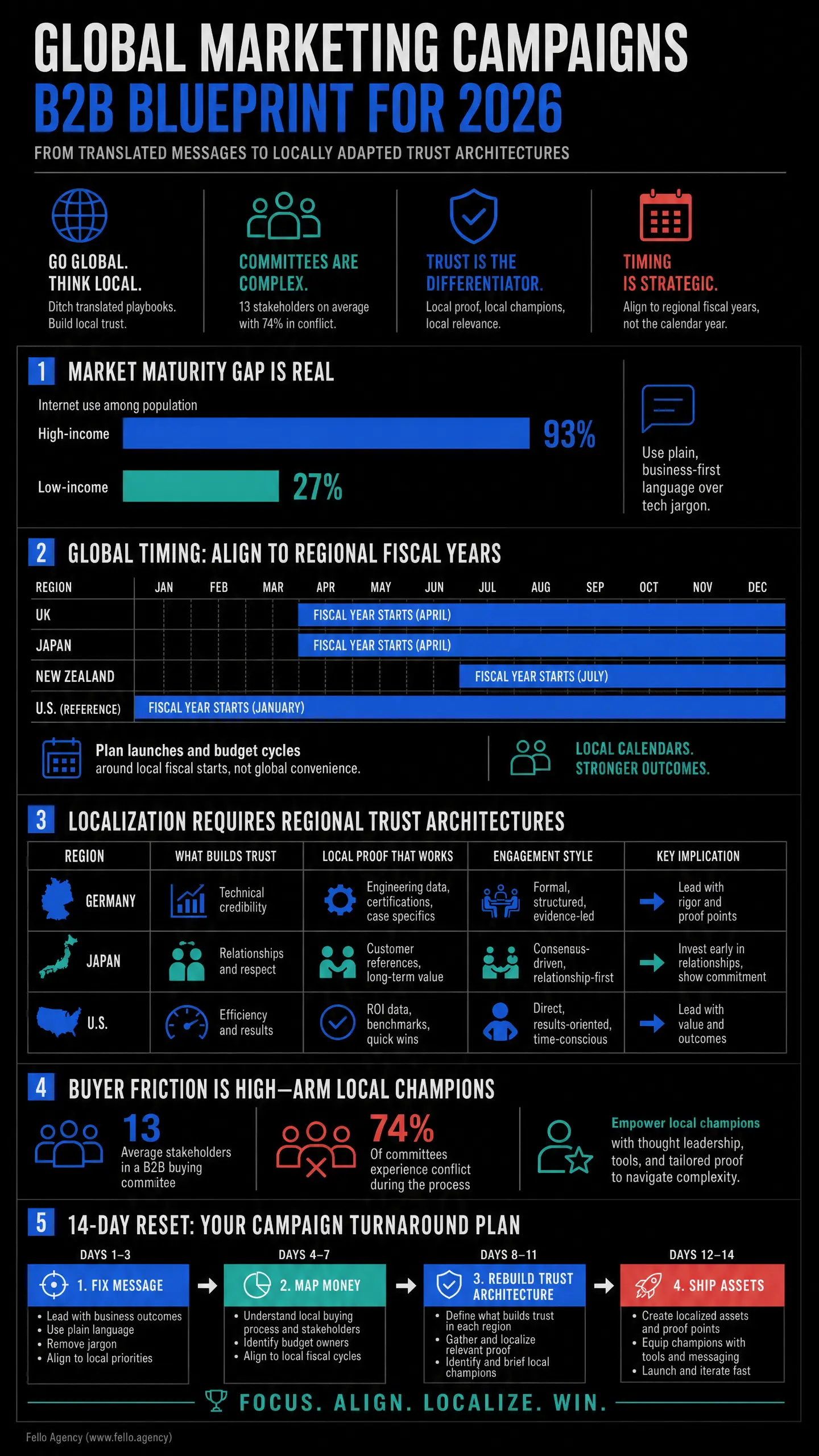
When teams say "global," they usually mean this: build for the most mature buyer in the US, translate the copy, push it into a few new regions, and hope it travels. It won't. The message is already carrying the assumptions of the most educated market.
I build the other way. I start from the least mature market.
Why? Because that market forces discipline. It forces you to explain the problem clearly. It forces you to say why the product matters in plain business language. It makes you answer the question your buyer is already asking: how do I make money, save money, reduce risk, or move faster?
The maturity gap is still massive. ITU's 2023 data shows internet use at 93% in high-income countries and 27% in low-income countries. If access itself is that uneven, category familiarity is going to be uneven too. You cannot assume the buyer in every region already has the language for what you sell.
This is where a lot of technical companies get stuck. They lead with technical talk. The buyer needs business talk. Your website needs to speak business.
At Fello, we do our research in a very specific order. We talk to customers first. Then sales. Then marketing. Then leadership. Customers give you the real friction. Sales gives you the real objections. Leadership gives you ambition. That order matters because I don't want the message polluted by internal politics on day one.
I've seen this work very clearly with Sphere. We didn't force one vague XR story across every buyer. We built separate industry pages for factories, medical tech, and defense. We led with ROI and specific use cases instead of abstract innovation language. That helped drive lead generation up 3x.
That's the kind of shift global campaigns need. Less "look how advanced we are." More "here's why this matters to your business."
Your Campaign Calendar Is Probably Wrong
A lot of global marketing plans fail on timing alone. The team builds around the North American Q4 budget flush and assumes everyone else is living in the same window. They're not.
I've told clients this before and they were genuinely shocked. Their buyers' calendars aren't North American just because the company is. Your internal quarter does not decide when international buyers have money.
The UK public-sector financial year runs April to March. Japan's fiscal year starts on April 1. New Zealand's government year runs from July 1 to June 30. In Europe, framework agreements can stretch to four years. That changes everything about how you pace awareness, proof, follow-up, and partner support.
So what should you do? Map the procurement calendars of your top three markets before you build the campaign cadence. I'm serious. Do that before you argue about ad creative, event budgets, or regional copy decks.
If your big push starts in November because that's when HQ gets excited, you may be arriving in a dead zone for half the world. That's a planning failure. It has nothing to do with your product.
And speed matters here. You don't wanna be moving slow in tech, you're gonna get killed. A lot of companies want to move in months when they should be moving in weeks.
Localization Is a Trust Architecture
Translation matters. Of course it does. CSA Research found that 76% prefer to buy with information in their native language, and 40% will not buy from sites in other languages. That should be enough to kill the lazy one-language rollout.
But language only gets you in the door. Trust gets you through the deal.
This is where most teams stop too early. They translate the English page, swap a phone number, maybe add a local office address, and call it localized. Real localization means rebuilding the trust architecture for each market.
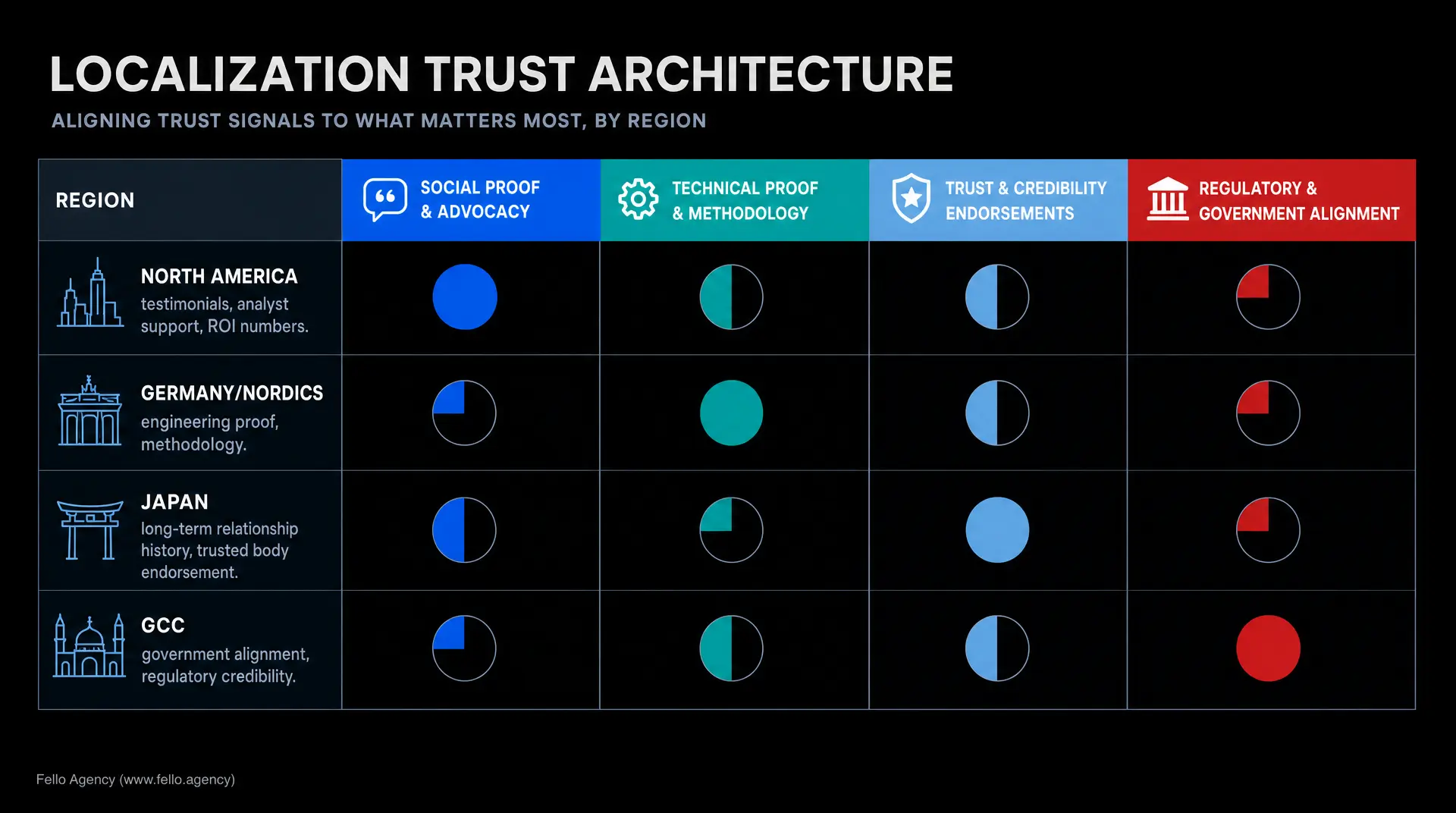
In North America, buyers often respond well to testimonials, analyst support, and ROI numbers. In Germany and the Nordics, engineering proof carries much more weight. Show the cert. Show the methodology. Show how the thing works. In Japan, long-term relationship history and endorsement from a trusted body can carry the room. In the GCC, government alignment or regulatory credibility can do more work than a quote block ever will.
You need to ask a much sharper question: what counts as proof in this market?
That answer should change your landing pages, your PDFs, your videos, your sales decks, and your case studies. Same language, wrong proof format, and the campaign goes flat.
This matters even more in deep tech and frontier categories. A lot of that work sits under NDA. I know that world well. We deal with heavy confidentiality all the time. I don't treat that like a weakness. I frame it properly.
If a client outcome is confidential, publish the methodology. Show how you think. Show the process. In complex tech, the biography is the case study more often than people realize. The founder's track record, the scientists involved, the advisors, the papers, the speaking invitations, the awards, the partnerships - those are all trust signals.
Detailed case studies available upon request under NDA. That line does real work when it's used correctly. It gives serious buyers a reason to get on the call.
Global Campaigns Do Not Close Global Deals. Local Champions Do.

This is one of the biggest mindset shifts I'd push on any global CMO. Your campaign does not close the deal in-market. The local champion does.
Outside North America and parts of Western Europe, the contract often gets pushed across the line by a regional sales lead, a distributor, a systems integrator, or a local partner. The central campaign creates awareness. The local person carries the conversation.
So stop building global programs as if every lead is going back to a sales rep in Austin who has never been to the country.
Your job is to arm the person in-market. Give them proof they can use. Give them language they can forward. Give them content that survives a committee review.
And committees are messy right now. Forrester says an average of 13 people are involved in a B2B buying decision. Gartner found 74% of buyer teams show unhealthy conflict during the decision process. That means your local champion is not walking into a clean room. They're walking into politics, risk, disagreement, and stalled momentum.
One generic deck won't survive that.
This is why I push thought leadership and technical proof so hard. Edelman and LinkedIn found that 73% of decision-makers trust thought leadership more than product sheets, and 86% would be likely to invite a company into an RFP after consistently strong thought leadership. That's exactly why I like white papers, technical briefs, and smart PDFs. They're not there to look smart. They're there to help your buyer sell internally and help write their future RFPs.
That's also why I split pages by job. I want landing pages that move a deal and collector pages that build loyalty. Partnership pages. Mission pages. Meet-the-team pages. Pages that make the market feel like they know you.
Remember the 95-5 rule. Up to 95% of your market is out of market at any given time. You're not only trying to convert demand. You're trying to stay memorable until the window opens.
Your Digital Proof Stack Has to Do Real Sales Work
A lot of buyers want to self-serve before they ever talk to you. Gartner found 67% of B2B buyers prefer a rep-free experience. At the same time, 69% still validate AI-generated insights with sales reps. So your proof stack needs to work before the call, and your sales team still needs to close the trust loop.
That means your website matters a lot more than most teams admit. McKinsey also found that 71% of B2B companies offer e-commerce, and 73% of buyers are comfortable placing orders above $50,000 online. Buyers are already doing serious validation and serious purchasing in digital environments. Your site has to carry that weight.
My hierarchy is simple. Lead with a hero that creates credibility. Put case studies right underneath. Then show strong product assets, testimonials, a clear CTA, and resource pages. If I land on a B2B tech site with no case study page or no testimonial page, that's a red flag right away.
And if your CMS is a mess, you have another problem. If you don't have a proper CMS, there is no point of even having a website. In a global campaign, your team needs to launch a partner page, a region-specific brief, or a market update fast. My benchmark is simple: once the content is ready, the team should be able to launch it in three minutes.
Visual trust matters too. I do not think visual fidelity is the only moat in B2B. I do think it makes you look durable. Buyers read that immediately. Dress for the client that you need.
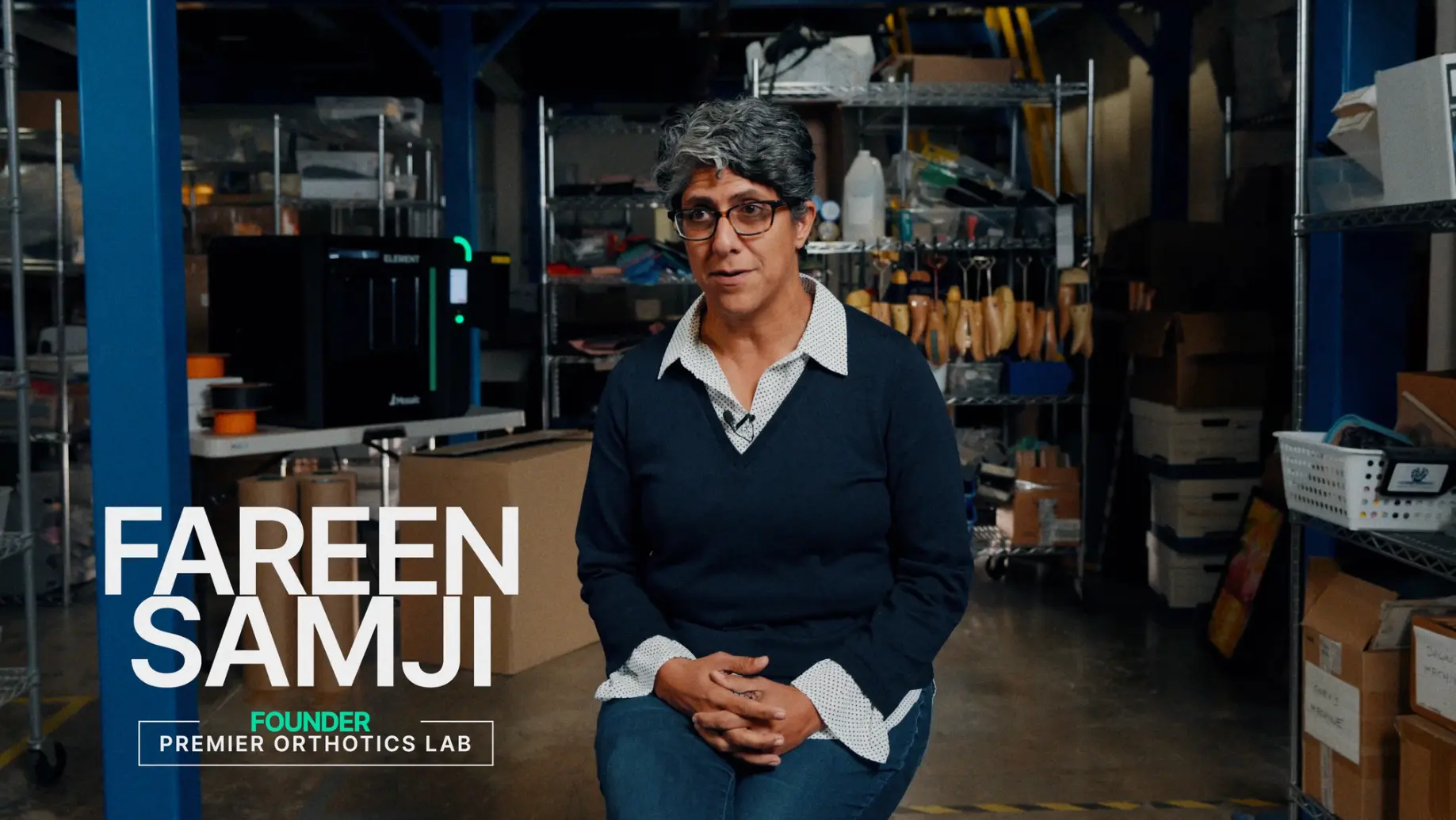
I've seen this play out with Mosaic Manufacturing. We built case study videos around the orthotics customer and their business. We did not build them around printer specs. We showed the workflow, the value, and the upside from the buyer's point of view. That work helped drive a 25% jump in inbound leads and a 15% increase in booked meetings within two months.
That's what I mean when I say sell a lifestyle, even in technology. Show the buyer what they become after they buy from you. Not how smart the device is, but how much smarter you're going to be.
And please, don't flood your global rollout with AI generated slop. Buyers can feel it. Everybody looks sort of polished now. Sort of sharp. Sort of forgettable. If everybody's super, then nobody is. If it looks like bullshit, no one's gonna want to work with it.
Measure Momentum, Not Marketing Theater
This is where standard dashboards start to betray people. In global B2B, especially in deep tech and hardware-heavy categories, SaaS-style monthly obsession can send you in the wrong direction.
Forrester found nearly 90% of B2B purchase processes stalled in 2023. That tells you something important. Lead volume on its own is a weak comfort blanket.
I care much more about sales velocity. Are the right regions sending demo requests? Are technical briefs getting downloaded? Are buyers forwarding your material internally? Are your local teams actually using the assets? Are reply times getting faster after the launch? Is sales telling you the first meeting feels easier?
Those are real signals. I've seen strong branding improve response speed and trust perception within days. Sales starts to feel the difference before the dashboard fully catches up.
I also look at global programs on a longer loop. In many complex B2B categories, quarterly readouts are far more honest than monthly panic. Monthly reporting makes good teams chase noise.
Then there's dark social. This is huge, especially internationally. I spend a lot of time building rooms, intros, and ecosystems through Fello Foundry, and the lesson is always the same: influence moves through people before it shows up in software.
In MENA, South Asia, and Latin America, a lot of it runs through WhatsApp groups. In Japan and Thailand, it can run through Line communities. In every region, private emails and peer forwards still do heavy lifting. Your analytics will miss a lot of that. Your regional lead will hear about it first.
So build feedback loops with the people on the ground. Ask what content got shared. Ask which proof asset got forwarded. Ask which message actually started conversations. The digital numbers might look clean while the real influence is happening somewhere else entirely.
My 14-Day Reset for 2026
I do not believe in the 90-day audit trap for this kind of work. Ninety days of diagnosis is eternity. If someone needs three months before they can tell you what's broken, they are learning your market on your dime.
Here's how I'd reset a global B2B campaign quickly.
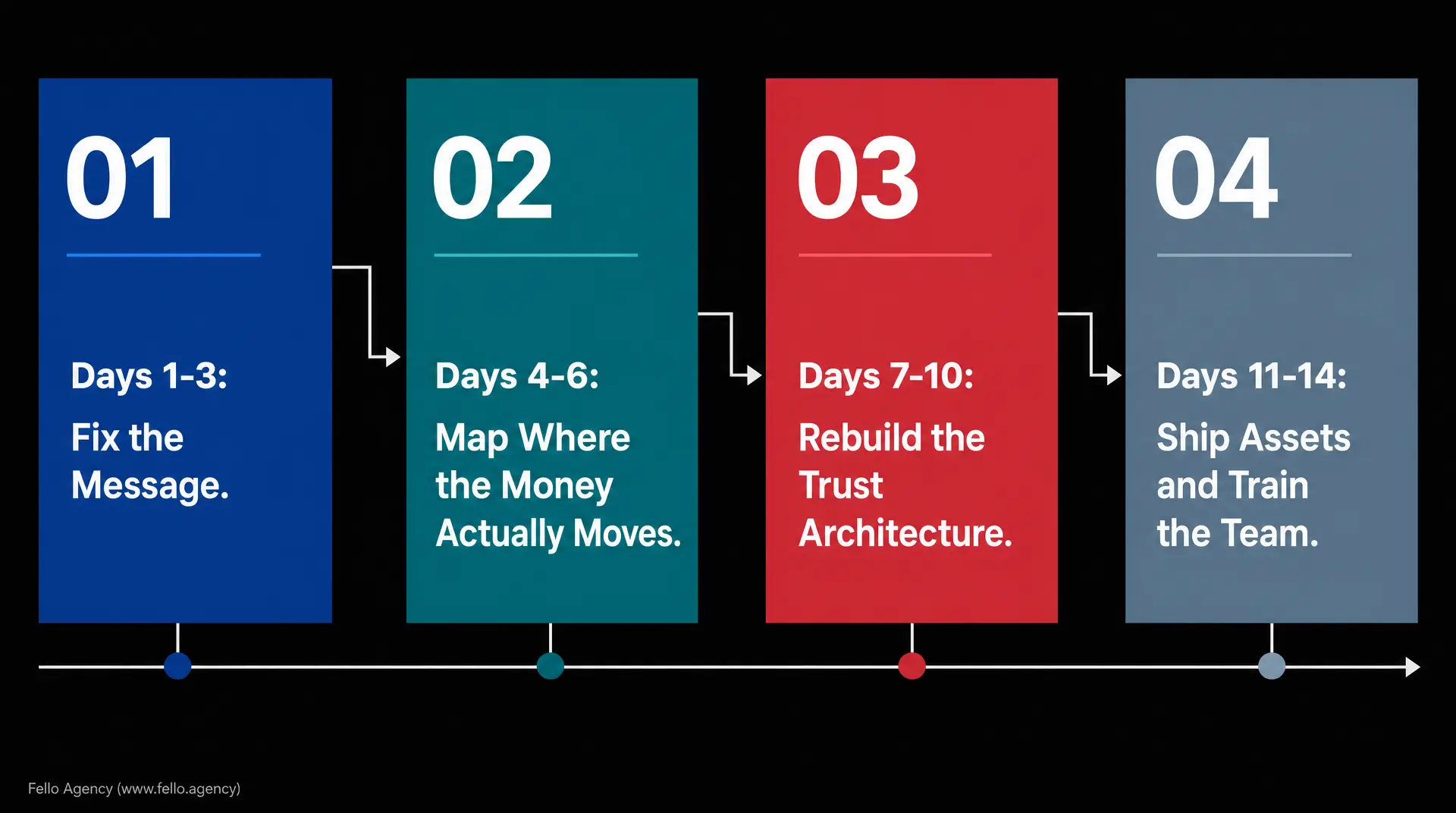
Days 1 to 3: Fix the Message
Start with customers, then sales, then marketing, then leadership. Pull the real pain out of the market. Build the message from the least mature region. Reduce it to one sentence a non-technical executive can repeat. If your team cannot explain the product clearly in 60 seconds, you are not ready to scale globally.
Days 4 to 6: Map Where the Money Actually Moves
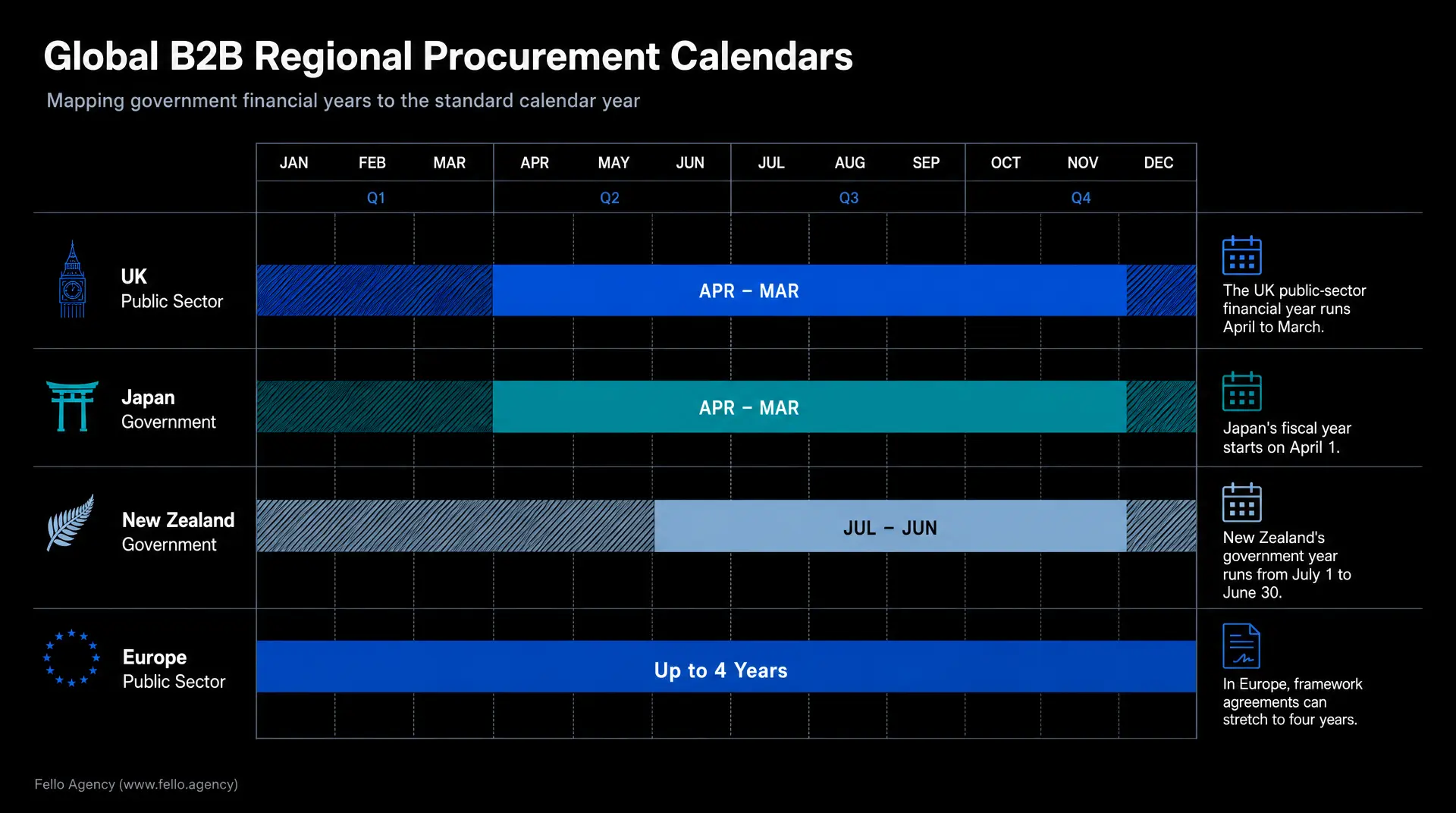
Take your top three markets and map fiscal starts, procurement cycles, key trade windows, and partner motions. Stop timing the world around your internal quarter. Build the campaign around buyer budget reality.
Days 7 to 10: Rebuild the Trust Architecture

Decide what counts as proof in each region. Choose the right format. That may mean testimonials in one market, methodology-heavy briefs in another, and relationship-led pages in a third. Build the content for the people who actually close the deal locally.
Days 11 to 14: Ship Assets and Train the Team
Launch the pages. Publish the proof. Put the case studies where buyers can find them. Gate the deeper material where NDA makes sense. Train your internal team on the CMS so they can move without a developer every time they need a new regional asset.
That is how you get moving again. Weeks. Not months.
Final Thought

The global B2B teams that win in 2026 will be the ones that respect market maturity, budget timing, local proof, and local people. They will speak business. They will build trust architecture. They will give local champions real tools. They will measure momentum instead of vanity.
Strong B2B branding is still one of the last moats standing because it helps you skip a level in the sales cycle. Take this seriously, because your competitors will. And they will win the deal.
Frequently Asked Questions
How should CMOs balance regional demand-gen pressure against global brand building?
Stop chasing immediate regional leads at the expense of memory. The 95-5 rule dictates 95% of buyers aren't currently in-market. Allocate central budget to durable thought leadership, and let local field teams spend on capturing that active 5%.
How can global marketing teams accurately track ROI when buyers jump across multiple regional touchpoints?
You can't track it perfectly, so stop forcing a messy reality into a clean dashboard. Buyers use an average of 10 channels. Rely on regional sales feedback and pipeline momentum, rather than obsessing over multi-touch attribution software that completely misses dark social.
Should we implement self-serve e-commerce for high-ticket, frontier tech products?
Yes. Stop assuming complex tech requires a human for every transaction. McKinsey found 73% of B2B buyers are comfortable placing orders over $50,000 online. Build an airtight digital proof stack and let the buyer validate and purchase on their own timeline.
How much autonomy should local sales teams have to alter centralized campaign messaging?
Give them the framework, but let them adapt the proof. B2B purchases involve an average of 13 people. A rigid corporate message won't survive local committee politics. Centralize your core positioning, but let regional champions localize case studies to fit their market.
How do we accelerate pipeline velocity when international buying committees are completely gridlocked?
Arm your local champion with objective, unbranded proof. Committees stall because of risk. With 74% of buyer teams facing unhealthy conflict, your marketing must supply technical briefs and third-party validation that helps your advocate win internal arguments. Cut the fluff.
Your Creative Partner for Innovation That Matters
From advanced tech to transformative healthcare, Fello helps visionary teams shape perception, launch products, and lead industries.
Let’s keep in touch.
Discover more about high-performance web design. Follow us on Linkedin and Instagram.