


Marketing's entire toolkit rests on a single hidden assumption: that somewhere out there sits another buyer you haven't reached still. Technical markets have no 'out there,' and the complete list of people who can purchase fits on one page.
A semiconductor client of mine had ground cost per lead down to $40, the number he was proudest of, while exactly 140 companies on Earth could ever buy his product. That figure had spent years efficiently paying to reach students, consultants, and competitors doing research - every category except a buyer.
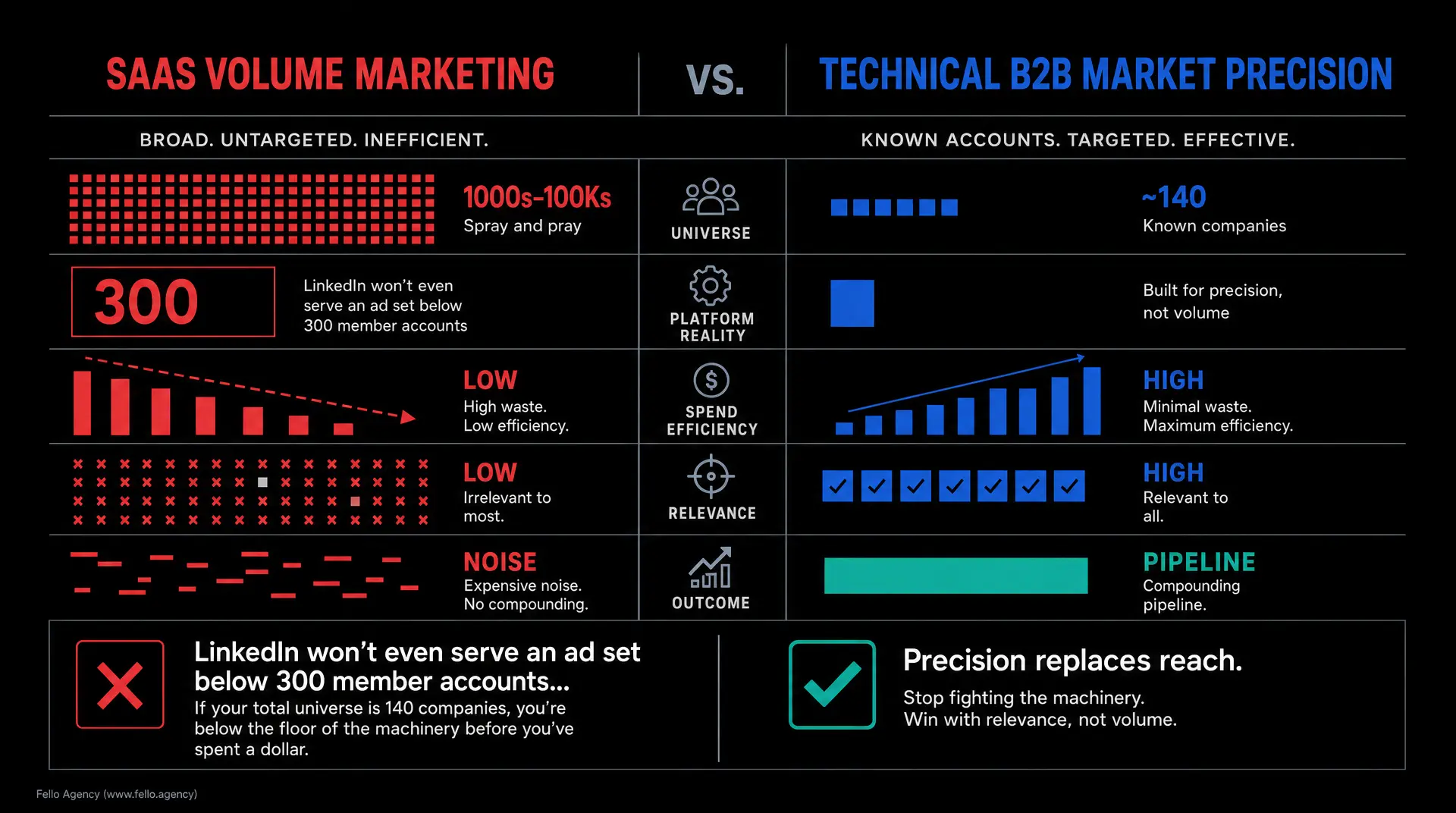
A market you can name by Friday breaks every instrument built to find strangers. LinkedIn won't serve an ad below 300 accounts, and reach stops meaning anything the moment you already know all 140 doors.
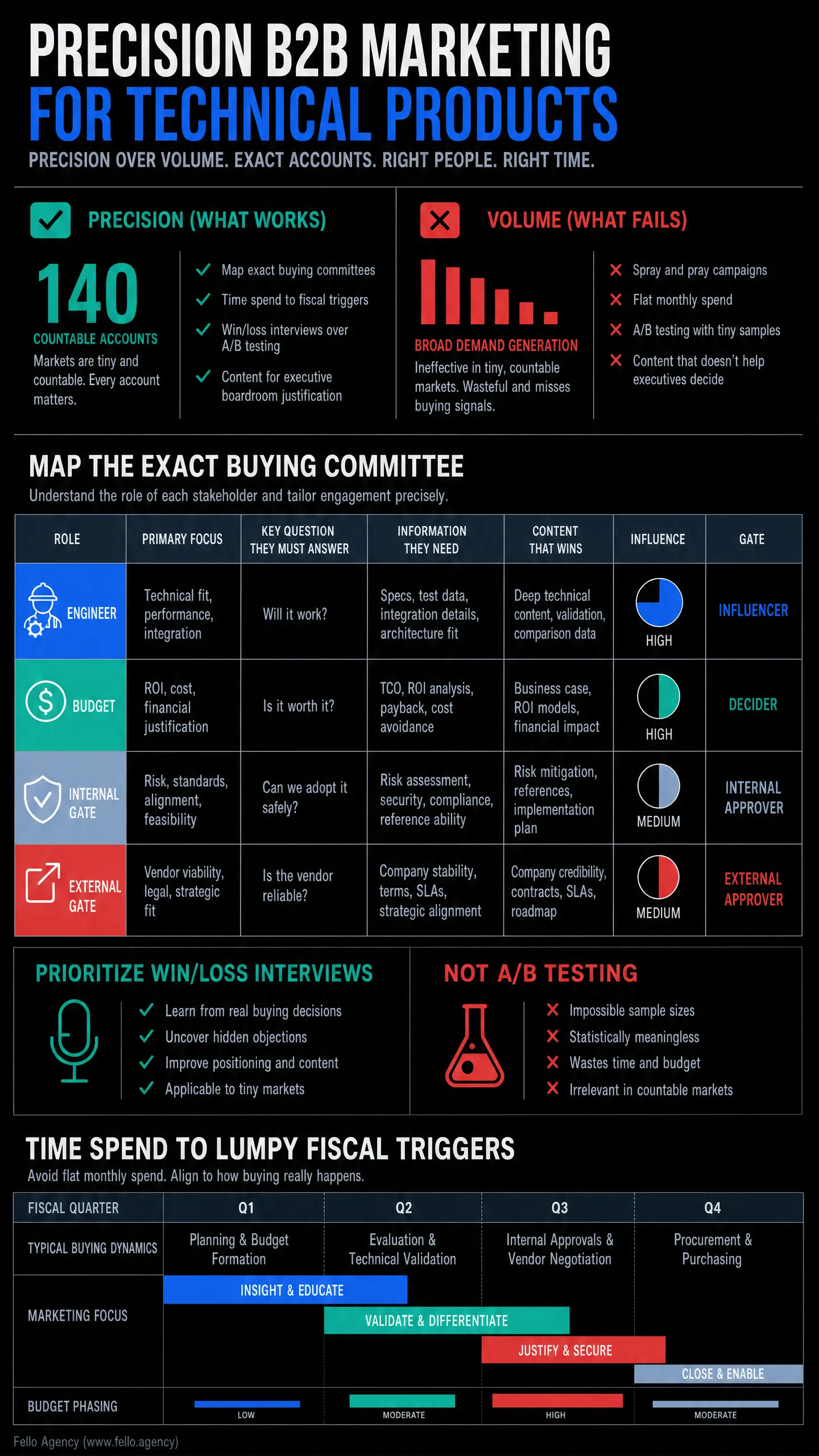
Key Takeaways
Standard ad platforms fail in ultra-niche technical markets because LinkedIn requires a minimum of 300 member accounts and Google remarketing needs at least 100 active visitors to function.
Because internal organizational changes drive 99% of B2B purchases, technical marketing spend should cluster in the 90 days preceding fiscal year-ends rather than spreading flatly across 12 months.
Technical marketers should replace mathematically impossible A/B testing with win-loss interviews, as detecting a half-point conversion lift requires 15,311 observations under NIST formulas.
With 61% of buyers reporting that legal departments slow or block purchases, technical campaigns must build dedicated messaging tracks for procurement gatekeepers instead of solely targeting evaluating engineers.
Standards working groups act as untrackable marketing channels that pre-define technical purchase requirements, with WTO-notified technical regulations linking to 92% of United States goods exports.
Why Is Total Addressable Market Arithmetic Crucial for Technical B2B Marketing Campaigns?
Start with arithmetic, because it's the thing most campaign advice quietly assumes away.
The ad platforms will tell you themselves that you're too small. Nobody reads the fine print. LinkedIn won't even serve an ad set below 300 member accounts. Its own guidance suggests 50,000 to actually drive results. Google's remarketing lists need at least 100 active visitors in a 30-day window before they function at all. If your total universe is 140 companies, you're below the floor of the machinery before you've spent a dollar. Lookalike audiences have nothing to look alike. And cost per lead becomes an actively harmful metric, because it rewards volume in a market where volume is noise.
The flip side is the part I love. A countable market hands you something a SaaS CMO will never have: you can name your buyers. All of them. I tell clients to make a magic list. Every account that could ever buy. Every human inside those accounts who touches the decision. What each of them currently believes, and what they'd need to believe instead. At 50,000 prospects, that's fantasy. At 200, it's a week of work. Precision replaces reach, and everything downstream changes.
Why Is Demand Generation Ineffective for Technical Products Like Cryogenic Control Systems?

This one stings more. No campaign ever made a program office fund a line item. No webinar pushed a device through an FDA panel. No LinkedIn sequence convinced a prime contractor to open a supplier slot. The triggers in technical markets fire on someone else's calendar, for someone else's reasons.
The data agrees with what I see in the field. Gartner found 99% of B2B purchases are driven by change inside the buying organization. Transformation programs, new mandates, operational shifts. Your budget cannot manufacture those events, no matter how creative the campaign is.
Which means your campaign has exactly one job: be the obvious answer when the trigger fires. Eighteen months from now. In front of a committee you never met. In a meeting you will never see. Everything else in this guide hangs off those two facts. The market is countable, and the demand is triggered.
Why Does Buying Committee Coverage Beat Reach Volume in Technical B2B Marketing?
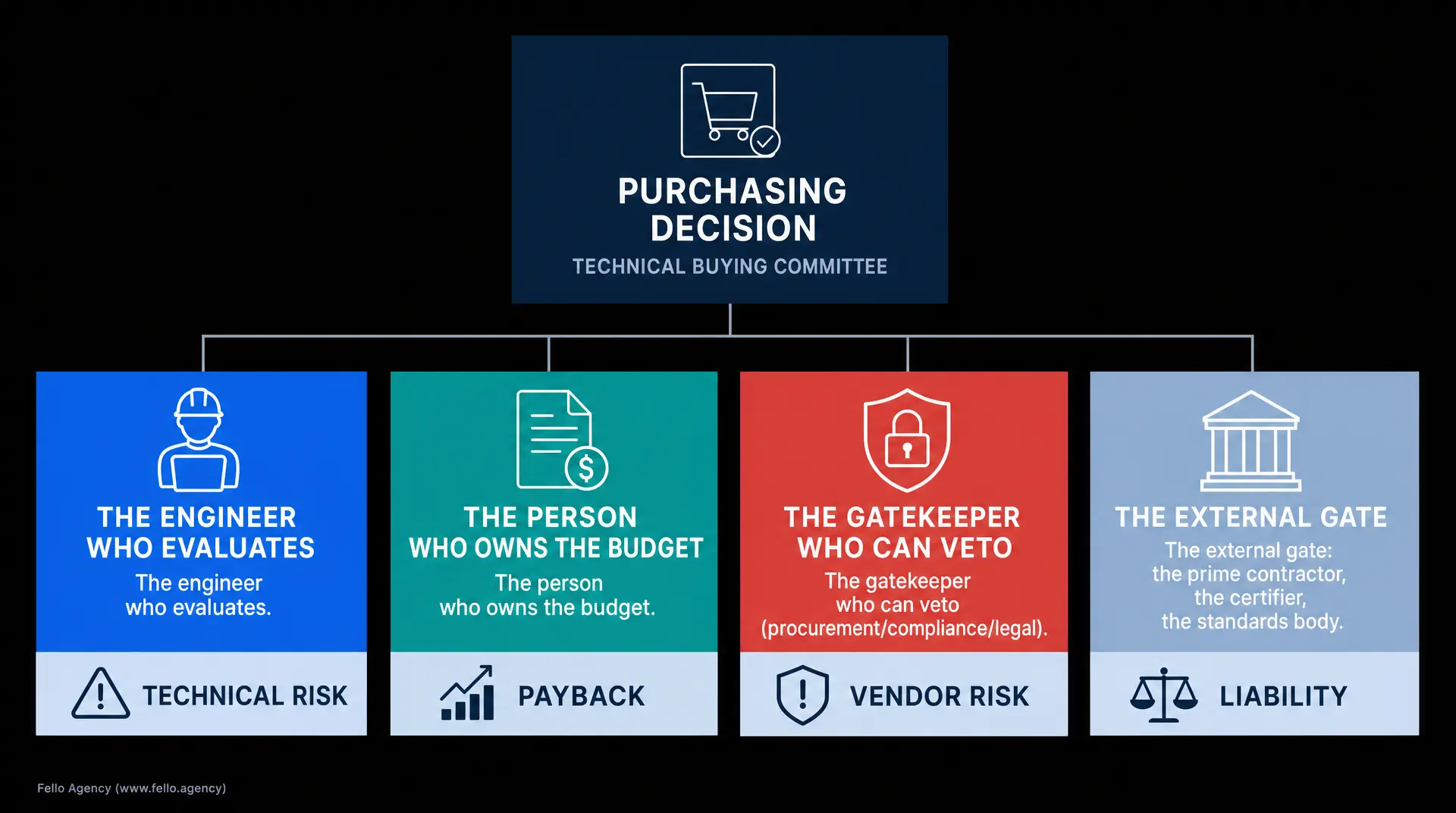
Four roles buy technical products. The engineer who evaluates. The person who owns the budget. The gatekeeper who can veto, meaning procurement, compliance, security, legal. And the external gate: the prime contractor, the certifier, the standards body, sometimes an insurer.
Gartner puts the average enterprise buying group at five to 11 stakeholders across five business functions. In my experience the technical version is worse, because two of those functions often sit outside the building entirely.
Most technical campaigns speak brilliantly to the engineer and never once to the gatekeeper. Then the deal dies at month 14 in a procurement review marketing never knew existed. G2 found that 61% of buyers say legal tends to slow or block purchases. 61%. When was the last time your content calendar had a single asset aimed at the person holding that veto?
Underneath it all, every client we take on at Fello is doing the same thing: convincing somebody who's been doing something one way to change it, to either make money or save money. The four roles just weigh that change differently. The engineer weighs technical risk. The CFO weighs payback. Procurement weighs vendor risk. The external gate weighs liability. One pitch deck cannot carry all four weights, which is why in our robotics work we build separate messaging tracks for the VP of operations, the IT team, the floor manager, and the CFO. A generalized message reaches everyone and convinces no one.
At 200 accounts, reach is trivial. You could put your logo in front of every prospect alive by Friday. Coverage is the real work. Score your last campaign on coverage instead of impressions and watch how fast "successful" gets uncomfortable.
How Do Fiscal Timelines and Budget Triggers Dictate B2B Technical Marketing Spend?
LinkedIn's B2B Institute estimates only about 5% of buyers are in market in a given quarter. In technical markets it's lumpier than that. Demand clusters around fiscal year-ends, program milestones, and budget planning season, the short windows when a committee is actually holding a pen.
Your spend should cluster in the 90 days before those triggers. Almost nobody's does. Most budgets are flat across 12 months, and not for any strategic reason. Flat is how retainers bill. I've gone after agencies for the $500-a-month "website service fee" that delivers nothing, and the evenly-spread annual campaign is the same disease with more zeros. Money flows monthly, so most of it lands when nobody is buying.
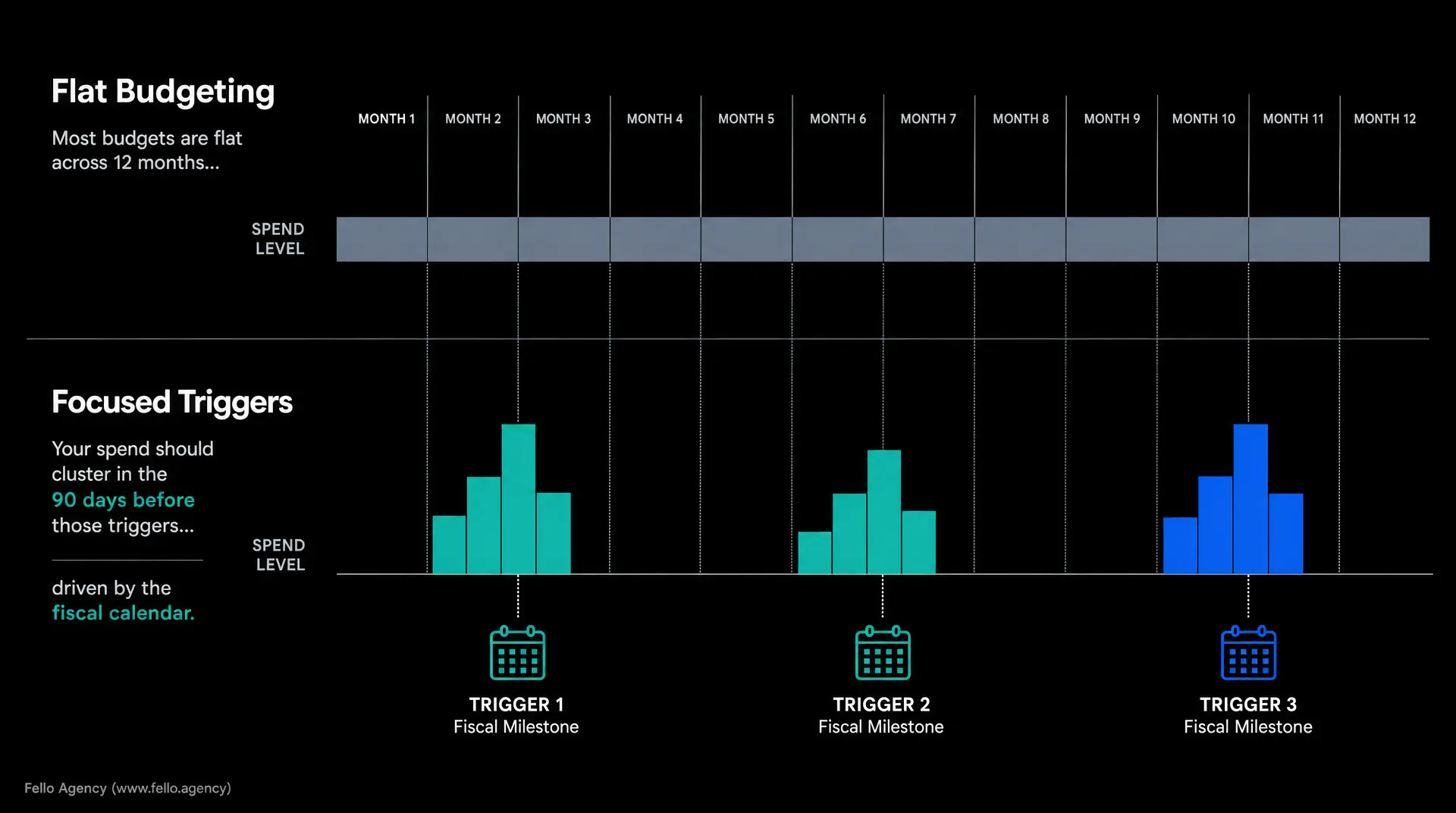
In a countable market you can build an actual calendar instead. Forty accounts, each with a fiscal year, a planning season, a program review cadence. Map the decision dates of your top accounts and the calendar will embarrass your current media plan. The uncomfortable implication: some quarters you should be nearly silent, and some quarters you should be everywhere at once. Lumpy spend looks alarming on a board slide. Lumpy spend is correct.
Why Should Technical B2B Marketers Replace A/B Testing With Win/Loss Interviews?
Run the math before you run the test. Using NIST's own sample-size formula, detecting a half-point lift in conversion takes roughly 15,311 observations per variant. Your market has maybe 800 humans in it. The test will never conclude. It will just quietly burn budget while producing numbers that look like science.
Replace experiments with win/loss interviews and recorded sales calls. Ten win/loss interviews in a 200-account market is a 5% sample of your entire universe. No split test on Earth gives you that density of truth. The calls hand you the exact words buyers use for the problem, the caveat that made them nervous, the slide that got forwarded upstairs.
Then ship one version. With conviction. At Fello we've run full brand sprints in 14 days, and the way we hit that speed is by making decisions instead of hosting votes. I've also watched founders stall for nearly two years running communication strategy workshop after communication strategy workshop. Four workshops. Two years. Listen, you don't want to be moving slow in tech. You're going to get killed.
Which Leading Indicators Should Measure Success in Long-Cycle Technical B2B Marketing Campaigns?

An 18-month campaign gets killed at month five by a CFO doing exactly their job. And I want to be honest here, the CFO is right to do it. If marketing handed them no leading indicator they signed off on up front, cutting the spend is the rational call.
I've seen the extreme version. A massive pharmaceutical company we worked with had stalled out completely. Internal gridlock, endless stakeholders, nothing shipping. They had a major raise coming, and the PE firm behind them took the whole product offline because nothing got done. Think about that. Two years of work, out the window, because the people holding the money couldn't see progress and eventually acted like there wasn't any.
So before you spend, get written agreement on what progress looks like at months three, six, and nine, knowing full well revenue cannot appear before month 14. My position: measure sales velocity, not website traffic. Are emails getting answered faster? Are demos easier to book? Did a named account on your list move a stage? Is the technical brief being requested, and by whom? For deep tech clients we also track brand recall, trust perception among named decision-makers, and share of voice at the two or three industry events that actually matter.
And track it quarterly, not monthly. A 16-to-18-month cycle produces no meaningful monthly movement, and pretending it does teaches your CFO to distrust every number you bring them.
How Do Untrackable Channels Like Standards Committees Impact Technical B2B Purchases?
Trade shows. Technical journals. Standards committees. Prime contractor supplier ecosystems. The private group chat where the 12 engineers who matter in your niche compare notes. Technical buying decisions form in these places, and none of them produce a dashboard.
A plan built only from measurable channels is wrong before it launches. The digital numbers will look clean while the real influence happens somewhere you can't see. And that's a strategy problem, not a measurement problem.
Take standards bodies, the least glamorous channel on that list. The International Trade Administration linked WTO-notified technical regulations to 92% of US goods exports. The specs get written before anyone evaluates a vendor. The company sitting on the working group is helping draft the requirement everyone else will bid against. There is no CPL for that seat. There is also no substitute for it.
Trade shows run on the same logic. Nobody scans a badge and buys a cryostat. You show up so that when your name surfaces in a program review two years later, somebody in the room has shaken your hand. I tell B2G clients to treat shows as pay-to-play credibility makers, full stop.
How Should Technical B2B Marketing Assets Be Designed for Executive Boardroom Approval?

The scene that decides most technical deals: an engineer likes your product, forwards your PDF to their VP with two lines of context, and the VP gives it 90 seconds. Page one is now doing a sales meeting without you in the room.
Design for that meeting. Page one has to speak business, meaning outcome, cost, and risk, because the person it gets forwarded to almost never speaks spec. The data on this is blunt: 67% of buyers said the winning vendor's content made it easier to show ROI and build the internal business case. Your content isn't competing for attention. It's competing for your champion's credibility when they walk it upstairs.
For Mosaic Manufacturing, the 3D printing company, we built case study videos told entirely from the customer's side. An orthotics business owner talking about what the machine did for her business, and not one frame of printer specifications. Inbound leads jumped 25% and booked meetings rose 15% within two months. But the result I actually care about is where those assets ended up: inside investor decks and trade show presentations, selling in rooms we never entered. That's the whole test.
Two more moves on this. We stopped letting clients bury technical content in static PDFs, converting one-pagers into trackable pages with a CTA, so you can finally see who read the thing and whether it traveled. And on long cycles, I write white papers so a buyer can lift the language straight into their future RFP. When your words show up in the requirement document, you've skipped a level in the sales cycle.
What Are the Most Common B2B Marketing Campaign Patterns in Technical Markets?
Most b2b campaign examples you'll find online celebrate reach. A viral video, a stunt, a big impressions number. The best b2b marketing campaigns in technical markets are quieter and much stranger, and if you're hunting for b2b campaign ideas, steal the shape of these, never the tactics.
One note first. These are composites, patterns we've seen more than once, reassembled so nobody is identifiable. Every detail is real. The names are gone on purpose.
How Did Missing Procurement Line Items Cause a Quantum Technology B2B Marketing Campaign to Fail?
Strong pipeline, glowing technical evaluations, and deal after deal dying at the budget stage. The internal diagnosis was obvious: a competitor is beating us late. So they sharpened battle cards and rebuilt the comparison pages.
The win/loss interviews found no competitor. In every dead deal, the buyer had no budget category the purchase could live in. Procurement asked which line the money came from, the champion had no answer, and the deal evaporated without a rejection ever being issued. The vendors actually winning had been in those accounts for two budget cycles, helping the line item get written. Government buyers make this explicit. The FAR requires agencies to do market research before writing requirements. The winners were in the building before the requirement existed.
Nobody invents a line item for a vendor they met four months ago.
How Did Misaligned Fiscal Calendar Spending Cause a Defense B2B Marketing Campaign to Fail?
Twelve programs in the pipeline. Always-on content, steady monthly spend, flat results. The obvious call was creative fatigue. Refresh the campaign, maybe fire the agency.
Then somebody mapped the decision dates. Eight of the 12 programs decided inside the same six-week window, driven by the fiscal calendar. 85% of the year's budget had landed outside that window. And this is structural, not a fluke: GAO tracked a fiscal year where the Department of Defense obligated 30.1% of its entire contract spend in the fourth quarter. The creative was fine. It was punctual for meetings that weren't happening.
A flat budget is a billing schedule pretending to be a strategy.
How Did Pre-Clearance Unbranded Education Drive Success for a Medical Device B2B Marketing Campaign?

Standard counsel before regulatory clearance is silence. Say nothing, then launch big. One device company took the silence about the product and ignored the rest of the advice. For six months before clearance they ran unbranded education on the clinical problem. The gap in the standard of care, the cost of the status quo, the data everyone was politely ignoring. Not one word about the device.
The board hated it. They were convinced the company was educating the market for competitors. What actually happened: when clearance came, launch day didn't have to teach anyone anything. The committees already agreed on the problem, and the device dropped into a conversation the company had spent half a year building.
Launch day is a terrible day to start an education.
How Did Highly Technical Content Exclude P&L Data and Kill an Additive Manufacturing B2B Deal?

Deals cleared technical validation, then died two levels up. First diagnosis: pricing. Second: sales execution. Sales blamed lead quality, marketing blamed follow-up. Every CMO reading this has sat through that exact meeting.
The recorded calls told a different story. Engineers loved the machine. The kill happened after the engineer forwarded the flagship asset, a 26-page technical PDF, to an ops VP. Page one was tolerances and material science. Cost per part, throughput, downtime, nowhere to be found. Nothing on that page spoke P&L, so the deal wasn't rejected. It was quietly deprioritized, which is worse, because nobody tells you why.
You didn't lose that deal on price. You lost it in silence.
How Did Ignoring External Industry Standard Committees Cause an Inspection Robotics B2B Campaign to Fail?
Forty named accounts. Deep, genuine coverage of the engineering teams, with content the engineers actually rated. And every deal stalled at the same late stage. Diagnosis: our champions aren't senior enough. So they built executive content and pushed higher up the org chart.
The real gate wasn't inside the accounts at all. Insurers were quietly defining what counted as acceptable inspection for the entire industry, and a competitor was sitting on the working group, writing itself into the definition. Forty accounts covered flawlessly, while the standard governing all 40 got drafted in a room the company had never mapped.
While you're covering the org chart, someone else is writing the standard.
Why Did Missing Boardroom Justification Narratives Prevent Expansion in an Industrial Robotics B2B Campaign?

An industrial robotics company stuck in pilot purgatory. Pilots hit their metrics. Expansions never came. The board read it as product gaps, so the roadmap grew and the timelines slipped.
The pilots were never the problem. The champion was an operations manager who had to walk into a boardroom and ask a CFO for eight figures, armed with sensor data and a spec sheet. Everything marketing produced served the evaluation. Nothing served the justification. When the company started building boardroom-ready narratives for that one person, the cost story, the risk story, the before-and-after, expansions closed. The robot never changed.
Pilots die in the boardroom, not in the field.
How Does Internal Stakeholder Complexity and Feedback Bloat Kill Technical B2B Marketing Rebrands?

I've seen this one so many times I can narrate it in advance. A company raises a serious round. Real money, real headcount, real pressure to look like a company that deserves it. And the marketing hasn't caught up. The website still describes the company from three years and two pivots ago. The messaging was written by a founder at 2 a.m. before demo day. There are now four people with opinions about the brand where there used to be one.
So they do the reasonable thing and try to fix it all at once. The messaging work generates 19 value propositions. The website grows from eight pages to forty. Every department wants a section. Legal wants caveats. The board wants the funding mentioned. Sales wants a page for every vertical, including two they've never sold into. Six months later they launch a beautiful, enormous, exhausting thing that says everyone and lands nowhere.
Campaigns like this never fail in market. They die in the fourth round of stakeholder feedback. They stall because one person who couldn't approve the direction was traveling for three weeks. They ship six months late, compromised by everyone who touched them. The market never gets a vote.
The biggest threat to your campaign is your own org chart, not your competitors.
Why Is Content Subtraction and Simplification a Mandatory Discipline in Technical B2B Marketing?
The discipline underneath all of it is subtraction. Not because simple is prettier, but because complexity is where campaigns go to die, and in technical companies complexity is the default state. Your product is complicated. Your engineers have real nuance to add, and every caveat they want included is true. That is exactly what makes it dangerous. The campaign that survives is the one where somebody had the authority to cut.
In exchange for all this inconvenience, you get the one thing a SaaS CMO will never have. They will never know their whole market. You can. Two hundred accounts. Eight hundred people. Four roles. A handful of decision windows a year. Knowable, mappable, by name.
The market is countable. Count it. Then build the machine that fits.
Frequently Asked Questions
How should CMOs structure campaigns for the vast majority of enterprise accounts not actively buying?
Stop trying to force a trigger. LinkedIn research shows 80% of companies change banking services only every five years. Most of your market isn't buying right now. Your campaign's true job is building memory links so you become the obvious choice when their internal operational mandate finally fires.
How can marketing campaigns actively accelerate complex deals once the CRO's team takes over?
Build assets the buyer and seller use together. Self-service content hits a wall. Gartner reports buyers are 1.8x more likely to close high-quality deals when using supplier-provided digital tools alongside a sales rep. Stop producing static PDFs. Start building interactive calculators that actively arm your champions.
How long should the board expect a technical B2B marketing campaign to take before generating pipeline?
Expect quarters, not months. G2 found 49% of buyers take four months or more just to decide on software over $20,000. For deeper technical categories, it is far worse. If the board demands pipeline in month two, they are managing a spreadsheet, not a market. Track sales velocity instead.
What specific website content is mandatory for justifying a complex enterprise technology purchase?
Your website must instantly answer the business case. The 2024 Demand Gen Report shows 86% of buyers demand pricing and 85% need functionality immediately. Stop hiding capabilities behind a demo form. If your content cannot help a champion defend costs upstairs, you will lose in silence.
How do you prove marketing attribution to the CEO when the buying committee has 11 stakeholders?
Abandon single-touch attribution. Enterprise deals are a consensus, not a single click. G2 notes 42% of buyers say the C-suite ultimately owns the purchase decision. Marketing's job isn't claiming one specific lead source. It is surrounding the entire committee. Measure total account penetration, never individual vanity clicks.
Your Creative Partner for Innovation That Matters
From advanced tech to transformative healthcare, Fello helps visionary teams shape perception, launch products, and lead industries.

Let’s keep in touch.
Discover more about high-performance web design. Follow us on Linkedin and Instagram.