


The engineer who decides whether you make the shortlist will never call, and by the time you'd want him to, the choice is mostly made. He completes 60% of the buying process before he speaks to a vendor, and he spends much of it on your website.
His only reason for being there is to finish a job: pull a model, confirm a tolerance, get a number. Fail him and he takes a competitor's CAD file, and the part he builds around it gets purchased 82% of the time.
Your dashboard logs a bounce and keeps no field for the program you just lost, which is exactly why the brief on your desk asks for a cleaner homepage.
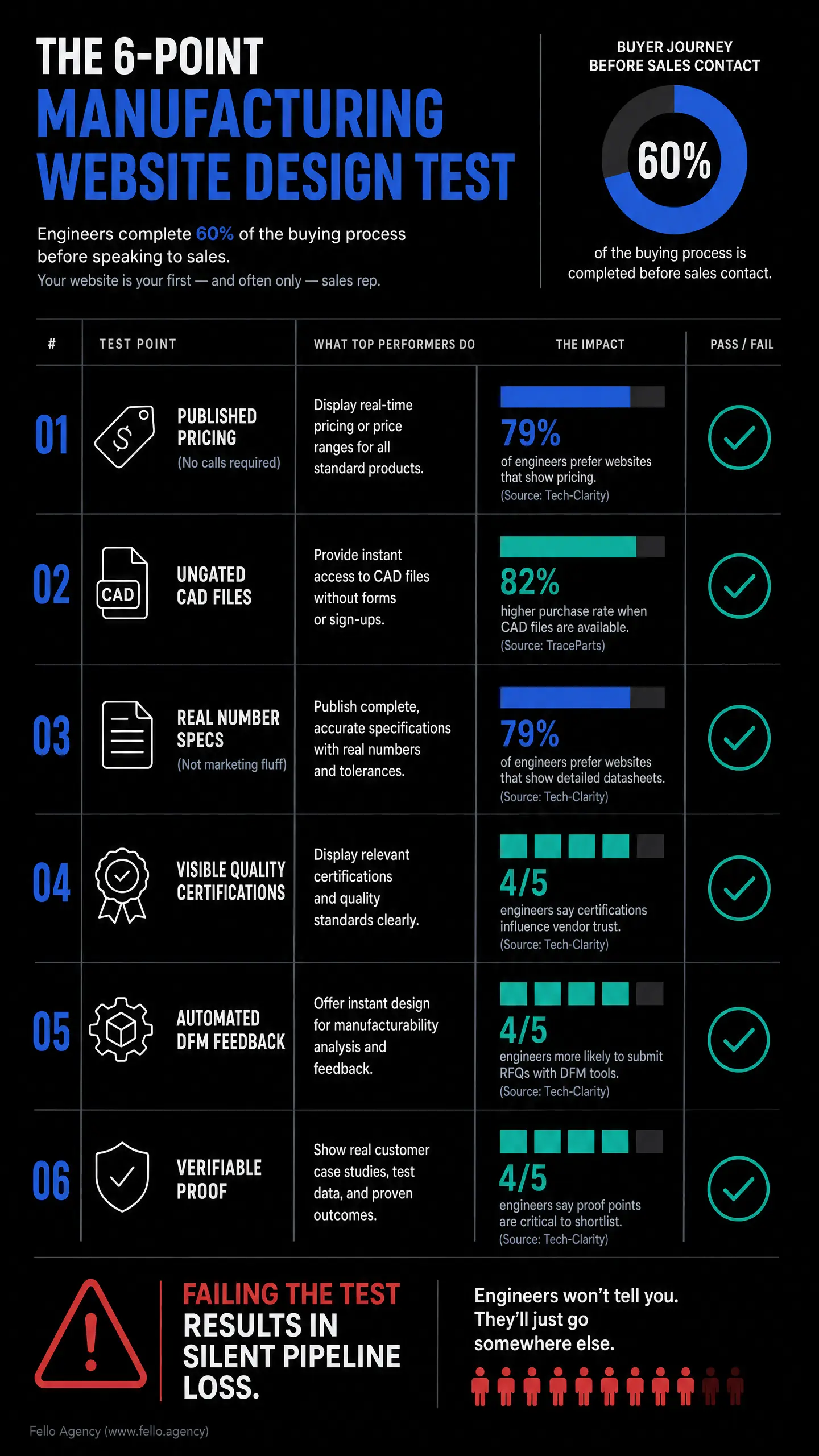
Key Takeaways
When manufacturing websites provide ungated CAD file downloads, engineers purchase the corresponding physical part 82% of the time.
If native CAD models remain unavailable or gated online, 46% of engineers download an alternate supplier's model and 35% redraw the part themselves.
Although many manufacturers obscure product costs, 40% of technical buyers report that pricing or inventory questions are what finally push them to contact a salesperson.
Industrial buyers rank quality certifications like ISO 9001 and ITAR among their top three supplier-selection factors, requiring immediate visibility on manufacturing homepages rather than hidden inside footers.
Technical buyers rate an informative website as a stronger trust signal at 4.0 out of 5, outranking case studies featuring well-known brand logos at 3.6.
Because engineers evaluate manufacturing capabilities through concrete numbers, 79% of technical buyers rank datasheets as their most valuable content format for significant purchases.
Why Do Manufacturing Companies Lose Engineering Deals in Silence?
A failing score never shows up in your dashboards. That's exactly what makes it dangerous for anyone whose bonus rides on pipeline.
By the time an engineer hits your site, most of the evaluation is already happening without you. TREW Marketing's 2025 survey of over a thousand technical buyers found engineers complete 60% of the buying process before ever speaking with a vendor, and 73% routinely lean on supplier websites while they do it. They're on your site to finish specific jobs, not to start a conversation. Get a price. Pull a model. Check a tolerance. Confirm a certification.
Help them finish the job and you stay on the list. Fail, and they leave quietly. Your analytics logs a bounce. Nobody logs the lost program.
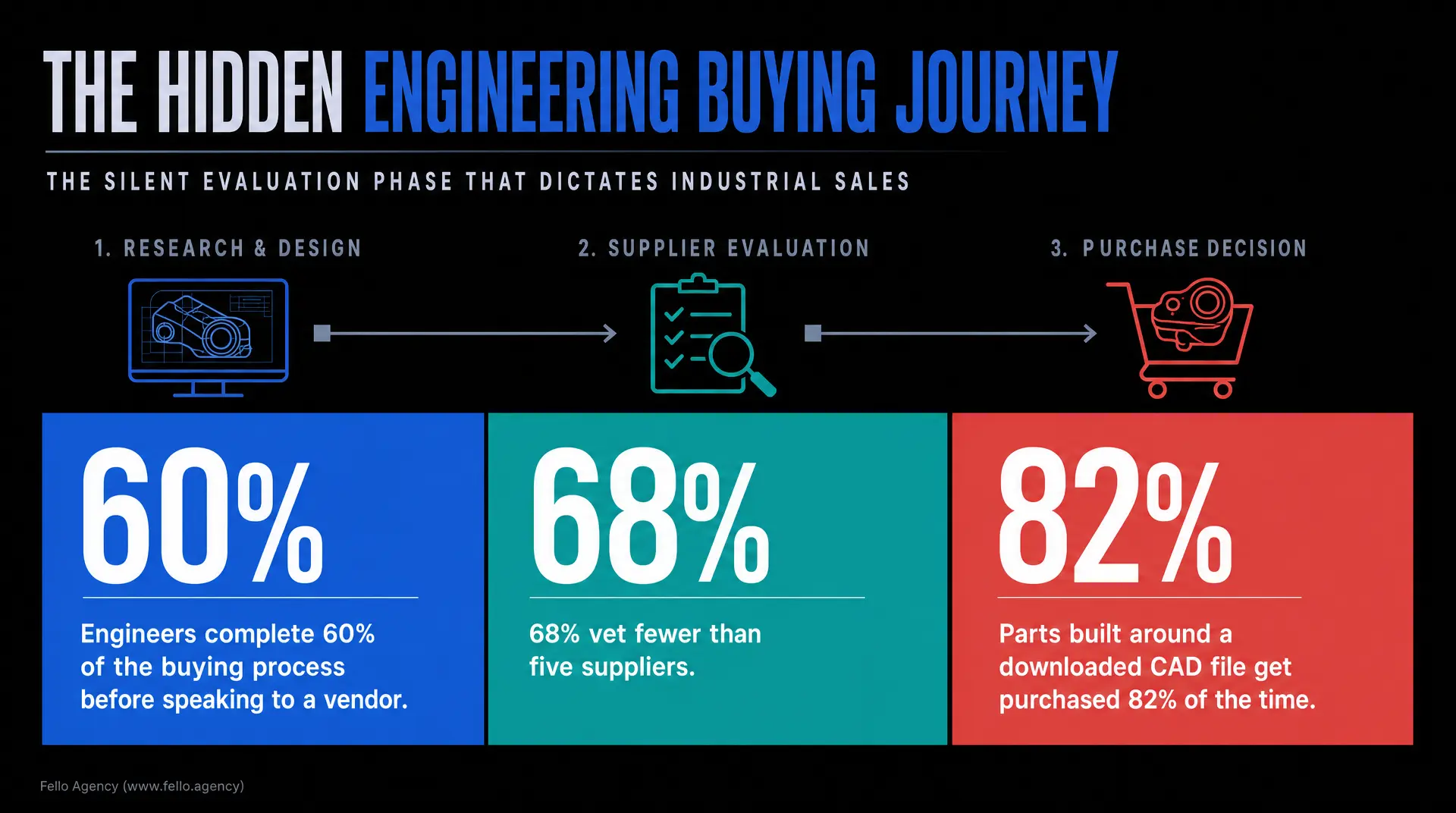
That's the trap in appearance-first briefs. A prettier homepage is visible in the boardroom. The CAD download that never happened is invisible everywhere.
Six questions. Yes or no. No partial credit.
Why Must Manufacturing Websites Provide Pricing Information Without Requiring a Phone Call?
This is number one because it's the biggest gap and the biggest excuse. Every manufacturer tells me their pricing is too complex to publish. Look, sometimes it genuinely is. But there's a huge difference between a full instant-quote engine and what most sites do, which is nothing at all.
You have options across a whole spectrum. Instant quoting if you can automate it. A configurator if your product has defined variables. Published ranges. Even just a starting price: "projects typically start around X."
Here's what happens when you publish nothing. The engineer assumes you're expensive, or assumes you'll waste their time, and they go to the competitor who gave them a number. You didn't lose that deal on price. You lost it in silence.
The shortlist is less forgiving than most marketing leaders assume, too. In Thomas's survey of 401 industrial buyers, 68% vetted fewer than five suppliers. One silent cut and you were never in the deal at all.
Your sales team might tell you pricing calls are "engagement." I'd push back on that. Among technical buyers, 40% say pricing or inventory questions are what finally push them to contact a salesperson. A lot of those calls exist only because you hid the number.
Mosaic Manufacturing does an incredible job here. The way they talk about materials, the way they communicate ROI on their machines - it's marketing done in the right era with incredible tech. When we reframed Mosaic's messaging with videos and landing pages built for their different segments, inbound leads jumped 25% and booked meetings rose 15% inside two months. Clear numbers moved that pipeline.
How Do Ungated CAD File Downloads Impact Manufacturing Component Sales?
If you make components, this is table stakes, and a shocking number of sites fall flat on it. I've had multiple clients, especially ones under NDA, get asked this exact question: can I download the CAD file?
The engineer is sitting in SolidWorks. They want your model in their assembly. Every step you put between those two things - a form, a login, "email sales for files" - is a step where they just use someone else's part instead. And it compounds, because once your model is in their assembly, you're specced in. Then you get priced into the whole program. For a component supplier, that's the whole game.
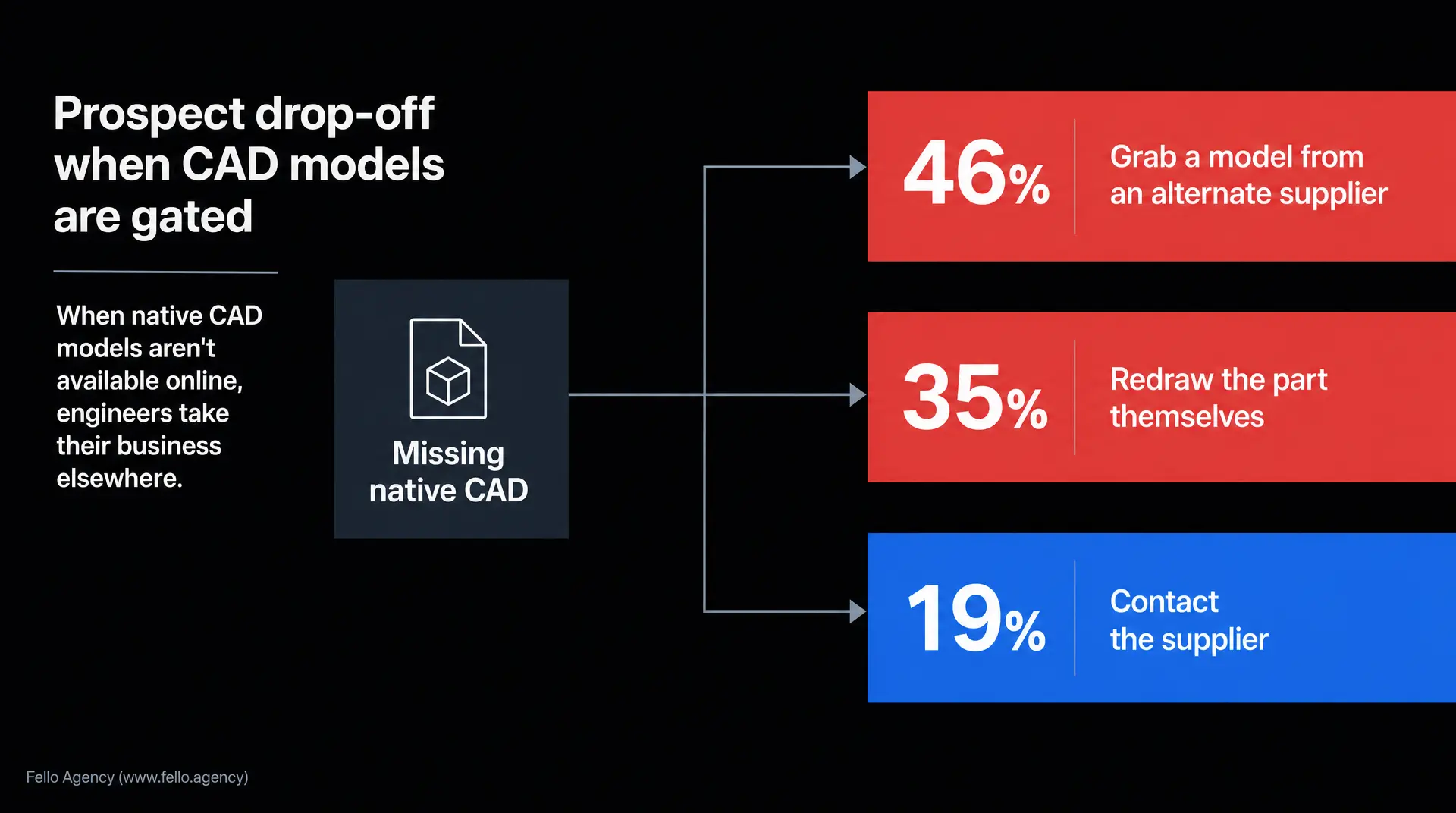
The numbers on this are almost absurd. Engineers report that when they download a CAD file, the physical part ultimately gets purchased 82% of the time. And when CADENAS asked engineers what they do if native models aren't available online, 46% grab a model from an alternate supplier, 35% redraw the part themselves, and only 19% contact the supplier. Gate your files behind a form and roughly four out of five prospects vanish without ever talking to you.
The CAD download isn't a nice-to-have on your resource pages. It's a primary conversion event, and almost nobody treats it like one. Check whether your stack even tracks it. Most marketing teams obsess over demo requests while the strongest intent signal a technical buyer can send goes completely unmeasured. Fix that and a chunk of your attribution problem fixes itself.
The best version of this: let them configure the part inside your own CAD environment, so they never have to leave at all.
Why Must Manufacturing Specifications Use Real Numbers Instead of Marketing Adjectives?
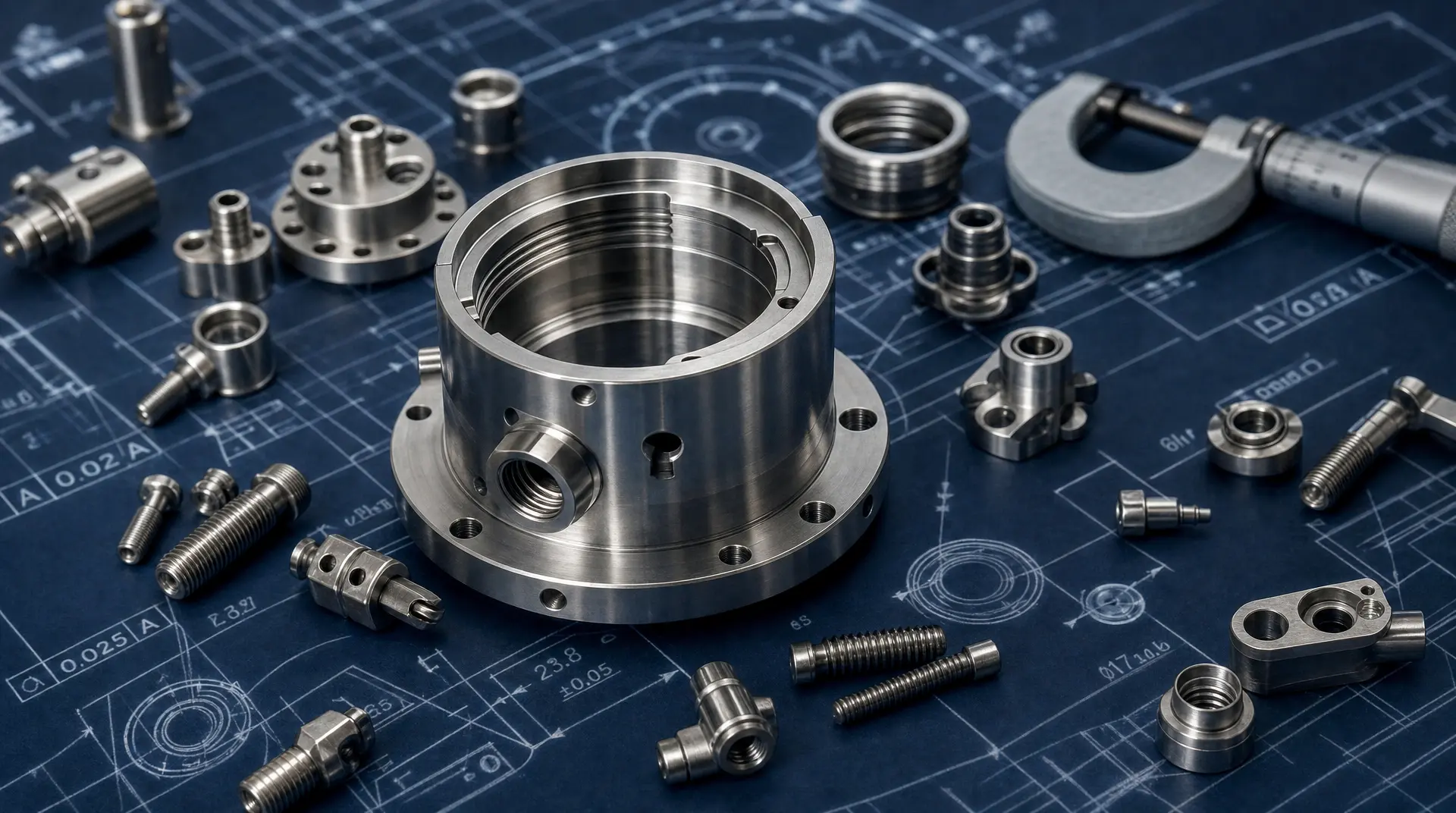
I talk to engineers all the time. We work with some of the most innovative companies in tech, and there's one question they keep asking: "Are the specs real?"
By real, they mean numbers in a table. Tolerances. Material properties. Lead times. Capacity. Not a paragraph that says "precision engineering to the highest standards."
Engineering reads a tolerance the way I read a price. It's a number that tells them whether this is a conversation worth having. And there's a telling gap between average sites and good ones. Most publish one blanket tolerance for everything. The good ones publish tolerance per material, per thickness, per process. The level of specificity itself is a credibility signal. It proves you actually know your process.
Buyers confirm it. Technical buyers ranked datasheets as their most valuable content format for significant purchases, at 79%. Generic marketing copy didn't crack the list.
A lot of manufacturers can't name specific parts because of NDAs. Fine. Use case studies and go broader on the material, but keep the numbers real. If your capability page is adjectives, you've got an adjective problem, not a design problem.
Where Should Manufacturing Websites Display Quality Certifications for Engineering Buyers?
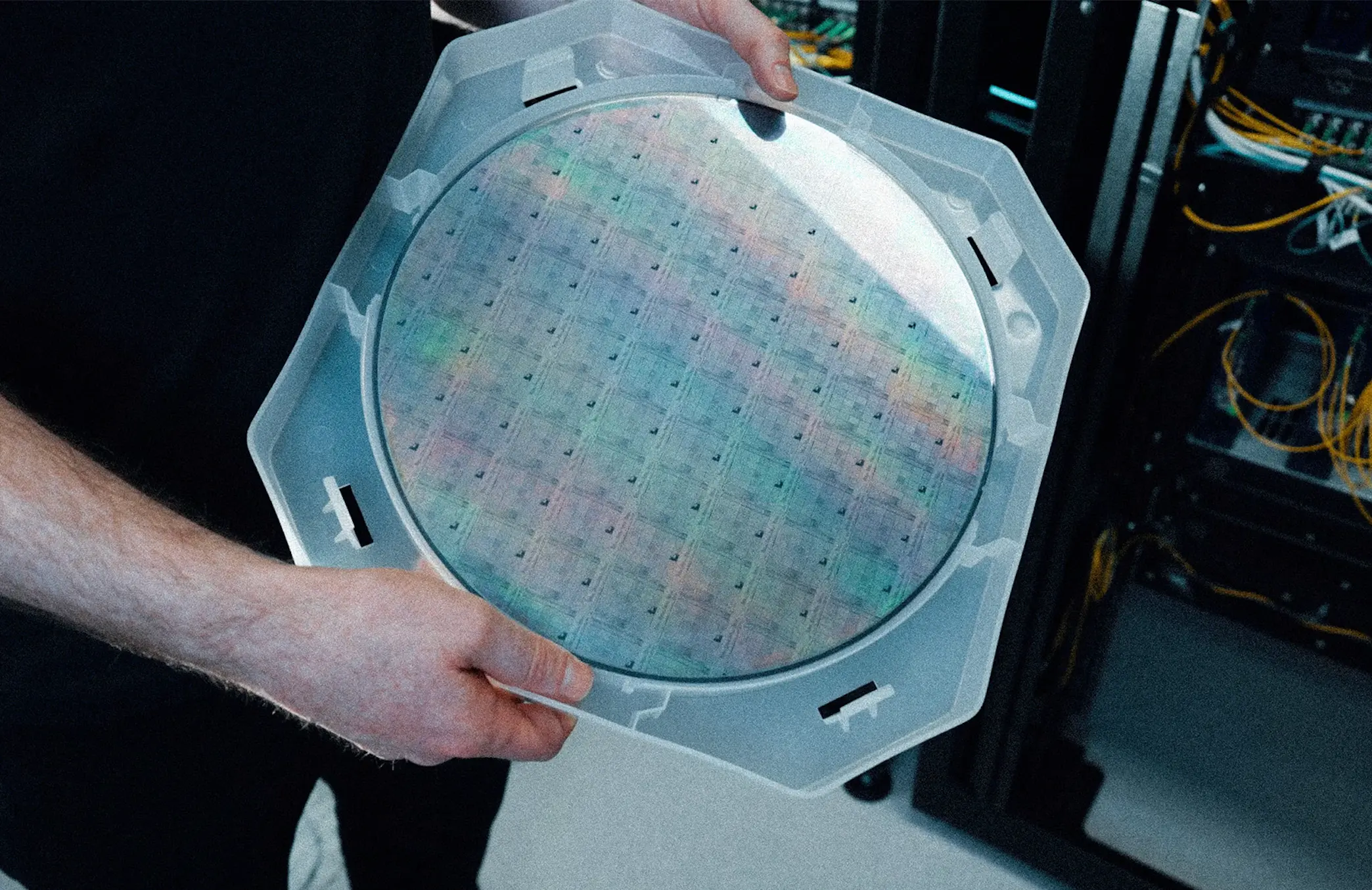
This is the one I'd fix this afternoon if I only had an afternoon.
If you sell into aerospace, medical devices, or defense, your certifications aren't a trust badge. They're the qualifying question. ISO 9001. AS9100. ISO 13485. ITAR registration. CMMC. An engineer holding a regulated part filters on those before reading anything else, and industrial buyers rank quality certifications among their top three supplier-selection factors, right beside lead times and price.
Defense makes the stakes obvious. The DoD's CMMC rule covers a Defense Industrial Base of roughly 220,000 entities. In a pool that size, "what's your compliance status" is a two-second homepage check, not a discovery-call question. Bury the answer and you've been filtered out before your sales team ever gets a shot.
What kills me is that most manufacturers already hold these certifications. They spent real money earning them, then buried them in the footer or on an About page nobody reads. Put them where the filtering happens - homepages, capability pages, quote pages. You're not bragging, you're answering. And you're letting a wrong-fit prospect part ways before anyone wastes a meeting on it.
Our client InGen is the model: credentials up front, before anyone gets asked to fill in a form. Answer the qualifying question first. Earn the contact details second.
Why Should Manufacturing Websites Provide Automated Design-For-Manufacturing Feedback?
Question five separates the companies selling millions of dollars of parts from the ones just starting out.
The best manufacturing sites do engineering work for the visitor before any money changes hands. We work with a client that sells incredible manufacturing machines, and inside that business sits an unadvertised consulting operation that does exactly this kind of work for customers. Our advice to them, and to clients like them: put a slice of that expertise directly on the site. Design-for-manufacturing feedback on an uploaded file. Bend calculators. Minimum feature size guides. Wall thickness rules. Charts showing what your process can and can't hold.
Two things happen when you do this. One, you save yourself a pile of unquotable RFQs, because bad designs get filtered before they reach your team, and your application engineers stop burning hours quoting parts that were never going to work. That's a sales-alignment win your CRO will feel within a quarter. Two, and this is the big one, you've demonstrated competence instead of claiming it. Anyone can write "our engineering team is world-class." Very few will publish the rules that actually prove it.
There's a softer payoff underneath. A working tool tells a skeptical engineer you give a shit about their time before you've made a dollar off them. In a sector drowning in identical capabilities pages, that alone makes you memorable.
What Type of Verifiable Proof Do Engineers Require on Manufacturing Websites?
Most manufacturing proof is unfalsifiable. "Trusted by industry leaders." "Decades of experience." "Committed to quality." An engineer's brain filters that out completely. It's noise.
Specific proof is a named customer, a real number, a verifiable claim. A case study with a tolerance in it. A result like "improved by 95% for this named company." The honest version is that a logo gets you the meeting, but it doesn't get you specced in. What gets you specced in is a number an engineer can go away and verify.
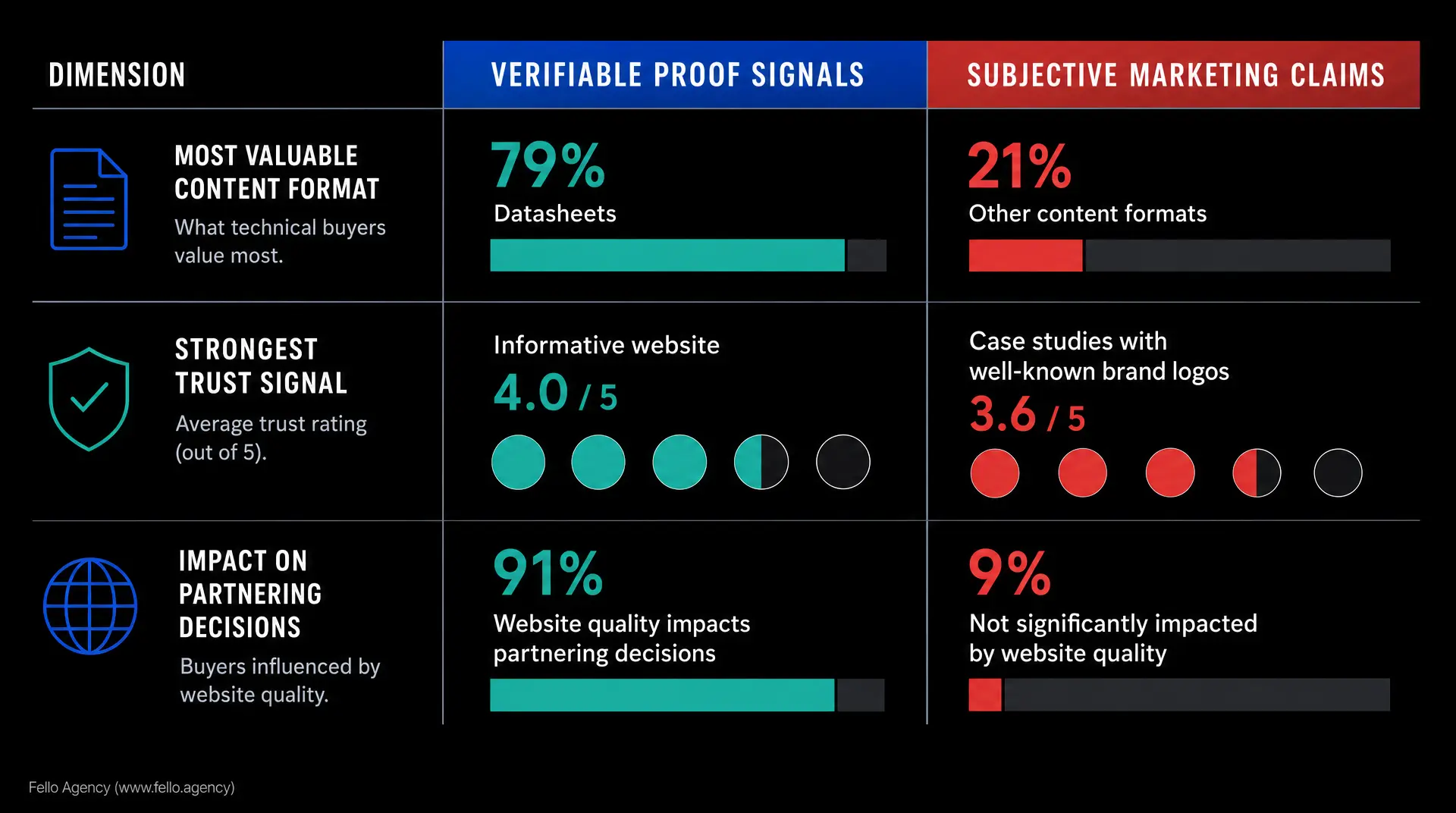
The research backs this inversion. In TREW's credibility rankings, technical buyers rated an informative, well-maintained website the strongest trust signal at 4.0 out of 5, ahead of case studies with well-known brands at 3.6. The substance on your own pages outranks borrowed prestige from a famous logo wall.
Run every claim on your site through that verification filter and watch how much of your current copy evaporates.
How Can Companies Objectively Score Their Manufacturing Website Design?
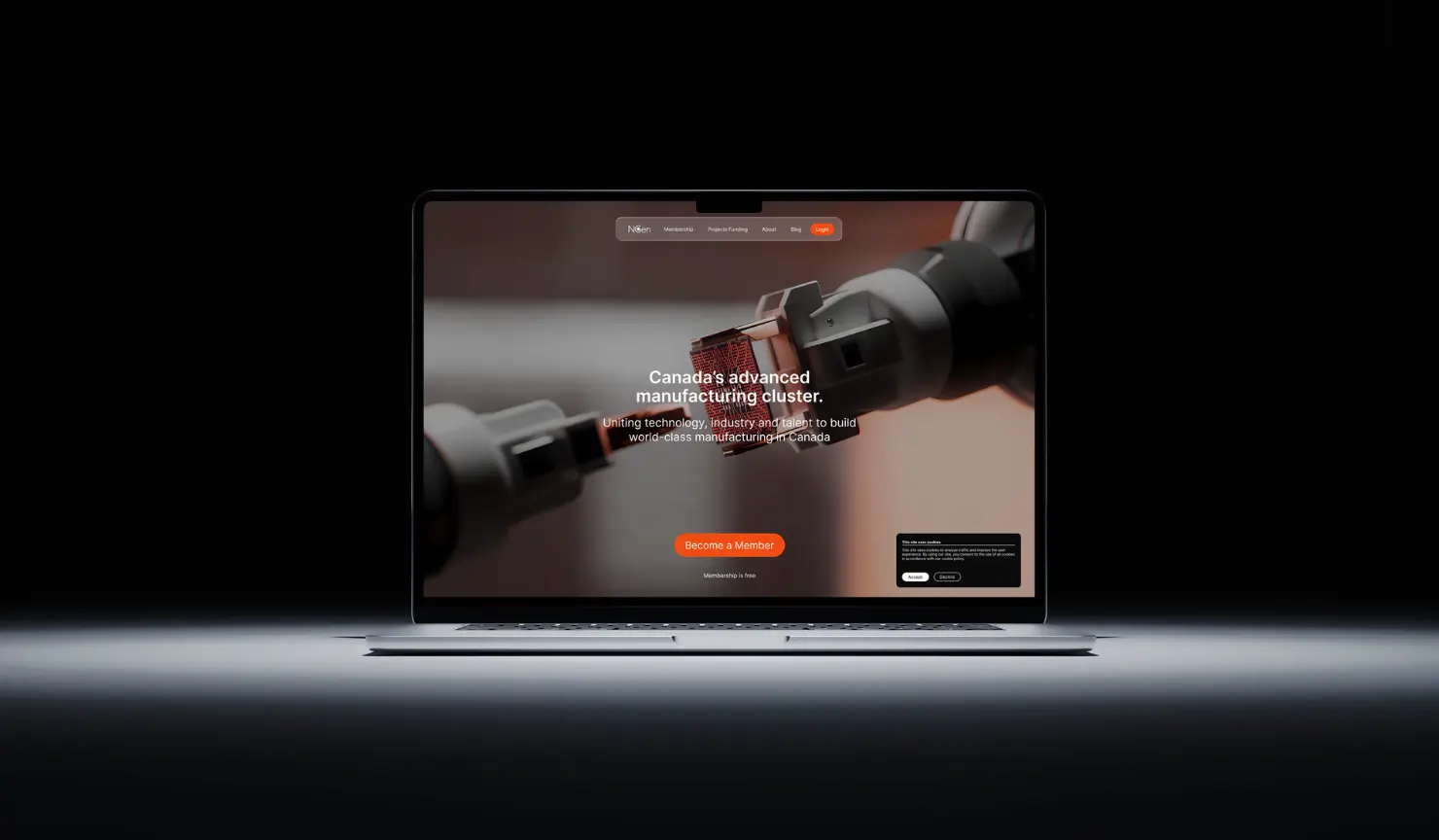
Open an incognito window and run all six questions as if you've never heard of your own company. That's the only honest way to do it. No partial credit. "It's on the About page" is a no. "Sales can send that over" is a no. If the engineer can't finish the job on the site, it's a no.
What Is the Financial Cost of a Low Manufacturing Website Design Score?
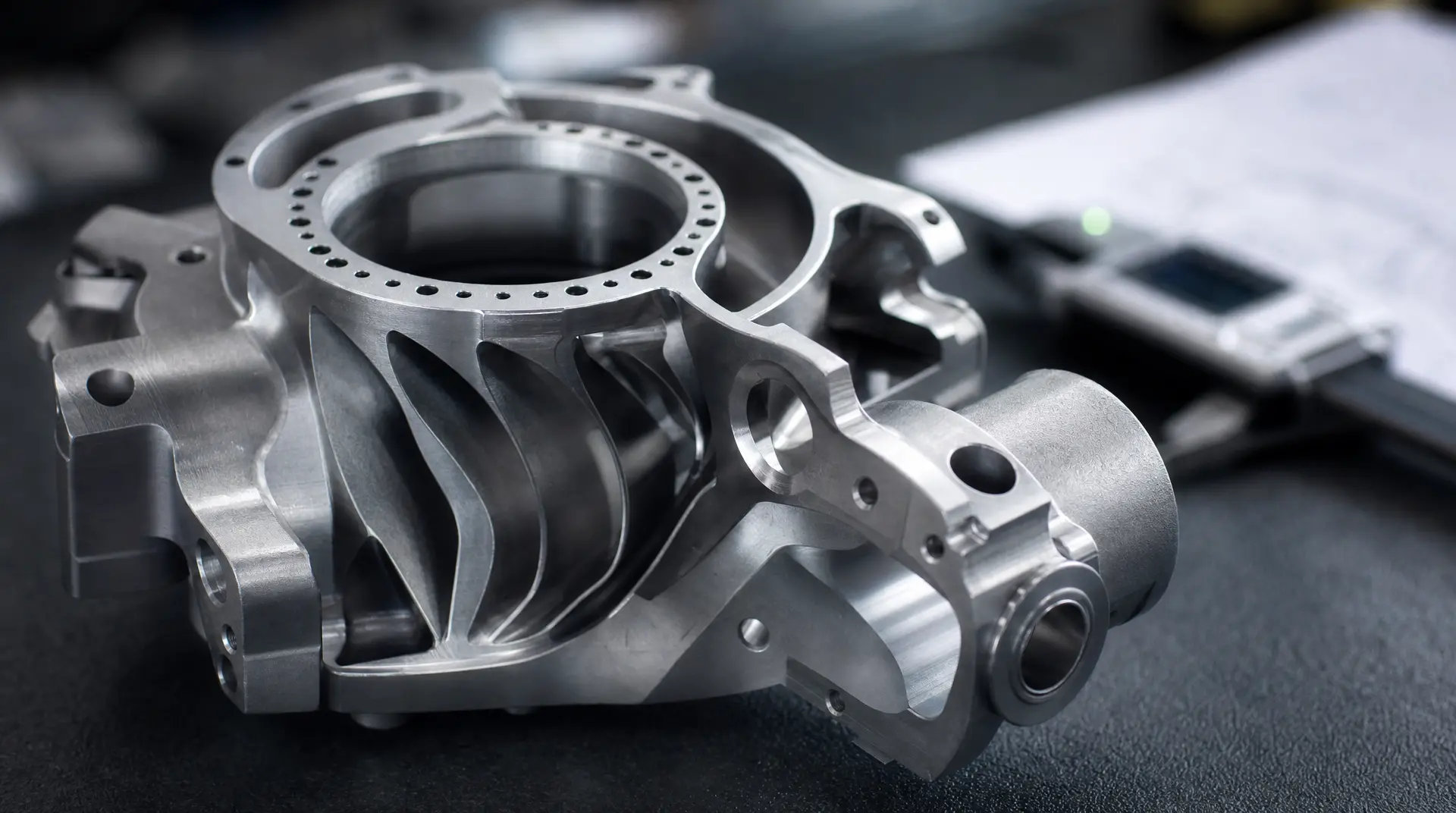
Most manufacturers land on two or three, and I've watched what that number costs in the real world.
We worked with a company that almost did a deal with Amazon. The work was real. But they had no legitimate design capability system behind it, and honestly, they looked like a joke. The manager at Amazon wasn't willing to risk his neck putting them in front of his boss. Deal gone. No lost-deal reason in the CRM, no competitor to blame. Silence again.
Behind every engineer scoring your site sits a mid-level champion deciding whether you're safe to recommend internally. In Thomas's industrial buying research, 91% of buyers said the quality of a supplier's website impacts their decision to partner, and 40% said it matters "a lot." Every "no" on this test hands that champion one more reason to protect their own reputation and pick someone safer.
What Is the Financial Return on Investment of Optimizing a Manufacturing Website?
I tell clients constantly that your website needs to speak business. For a manufacturer, speaking business to an engineer means speaking in numbers. Prices, tolerances, certifications, verifiable results.
And the fixes rarely require the six-figure redesign sitting in your draft brief. Publishing a starting price takes one internal meeting where somebody finally overrules the "too complex" objection. Moving certifications onto the homepage is an afternoon of work. Tolerances per material and process is a content exercise with your engineering team, because the knowledge already exists in-house. The bigger builds, like a CAD library or a DFM tool, become assets that qualify buyers every single day. And in 18-to-24-month sales cycles, every early filter compounds. The advanced move we run with manufacturing clients is publishing technical content so specific it helps buyers write their future RFPs.
Every fix pays off in the metrics you actually answer for. Prospects arrive pre-qualified, so lead-to-opportunity conversion climbs. Engineers spec you in earlier, so cycles shorten. The pipeline you were losing invisibly finally becomes visible, and attributable.
Score your site tonight. Fix the cheapest gap first. And take this stuff seriously, because your competitors will, and they will win the deal.
Frequently Asked Questions
How do manufacturing CMOs prove the revenue impact of a website redesign?
Stop reporting on traffic and start tracking invisible pipeline. When 91% of buyers say website quality dictates their partnership decisions, a redesign isn't cosmetic - it's a revenue engine. Tie the investment directly to shortened sales cycles, higher lead-to-opportunity conversions, and fewer unqualified RFQs hitting sales.
How should marketing teams track ungated technical content for pipeline attribution?
Map intent signals, not form fills. Technical buyers rank datasheets as their most valuable format at 79%, but gating them kills your reach. Instead, use reverse-IP tracking and CRM integrations to monitor which accounts consume specs. When sales closes the deal, that account-level data proves your marketing influence.
How can manufacturing website design fix sales and marketing misalignment?
Build a digital filter that stops bad leads and accelerates good ones. When 40% of technical buyers contact sales merely to ask about pricing, you're wasting your CRO's headcount. Upfront price transparency and self-serve configurators instantly improve lead quality, stripping out friction and forcing true sales alignment.
Which interactive website tools generate the strongest purchase intent signals?
Tools that help engineers finish their jobs are your highest-intent signals. Technical buyers value parametric search tools (66%) and product configurators (44%). When an engineer configures a part or filters specific tolerances, they aren't browsing - they are actively speccing you in. Track these interactions obsessively in your CRM.
Should marketing budgets prioritize third-party publications or our own manufacturing website?
You need both, but your website is the true conversion engine. Technical buyers rely equally on trade publications and supplier websites (73%). Publications buy rented top-of-funnel awareness, but your website is where CAD downloads, price checks, and actual buying happen. Fund your owned conversion point first.
Your Creative Partner for Innovation That Matters
From advanced tech to transformative healthcare, Fello helps visionary teams shape perception, launch products, and lead industries.

Let’s keep in touch.
Discover more about high-performance web design. Follow us on Linkedin and Instagram.

