

If you lead marketing at a tech company and you want government revenue in 2026, you need to reset the playbook.
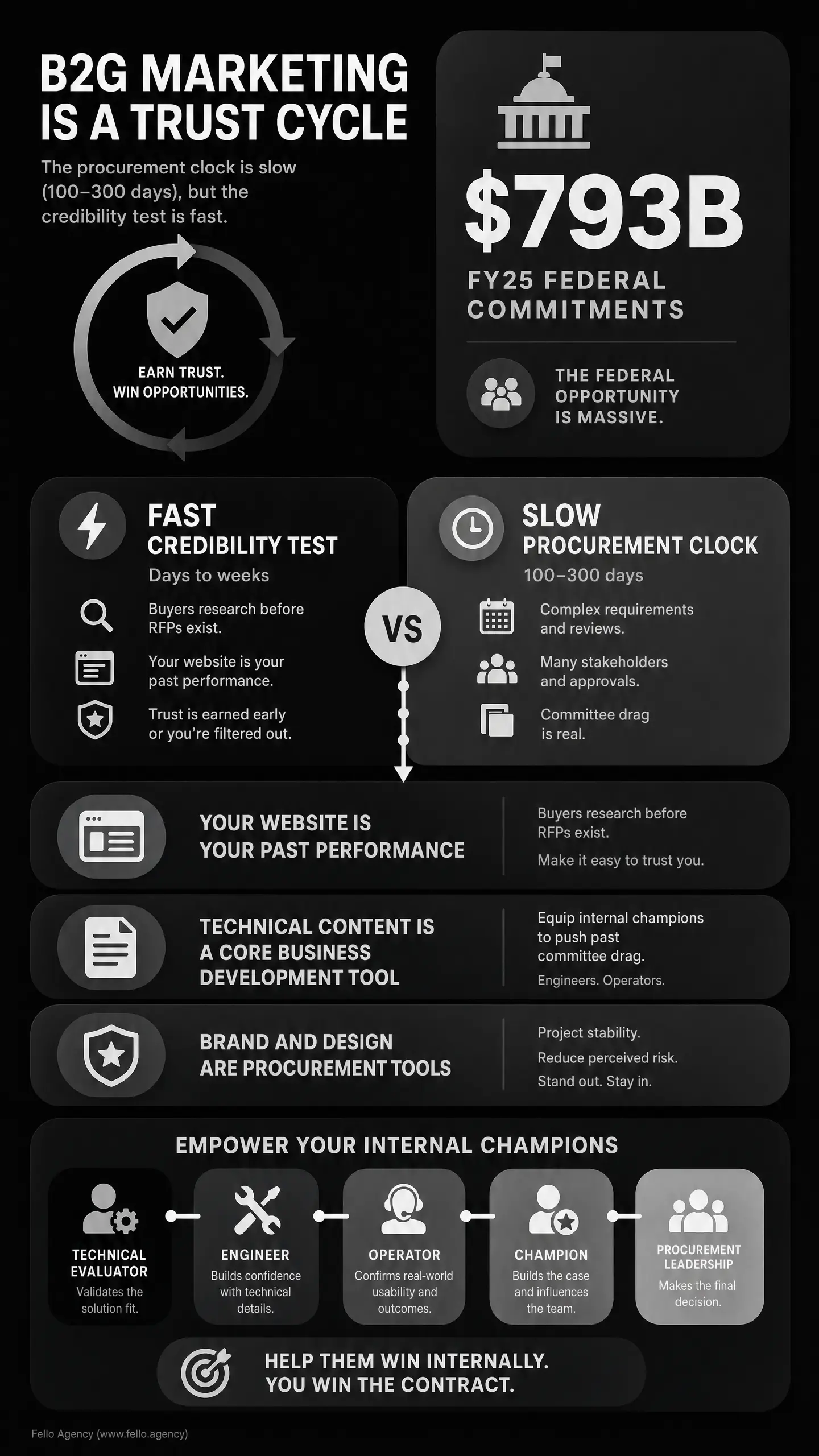
A lot of teams still treat B2G like enterprise SaaS with more paperwork. I don’t. I look at it as a trust cycle. The procurement clock is slow. The credibility test is fast.
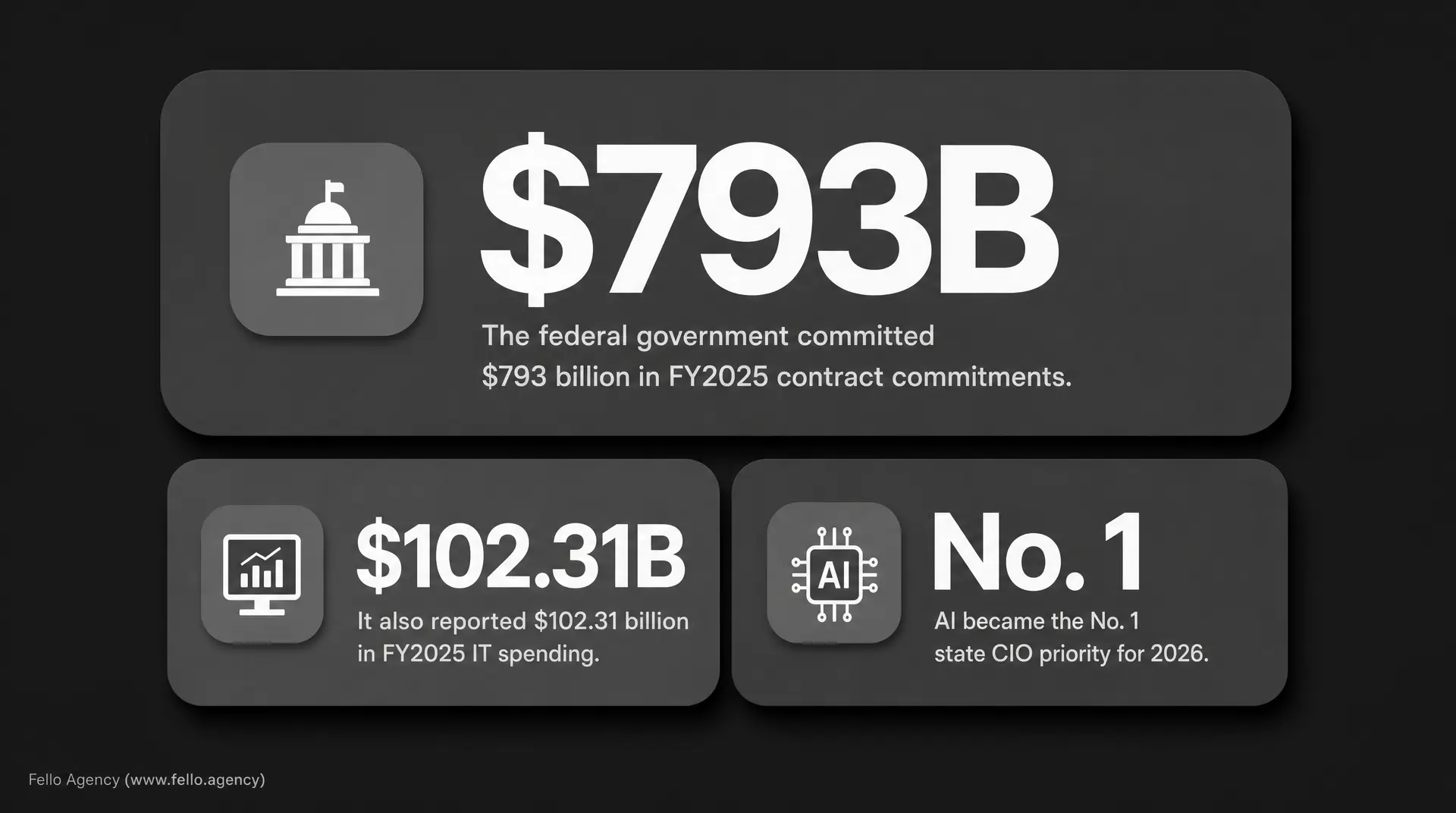
The opportunity is massive. The federal government committed $793 billion in FY2025 contract commitments. It also reported $102.31 billion in FY2025 IT spending. On the defense side, the FY2026 DoD budget request keeps serious money moving through procurement and RDT&E. And outside federal, the pressure is growing too. In a survey of 51 state and territory CIOs, AI became the No. 1 state CIO priority for 2026.
So yes, the market is there.
The issue is whether your company looks credible enough, clear enough, and stable enough to get invited into the conversation.
At Fello Agency, I help companies in AI, robotics, quantum, advanced manufacturing, medtech, XR, and defense translate complex technologies into brands, marketing systems, and go-to-market traction. If you’re reading this, I’m going to assume you already know brand matters. I don’t spend a lot of time convincing skeptics anymore. The better question is this: how do you make brand, web, content, and sales enablement actually pull their weight in a B2G motion?
That’s what this guide is about.
B2G Is a Trust Cycle Long Before It Becomes a Contract
One thing I want every CMO to internalize is this: buyers are looking before the RFP exists.
Agencies are required to do market research before new requirements are written. That matters. It means your company is being screened before formal procurement starts. People are Googling you. They are asking around. They are comparing your digital presence to companies they already trust.
That is why I keep saying your website is your past performance.
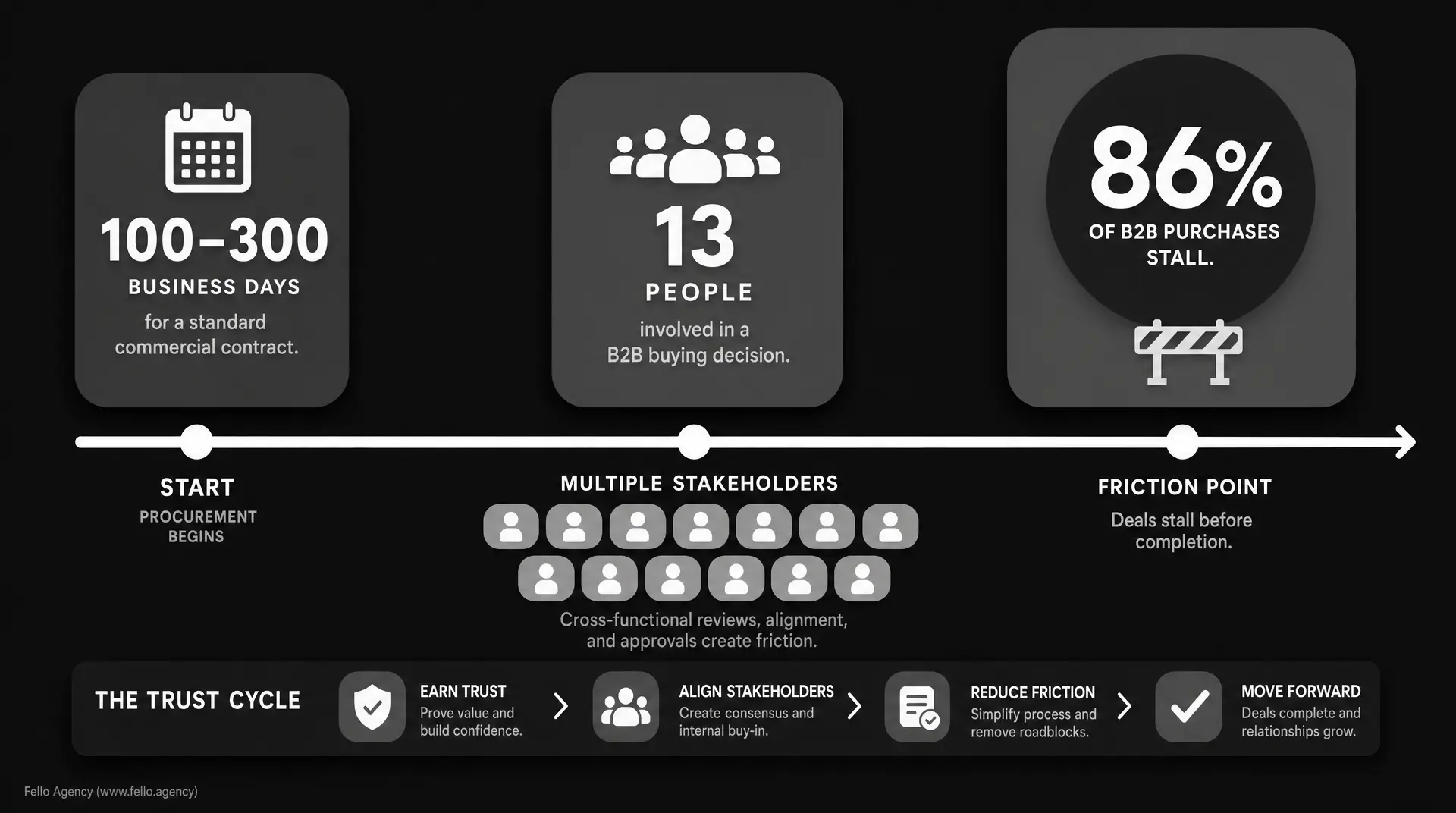
Formal procurement is also slow by design. GSA’s own timeline shows 100 business days for a standard commercial contract after the package and funds are accepted. Some paths can stretch to 300 business days. You do not control that clock. You do control whether your company looks trustworthy enough to survive it.
And then there’s committee drag. It’s real. Forrester found an average of 13 people are involved in a B2B buying decision. It also found 86% of B2B purchases stall. In B2G, that friction gets worse when nobody inside the buyer’s organization can explain your value in a way that leadership, finance, procurement, and operations can all repeat.
That’s where marketing comes in.
Your job is to instill trust before sales ever starts pushing. Your job is to make the business case obvious. Your job is to give your internal champion a boardroom-ready narrative so the pilot doesn’t die in committee.
Most B2G Marketing Targets the Wrong Layer
A lot of teams still market to procurement first. I think that’s backwards.
A lot of the time, the person who signs the contract isn’t the person who found you. It’s an engineer. An operator. A mission planner. A technical lead. Somebody who whispers your name upstream and says, “We should talk to these guys.”
That person matters more than most B2G marketing plans admit.
I’ve seen this play out in manufacturing. We’ve helped credible manufacturing companies move into lucrative government work tied to countries upgrading infrastructure. A lot of the early momentum came from how the company showed up. The story. The assets. The clarity. The material gave someone inside the buyer organization something they could actually forward.
That is why technical content is one of the best business development tools in this space. Not because it makes the marketing team feel smart. Because it moves through organizations.
In most B2G deals, you’re serving several audiences at once. The technical evaluator wants proof, integration detail, and clean documentation. The business decision-maker wants ROI, timeline, and a clear operational outcome. Procurement wants stability, compliance, and confidence that your company won’t become a risk. The end user wants to know the thing will actually work in the field.
One generic hero message won’t carry all of that.
This is where a lot of robotics and dual-use companies get jammed up. They put one broad line on the homepage and hope the rest sorts itself out. Then sales spends half the call explaining what the company is not. That’s a positioning failure baked into the identity. I’ve said before that pilot purgatory is usually a branding problem, not a tech problem. The internal champion can explain the feature set. They cannot explain why leadership should scale it.
When that happens, the pilot stalls. The brand didn’t equip the buyer with the story.
So start there. Ask yourself who actually discovers your product first. Then build for that person.
Your Website Is Your Past Performance
I say this a lot because it’s true.
Your website is your past performance.
Yes, CPARS is the formal record once contracts exist. It is the official governmentwide source for past performance information. But before any buyer gets there, they hit Google. A contracting officer. A program manager. A prime. A technical evaluator. Somebody is checking whether you feel real.
Government buyers pattern match for stability. If your site looks like a startup that launched last year, you are making the buying process harder for everybody inside that account.
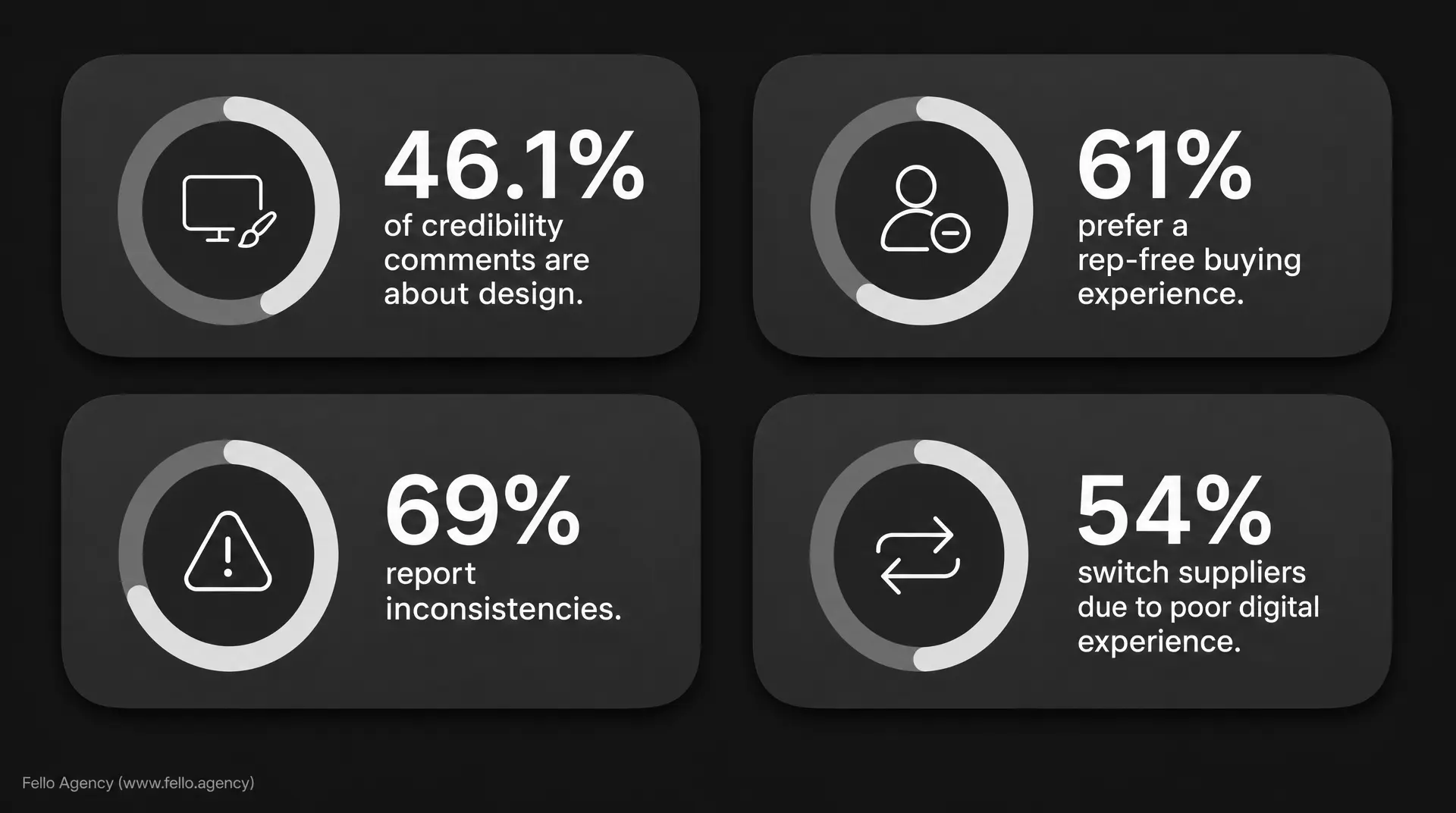
There’s data behind this too. Stanford’s credibility research found 46.1% of credibility-related comments were about design look. That means layout, typography, font size, and color. Before the buyer has even read the copy, design is already doing commercial work.
And buyers want to self-serve more than most teams think. Gartner found 61% of B2B buyers prefer an overall rep-free buying experience. It also found 69% report inconsistencies between supplier websites and seller-provided information. That gap kills trust. McKinsey sees the same thing from another angle. Buyers still split into a rule of thirds across in-person, remote, and digital self-service channels. And 54% of B2B customers say poor digital experiences push them toward switching suppliers.
So what does a strong B2G website do?
It handles a whole slew of things very quickly. It shows a credible visual world. It states the outcome before the mechanism. It makes proof easy to find. It points the buyer to the next step. If you’re dual-use, it splits the path early so commercial and defense visitors do not get trapped in the same story.
A lot of teams lead with the heavy stuff. Acronyms. Specs. Internal language. They put the mechanism above the fold and hope the buyer works out the value. I wouldn’t. Sell the sizzle, not the steak. Lead with the mission outcome. Keep the technical depth lower on the page, inside the product sections, the docs, the brief, the capability deck.
I’ve used this example before because it’s clean. An autonomous inspection drone company can lead with SLAM algorithms. Or it can lead with preventing pipeline shutdowns. One sounds clever. The other wins RFPs.
The same logic applies in space. Founders love talking about the satellite. I care more about the outcome the data reveals. The satellite is the delivery mechanism, not the value.
And in the new dawn age of AI, buyers spot bullshit a mile away. They see the same stock image. The same AI-generated layout. The same empty gradient. Credibility drops instantly. Human design credibility still matters.
If you’re asking someone to spend millions, you are a Michelin star restaurant. Every page, every photo, every font, every CTA has to imply a top-tier experience. At any given moment, a life-changing deal could come in. Be ready.
I’ve seen this play out directly. For Sphere, tightening the brand guidelines and updating the website drove an immediate 50% lift in traffic. The bigger rebuild pushed further. Alexandra Corey, Head of Marketing at Sphere, said it plainly: “The new website has more than tripled our lead generation efforts.” I’ve also seen a haptics company need a full rebrand in a month and a half because CES meetings with OEMs were on the line. The reason was simple. They needed the market to believe them the second they showed up.
B2C Habits Are Already in the Room
One shift CMOs need to take seriously is the B2C-ification of B2G.
A younger generation of buyers, operators, engineers, and procurement people grew up with polished consumer products. They carry those expectations into work. They scroll fast. They compare fast. They subconsciously decide whether you’re legitimate before they read much.
That’s why companies like Anduril and Shield AI stand out. They understand communication strategy. They understand a lifestyle layer. They understand visual confidence. Anduril can run loud campaigns and still keep a black-and-white institutional core. That combination works because it feels modern without losing authority.
This matters for talent too. Top engineers and operators quietly judge companies by their brand long before they apply. If your careers page looks old or your pitch deck feels like a grad school project, you lose candidates and you won’t even know it.
Rocket Lab is a great example of how consistent, high-quality content can attract engineering talent. I’ve seen the same principle with smaller companies. A founder in aerospace and defense told us the concept visuals we created “helped me attract engineers to join my team.” That was before a physical product was ready. Brand did real commercial work there. It helped recruiting. It helped legitimacy. It helped the company move faster.
Your future buyers, partners, employees, and investors all see the same signals. Keep them clean.
Brand and Design Are Procurement Tools

When I say brand, I mean the feeling somebody has when they see your company.
In B2G, I want that feeling to be trust, interest, and curiosity. I want them to feel they are dealing with adults. I want them to feel the company is stable, serious, and worth remembering.
That doesn’t come from a logo alone. It comes from the whole system. Your proposal templates. Your quad charts. Your capability briefs. Your org charts. Your decks. Your videos. Your LinkedIn presence. The question isn’t whether the logo is good. The question is whether the system can support the next 20 touchpoints while still looking consistent.
A lot of B2G teams forget this. They build a nice homepage and then drop the ball inside the proposal itself. I think that’s a huge miss. The brand system needs to work inside of a 60-page proposal, not just your homepage. That’s where a lot of the real credibility gets tested.
Formal trust signals matter too. As of May 2026, the FedRAMP marketplace listed 515 certified services. On the defense side, CMMC Level 2 is built on 110 NIST SP 800-171 controls. Buyers use those signals to screen vendors. Your job is to surface them clearly and make them easy to understand. Say the right amount to the right people without saying too much.
And if you’re in defense, be careful. Controlled does not mean classified. Public AI tools can create a deemed export risk if controlled technical data goes in. Your content team needs rules. Not vibes.
Visually, I’m seeing a strong pattern in 2026. A strict black-and-white palette has become one of the clearest signals for high-value innovation. I’ve called black an empty vessel that adapts. It feels premium. It feels serious. We even made that shift ourselves at Fello. We moved from purple and black to a cleaner white, black, and gray system because we wanted more immediate trust. We got it.
Typography matters too. Buyers spend very little time on a page. Fonts become a subconscious legitimacy filter. IBM Plex is fantastic for infrastructure, enterprise, and quantum because it balances engineering logic with human rhythm. Helvetica Now works well in defense because it can blend institutional authority with modern precision. Space Grotesk is strong when you want the signal to innovation.
I’ve seen typography fix tone in a very real way. We had a manufacturing and medical device brand that felt off until we applied IBM Plex. The whole thing suddenly shouted professionalism. With Revanesse, we kept the science-led black-and-white base, then added orange light in the lab visuals so the brand felt clinical without becoming cold.
That’s design doing commercial work. Design is a commercial gatekeeper.
Technical Content Is One of the Best Business Development Tools

A lot of people still talk about content like it’s a vanity layer. I don’t.
Technical content is one of the best business development tools in B2G.
I’m talking about white papers, capability overviews, mission-specific one-pagers, technical briefs, and short videos that explain the value cleanly. These aren’t usually thought leadership vanity plays. They’re materials that get attached to internal emails and forwarded to project managers. They help your champion do their job.
That is the standard.
Your content should speak engineer and executive at the same time. It should make the invisible visible. It should help the technical evaluator feel respected while helping the budget holder understand the commercial reality.
We’ve done this in a lot of different sectors. With Nord Quantique, we turned dense quantum mechanics into a visual narrative. The result was an 80% surge in web traffic in six weeks and double the social engagement. The science didn’t get dumbed down. It just became easier to carry.
With ACTO, we built explainer videos that the commercial team could use to educate the market without relying on screenshots or product tours alone. Wafa Sayeed-Irtiza, their VP of Marketing, put it perfectly: “Both marketing and sales teams couldn’t wait to start circulating the videos in campaigns and outreach.” That’s what you want. Good content gets used.
This is also where all modern companies being media companies really starts to matter. I treat LinkedIn less like a direct lead engine and more like a buyer verification layer. LinkedIn’s own data says employee networks are about 10x larger than company-page audiences, and employee-shared content tends to drive 2x the click-through rate. So use your people. Founder posts. CTO posts. Engineer insight. Real team content. Buyers trust technical voices. Edelman found scientists are trusted by 74% of Americans. That should tell you something.
Long cycles need a steady drumbeat too. In aerospace, defense, and heavy deep tech, I like monthly video updates and lab tours. They make prospects feel like internal stakeholders. They help justify the price tag. They also keep the company top of mind during the dead space between meetings.
And one more thing. Show the real thing whenever you can. Technical buyers want authenticity. Stock imagery kills trust. Over-polished vaporware kills trust. If you need renders because the product is pre-launch or controlled, pair them with real-world context and real process. That is how you keep the experience legitimate and absolutely won.
Don’t Create a New Category Unless You Have the Runway
A lot of tech teams think they need category creation to win. I usually disagree.
If you are entering B2G and you do not have an 18-month runway and a serious budget, don’t invent a whole new category. Hijack an existing one.
Buyers search for known problems. Budgets are already organized around known problems. Procurement language follows known problems. If you invent a label nobody searches for, you just made discovery harder and trust slower.
What works better is stepping into a category the market already understands, then sharpening your point of view inside it. If you sell autonomous inspection drones, step into inspection, uptime, asset integrity, or force protection depending on the buyer. If you sell space data, organize the story around insurance, sustainability, planning, or infrastructure outcomes. Keep the hardware in its proper place.
This is also how I think about dual-use. Keep the top of funnel broad enough to catch the right people. Then get specific lower down. On the homepage, split the journey early. Commercial on one side. Defense on the other. Maybe infrastructure as a third path. Then let each audience see its own business case fast.
Brand serves the buyers, not the founder’s ego.
Trade Shows Are Credibility Makers, Not Lead Gen
Look, trade shows still matter. Just measure them properly.
In B2G and defense, they are usually pay-to-play credibility makers. You are there to prove you belong in the conversation.
I had a conversation at Cannes with someone who had been going for about 10 years. His point was dead simple. You have to keep showing up. He was right. The first year people notice you. The next year they remember you. Then the room starts to open up.
That changes how you plan. Your booth, your deck, your reel, your one-pager, and your follow-up pages should all carry the same story. Your presence should feel consistent. Buyers should leave with recall.
For Sphere, the new brand templates and tradeshow assets helped the team show up with much stronger signal. And event content can keep working long after the booth is packed up. A software company we worked with saw its trade-show recap video get 70% more views than its other content. That is useful. It extends the event. It keeps the conversation moving.
So yes, go to the event. Just don’t judge success like it’s a cheap lead-gen campaign. Judge whether you earned credibility.
Prove ROI in the Language the Board Actually Cares About
CMOs do not need another lecture on why brand matters. You need a way to defend the spend.
This is where I change the language. I talk about communication strategy, marketing investment, and credibility infrastructure. I frame the website, the sales deck, the video system, and the brand work around business value. Lower CAC. Better lead quality. Faster trust. Shorter time spent proving legitimacy. More alignment between sales and marketing.
That is how you move marketing from cost center to revenue engine.
In deep tech, a normal B2B sales cycle can run six to twelve months. In government it can go much longer. Strong branding does not erase procurement time. It does compress the messy part at the front. The referral did its job because the website didn’t undo it. The sales team is kind of skipping a level. They don’t have to spend the first half of the call proving you’re real.
I care about influenced pipeline, lead-to-opportunity rate, meeting quality, asset usage by sales, and how often reps have to re-explain the basics. In B2G I also watch brand recall, repeat booth traffic, and whether the right people are reaching out more often.
Sphere is a clean example. The brand and site overhaul drove more than 3x lead generation. Mosaic Manufacturing is another. Once we reframed the story around buyer outcomes and tailored the assets by segment, inbound leads jumped 25% and booked meetings rose 15% in two months. For one field sales software client, a unified mobile-first toolkit replaced scattered collateral. Prep got faster. Reps felt more confident. Conversations became more consultative.
That is sales enablement that actually closes.
You also don’t need to spend like a giant to look credible. For many deep tech startups, I think an initial professional brand investment can start around 15 to 30 thousand dollars. For Series A and B teams moving into enterprise and public-sector buying, a serious rebrand usually lives in the 50 to 150 thousand range. Spend what the scope calls for. Just don’t drift into over-branding. Technical buyers can smell that too.
This is one reason I keep Fello lean. No bloated account teams. Budget should go into the actual work.
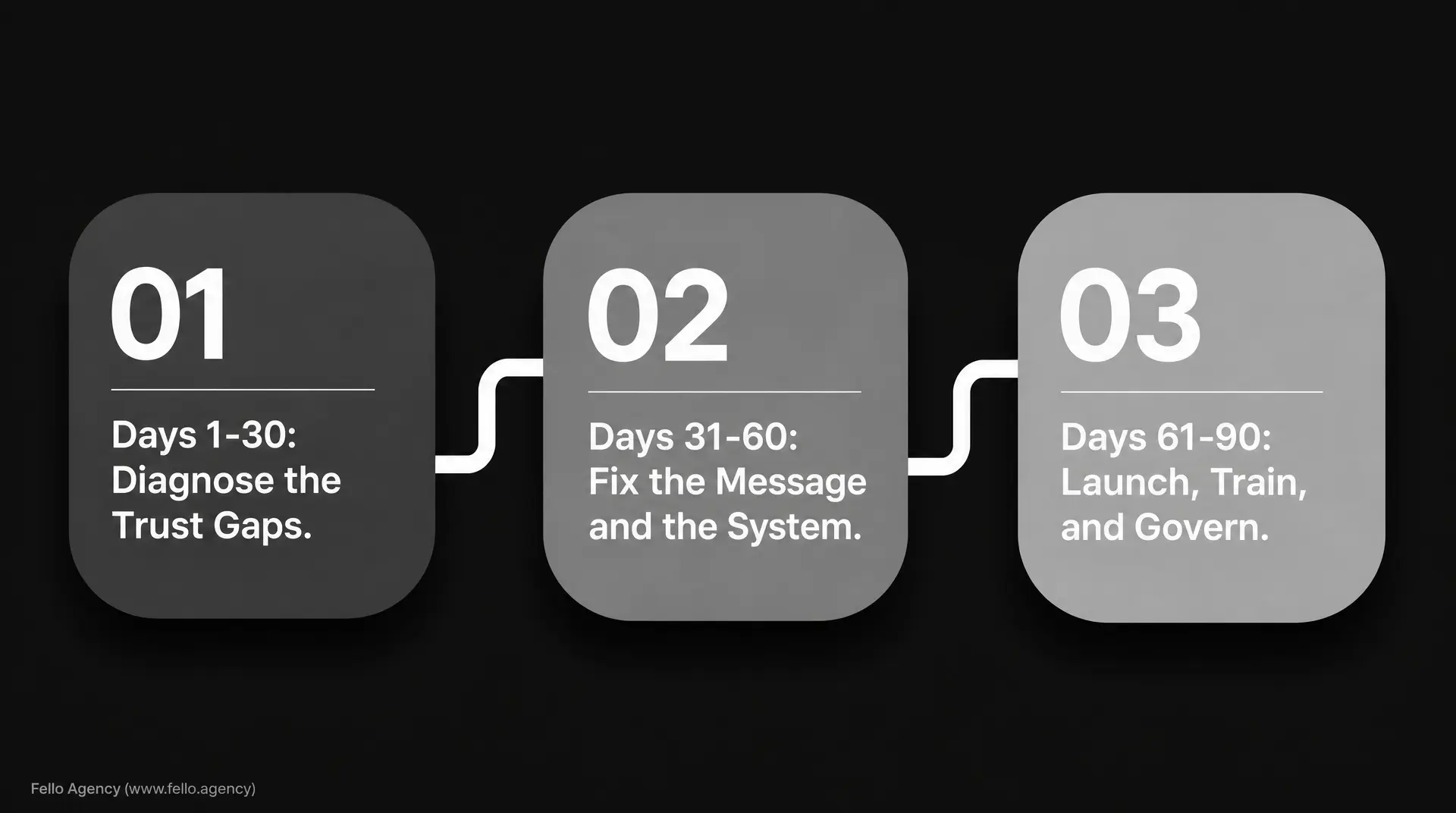
What I Would Do in the Next 90 Days
A lot of go-to-market strategies fall at the brief, not the launch. The internal language never gets translated into buyer language. Then the team blames the channel instead of the architecture.
So if I walked into your team on Monday, here’s how I’d think about the next 90 days.
Days 1 - 30: Diagnose the Trust Gaps
Start with reality. Benchmark five competitors. Interview at least 10 power users. Then work through stakeholders in the order I like: customers first, then sales, then marketing, then leadership. That sequence matters. It gets you out of internal echo chambers and into what buyers actually believe.
Use modern research tools too. Perplexity. ChatGPT. Google deep research. All of it. I have very little patience for teams that say they don’t know the market in 2026. Build the ICP with input from product, customer success, sales, and marketing together. Figure out who gets value the fastest.
Then look for the danger signs. If sales spends more time explaining what you are not than what you are, that gap is a rebrand trigger. If your product has pivoted and the old brand wrapper stayed behind, that gap is a rebrand trigger too.
Days 31 - 60: Fix the Message and the System
Now lock the story. Decide which existing category you are hijacking. Define the core message, the proof points, and the voice pillars. Get direct C-suite sign-off early. Don’t leave that for the end.
Then build a brand kill list. I think this is one of the most underrated tools in the process. Write down what is being removed. Old phrases. Old slides. Old visuals. Old naming. Old decks. If you don’t kill the legacy stuff on paper, it keeps leaking back into market.
From there, rebuild the surfaces that matter most. The homepage. The key landing pages. The capability brief. The proposal shell. The executive deck. The LinkedIn presence for leadership. If you’re dual-use, split the journeys early. If you’re selling technical systems, lead with the business outcome and put the heavy technical depth where it belongs.
Days 61 - 90: Launch, Train, and Govern

Once the system is ready, train the team hard. Sales, marketing, and leadership all need the same communication strategy. One of the clearest signs a brand project worked is simple: everybody in the company starts telling the same story.
Then update the rest of the environment. Proposal templates. Partner pages. Docs. Third-party listings. G2. Crunchbase. Anywhere the buyer may check. If the brand changed inside software, roll it out carefully and track whether adoption improves.
For full rebrands, I use a longer 20-week framework that runs through discovery and audit, strategy, design and build, migration and launch, and post-launch measurement. But even inside 90 days, you can get the core system live if you move 10 times faster than you think you do.
After launch, measure what people actually use. Watch organic traffic. Watch brand search. Watch proposal progression. Watch sales adoption. If you changed API or SDK branding, watch developer behavior too. Then run an internal retro. What broke? What surprised you? What should be repeated?
Branding never ends.
Final Thought
B2G marketing in 2026 rewards the company that looks clear, stable, and easy to champion.
The procurement timeline will still move at its own speed. Fine. Your job is to make trust form before the paperwork catches up. Your job is to give the engineer something worth forwarding, the evaluator something worth trusting, the procurement team something that feels stable, and the sales team a chance to skip a level.
That is what brand does when it’s done right.
It takes conversations out of the lab and into the boardroom of value. It makes the experience feel legitimate. It helps your company instill trust at scale.
And if you don’t have a brand, then you’re going to be forgotten.
Frequently Asked Questions
How can marketing influence B2G requirements before an RFP is even published?
Under FAR 10.001, agencies must conduct market research before writing requirements. Marketing’s job is to dominate that discovery phase. Build public-facing technical briefs so your specs become the foundation of the eventual RFP. By the time formal procurement starts, you’ve already framed the rules.
Should we center our B2G marketing messaging around our FedRAMP or CMMC status?
No. Compliance is the baseline, not the value proposition. Out of 515 FedRAMP certified services, nobody buys just because you have a stamp. Lead with the mission outcome. Keep your compliance badges clearly visible as trust signals, but sell the sizzle, not the audit.
How do we leverage social selling when our technical team is hesitant to post online?
Ghostwrite for your engineers. B2G buyers trust technical experts, not logos. Data shows employee networks have 10x the connections of company pages and drive double the click-through rates. Turn internal Slack discussions into polished LinkedIn posts for your CTO. Make buyer verification easy.
Are government technology buyers actually doing digital self-serve research?
Absolutely. Government buyers aren’t waiting for a cold call. McKinsey data shows roughly one-third of buyers prefer digital self-service anywhere in the cycle. If your site hides technical specs behind a ‘book a demo’ form, you introduce friction and lose deals to faster competitors.
How do you prove marketing ROI when a B2G deal takes two years to close?
Stop looking for single-touch attribution. B2G deals involve an average of 13 people and routinely stall. Measure leading indicators: influenced pipeline, time-in-stage velocity, and account engagement. If marketing works, the pilot survives committee drag, and sales spends zero time proving you’re real.
Your Creative Partner for Innovation That Matters
From advanced tech to transformative healthcare, Fello helps visionary teams shape perception, launch products, and lead industries.

Let’s keep in touch.
Discover more about high-performance web design. Follow us on Linkedin and Instagram.