


Photo by Hans Eiskonen on Unsplash
Your homepage is now a legal document, and a single word of it can move the stock while your revenue sits untouched.
A rewrite that improved pipeline cost one company 6% of its market value, because an analyst read the tighter positioning as a shrinking market. The marketer who wrote it was right, and was fired anyway.
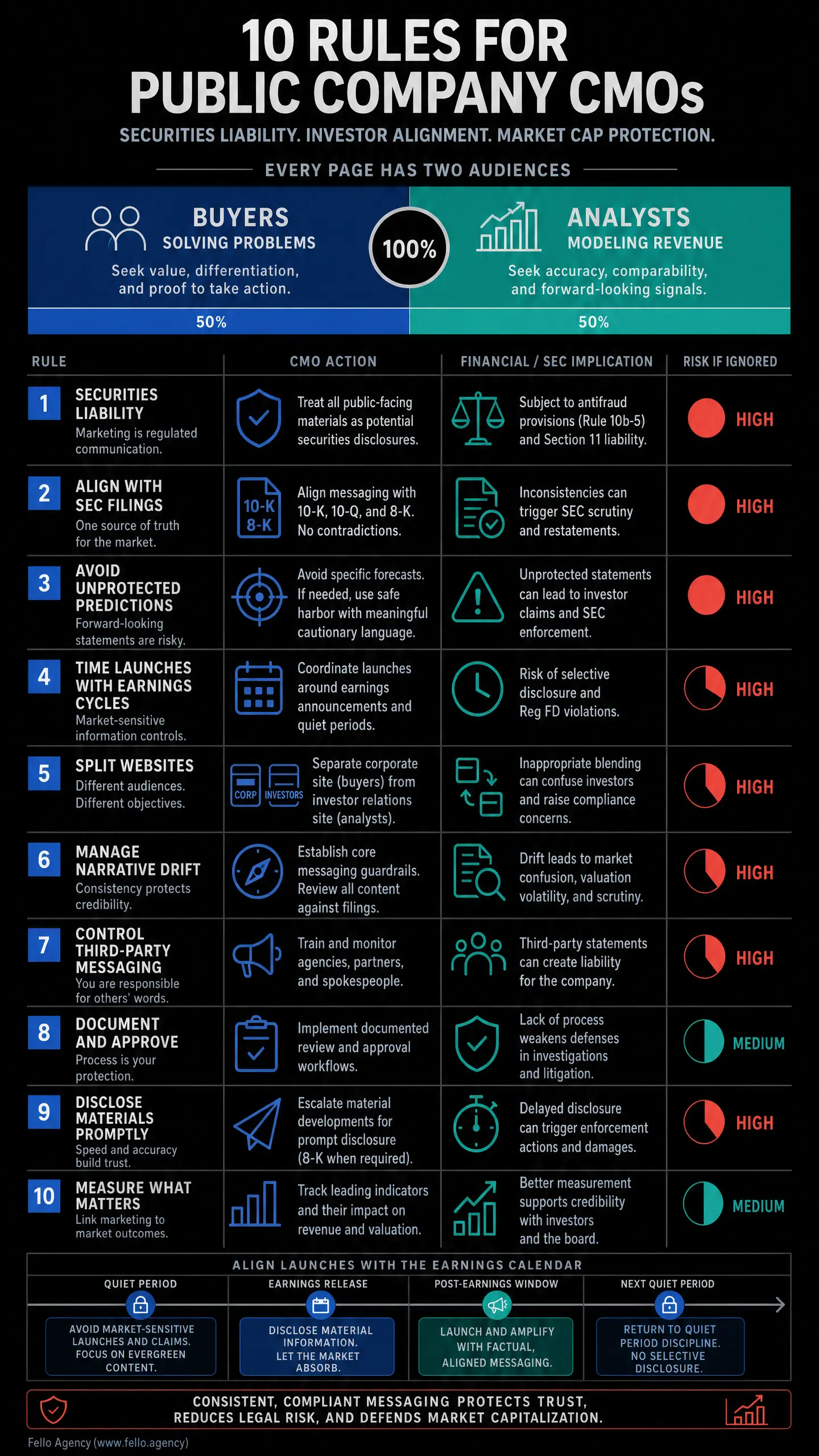
Key Takeaways
A public company lost 6% of its market value after updating its homepage to target regulated industries, which financial analysts interpreted as a shrinking Total Addressable Market.
Predictive marketing claims on product pages lack the Private Securities Litigation Reform Act safe harbor protections found in 10-K filings, exposing public companies to direct securities liability.
Nasdaq regulations require publicly traded companies to notify the exchange at least 10 minutes before releasing material marketing announcements or product launches between 7 a.m. and 8 p.m. Eastern Time.
Because accounting rules mandate disclosing any customer representing 10% or more of total revenue in 10-K filings, competitors routinely weaponize these concentration metrics in outbound sales motions.
Publishing unannounced contract values or deployment timelines in B2B marketing case studies can trigger unintended Form 8-K requirements and Regulation FD mandatory public disclosure countdowns within 24 hours.
Quoting non-GAAP financial figures on marketing landing pages requires a quantitative reconciliation to comparable GAAP numbers to comply with SEC Regulation G and defend against short-seller audits.
Why Must Public Company Marketing Pages Address Both Buyers and Financial Analysts?
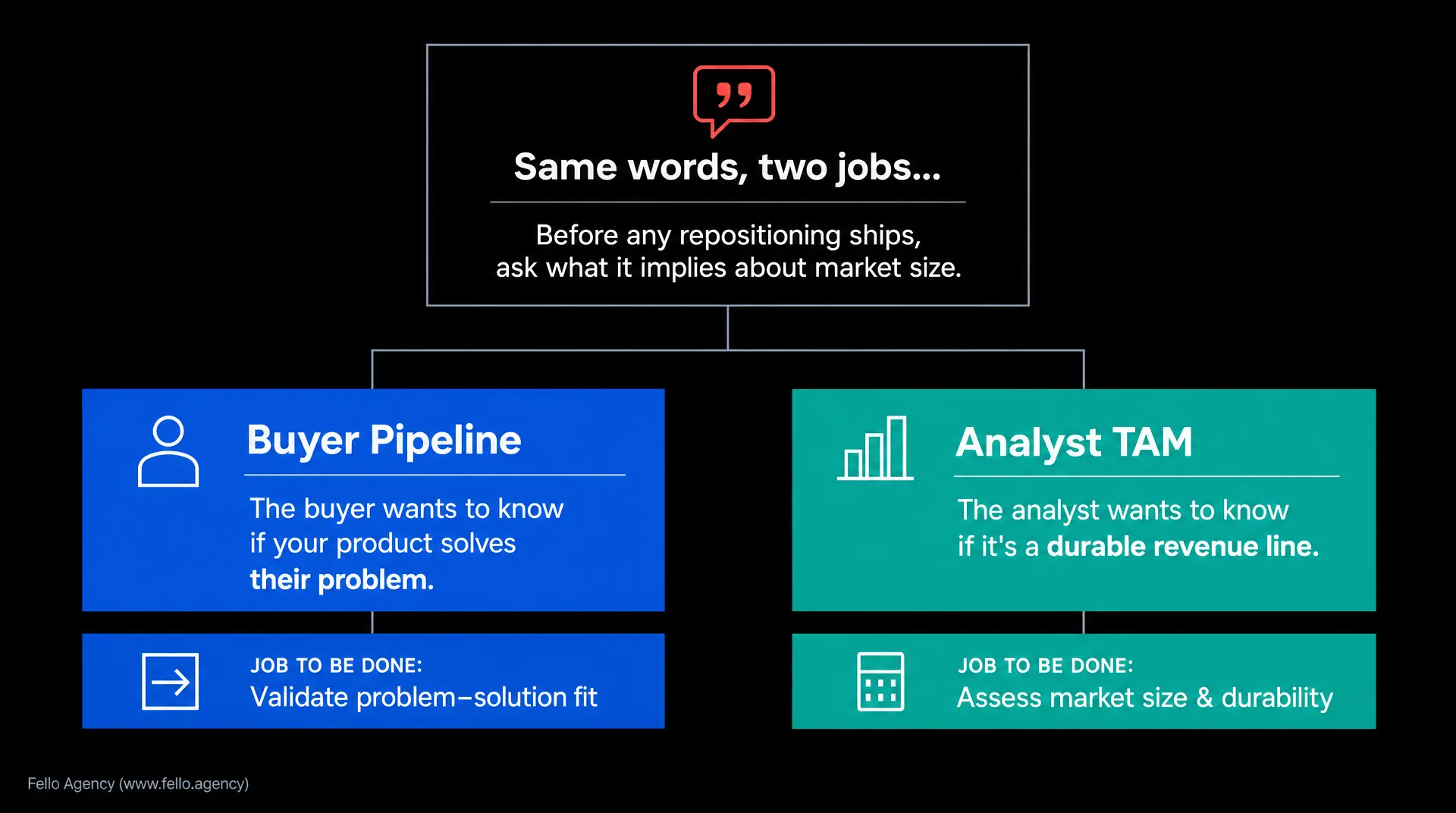
The bell rang, and a lot of CMOs think they gained an audience. Wrong framing. You gained a second reader for every sentence you'd already published. The buyer wants to know if your product solves their problem. The analyst wants to know if it's a durable revenue line. Same words, two jobs, and they pull in different directions.
At a private company, the only judge of a headline is its conversion rate. At a public company, that same headline feeds a financial model. An analyst prepping for your earnings call will open your homepage and read the positioning as a claim about the business itself - how big the market is, how concentrated the revenue is, how long it lasts.
Take a sentence as harmless as "We now focus exclusively on enterprise." A buyer reads focus. An analyst reads a shrinking logo count. Neither one misread you. Do you get what I'm saying? Before anything meaningful ships, read it twice. Once as a buyer with a problem, once as an analyst with a spreadsheet. If the two readings disagree, hold the page.
How Does Repositioning Impact Market Size and Stock Value for Public Companies?

Hours before we came on with one client, their team shipped a homepage rewrite leading with "the observability platform for regulated industries." As pure marketing, it worked. Pipeline improved. The narrowing worked. Buyers self-identified faster than they ever had.
Then Q3 earnings landed. An analyst opened the site and asked the question nobody had prepped: you've repositioned around a regulated vertical - should we be modeling a smaller TAM? The stock dropped 6% on positioning. Not on revenue, not on churn. On wording. The person who shipped that page ended up getting fired.
The brutal part is that the positioning was right. A lot of the work we did later essentially made the same move. The difference was sequencing - brief IR before the page goes live, not after the call. So the rule I give these companies: before any repositioning ships, ask what it implies about market size. Narrowing is great for conversion and terrifying for a growth multiple.
There's a regulatory floor under this too, and most marketers have no idea it exists. Regulation S-K expects public companies to disclose material changes to a previously disclosed business strategy. Narrow the story hard enough on your homepage and you may have announced a strategy shift your filings haven't caught up with still. Your website just outran your lawyers.
I'm based in Toronto, where I already call the TSX a valuation graveyard for tech - listings here trade at a 20% to 40% discount to the NASDAQ. Multiples are fragile everywhere. Don't let your own homepage vote against yours.
Why Do Predictive Marketing Claims Like "Will" Create Securities Liability for Public Companies?

A robotics company publishes a product page: "Our autonomous fleet will cut warehouse labor costs by 40% by 2027." It's a model prediction from a pilot. The rollout slips two quarters. A plaintiff's firm files - and it quotes the product page, not the 10-K. Nobody ever reviewed that claim, because nobody considered a product page a disclosure.
The reason the 10-K survives that lawsuit while the product page doesn't comes down to armor. Forward-looking statements in filings sit behind the PSLRA safe harbor, which requires them to be flagged as forward-looking and wrapped in meaningful cautionary statements. Your product page carries none of that. Which means the least protected version of your boldest claim usually lives on your highest-traffic page.
How Should Public Companies Develop Legally Safe Predictive Marketing Vocabulary?

People always ask me for a list of legally safe words that still excite buyers. Honest answer: there isn't a universal one, and anyone selling you one is guessing. Every company is different. In my professional opinion, you speak a little more broadly on anything predictive, you attach numbers only to things you've already measured, and you build the vocabulary with your CFO and counsel at the table. Then you audit every page for the word "will." Somewhere out there, a plaintiff's firm is already reading your site that carefully. You should read it that carefully first.
Why Must Public Company Marketing Teams Align Launch Calendars with Financial Earnings Cycles?
A health AI company I can't name scheduled its largest-ever launch for the second week of February. Nobody checked the finance calendar. Earnings landed 48 hours later. The CEO was locked in prep. IR blocked every press interview. The launch shipped into a blackout with no executive voice behind it and got a fraction of the coverage it deserved. Then the team burned an entire quarter arguing about whether the messaging failed. The messaging never got a fair test. The timing killed it two days before anyone read a word.
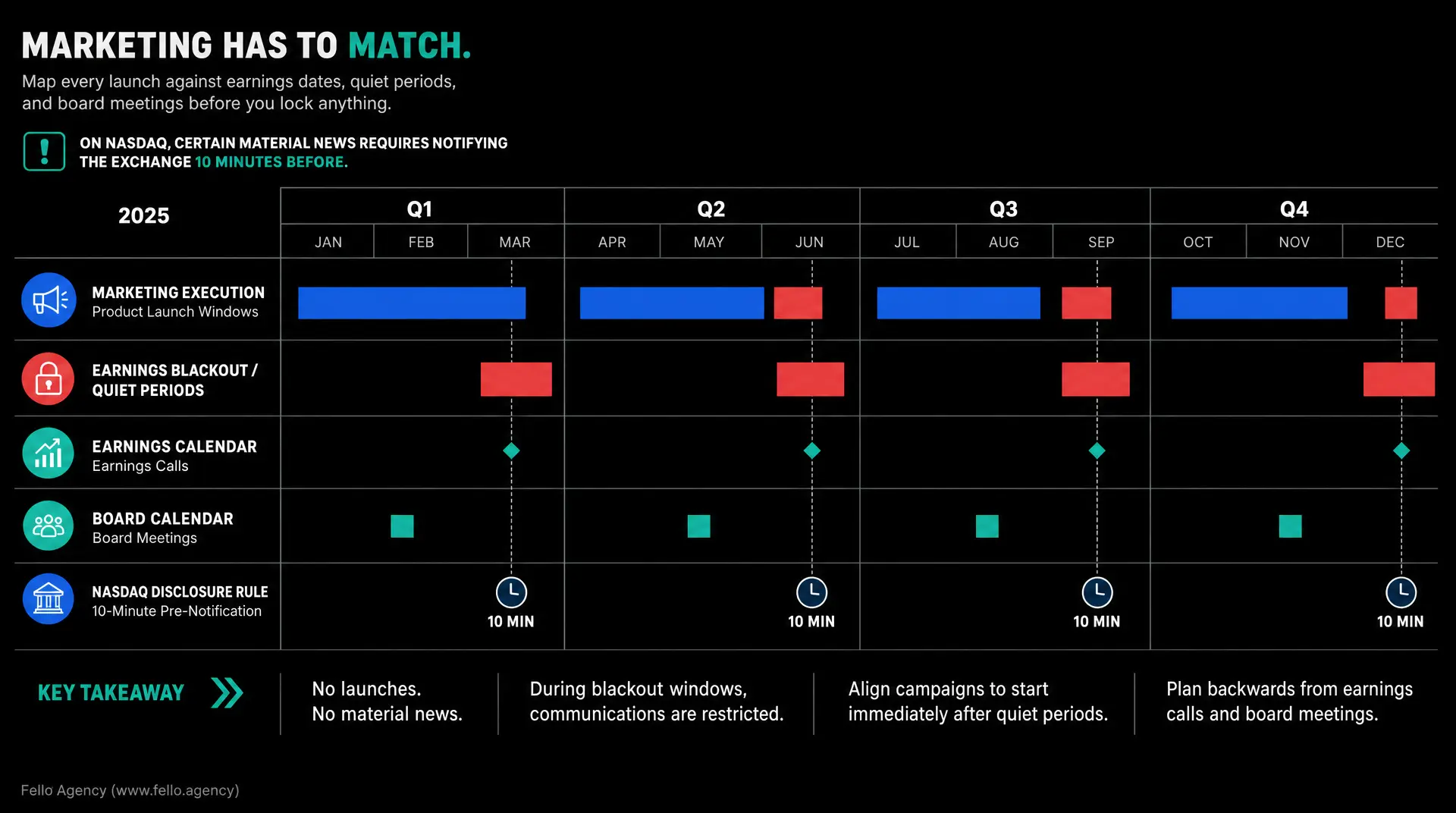
The secret to all of this is planning in quarters, the way the rest of a public company already does. Product runs on quarters. Finance runs on quarters. The board runs on quarters. Marketing has to match. Map every launch against earnings dates, quiet periods, and board meetings before you lock anything.
And learn the mechanics, because they're stricter than most CMOs realize. On Nasdaq, certain material news released between 7 a.m. and 8 p.m. ET requires notifying the exchange at least 10 minutes before the announcement goes public. Your surprise launch already has mandatory choreography attached. Better to design around it than discover it on launch morning.
How Can Competitors Weaponize 10-K Filings Against a Public Company's Go-To-Market Strategy?
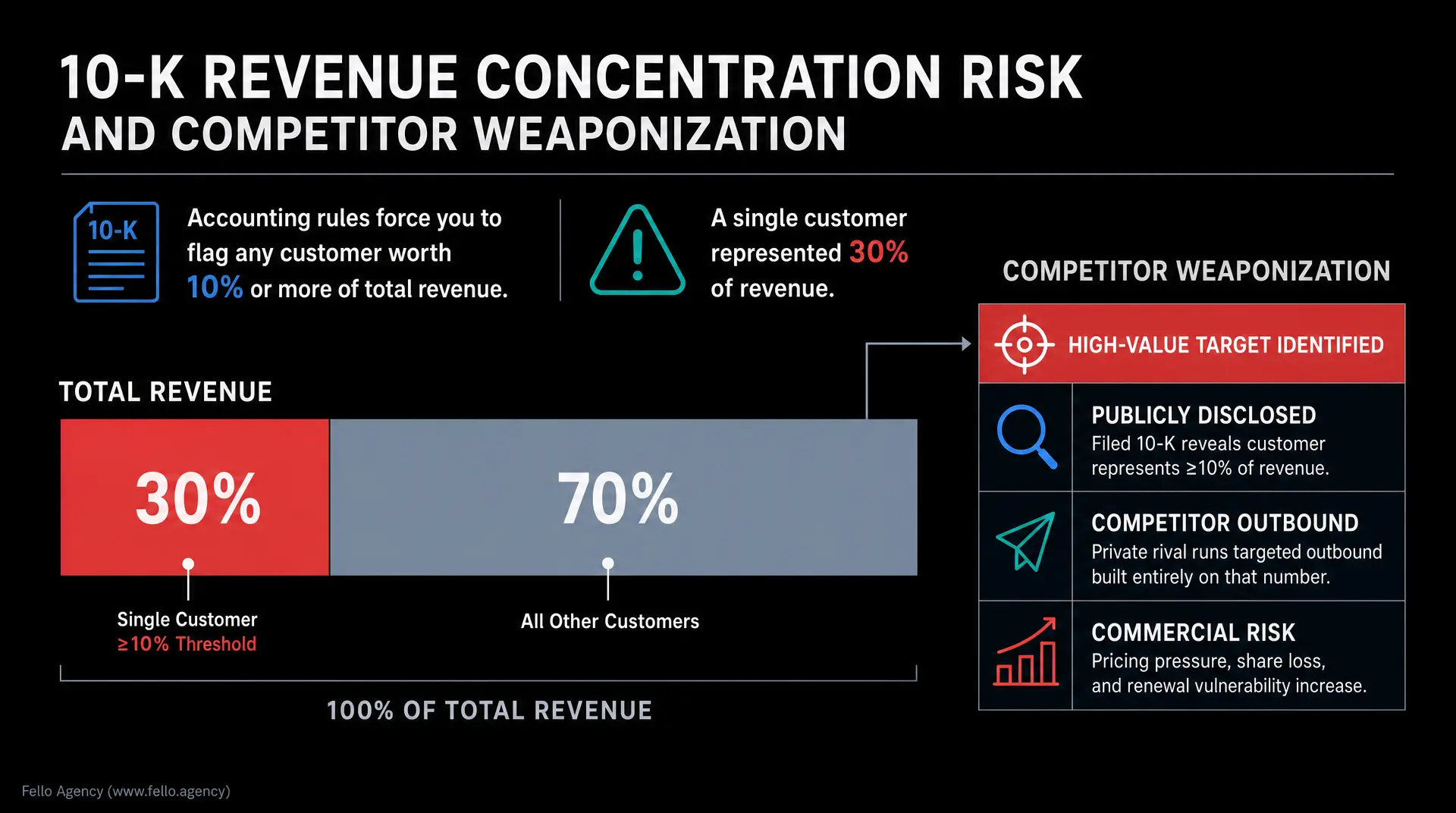
Three years ago, a semiconductor company's 10-K disclosed that a single customer represented 30% of revenue. Within a month, a private rival was running outbound built entirely on that number. Ask your vendor what happens to their roadmap when their biggest customer leaves. Sales started hearing that line in every single deal, with no prepped answer, because nobody in marketing had read the filing.
The company had no choice about the disclosure, by the way. Accounting rules force you to flag any customer worth 10% or more of total revenue. So the attack material was mandatory. The failure was that marketing treated the 10-K as finance's paperwork instead of the most-read competitive document the company publishes.
The habit that fixes this costs one afternoon per quarter. Read the 10-K and 10-Q cover to cover. Flag every line an aggressive rival could weaponize - concentration, litigation, risk factors, segment revenue. Write the counter-messaging before anyone needs it and put it in sales' hands the week the filing drops. Take this stuff seriously, because your competitors will, and they will win the deal. Honestly, nothing makes a CMO more valuable in a go-to-market meeting than knowing the filings better than the rival's outbound team does.
How Do B2B Marketing Case Studies Trigger Form 8-K and Regulation FD Disclosure Violations?

Nobody saw this one coming, and I remember it well. A defense technology company we worked with published a case study describing an eight-figure, multi-year deployment. Real program, real scale - exactly the kind of proof I'd normally push a client to publish loudly. One problem. The deal had never been announced. IR found out from a reporter. The company filed an 8-K reactively, and the marketing team learned the phrase "selective disclosure" the hard way.
Look at the machinery that one blog post touched. A contract that size belongs on a Form 8-K, where most triggering events must be reported within four business days. And once material nonpublic information slips out unintentionally, Regulation FD starts a clock - the company must disclose publicly within 24 hours or by the start of the next NYSE trading day, whichever comes later. A case study started a regulatory countdown the marketing team didn't know existed.
Here's the reframe I give clients: your CMS is now part of the company's disclosure controls. Public companies are legally required to maintain disclosure controls and procedures that route information to the officers who make disclosure calls. A content pipeline that can publish customer deal terms without an IR checkpoint is a hole in that system, whether anyone designed it that way or not. So build the checkpoint. Customer names, contract values, deployment timelines, revenue implications - all of it passes IR and the CFO before going live. I believe everybody should be at the table on this one. There are so many ways to release information. You have to be deliberate about which door it walks through.
Why Do Unscripted Executive Communications Create SEC Regulation FD Risks for Public Companies?
I'm going to say something unpopular. I don't let executives at public companies speak their minds openly. I know how that sounds coming from me - for private founders, I'll tell you passion beats hardcore planning on LinkedIn every single time. Going public is the big leagues. It's not a chance for people to talk. Every unscripted word can create massive risk, and the market doesn't grade on intent.
You don't have to take my word for it. The SEC opened a Regulation FD inquiry after Reed Hastings posted on his personal Facebook page that Netflix had streamed 1 billion hours in a single month - no press release, no 8-K, and shareholders had never been told his personal page was a company channel. Then there's the famous one. Musk tweeted about taking Tesla private at $420, and the SEC settlement cost him and Tesla $20 million apiece, plus mandatory oversight of his investor communications going forward. When a tweet carries a $40 million combined invoice, "authentic executive voice" stops being a free strategy.
Does the CEO become a robot? No. The best public-company executives rehearse the approved story until it sounds like their own opinion, because it usually is. Message discipline and personality live together fine. Improvisation and a live ticker don't. And for the genuine crisis - the outage, the recall, the moment the CEO must speak live - there are incredible firms that do crisis communications for exactly that scenario. Retain one before you need them, because you won't have time to shop during the fire.
How Do Short Sellers Exploit Discrepancies Between Marketing Metrics and SEC Financial Filings?
When a CEO pushes back on Rule 7, one sentence keeps their mouth shut real quiet: short sellers read your marketing.
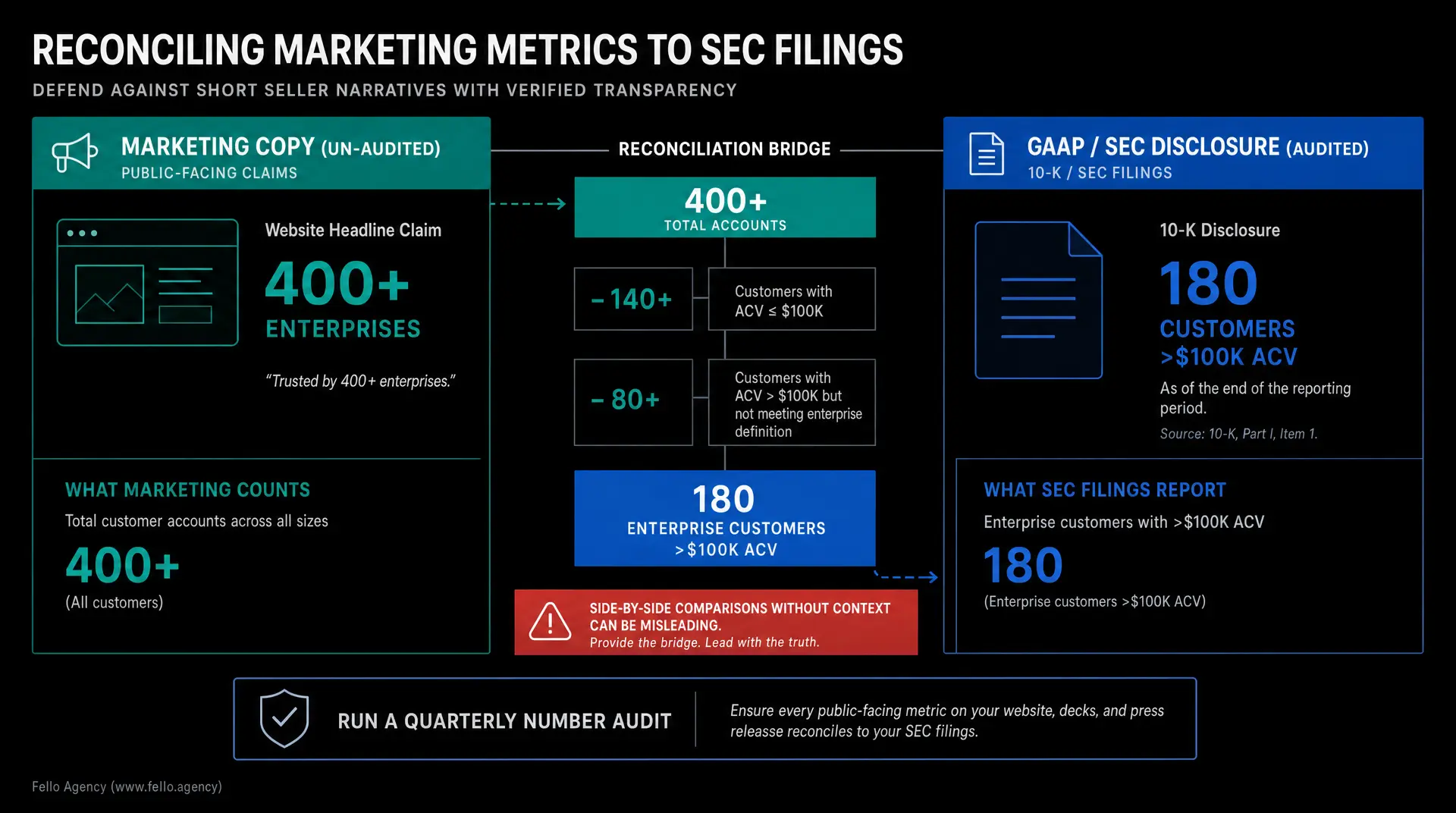
A software company's website says "trusted by 400+ enterprises." Its 10-K says approximately 180 customers with annual contract value above $100,000. Both statements are true - the 400 includes free-tier and legacy accounts. The short report doesn't care. It puts the two screenshots side by side. Accuracy stops mattering the moment they've poked a hole in your story. Now the CFO is auditing every number on the site and marketing cannot move. I've seen teams stall themselves out for quarters over exactly this.
Understand the scale of the industry hunting you. One academic study tracked 351 activist short reports against U.S.-listed companies and found the targets publicly responded just 31% of the time. Most companies simply eat the hit. So your real defense sits upstream, before any report gets written. Run a quarterly number audit where every stat on your site either reconciles to your filings or carries a methodology you'd happily defend on an earnings call. And if a landing page quotes a non-GAAP financial figure, Regulation G expects the comparable GAAP number and a quantitative reconciliation alongside it. One source of truth per number, owned jointly by marketing and finance. That's the line between marketing as a growth engine and marketing as a frozen department waiting on the CFO's initials.
What Is Narrative Drift in Public Companies and How Can Chief Marketing Officers Fix It?
This is the pattern I use to scare clients straight. A company IPOs as a quantum computing business. Three years later, 80% of its revenue is classical simulation software sold to pharma. Customers renew at 130% net retention - the business is genuinely healthy - but the stock is still priced as a quantum pure play. So every quarter the CEO defends one story while the sales team sells another, and marketing produces two incompatible bodies of content, doing neither well.
I call this narrative drift, and it's a slow bleed. Sales decks update monthly because reps live in reality. The IR narrative updates never, because leadership is scared to touch the IPO story. The gap widens a little each quarter until a short seller or an analyst names it out loud - on their terms, not yours.
The whole company needs to be behind one message. When reality outgrows the IPO story, you run a deliberate re-narration: CEO, CFO, IR, sales, and marketing in one room agreeing on what this company actually is now, then briefing the street properly. And a re-narration is a repositioning, so Rule 2 applies in full - ask what the new story implies about market size before it ships. As CMO, you're usually the first person positioned to see the drift, because you sit exactly between what sales says and what IR says. Seeing it and staying quiet is how you end up owning the failure.
Why Should Public Companies Build a Dedicated Investor Relations Website for SEC Disclosures?
We tell our publicly traded clients to build a dedicated investor site. An overview, why invest, governance, financials, stock information, press releases, shareholder services - that's an entire content universe, and it's too big to put on a corporate website. Your corporate homepage has one job, which is moving a technical buyer toward pipeline. A frustrated shareholder hunting for proxy documents doesn't advance that job, and a wall of governance material confuses the buyer who just wants product proof.
There's a disclosure angle most people miss. SEC guidance treats a company website as a potential channel for meeting disclosure obligations - but only if it operates as a recognized channel of distribution that genuinely pushes information out to the market. A properly maintained investor site is how you earn that status. An IR tab buried under your product nav isn't.
Why Do Disconnected Corporate and Investor Relations Websites Create Financial Narrative Risks?

The pushback I get is that two sites create two narratives. Only if you build them from two sets of facts. Both sites draw from the same numbers - the filings - and the same positioning spine. What changes is depth and framing. The buyer gets outcomes and proof. The investor gets durability and governance. The split cracks when two teams maintain two vocabularies and nobody reconciles them, at which point you've built the short seller's screenshot for them. Fold both sites into the Rule 8 audit. Same afternoon, same source of truth.
One more thing while you're in there. At Fello we treat the stockholders of public deep tech clients as a genuine consumer audience, because retail investors consume your story the way consumers consume a brand. Market to them deliberately, on their own dedicated ground, with the same craft you give buyers.
Why Does Slowing Down Marketing Execution Protect Public Companies and Build Narrative Moats?
Look, I understand how the last 2,500 words read to a marketer who built a career on speed. I'm that marketer. I've run complete brand-and-website sprints in 14 days. I push private clients to launch in weeks while their competitors are still scheduling workshops. And I'm telling you that at a publicly traded company, slower is correct. The teams that get burned are the ones still sprinting like a Series B while carrying securities liability on every page they publish.
But don't read these 10 rules as pure defense, because there's a prize at the end. A public company whose buyer story and analyst story reconcile perfectly builds something genuinely rare: a narrative nobody can poke a hole in. Not a short seller with screenshots. Not a rival mining your 10-K. Not a skeptical analyst on the Q3 call. I've said for years that strong B2B branding is the last moat standing. Public markets pressure-test that moat every single trading day. When it holds, your sales team skips a level in every cycle, your multiple stops fighting your marketing, and the board starts treating the CMO like a business leader instead of a budget line.
You wanted the big leagues. This is what they cost. Play accordingly.
Frequently Asked Questions
If a social media manager accidentally leaks unannounced product details, what is the regulatory ticking clock?
The second that post goes live, Regulation FD starts a brutal countdown. You've just triggered a non-intentional disclosure. The company must publicly disclose the information - usually via a Form 8-K - no later than 24 hours or the start of the next day's NYSE trading. Your CMS error is now a securities fire drill.
How must PR teams choreograph major press releases issued during active trading hours?
You don't just hit publish anymore. If you're dropping material news between 7:00 a.m. and 8:00 p.m. ET, exchanges mandate strict choreography. Both Nasdaq and NYSE require 10 minutes' advance notice to their Market Watch teams before public announcement. Miss that window, and you're trading PR buzz for an exchange halt.
Can marketing campaigns headline custom growth metrics if they aren't official GAAP numbers?
You can, but it carries a heavy tax. Under Regulation G, whenever you publicly disclose a non-GAAP financial measure, you must present the most directly comparable GAAP measure right alongside it, plus a quantitative reconciliation. You can't just invent pipeline math anymore. If the street sees it, finance has to defend it.
At what point does a single massive customer become a mandatory marketing disclosure?
It happens exactly at the 10% mark. U.S. GAAP segment reporting legally forces you to disclose reliance on any external customer that represents 10% or more of total revenues. If you land a whale that dominates your pipeline, your competitors will read about it. Write the counter-messaging before the ink dries.
Can marketing silently test major go-to-market pivots before IR updates the filings?
Absolutely not. Testing a radical go-to-market direction on your homepage isn't agile marketing. It's an unfiled disclosure. Regulation S-K Item 101 demands companies disclose material changes to business strategy. If you pivot the website's narrative before the 10-Q catches up, you just outran your own lawyers.
Your Creative Partner for Innovation That Matters
From advanced tech to transformative healthcare, Fello helps visionary teams shape perception, launch products, and lead industries.


Let’s keep in touch.
Discover more about high-performance web design. Follow us on Linkedin and Instagram.

