

The most durable position in any market names a broken behavior the entire industry has quietly agreed to tolerate. Founders keep hunting for a feature instead.
Anduril never has to argue that defense procurement is slow. GAO's own assessment of over $2.4 trillion in planned spending, with an average of more than 12 years to field a single capability, argues it for them.
Name the flaw your market has stopped noticing, and every competitor left standing becomes your evidence.
Key Takeaways
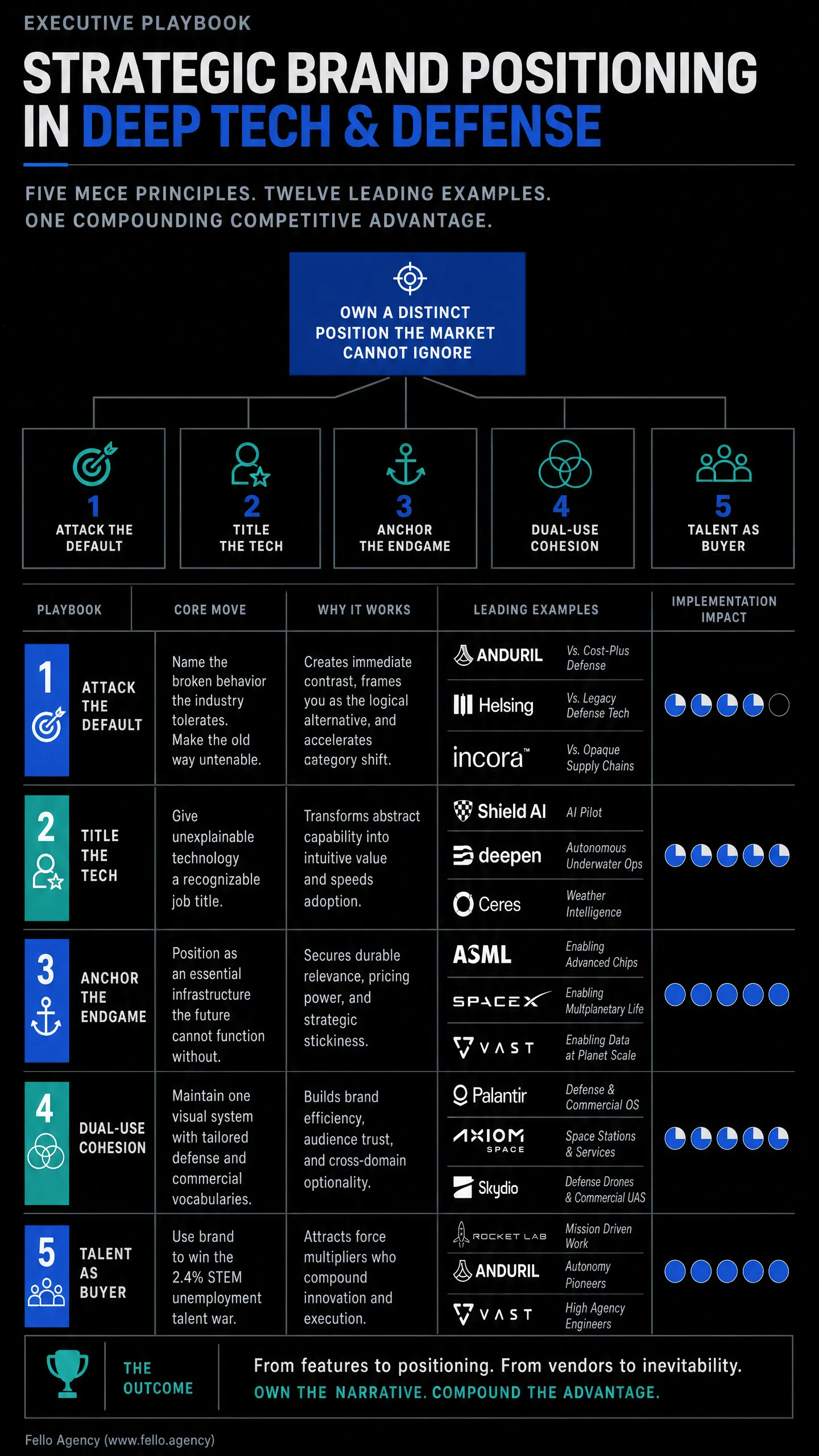
Deep tech companies establish durable market positions by critiquing broken industry behaviors, such as Anduril citing GAO data on 12-year capability timelines to challenge cost-plus defense contracting.
Shield AI compresses complex autonomy software by using the relatable job title of an AI pilot, a positioning validated by its Hivemind system flying an F-16 in 2022.
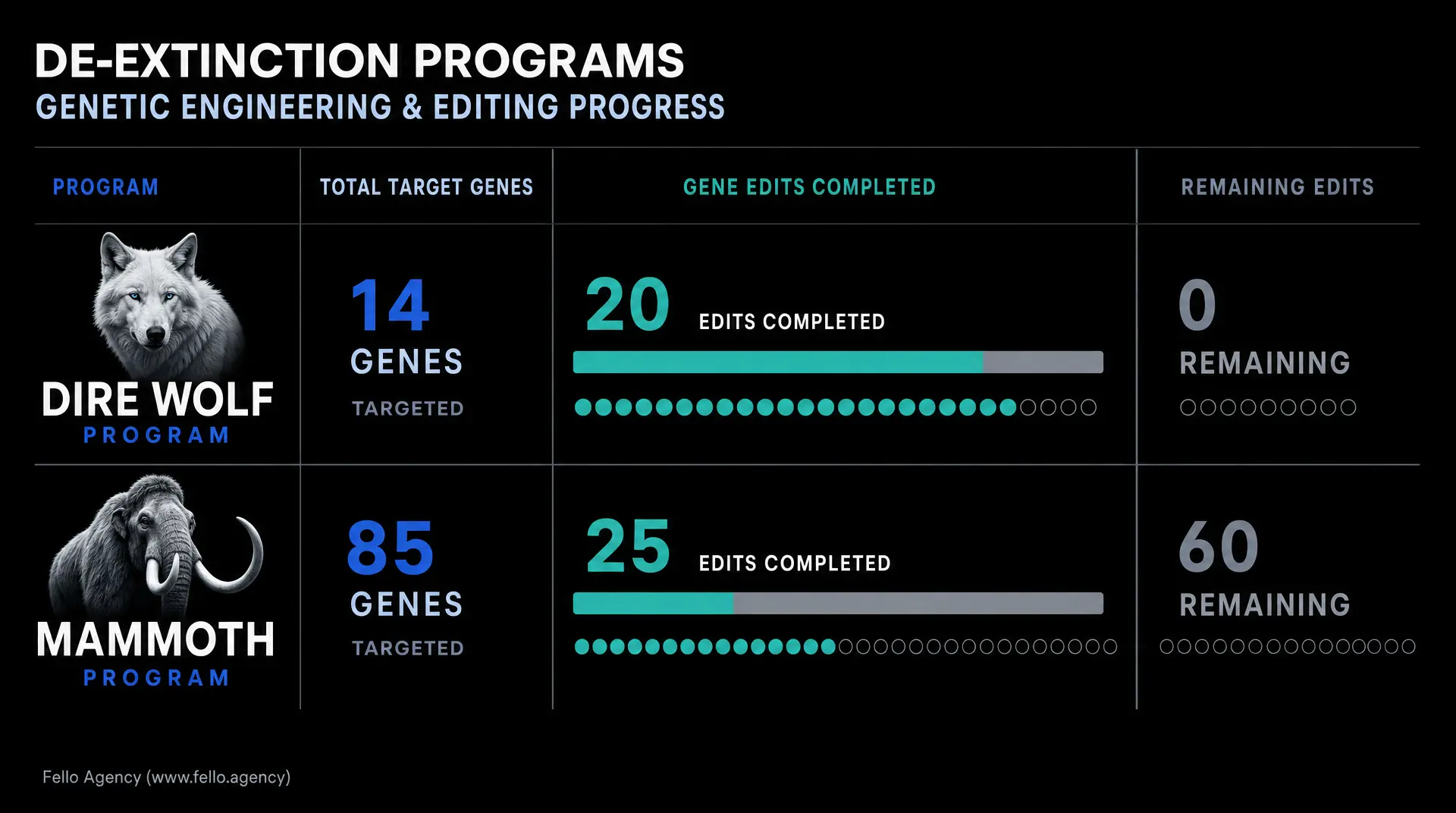
Colossal Biosciences anchors its genetic engineering platform with concrete imagery of mammoth de-extinction, supporting the narrative with precise milestones like 25 completed gene edits out of an estimated 85.
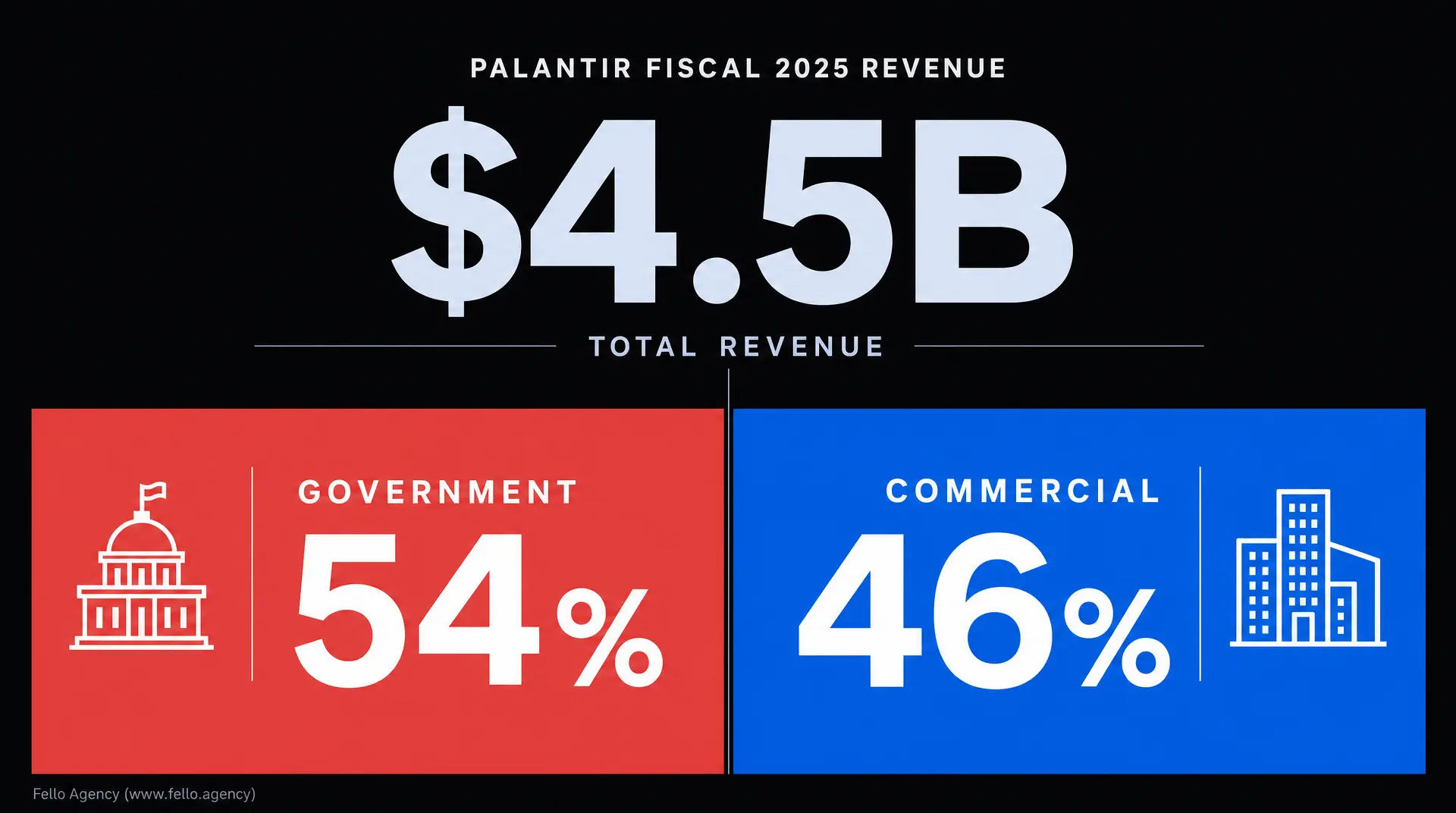
Palantir manages inverted trust signals across its $4.5 billion revenue split by maintaining a unified visual identity while deploying distinct capability and outcome vocabularies for defense and commercial buyers.
Technical brands must function as recruiting tools in a tight labor market with 2.4% STEM unemployment, a strategy Rocket Lab leveraged while scaling 2025 revenue to $601.8 million.
More than 40% of B2B deals stall due to internal buying group misalignment, making a concise positioning statement essential for internal champions advocating to executive committees.
Why Do Deep Tech Companies Need Multiple Versions of Positioning Statements?
Founders think they get one mission statement and that's all they can use for anything. Wrong. You need versions. One for the pitch deck. One for a cold email. And one core version that every single person at your company knows cold.
Placement matters too. I'm a big believer that the short version belongs in the H1 or H2 of your homepage. When I see "proprietary propulsion architecture" or "multi-sensor autonomy stack" up top, I know a founder wrote it for himself. Those phrases are solution-page material. The homepage needs to be bigger than your stack.
Now, the 12.
How Does Anduril Position Against the Cost-Plus Defense Contractor Model?
Anduril describes itself as building autonomous systems and defense technology to protect the United States and allied forces. Sounds standard. Then you notice what they're actually positioning against: the business model of their own industry, not any single competitor.
The whole brand is built as the opposite of the cost-plus defense contractor - the model where the government reimburses allowable incurred costs no matter how long development drags. Anduril's "Rebuild the Arsenal" thesis attacks that model by name, and they back the words with concrete: Arsenal-1, a 5-million-square-foot facility built to produce every Anduril product at full rate simultaneously. We build products with our own money, then sell them working. Every part of the company reinforces that one sentence.
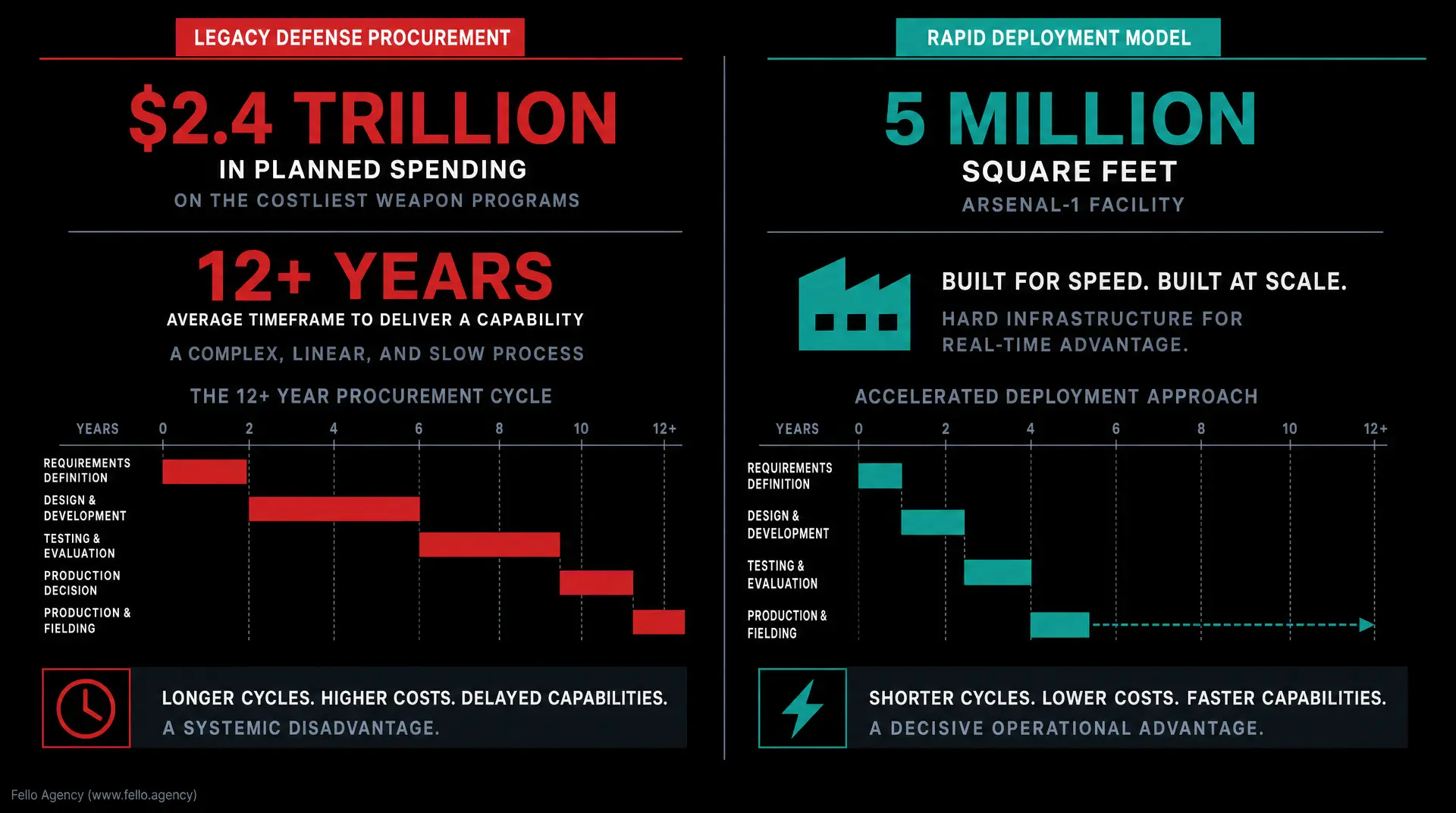
This is maybe the most powerful move available: position against the category's default behavior, not against a company. Everybody instantly understands it. Better still, every incumbent proves your point daily just by operating. GAO's latest assessment covers over $2.4 trillion in planned spending on the costliest weapon programs and puts the average timeframe to deliver a capability at over 12 years. Anduril never has to argue the system is slow. The system argues it for them.
Founders ask me how a Series A company copies this without looking like a joke to the Pentagon. My answer is a question back: what do you do differently that buyers haven't seen before, and how do you say it super simply? If your answer is a feature, keep working. If it's a broken behavior your entire market tolerates, you've found your fight.
Why Does Shield AI Position Its Autonomy Software as an AI Pilot?
Shield AI's flagship line is "the world's best AI pilot." Not autonomy software, not an AI flight stack - a pilot.
They took an unexplainable technology and gave it a job title everybody already understands. A pilot has judgment. A pilot handles things going wrong. Every association you carry with that word does the positioning work for them, for free. And their mission line - protecting service members and civilians with intelligent systems - tells you who it's for in one breath.
The title is earned, which matters. By Shield AI's own account, Hivemind was the first AI pilot deployed in combat in 2018, flew an F-16 in 2022, and won the first AI dogfight in 2023. The claim and the record point the same direction, so the compression holds up under scrutiny from the exact buyers who love scrutiny.
I call this the fastest compression trick in deep tech. If your product needs a paragraph to explain, ask what job title it would hold. An inspector. A dispatcher. A translator. The moment your technology has a job, the buyer knows what to expect from it and what to hold it accountable for. That second part is what makes technical buyers relax.
How Does SpaceX Use Endgame Positioning for Its Space Technology Narrative?
SpaceX's stated goal from day one: revolutionize space technology, with the ultimate goal of enabling people to live on other planets.
Notice what that does. Rockets aren't the product - they're milestones. Every launch, every landing, every Starship test becomes evidence of progress toward a story bigger than any product line. That's why their failures read as progress while a competitor's identical failure reads as failure. The narrative absorbs them.
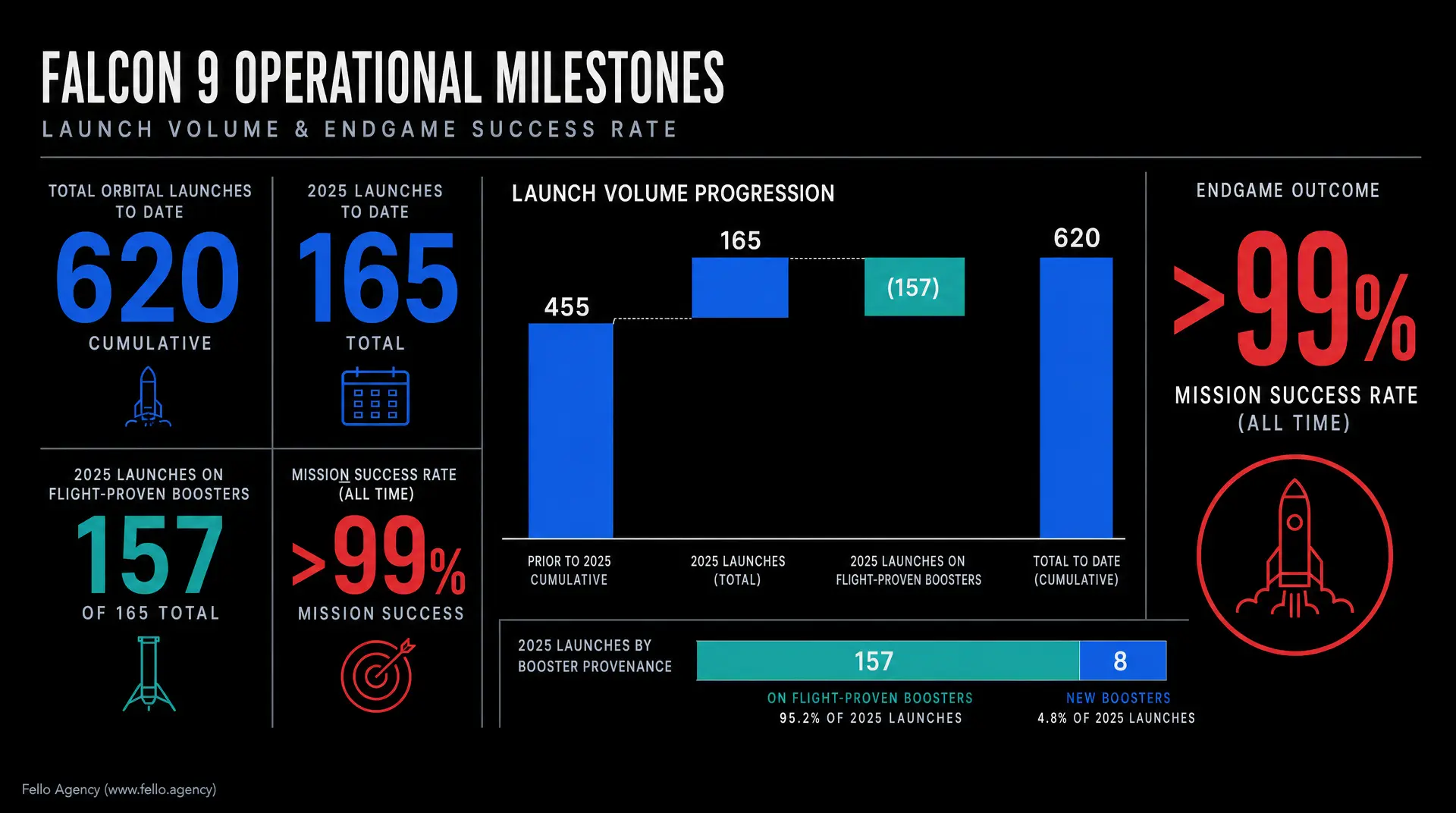
Eventually the operational record catches up to the story. A 2026 SEC filing puts Falcon 9 at roughly 620 orbital launches with an over 99% mission success rate, including 165 launches in 2025 alone, 157 of them on flight-proven boosters. The endgame positioning bought them room to blow things up publicly for years while they built that record.
Deep tech founders are trained to be technically modest, which is why this move is so underused. But if your roadmap only makes sense in light of a destination, say the destination. It reframes everything underneath it. You're burning cash through multi-year R&D either way. Position on the product and every failed test becomes a red flag in your next diligence process. Position on the endgame and the same test reads as a chapter.
How Does Colossal Biosciences Use Concrete Imagery for Genetic Engineering Positioning?
Colossal is working on a whole slew of things, but the world knows them for one: bringing back extinct species. The woolly mammoth, the dire wolf, the dodo - for climate, conservation, and ecosystem reasons. Great science underneath, great branding on top. The way they talk about each program, the website, the communication strategy - all of it works together.
The move most people miss is what they choose to lead with. Colossal's actual asset is a genetic engineering platform. They lead with the mammoth. A journalist can repeat a mammoth. An investor can repeat a mammoth. A senior engineer choosing between offers can picture one.
And the rigor stays intact underneath the image. The numbers they publish are specific: 20 edits across 14 genes for the dire wolf project, and a mammoth program estimated to need edits across 85 genes, 25 of them done as of early 2025. That balance is the real lesson here. STEM founders assume a vivid mission means abandoning precision. Colossal stacks them - the mammoth opens the door, the published edit counts keep the scientists onside.
I tell space tech founders the satellite is the delivery mechanism, not the value. Same principle. Your platform is the delivery mechanism. Give the market one concrete image of what it delivers and let that image carry the story.
How Does Lockheed Martin Skunk Works Productize Secrecy in Defense Contracting?
Skunk Works runs on defining the impossible, again and again. The heritage is earned - Lockheed's own history tells of engineers developing the P-80 Shooting Star in 143 days, working in what they proudly call "abject secrecy."
But the detail I'd steal is on their capability page. Alongside things that go fast and things you can't detect, there's a category for things they can't talk about. That is a productized classification. The obstacle every defense company complains about - we can't discuss our best work - Skunk Works turned into the most intriguing line on the page.
I push this on defense and dual-use founders constantly, because most of them are over-credentialed in private and under-known in public. Their best wins are classified, so the public website reads thin, and they apologize for it in every sales conversation. Stop apologizing. Name the silence, frame it deliberately, and let the buyer's imagination do the work your security officer won't let you do.
One more thing about their line: "again and again." Anyone can defy the impossible once. The repetition is the moat.
Why Does Lyntris Use Quiet Brand Positioning in the U.S. Defense Sector?
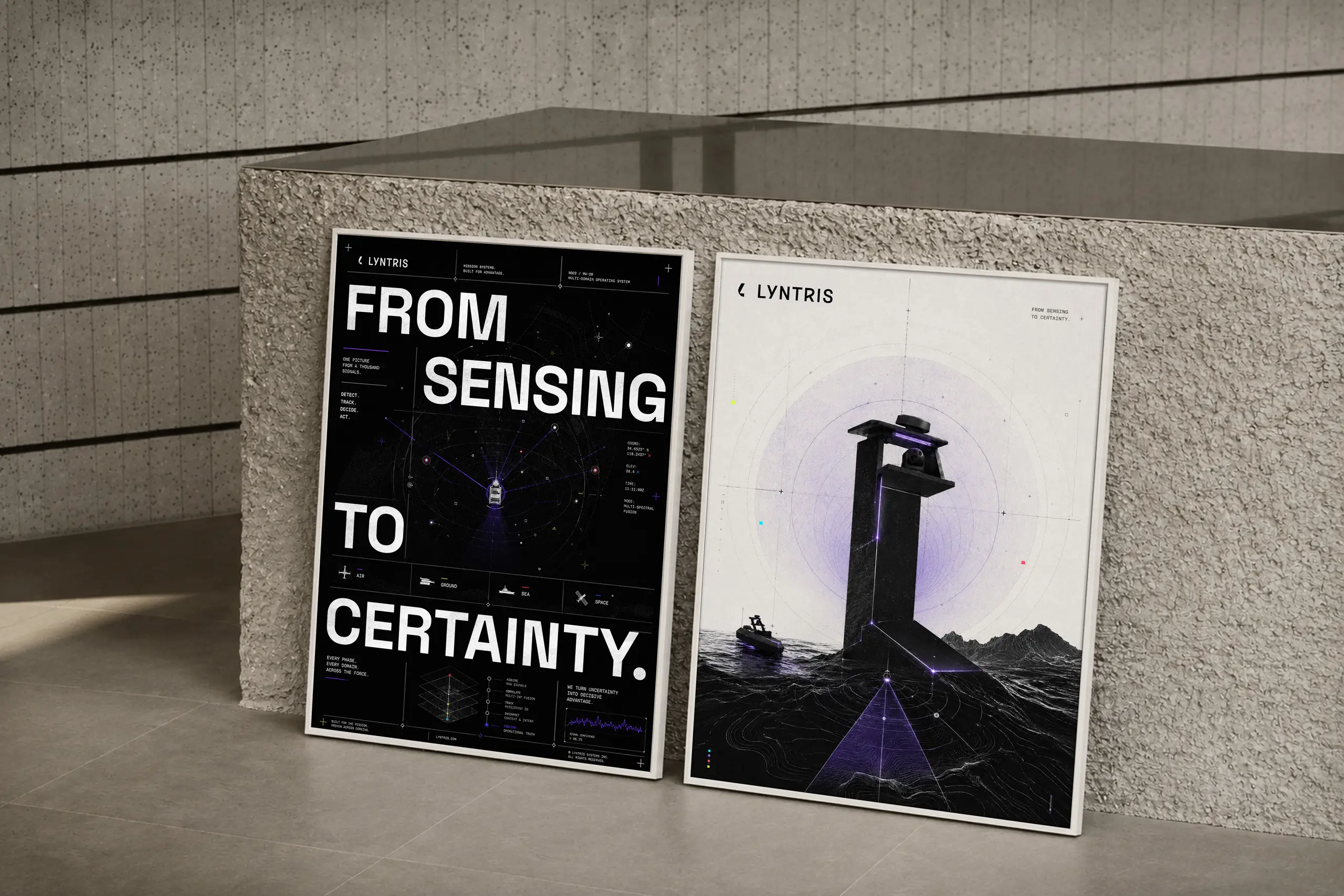
I'll flag this one as our own work at Fello, so judge accordingly. But it's also the one where I can tell you why every word is there.
Lyntris builds autonomous systems and mission software for U.S. defense - pilotless aircraft, crewless vessels, 500 engineers on active federal programs - and they're heading to the public markets in the next couple of months. Their homepage line is "From sensing to certainty." The positioning built underneath it: "the quiet layer of modern defense."
"From sensing to certainty" names the transformation, not the technology. It hands the buyer - a program manager - the noun they actually purchase. No program manager wakes up wanting a sensor fusion stack. They wake up wanting certainty about what's in their airspace, and they'll commit serious budget to get it.
"Quiet" is a deliberate contrast play. Defense is the loudest category in tech right now. Anduril made loud work, and now half the sector copies loud without understanding why it worked for Anduril first. When the entire category shouts, quiet reads as the company that's already inside the programs. Infrastructure doesn't advertise. So study what the winners in your category made fashionable, then ask what the opposite would signal.
How Does Palantir Balance Brand Identity Across Defense and Commercial Markets?
Palantir has been around more than 20 years, but they seriously upgraded their branding recently, and the upgrade coincided with the stock becoming a market story. What interests me is the balancing act underneath. Palantir's fiscal 2025 numbers show $4.5 billion in revenue split almost evenly, 54% government and 46% commercial.
Those two audiences have inverted trust signals. Defense buyers trust opacity and classified histories. Commercial enterprise buyers demand transparency and open proof. Most dual-use companies respond by building two half-brands and confusing everyone.
Palantir keeps the identity fixed and flexes the story. Same typography discipline, same color logic, same visual system across both worlds, with the narrative tailored underneath. The vocabulary is a loyalty test. Use capability-driven defense language on a commercial enterprise call and you sound tone-deaf. Use soft outcome language in front of a procurement office and you sound unserious. One system, two vocabularies, zero visual fragmentation.
The same discipline applies when you raise. Pitch the government and commercial narratives in a single deck and you walk into a multiple trap - growth investors discount you for regulatory risk while defense investors discount you for commercial distraction. At that point, your positioning is shaping the cap table conversation, not just your marketing.
How Does ASML Position Its EUV Lithography Systems as an Essential Dependency?
ASML makes the lithography machines that print advanced chips, and for the most advanced generation - EUV - they're effectively alone on Earth. Their annual report lists 48 EUV lithography systems and states plainly that High NA EUV is essential to advancing Moore's Law. Intel's own annual report names ASML the sole supplier of the EUV tools it's deploying for its leading-edge nodes.
Sit with that. Your customer's regulatory filings describe you as a single point of failure for their entire roadmap. ASML's positioning job is simply making that dependency legible, and they do it by talking about Moore's Law instead of machines. They sell the fact that the future doesn't ship without them.
I use ASML to teach one lesson about multi-year cycles: procurement teams do not buy vision, they buy credibility. On an 18-month evaluation, the buyer isn't asking whether you're impressive. They're asking what breaks in their world without you. If your positioning statement answers that in one line, you've stopped selling a product and started selling your position in the buyer's future. Every negotiation gets easier from there.
Why Does OpenAI Invest Heavily in Artificial General Intelligence Brand Positioning?
Founders love telling me the product is the brand. OpenAI is my standing counterexample. ChatGPT clears 900 million weekly active users - arguably the fastest-adopted product in tech history - and they still pour serious money into the rebrand, the commercials, the films. At that scale, there isn't a best product in the world without a crazy brand behind it. If they still invest, I'd love to hear your excuse.
Their mission does specific work too. Ensuring artificial general intelligence benefits all of humanity positions them as stewards of a transition, and stewards get patience that vendors don't. Every release becomes evidence of a larger arc instead of a feature drop.
Even the black is strategic. I read black in high-tech branding as an empty vessel - a premium, adaptable foundation that lets the work speak. We ran the same logic on ourselves at Fello, moving off our old purple-and-black identity to white, black, and gray. Trust with prospects went up almost immediately, and a completely different caliber of deal started coming in. Your visual identity is part of your positioning whether you planned it or not.
How Does Xanadu Use Internal Brand Positioning for Quantum Computing Alignment?
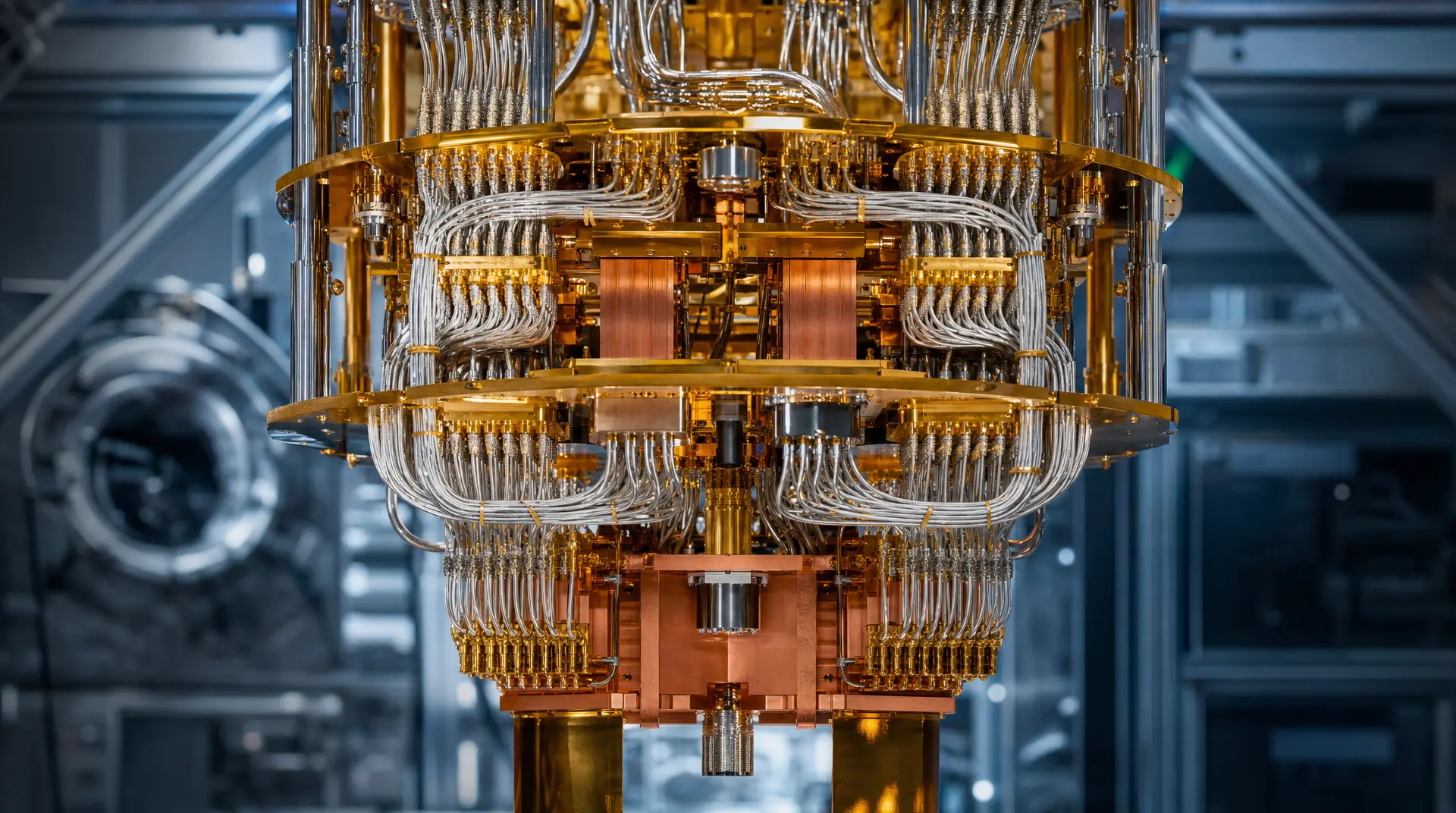
Walk into the office of Xanadu - the quantum computing company here in Toronto that recently went public - and you'll see the mission on the wall: build the first usable quantum computer.
One word carries the entire statement. Usable. Their own filings admit that nobody, Xanadu included, has produced a commercially scalable, fault-tolerant machine still. "Usable" quietly acknowledges what everyone in quantum knows and rarely says out loud, then stakes the company's claim on the one milestone that actually matters commercially. Conviction compressed into a sentence, with the honesty built in.
I love this example because it's the internal version done right. Remember the three versions from the top - deck, email, and the one every employee knows. The wall is the third one. When people ask how I know a brand has succeeded, my answer is buy-in from everybody: sales, marketing, C-suite executives, all aligned on one clear communication strategy. You cannot align a company around a paragraph. You align it around a sentence short enough to paint on a wall.
How Does Rocket Lab Use Brand Positioning to Recruit STEM Engineering Talent?
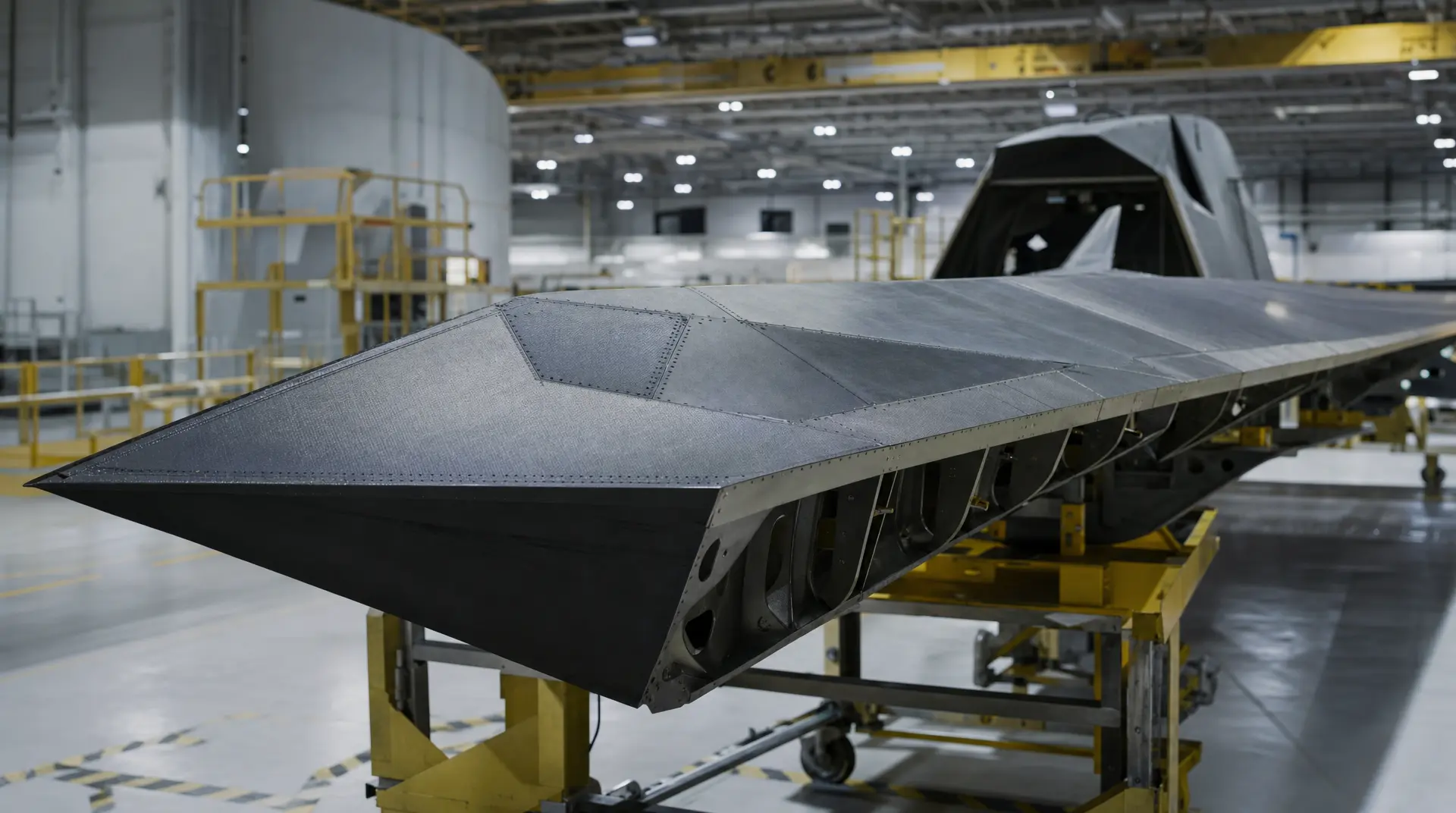
A truth that changes how you write your statement: your first customers aren't actually buyers, they're your hires.
Rocket Lab understands this better than almost anyone. Their steady stream of high-quality weekly content - launches, hardware, engineering stories - does something most founders never track. It recruits. I point clients to them for exactly this reason. And the brand kept pulling as the business scaled: Rocket Lab's latest annual filing shows revenue climbing from $244.6 million in 2023 to $601.8 million in 2025 as they expanded from launch into spacecraft design, components, and manufacturing.
You're fighting Google, Meta, and OpenAI for the same engineers, and the labor market gives those engineers all the leverage - STEM unemployment is running around 2.4%. In that market, the talent war is won on brand before compensation. If your site looks like a grad school thesis or a weekend Figma project, you've lost the fight before the offer letter goes out.
Anduril proved how far this goes with their recruiting campaign: don't work at Anduril if you hate America, don't work at Anduril if you're lazy. It filtered for exactly the hardworking people they wanted. Write your statement knowing a senior engineer will read it and decide whether your mission deserves the next five years of their life.
How Does Sphere Position Its XR Collaboration Platform Based on Buyer Outcomes?
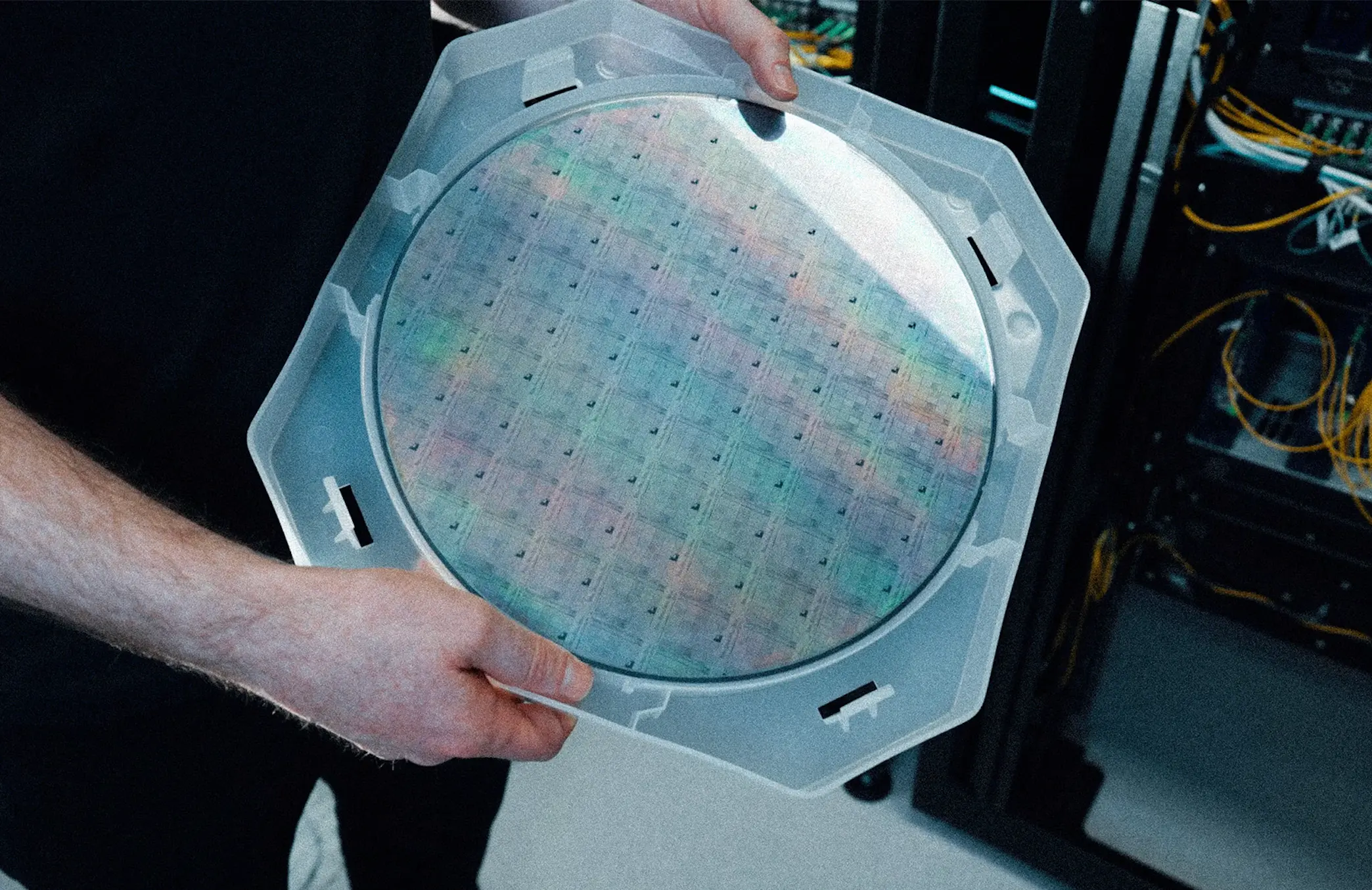
Let me bring this down to the scale most of you operate at. Sphere builds a complex XR collaboration platform. Genuinely impressive technology, and genuinely hard to explain - the kind of product where every stakeholder sees a different demo in their head.
When we fine-tuned their brand guidelines and rebuilt the website at Fello, we cut the general innovation language and the spec-first messaging. Everything got positioned on a single theme: collaboration. Numbers up front. The actual lifestyles of their ideal customer profiles made visible on the page. Traffic jumped 50% after launch, and - the part I actually care about - a higher tier of client started trusting them enough to engage.
The move: when your platform could technically do everything, position on the single outcome your buyer already wants more of. An enterprise buyer wants distributed teams that actually work together, and XR is simply how Sphere delivers it. Keep the full stack on the solution pages, where the technical evaluators will happily go find it.
How Can B2B Sales Calls Diagnose Brand Positioning Statement Failures?
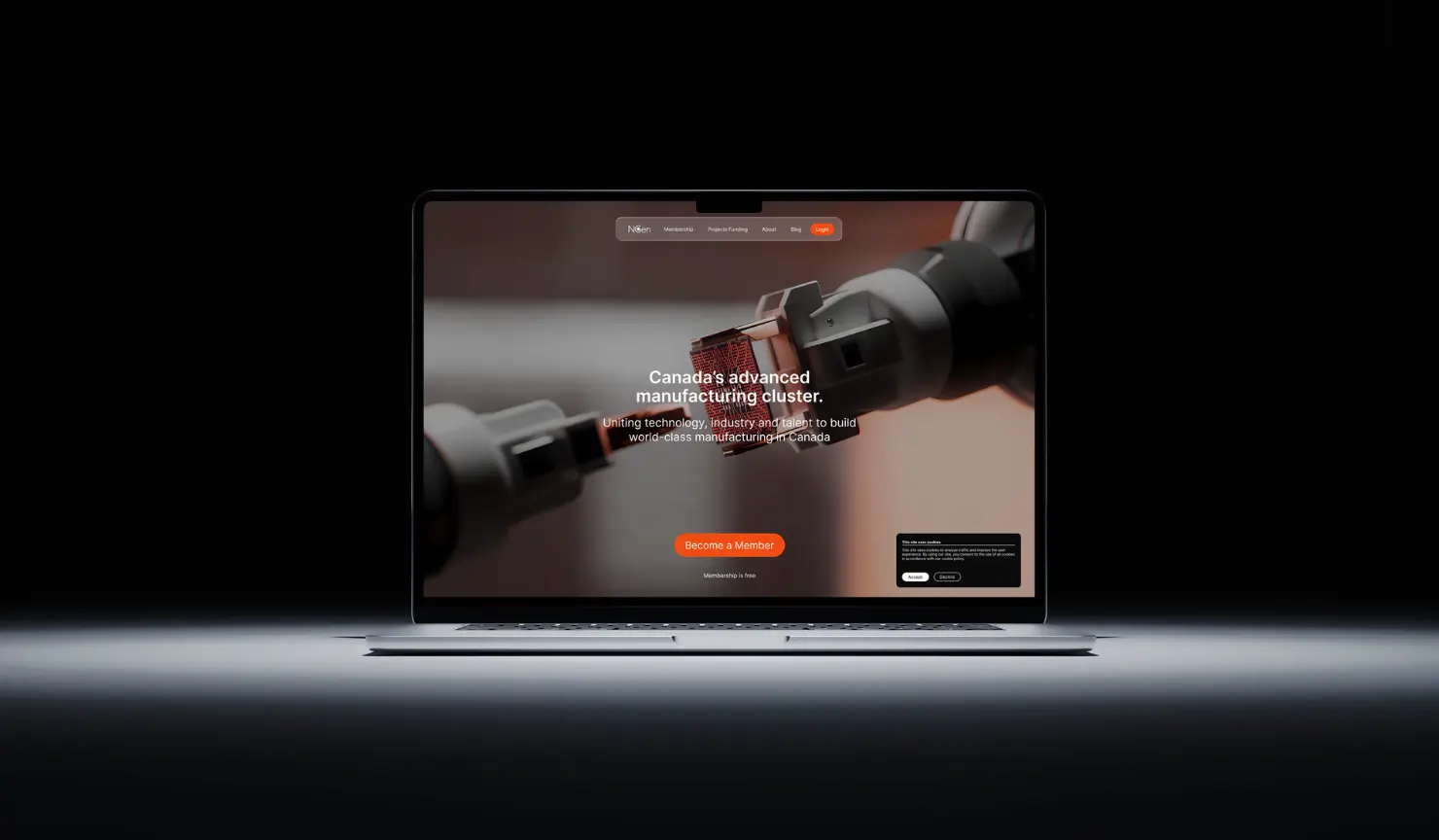
The diagnostic I use with every client is blunt. Listen to your sales calls. If your team spends more time correcting misconceptions - explaining what you're not - than pitching what you are, the positioning failure is baked into your identity. That gap is a rebrand trigger, and it gets more expensive every quarter you ignore it.
The stakes reach far beyond the calls themselves. I've had clients in conversations with Amazon who couldn't get internal champions to recommend them, purely because the brand didn't look credible enough to attach a reputation to. Your champion has to walk your name into a boardroom you will never enter. The research backs up how often this kills deals: more than 40% of B2B deals stall because of internal misalignment within the buying group. A tight positioning statement is the sentence your champion repeats when their CFO asks why the company deserves the bet. Without it, the pilot dies in committee and you never find out why.
Why Should Deep Tech Founders Elevate Rather Than Simplify Brand Positioning?
One last thing, because I know the PhD curse is real. Your academic training rewards precision and hedging. Positioning rewards simplicity, conviction, and emotion. That tension is exactly why brilliant technical founders write terrible statements - you were trained to qualify every claim, and qualified claims position nothing.
Everyone tells STEM founders to simplify. That's lazy advice. The real move is to elevate. Don't describe your solid-state electrolyte architecture. Say "we make batteries that last forever," then let the architecture prove it on the solution page. You're repackaging complexity as status and making your buyer feel smarter for getting it.
Look, at Fello we walk away from companies we'd have to convince of any of this - there's no point selling the why anymore. But if you've read this far, you already get it. The 12 companies above sell classified aircraft, EUV lithography, and fault-tolerant qubits on sales cycles measured in years, and their positioning still fits in a sentence. Yours can too. Write the three versions. Put the short one in your H1. Get everyone in the building aligned on it.
The technology earns you the conversation. The positioning decides whether anyone remembers you were in it. And if you don't have a brand, you're going to be forgotten.
Frequently Asked Questions
Does a positioning statement actually move the needle in enterprise or government sales?
Yes. Your champion must defend your vision in boardrooms you'll never enter. Without tight positioning, deals die. Research shows more than 40% of B2B deals stall from internal misalignment. Hand them one sharp sentence to repeat.
How does positioning help shake the 'science project' label?
It forces you to name the commercial outcome instead of the mechanism. If you pitch a 'multi-sensor autonomy stack,' investors see a risky R&D science project that burns cash. If you position as 'the quiet layer of modern defense,' you look like an inevitable, scalable commercial enterprise.
Should our positioning statement change when raising a Series B or C?
Absolutely. At Seed and Series A, you position to de-risk the technology. By Series B and C, investors demand commercial inevitability. Your statement must shift from proving the science works to proving your platform owns a category and scales revenue. Stop recycling early-stage R&D narratives.
How does a positioning statement impact our ability to recruit elite engineering talent?
It wins the talent war before the offer letter. The U.S. STEM workforce hit 37 million in 2024, with unemployment at 2.4%. Elite engineers have all the leverage. A razor-sharp mission statement proves your startup is a category-defining business, not a disorganized academic experiment.
How do we position a platform technology that could serve 10 different industries?
Stop listing every theoretical use case. It makes you look desperate and unfocused. To cross the chasm, anchor your positioning statement to a single, critical dependency for your highest-value buyer. You can expand later, but today, you must dominate one concrete commercial application.
Your Creative Partner for Innovation That Matters
From advanced tech to transformative healthcare, Fello helps visionary teams shape perception, launch products, and lead industries.


Let’s keep in touch.
Discover more about high-performance web design. Follow us on Linkedin and Instagram.

