Most defense startups sell to the wrong people in the wrong order. They hire lobbyists, chase program offices and build decks for primes, then wonder why nothing moves. We did it the other way around. We built something cheap that works, filmed it, put it in front of the people who'd actually use it, and emailed everyone else ourselves.
Sentradel builds autonomous counter drone turrets. Our system finds small drones passively with EO/IR cameras, which see both visible and infrared light, and it can also pull in tracks from external radar. It targets the drones on its own and takes them down, and a person stays in the loop on the trigger by default. Here's what has worked for us without expensive lobbyists, and what I'd tell anyone trying to sell to the government today.
Guns aren't going anywhere
I've spent more than eight years putting drones in the hands of government, defense and public safety teams. You learn what drones can do when you fly them for a living. You also learn how little anyone can do about one that shows up where it shouldn't.
I'm excited about alternate kinetic weapons, directed energy, railguns, acoustic weapons like the ones suspected in Havana, and more. But the reality is that guns are still the most widespread effector in service, in every military in the world. Armories around the world hold millions of guns, and they're going to keep using them.
What's coming in the next few years, and what's already here in Ukraine, Israel, Syria, Colombia, Mexico and parts of Asia, is a flood of unmanned systems. Right now that's mostly small drones carrying bombs and larger fixed wing drones, but it's also small and large systems on and under the water, ground robots, and soon underground ones too. "Drone" has become a catchall for anything unmanned. More and more of them will use onboard autonomy and AI, which means you won't be able to jam them at all. The only way to stop them is to physically destroy them, full stop.
The answer we came up with is to take the weapons people already own and mount them on a turret that can aim. That's what we build. We sell the turret and the tracking system that make them work against drones.
We also don't try to reinvent the parts that already work. Guns and cameras have been proven for decades. Our effort goes into the software and hardware that finds, tracks and aims, and into how we can make 10,000 units a month by the end of 2027.
The math matters as much as the tech. The line on our website says it plainly: a $500 drone shouldn't take a $100,000 missile to stop. If your cost per kill is higher than the cost of what you're killing, you lose the moment the other side buys more drones, and they always buy more drones. Iran is a great example. Even with a crippled economy, it can afford this math, because the economic toll of a war is a massive factor in whether countries choose to get involved. Make it painfully expensive to be in the war, and people start asking why you're spending millions on a Patriot interceptor when veterans at home are starving on the street. Iran and other adversaries know this, and they take advantage of that calculus.
Film it before you pitch it
A lot of companies put out AI slop these days. It's all fake renders. Big primes can get away with it because they have the reputation, but they've burned so many TPOCs and program officers that people don't trust what they can't see. When you're a random guy trying to establish credibility, nobody gives a shit what new insight you noticed, and spoiler, it's likely someone else is working on your exact idea or it's been done already in the 80s, cc Fire Ant making a comeback (google it, very cool anti tank robot). You have to prove it.
So we built it and posted our first video last year. It wasn't a marketing campaign. We needed to get the word out, see who was actually interested, and get in front of the right people. We knew how to go viral and get tens of millions of views, and the video simply showed us shooting drones down. Within days we were getting about a thousand emails a day. It was insane, and it helped us land some of our earliest investors and a lot of good connections.
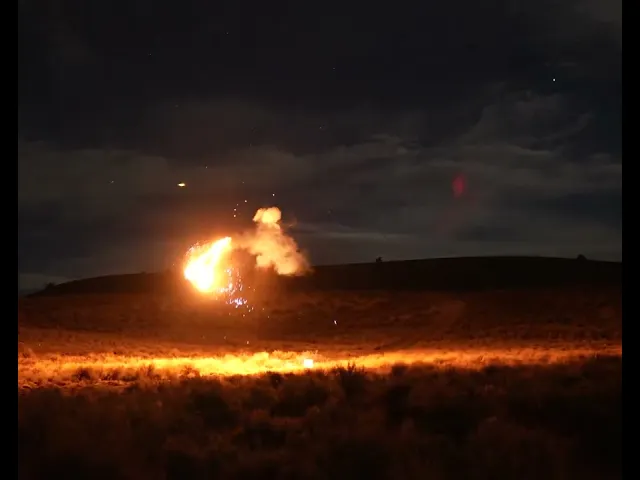
It did more than any deck could have. Defense buyers and investors have seen every slide about the future of counter drone and the ideas around it. What's much rarer is proof that two guys can deliver what they say they can.
It also showed us who was actually interested, which told us where to spend our time. Video does something else a deck never will. It scales, and it keeps getting forwarded after you've left the room. Almost every email we send now has footage in it.

You've been in the room longer than you think
People ask me about my first real conversation with the military. Honestly, I can't pick one. I've been talking to people in defense and policing for about ten years.
When I was 18 or 19, I'd find senior people and just chat with them. Most of them were happy to share their opinions, and they gave me some of the best advice I've ever gotten.
None of those early conversations were sales calls. They were me asking for advice. Years later, those are the people who pick up the phone, and some of the people I still text for advice now run massive companies themselves. Shoutout to Dan Magy of Firestorm, who gave me an hour of his time after one cold DM.
Put it in front of the people who'd use it
A few weeks ago, we shot down a few dozen drones, following the counter drone standards of JIATF 401, the Pentagon's joint task force for countering small drones. We also took inspiration from FPV pilots I met on my trip to Ukraine, who showed me what's actually happening there and how real combat threats are flown compared with the criteria JIATF uses to evaluate counter drone systems.
An operator doesn't care about your slides. They want to see it hit something, outdoors, in real conditions, with their own eyes. Winning them over matters, but it isn't as simple as getting them to like you. Operators often have a very strict set of criteria, so you also have to know what the programs you're selling into are actually looking for, so you don't waste time pitching someone who has no ability to give you money. But always, always build relationships. They pay dividends in ways you could never imagine.
Ultimately it comes down to making a ton of friends early. When people like you, they talk about you, and when you need them, you can call on everybody at once. You'd be surprised how often very senior people at defense primes have texted me out of nowhere to say they'd been talking about us and were impressed with our recent progress.
Procurement is mostly quiet work
We have contracts, and I won't say much more than that, which is normal in this industry. Very little of it would have happened if we'd waited for a solicitation to tell us what to build.
The part nobody tells you is how much of it is just showing up in writing. Answering the government's Sources Sought notices and RFIs is how a program office learns you exist. It's unglamorous and nobody posts about it, but it's where the conversations start.
Do the outreach yourself first
A lot of founders think they need lobbyists before they can sell to the government. Eventually, good ones can help a lot. At an early stage, though, you can do much more of it yourself than people expect.
Cold emails are your friend. As a founder, you can just email members of Congress and senior government officials, and their offices often respond. We asked lobbyists we'd worked with what their hit rate was on emails, and when I emailed offices myself, my hit rate was higher in every case. Lobbyists are better for appropriations and very specific asks.
A lot of it comes down to content. People skim. If your email has a good opener, a real hook, a video of the thing working and a few pictures, people will want to talk to you. Keep it short. Say what you build in one line, show it working, and ask for one specific thing, like a call or a demo. Offices get buried in email, and the ones that make it easy get answered.
The industry is hot right now, too. If you do what you say you'll do, people are going to give you contracts. That's the reality.
What I'd tell a founder starting in defense today
Pick a problem you know, that you have connections in, and that you can actually win. So many people are jumping into defense right now, but it's never too late. The bar is low, and a lot of people get lazy and don't bother building real hardware because it's hard. Just prepare yourself for a grind.
I once met a 24 year old woman at a bar in Ukraine. Her boyfriend had been killed by an FPV drone. When I told her what we were building, she said, "I really wish we had that." It's a good reminder of what we're building for.
If you're starting in defense today, build the cheap thing that works and film it. Put it in front of the people who'll actually use it. Email everyone yourself, and do what you say you'll do. The industry is hot, and there has never been a better time for a small team to win.
Cameron Rowe is the co-founder and CEO of Sentradel.
Published in Fello Foundry by Fello