

I spend a lot of time in the room with life-changing companies. AI teams. Robotics teams. Quantum teams. Medtech, XR, advanced manufacturing, defense. Through Fello Agency and the Fello Foundry community, I hear the same thing over and over.
The tech is real. The product is strong. The market still hesitates.
If you lead marketing in B2B tech, you already know the pressure. The CEO wants growth. The board wants proof. Sales wants better conversations. You are usually bushwhacking for a lot of these companies because there is no clean, stable playbook still.
That is why branding matters so much in STEM.
A brand is a feeling that somebody thinks about when they see your company. In this world, that feeling needs to be trust, interest, curiosity, and recall. If people do not trust you, they do not move. If they do not remember you, you disappear. If you don't have a brand, then you're going to be forgotten.
For a CMO or VP of Marketing, this is not soft work. This is pipeline work. This is how you take conversations out of the lab and into the boardroom of value. This is how marketing moves from a cost center to a revenue engine.
The Real Job of Branding in STEM
Most technical teams still hope the product will do the talking. I love great products. They make our job easier. But better product is not a go-to-market strategy. Great technology still needs a wrapper that instills trust fast.
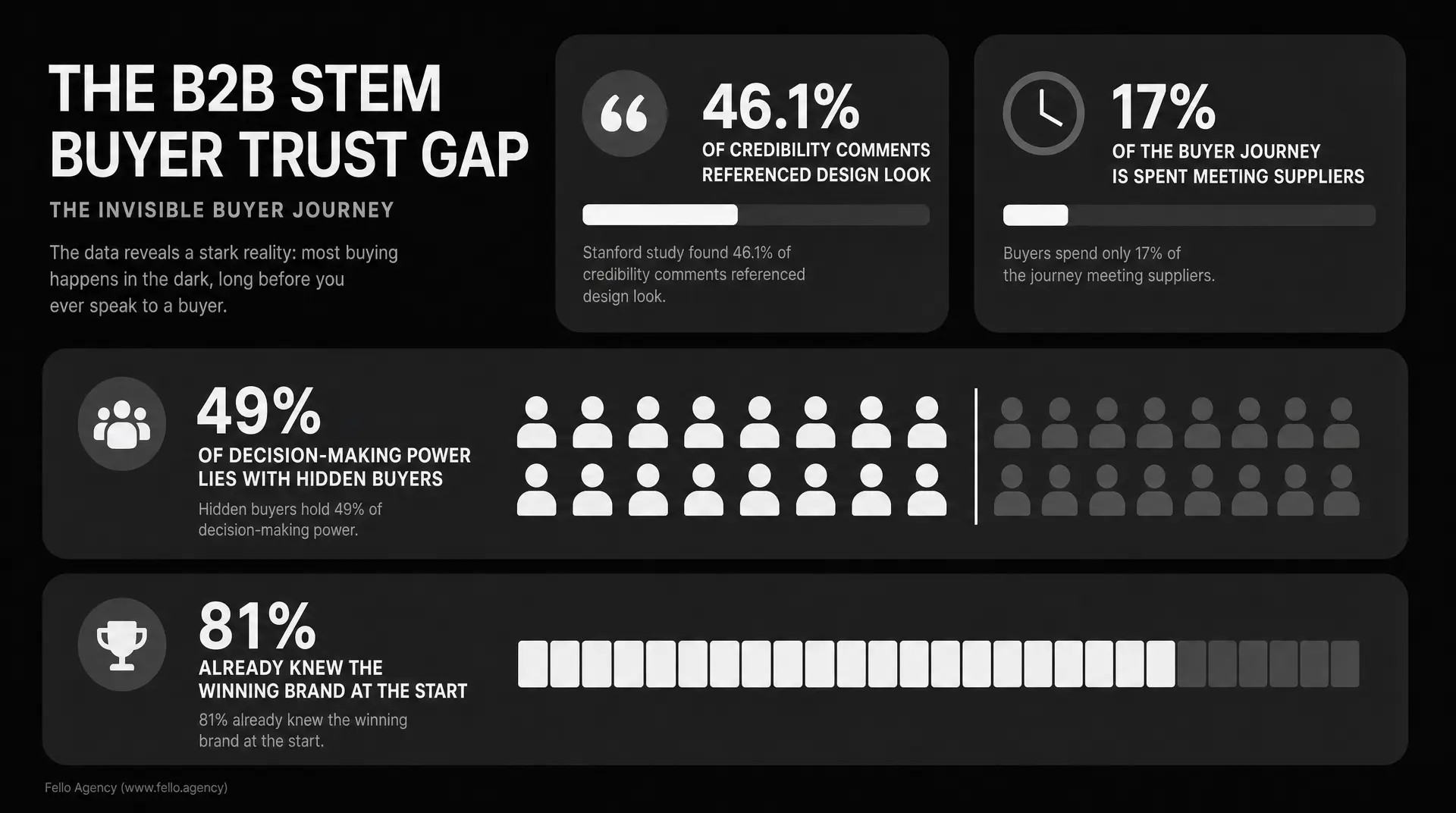
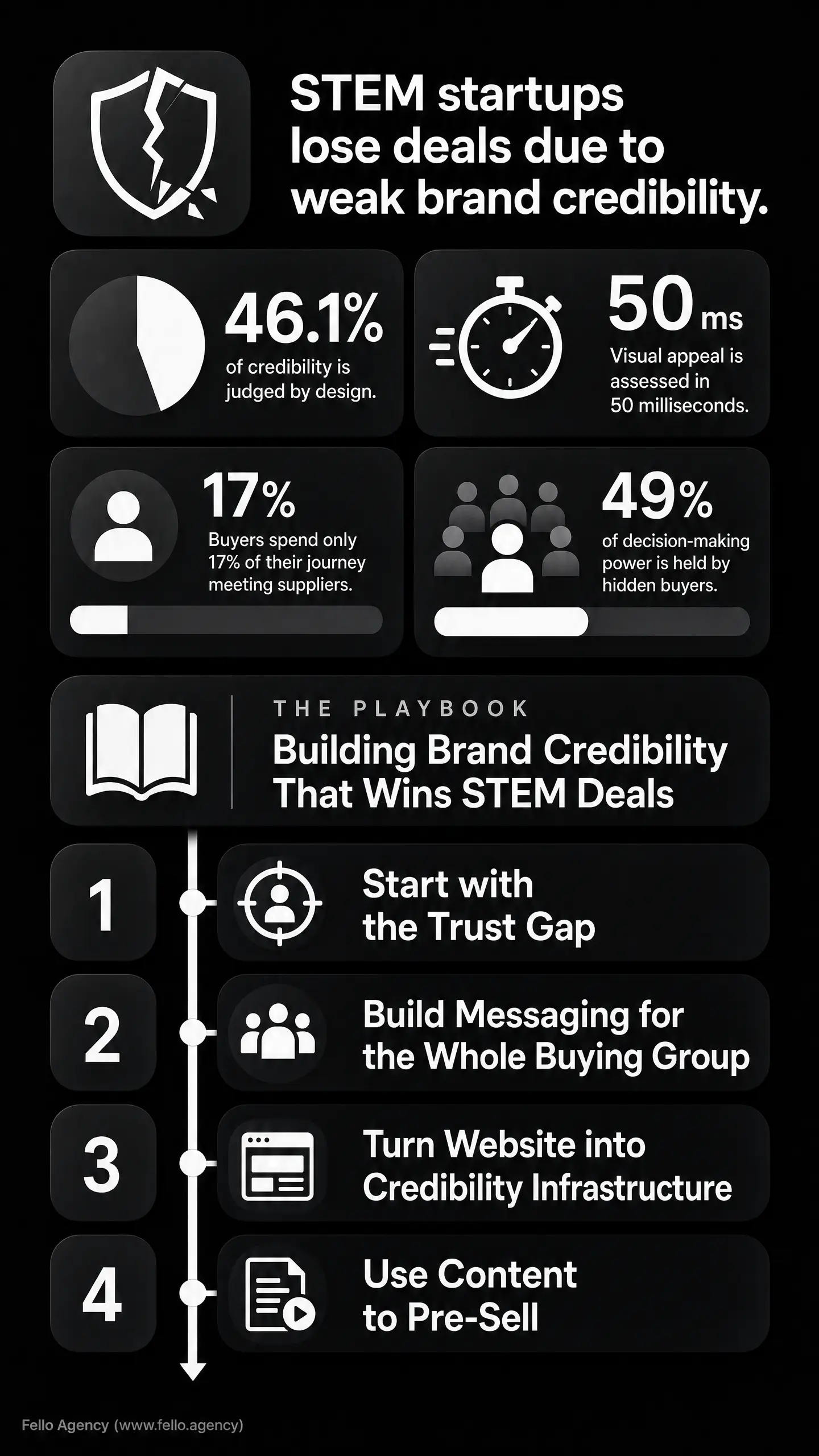
Buyers decide whether you feel legitimate much earlier than most founders think. A Stanford study found 46.1% of credibility comments referenced design look. So yes, the layout matters. The typography matters. The colors matter.
Another peer-reviewed study showed people judge a page's visual appeal in 50 milliseconds. Your copy has not even had a chance still. Design is a commercial gatekeeper before anyone reads the first line.
This matters even more in B2B because buyers spend very little direct time with suppliers. Gartner found buyers spend only 17% of the journey meeting suppliers. If three vendors are in the mix, each one gets around 5% of the buyer's time. You do not get a long runway to explain yourself.
Another Gartner survey found 61% prefer an overall rep-free buying experience. The same survey found 69% report inconsistencies between the website and the sales conversation. That gap kills trust. Fast.
And then you have the hidden buyers. Research cited by Brand Finance found hidden buyers hold 49% of B2B decision-making power. It also found they are 70% more likely to reject unfamiliar brands. Even more important, 81% of buyer groups already knew the winning brand at the start of the process.
So when I talk about brand, I am talking about commercial trust. I am talking about reducing perceived risk. I am talking about helping your buyer champion you internally without feeling stupid.
If you are asking buyers to spend serious money, your company is a Michelin star restaurant. Every detail of the experience needs to signal quality. Why would someone trust you with their most money if you will not invest to look your best?
That is why brand credibility is a go-to-market accelerant. It shortens the first part of the sales cycle where people are just trying to figure out if you are real.
Where STEM Startups Lose the Plot
The PhD Curse

One thing I really want technical founders to understand is this: people buy from people, and people judge technology based on the people who built it.
That is where the PhD curse kicks in. STEM founders are usually terrible brand builders because they are trained to be. Academia rewards precision, hedging, caveats, and mechanism. Branding rewards simplicity, conviction, and emotion.
I saw this hard early in my career with a very early AI company. We sat in the kickoff and it was obvious they were not ready to go to market. The questions made no sense. They were acting like they were selling coffee, not complex technology.
The "explain it to me like I'm 5" rule is wrong for this audience. Everyone tells STEM founders to simplify. I think that is lazy advice. The real move is to elevate.
Do not make the buyer feel dumb. Make them feel smarter for understanding why your tech matters. Apple did not make the M1 chip work by dumbing it down. They made people feel like they understood why it was important. The best STEM brands don't strip out complexity. They repackage it as status.
The founders who break through learn to say something with conviction. "We make batteries that last forever" lands. "We have a novel solid-state electrolyte architecture that demonstrates improved cycle life characteristics" does not. Same science. Totally different commercial signal.
The Uncanny Valley of Tech Branding
There is also an uncanny valley of tech branding where a huge number of startups get stuck.
They look too technical for normal people. They look too polished for the technical community. They end up with a gradient logo, a generic sans serif, and some copy about pioneering the future. Then they wonder why nobody remembers them.
That kind of brand feels professional on the surface, but it says absolutely nothing. I would rather see a scrappy identity with real conviction than a polished one with no point of view. At least scrappy signals authenticity.
Technical buyers spot bullshit a mile away. In the new dawn age of AI, they can smell sameness even faster. The same stock image. The same generic layout. The same prompt-built site. I use AI tools all the time for ideation, but human design credibility still has to finish the job. Claude-style layouts look fresh for about five weeks. Then the market clocks them.
The Series B Graveyard

I also see a whole graveyard of startups that promised themselves they would "do brand later."
They raised on vision. Then they tried selling to enterprise procurement with the same wrapper. That is where things get expensive.
Early brands often sell a future. Enterprise brands have to sell credibility. That gap becomes a rebrand trigger. You feel it when sales starts spending more time explaining what the company is not than what it is. That is a positioning failure baked into the identity.
I have seen heavily funded robotics and AI companies burn momentum this way. Incredible product. Weak market narrative. The pilot dies in committee because the internal champion never got a boardroom ready narrative. Pilot purgatory is usually a trust and narrative problem long before it is a tech problem.
The Playbook
Start with the Trust Gap, Not the Logo
I never start with the logo. I start with the trust gap.
Go-to-market strategies usually fall at the brief, not the launch. Internal teams speak in product language. Buyers speak in commercial reality. If you do not close that gap first, the website, ads, decks, and content all get softer.
My order is simple. I talk to customers first. Then sales. Then marketing. Then leadership. That sequence matters.
Customers tell you what they still do not understand. Sales tells you where deals keep stalling. Marketing tells you where the message has drifted. Leadership tells you what the company wants to become.
On a deeper rebrand, I want five competitor profiles benchmarked and at least 10 power users interviewed. I want to know what buyers trust, what confuses them, and where the competitor is winning the emotional part of the sale. Strategy and research usually account for about half the value in the whole engagement. The visuals come later.
Your ICP also has to be built cross-functionally. Sales data alone is backward-looking. Product, customer success, marketing, and sales all see different parts of the truth. I care about who gets value fastest, because that group gives you cleaner momentum.
And look, I do not accept "we don't know enough still" as an excuse from founders anymore. Use Perplexity. Use ChatGPT. Use Google deep research. Move 10 times faster than you think you do.
One more thing. A lot of founders love the idea of creating a new category. Great. Do you have 18 months and a very healthy budget to teach the market new language? Most teams do not. Hijacking an existing category is usually the smarter move. You cannot create demand for a category that does not exist in the buyer's mind still.
Build Messaging for the Whole Buying Group
One hero message across the entire site is usually where B2B STEM brands start leaking money.
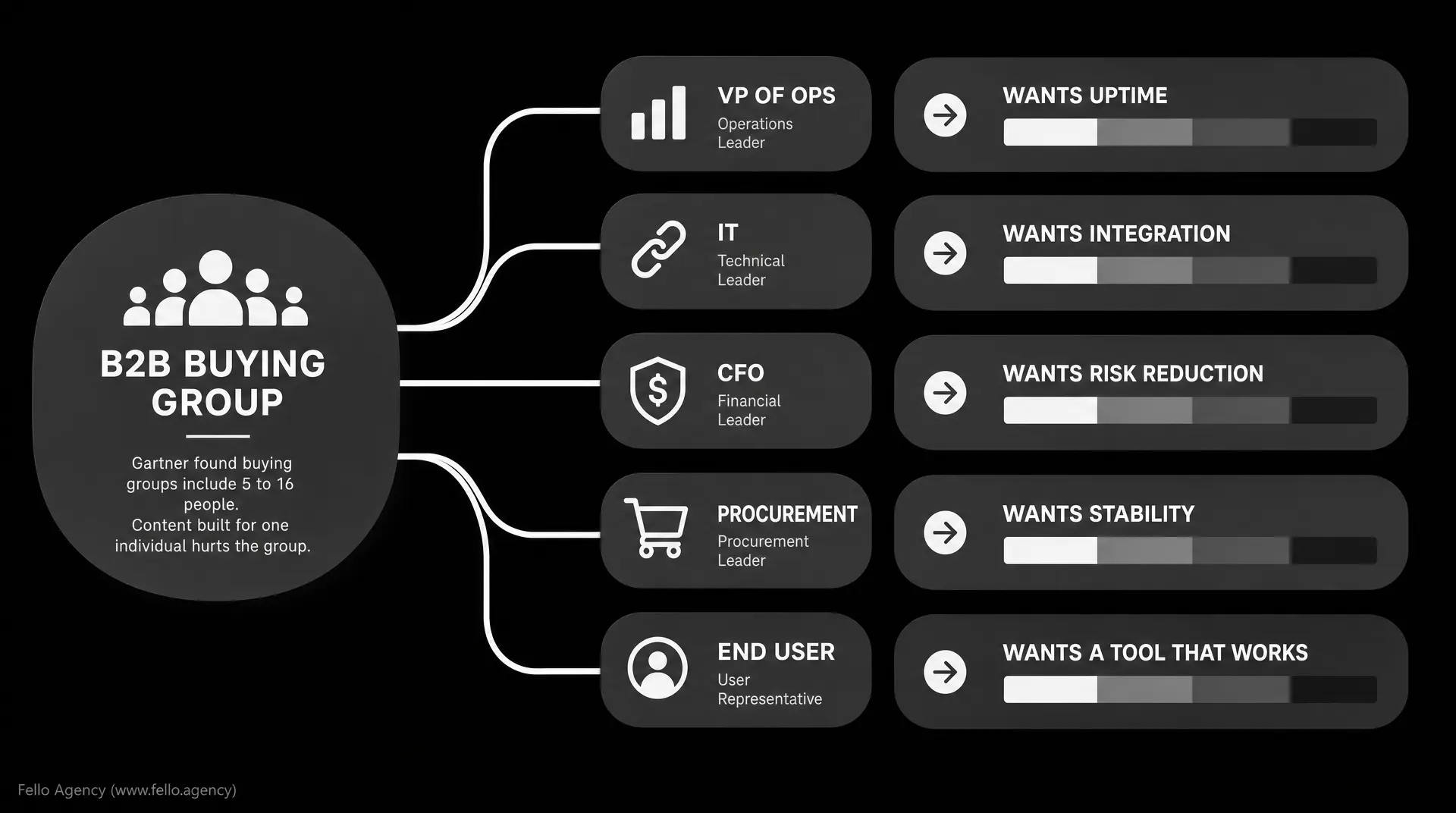
Gartner found buying groups often include 5 to 16 people across as many as four functions. The same research found buying-group relevant content improves consensus by 20%. Content built only for one individual can hurt the group.
Gartner also found 74% of buyer teams show unhealthy conflict during the decision process. Teams that reach consensus are 2.5x more likely to report a high-quality deal. Edelman and LinkedIn reported more than 40% of B2B deals stall because of internal misalignment.
This is why I push for separate message tracks. The VP of Operations wants uptime and throughput. IT wants integration and support. The CFO wants risk reduction and payback. Procurement wants stability. The end user wants a tool that works. You need to say the right amount to the right people without saying too much.
Above the fold, I want outcomes and value. The heavy stuff can live lower on the page, in product pages, in docs, and in sales materials. Founders usually put too much on the features and not the benefit. I keep pulling the conversation back to money, time, and risk, because that is the buyer's commercial reality.
We did this kind of segmentation work with ACTO. Partner pages were tailored to different ICPs so the company could balance technical proof and emotional clarity without turning the site into a Frankenstein.
Turn the Website Into Credibility Infrastructure

Your website is one of the most important assets in the whole system. In B2G, I call it your past performance. In enterprise, it plays the same role whether people admit it or not.
The homepage has to do a whole slew of things quickly. I want a strong hero image. I want a clear CTA. I want proof early. I want case studies near the top, not buried. I want product visuals that feel real, then testimonials, then resource pages that help buyers keep going.
This is how the experience becomes legitimate and absolutely won.
I also design B2B deep tech sites desktop first. Our internal data keeps pointing to the same thing: major buying decisions in these markets happen on computers. Mobile still matters. Desktop does the heavy lifting.
And your team needs control. Marketing should be able to launch a post fast, update a page fast, and fix a message fast. Waiting on a dev queue every time you need to publish thought leadership kills momentum.
Sphere is a strong proof point here. We updated the website, tightened the brand guidelines, and shifted the message away from vague innovation language toward collaboration, numbers, and ICP lifestyle clarity. Traffic jumped 50% right away. The new site ultimately drove more than 3x lead generation.
Alexandra Corey, Head of Marketing at Sphere, said it best: "The new website has more than tripled our lead generation efforts."
That is what happens when the brand and the website are doing the same job.
Make the Visual System Carry Weight
Typography and color are doing more work than most teams realize.
Because buyers move so quickly, font choice becomes a subconscious filter. It helps people decide whether you belong in the category before they fully read the copy. That is why I care so much about type.
IBM Plex is one of my favorites for enterprise, infrastructure, quantum, and manufacturing because it balances engineering logic with human rhythm. Space Grotesk gives AI and deep tech a future scientific feel. Inter is a clean workhorse for enterprise SaaS. JetBrains Mono belongs in developer docs and technical blogs because it was built for scanning code.
I had a manufacturing and medical device client whose tone was off until we applied IBM Plex. As soon as that went in, the site started shouting professionalism. Sometimes the smallest visual decision fixes the biggest credibility leak.
Color works the same way. Black is an empty vessel that adapts. White, black, and gray have become a strong signal for high-value innovation. Purple is emerging as the leadership color for AI. Navy blue says established authority. Electric blue says digital-first innovation.
Use those signals on purpose. Do not default into whatever the sector always does. If you sell advanced technology with a bright airy CPG look, buyers start questioning whether you are authentic. They may not say it out loud, but they feel it.
Use Content to Pre-Sell the Business Case
A lot of B2B tech teams still treat content like a side project. That is a mistake.
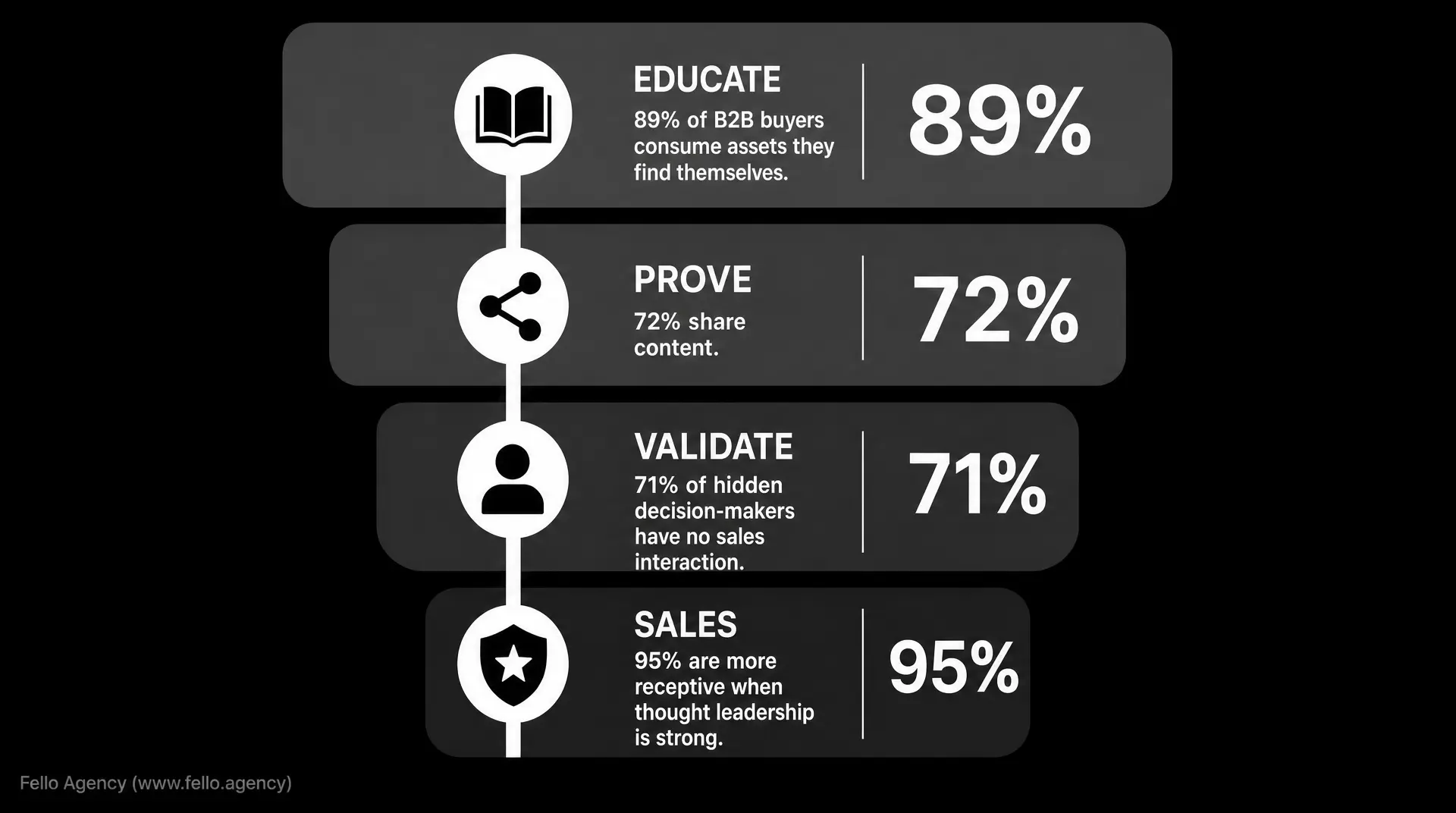
Content is one of the best business development tools in the system when you build it right. I think about it as a technical authority funnel. You educate the market on the problem first. Then you prove your method. Then you help the buyer validate the business case before sales ever joins the call.
That matters because buyers are already self-educating. Demand Gen Report found 89% of B2B buyers consume assets they find themselves. It also found 72% share content with relevant team members. Your technical brief is not a vanity asset. It is internal sales collateral for your buyer.
Hidden decision-makers prove this point even harder. Edelman and LinkedIn found 71% of hidden decision-makers have little or no interaction with sales. The same report found 95% are more receptive when thought leadership is strong. It also found 79% are more likely to advocate for RFP proposals from companies that publish high-quality thought leadership.
So move the giant PDF docket onto the site. Build ROI tools. Build a flagship report. Put named engineers in the webinar, not just marketers. Put methodology front and center. Let the buyer see you understand the problem at a peer level.
And stop pretending enterprise buyers only live on LinkedIn. They are also humans. They scroll Instagram. They use Reddit. They still respond to meet-the-team content because people buy from people. I have seen a client struggle with traction until we started posting meet-the-team content on Instagram. The following picked up because the company finally looked human.
LinkedIn still matters a lot, but I view it mainly as a buyer verification layer. It helps people check whether you are real. Founder and exec posts usually do more work there than a corporate page ever will.
Give Sales Assets They Will Actually Use
The best salespeople already know the power of branding because marketing does half their job when it is working.
Gartner found buyers are 1.8x more likely to complete a high-quality deal when they use supplier digital tools together with a sales rep. That is your website. That is your calculator. That is your technical brief. That is your deck. That is your explainer video.
This is why I care so much about sales enablement. Reps need assets they can actually forward, present, and reuse. Pitch decks, technical explainer videos, product launch kits, partner pages, capability briefs, trade show visuals. All of it should help them walk into the call with fewer misconceptions to fix.
ACTO is a good example. We created explainer videos focused on the audience's why rather than platform screenshots. Wafa Sayeed-Irtiza, VP of Marketing, said both marketing and sales teams "couldn't wait to start circulating the videos in campaigns and outreach." That is what you want. Immediate adoption across both teams.
When that happens, the sales team can skip a level. They are no longer spending the first half of the call proving you are legitimate. They are fitting the pieces together and moving the deal forward.
Treat Recruiting Like Go-to-Market
A lot of founders miss this completely. Your first customers are not actually buyers. They are your hires.
If the brand looks like a weekend Figma project, top engineers notice. Top operators notice. They compare you to OpenAI, Meta, Google, Anduril, Colossal Bioscience, Rocket Lab, all the companies that already invested in how they show up.
LinkedIn found employer brand is twice as likely to drive job consideration as company brand. Companies with stronger employer brands also see 28% lower turnover.
That is why I point to Rocket Lab when people ask about talent. Their steady stream of high-quality content helps attract engineers. That is why Anduril's recruiting campaigns work. They gave hard-working people a mission and an identity worth joining.
If you are smaller than the giants, lean into it. Build the underdog story. Give people a reason to join the underdog team besides salary. The talent war is won on brand before it is won on compensation.
How to Sell the Investment Internally
Talk to the CFO in Commercial Terms
If you walk into the boardroom asking for a prettier logo, you are making your own life harder.
Talk about communication strategy. Talk about marketing investment. Talk about credibility infrastructure. Talk about lower CAC, stronger LTV, better close rates, faster sales velocity, and reduced vendor risk perception. That is the language people hear.
I usually start by showing leadership the competitive set. Nine times out of 10, the top three competitors already have strong design, strong storytelling, and strong systems. The market has told you what winning looks like.
And if someone still thinks design is fluffy, McKinsey's Design Index found that top-quartile design performers achieved 32 percentage points higher revenue growth and 56 percentage points higher total shareholder return growth over five years. That is not an arts-and-crafts statistic.
I also use Fello as a case study because I know every inch of it. We moved our own identity from purple and black to white, black, gray, and light blue. Immediate trust improved. The incoming deal quality changed. We started attracting a different level of opportunity because the brand matched the room we wanted to be in.
That is how I frame ROI. Brand changes buyer confidence. Buyer confidence changes deal quality. Deal quality changes the math.
Budget It Properly and Move Fast
For an early-stage deep tech company, I usually say an initial branding investment of $15,000 to $30,000 can establish professional credibility if you stay disciplined.
Once you are in Series A or Series B and selling into enterprise, a real rebrand usually lands between $50,000 and $150,000. A fully editable website system often sits between $30,000 and $60,000. If the budget gets squeezed, I would rather cut scope than cut quality. Cheap creative gets expensive later.
At Fello, we stay intentionally lean for this reason. We have a small core team, direct client access, and no bloated account teams eating the budget. More of the money goes into the work. That model helped us complete more than 50 projects with a 4.9/5 rating, and it is why we can move quickly when companies need aggressive growth.
We were built organically too. No venture money. That changes how I think. I care about speed to clarity, not endless hours and endless revisions.
Launch Clean, Then Govern It
A product launch waits for no one's creative review cycle. That is why I hate slow, democratic feedback loops on technical go-to-market work. They destroy speed and usually soften the result.
I have worked on compressed timelines where the essentials had to be obvious right away. One haptics company needed a rebrand and website in about a month and a half so they could show up at CES and get meetings with major OEMs. In a sprint like that, you lock the core pieces fast. The logo, the visual guide, the colors, the typography, the communication strategy, and the site all need to move together.
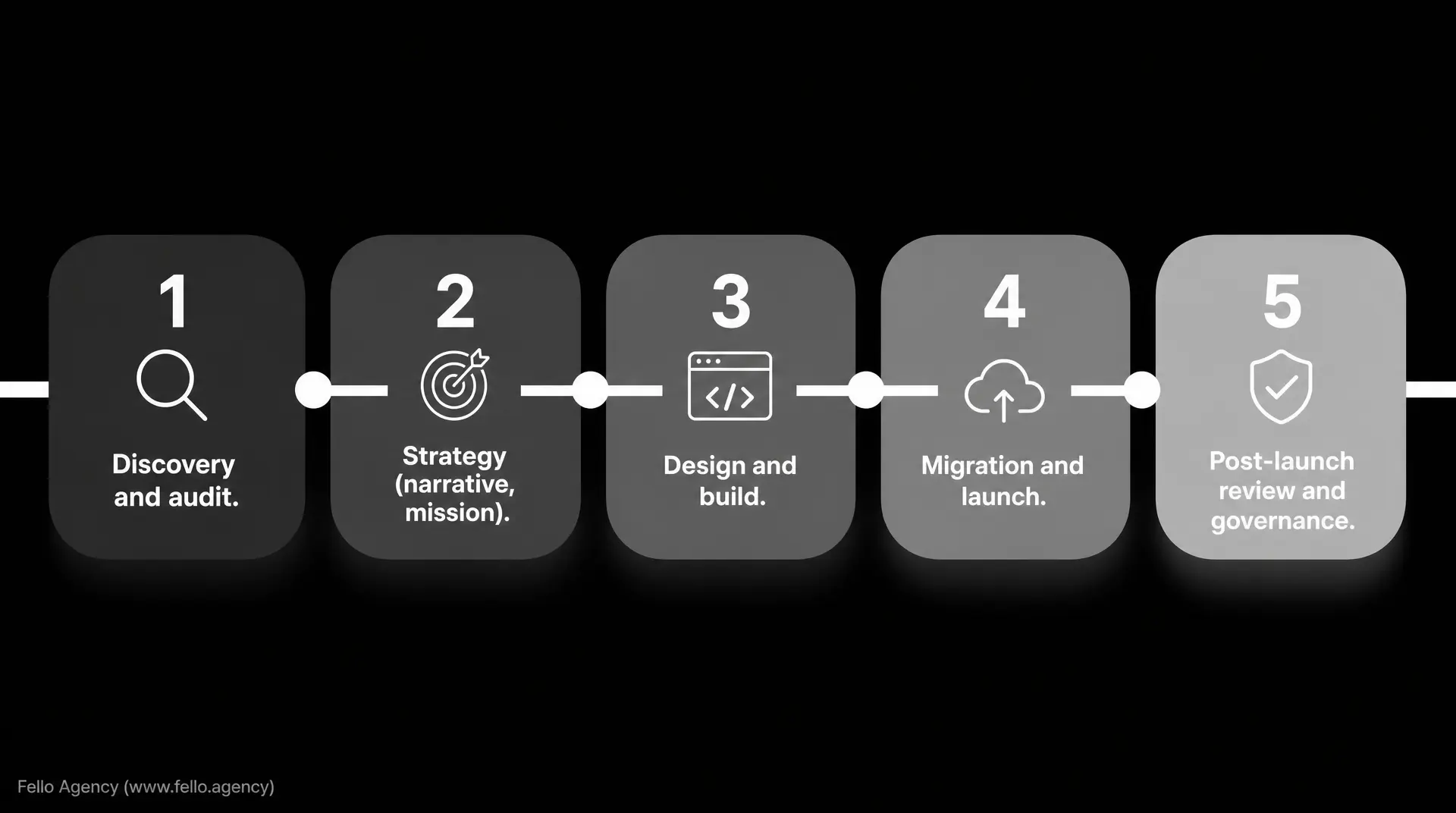
On a full rebrand, I use a 20-week framework. It starts with discovery and audit. Then strategy. Then design and build. Then migration and launch. Then post-launch review and governance.
During strategy, I want direct C-suite sign-off on the narrative, mission, vision, and voice pillars. I also want a brand kill list. Old assets hanging around are one of the fastest ways to wreck consistency.
During migration, I want redirects handled, third-party listings updated, and product brand-switch features mapped if the software itself is changing. After launch, I am looking at traffic, brand search, sales velocity, and developer adoption if docs or SDKs changed. Then we do an internal retro, document what broke and what surprised us, and set a governance rhythm.
Brand never ends. It needs upkeep.
You know you have succeeded when sales, marketing, and the C-suite are all saying the same thing about the company. That buy-in is the first big win.
Final Word
If you lead marketing at a STEM startup, your job is bigger than awareness. You are building trust. You are building the system that helps a buyer understand the value quickly, carry the story internally, and feel safe moving forward.
That system has to show up everywhere. In the website. In the sales deck. In the content. In the visual identity. In the way your team talks about the company. In the way your future hires decide whether you are worth joining.
I have seen too many strong companies wait too long. They assumed the product would do all the work. Then a competitor with worse tech and better storytelling captured the market narrative.
Do the work early. Build the message. Build the system. Make sure the referral did its job because the website didn't undo it.
If you don't have a brand, then you're going to be forgotten. In B2B tech, forgotten gets expensive very fast.
Frequently Asked Questions
How do you measure the ROI of a branding initiative in a long B2B STEM sales cycle?
You measure it through sales velocity and deal quality, not just immediate lead volume. Track your lead-to-opportunity conversion rate and the time spent in early-stage pipeline. A strong brand reduces perceived risk, meaning your sales team spends less time defending your legitimacy and more time closing high-value consensus deals.
How should marketing and sales teams align when rolling out a STEM startup rebrand?
Launching a rebrand without sales is a failure. You must co-create enablement assets. According to Gartner, B2B buyers are 1.8x more likely to complete a high-quality deal when using supplier-provided digital tools alongside a rep. Marketing builds the credibility infrastructure. Sales weaponizes it.
How do you distribute thought leadership to influence hidden decision-makers?
You cannot rely on sales outreach because hidden buyers avoid it. An Edelman report notes 71% of hidden decision-makers rarely interact with sales. Distribute high-value technical assets organically through SEO and ungated website resource hubs so they can self-educate and champion you internally.
How do you get resistant STEM founders to adopt the new brand narrative?
Stop debating aesthetics and start showing them customer data. When technical founders resist commercial messaging, I put them in front of the trust gap. Show them where deals stall in committee. Frame the brand as an engineered system designed to lower customer acquisition costs. They respect data, so bring the math.
When targeting complex B2B buying groups, should we gate our technical briefs?
Un-gate your heavy technical content. Friction kills consensus. Demand Gen Report found 89% of B2B buyers consume self-discovered assets, and 72% share them internally. Your technical briefs are internal enablement tools for your champion. Let them access and distribute the proof without fighting a form field.
Your Creative Partner for Innovation That Matters
From advanced tech to transformative healthcare, Fello helps visionary teams shape perception, launch products, and lead industries.

Let’s keep in touch.
Discover more about high-performance web design. Follow us on Linkedin and Instagram.

