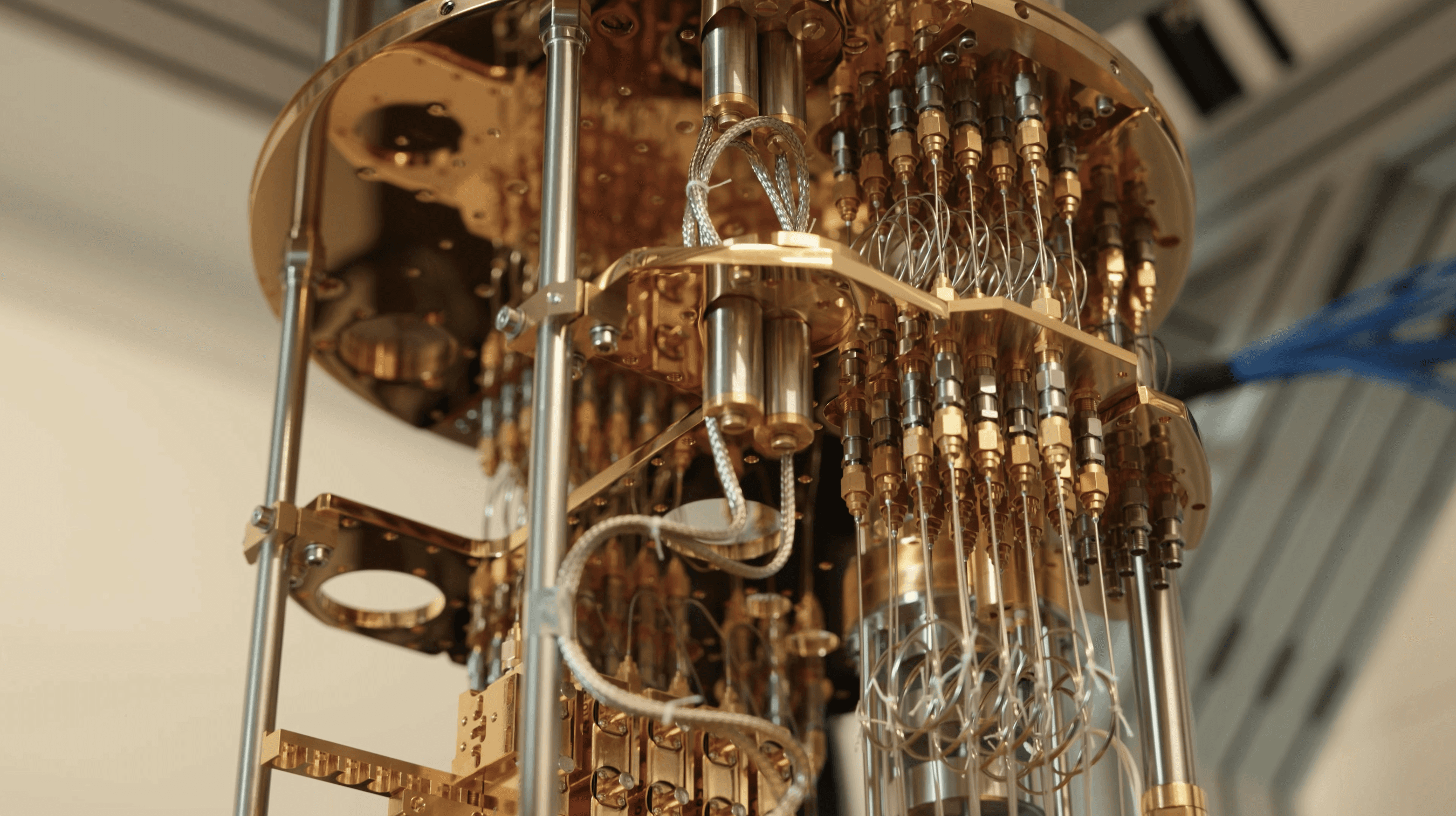


I’ve been in the room with a quantum computer. When the fridge alone costs around $1.5 million, you stop treating marketing like some soft layer on top of the company. You start thinking about trust. You start thinking about commercialization. You start thinking about how to explain something very real to people who are still deciding how real the market is.
When people ask me what it means to “translate complex technologies,” I keep it simple. It means helping some of the most innovative tech companies in the world commercialize. That’s the job. I’ve done that across photonics-based quantum systems, traditional quantum computing, and quantum security. Same challenge every time. Great science. Hard story. Big upside. Slow buying cycle. A market that needs clarity fast.
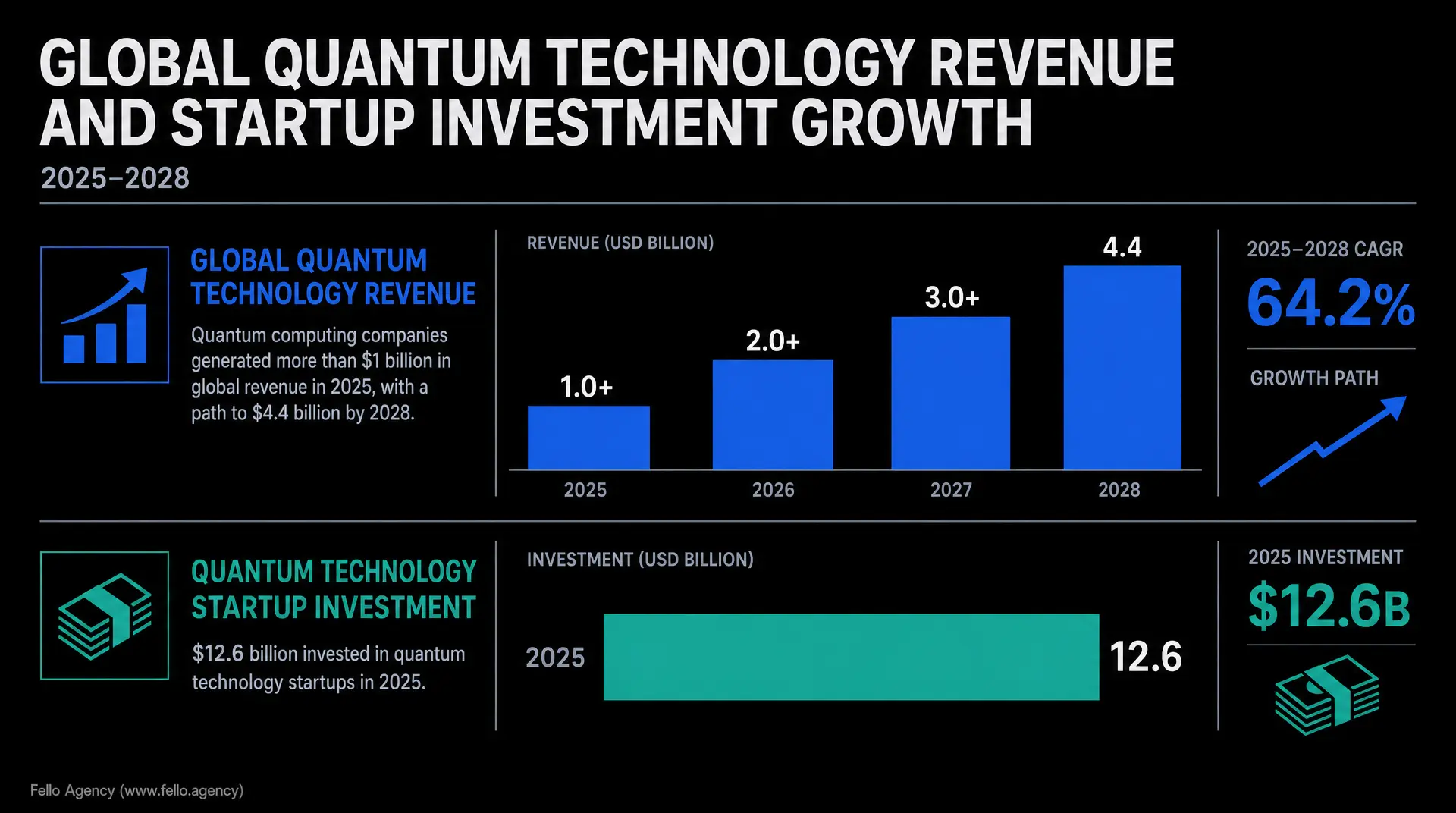
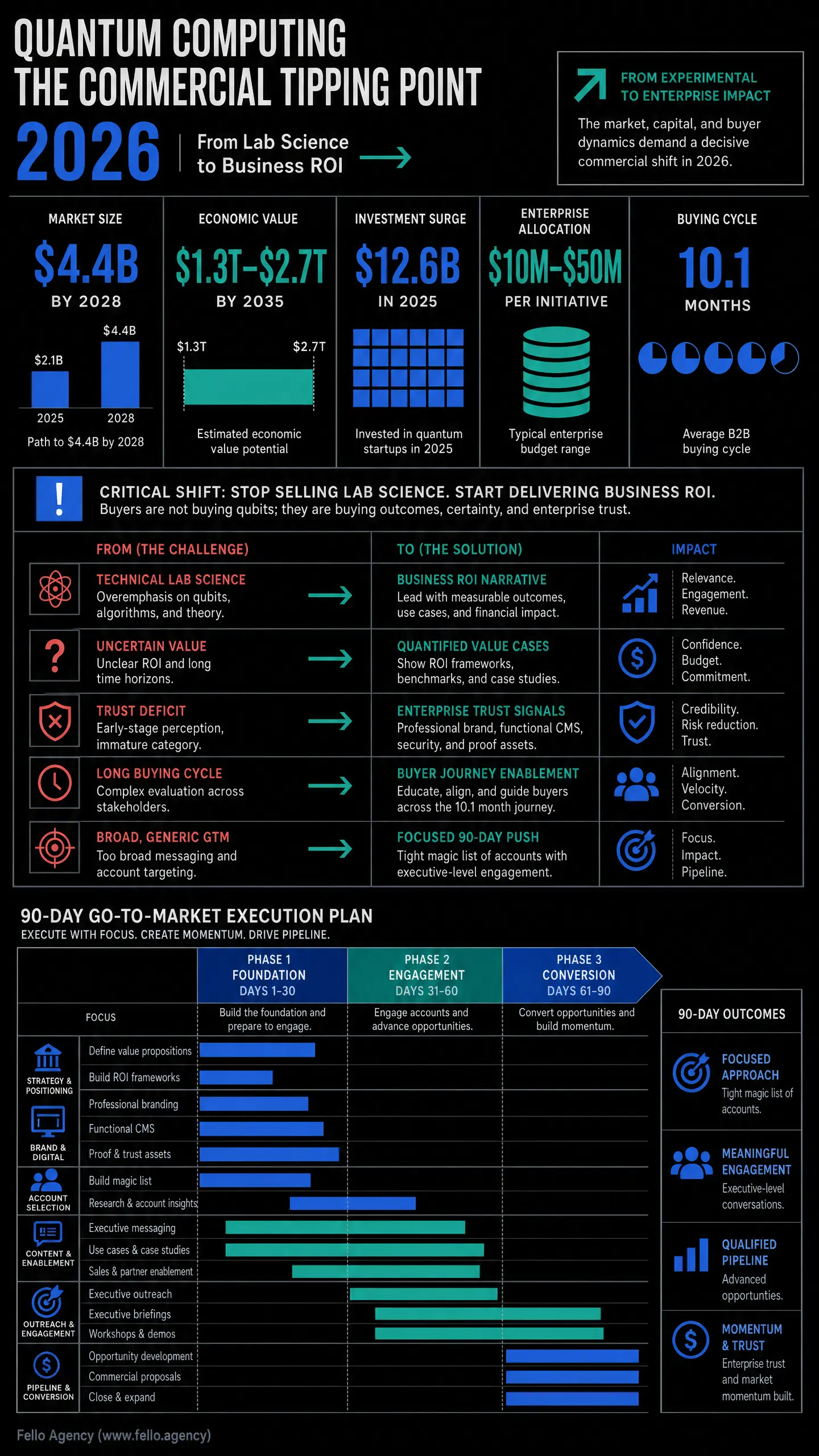
And quantum has changed. This is no longer a pure research conversation. McKinsey’s 2026 Quantum Technology Monitor says more than 300 organizations are already collaborating with quantum technology companies. It also says quantum computing companies generated more than $1 billion in global revenue in 2025, with a path to $4.4 billion by 2028.
If you’re a founder, that changes your job. Buyers are real. Budgets are real. Expectations are real. Your website needs to speak business.
Quantum Has Hit a Commercial Tipping Point
The upside is massive. McKinsey puts the long-term opportunity at $1.3 trillion to $2.7 trillion in economic value by 2035. That is not a niche story. That is board-level money.
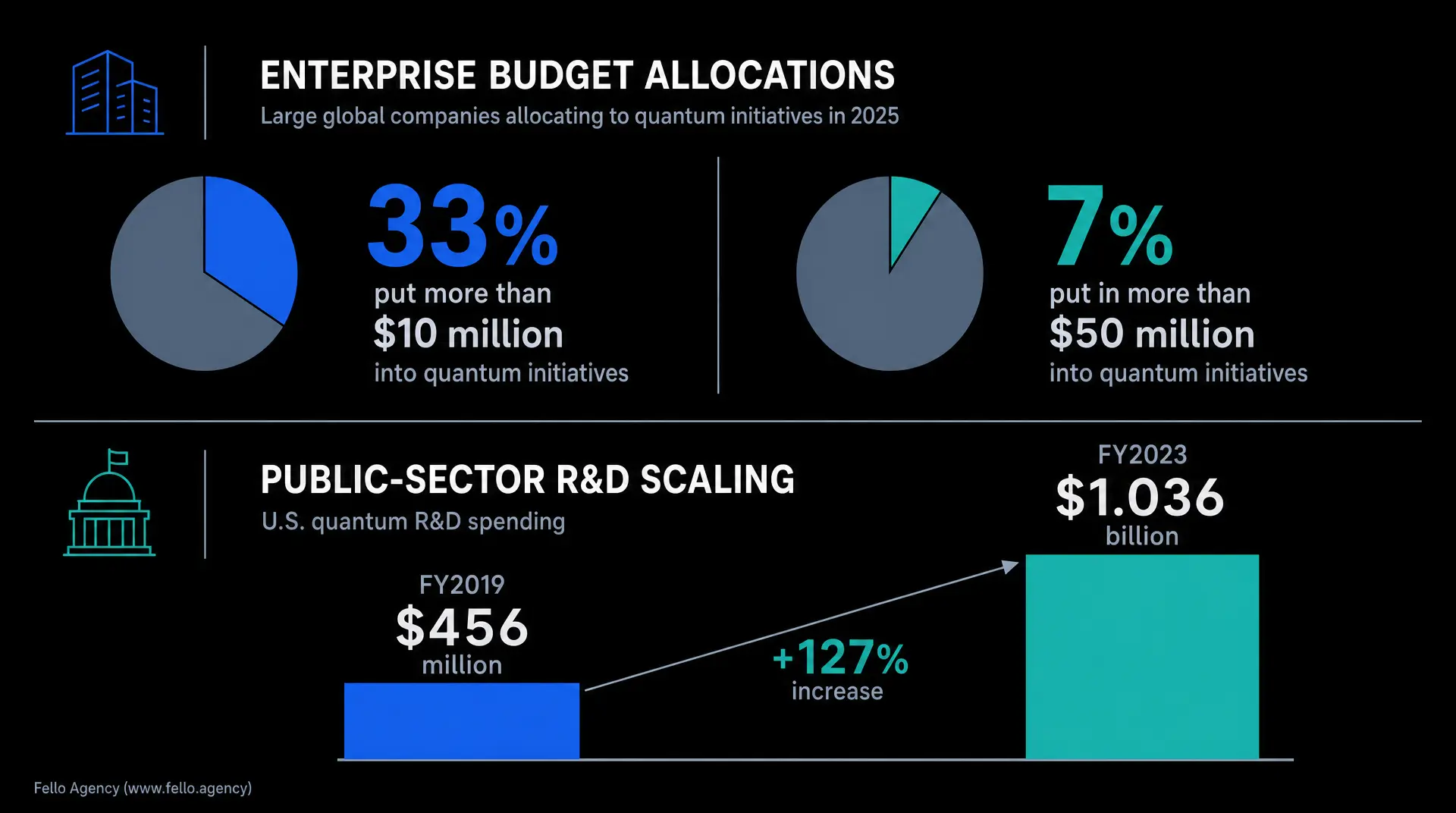
The budgets are already getting serious too. McKinsey’s 2026 analysis found that one-third of large global companies put more than $10 million into quantum initiatives in 2025, and 7% put in more than $50 million. When buyers start allocating eight figures, they do not want to deal with a company that looks half-finished.
Capital is moving hard as well. McKinsey reports $12.6 billion invested in quantum technology startups in 2025, and 90% of that went to quantum computing startups. Public-sector urgency is there too. The National Quantum Initiative budget supplement shows U.S. quantum R&D spending rose from $456 million in FY2019 to $1.036 billion in FY2023.
The hardware story is still milestone-driven. IBM’s April 2025 roadmap lays out Nighthawk at 120 qubits and Starling aimed at modular, error-corrected scale. Buyers are watching progress very closely. They want to know what is real now, what is coming next, and what each milestone changes for them.
And if you are selling quantum security, the urgency is even more direct. NIST finalized the first post-quantum cryptography standards in August 2024 and said organizations should begin migrating now. That gives you a clear business hook. Timing. Risk. Action. Budget. You do not have to force the urgency. It is already there.
So yes, a lot of quantum companies are still early. I work with early-stage deep tech all the time. But the category now has enough money, enough motion, and enough public proof that you cannot go to market like a science project and expect the market to do the translation for you.
Most Quantum Companies Are Speaking in the Wrong Order
The biggest problem I see is the order of the story.
Founders open with the architecture because that’s what they built. They lead with the science because that’s what they care about most. I understand that. But enterprise buyers are trying to answer a different question. They want to know what changes in the business if they take this meeting seriously.
So start there.
What gets faster? What gets cheaper? What gets safer? What risk goes down? What capability becomes possible that is blocked today? If your homepage opens with dense technical language before answering those questions, you are making the buyer do work they will not do.
This is the technical talk versus business talk problem. Both matter. I’m never telling a quantum company to dumb the science down. I hate that advice. You are not trying to make the company sound less intelligent. You are trying to make the business case easier to repeat.
A good one-liner should survive outside the lab. A board member should be able to say it. A partner should be able to pass it on. A sales rep should be able to use it without sounding lost. If that sentence keeps collapsing into jargon, the message is not ready.
I say this to technical founders all the time: pivot to an ROI narrative or you’re gonna stay in the lab. Create a business, not a research problem.
And yes, even in quantum, you need to sell a lifestyle. I do not mean that in some fluffy consumer way. I mean you need to show the buyer what they become after they adopt your solution. More capable. Faster. Earlier. Harder to compete with. The story has to move from how smart the device is to how much smarter the buyer is going to be.
A lot of quantum companies also need more than one translation of the same core message. Usually you need one version for the executive buyer, one for the technical evaluator, one for investors, and one for hires and partners. The core truth stays the same. The order of proof changes.
That is exactly why pre-revenue quantum companies need to be careful. If the product is still maturing, do not pretend it is further along than it is. Overselling and underdelivering will kill trust fast. Sell credibility first. Sell the people. Sell the milestones. Sell the seriousness of the mission.
We did that with Nord Quantique. The company was tackling hard applied science around quantum error correction. That is the kind of shift founders need to make. You are building a reputation even before you build revenue.
The Trust Gap Kills Great Companies
A lot of deep-tech companies think they have a product problem when they really have a trust problem.
I’ve seen companies with better engineering lose ground to companies with a better wrapper. There is a whole Series B graveyard built on that issue. Great science can raise early money. Commercial trust wins the market.
Branding, to me, is the act of authenticating what you already believe about your product. If you believe your company can change an industry, but you show up with weak visuals, messy decks, and a site that feels like it was stitched together by five different people, you are believing but not authenticating it.
I can say that more bluntly. If it looks like bullshit, no one’s gonna want to work with it.
I’ve seen a company lose a deal with Amazon solely because the brand visuals were poor. That is not theory. That is a real revenue consequence. Professional-level visuals are non-negotiable when you are trying to close serious business.
A lot of founders hold onto the lab look because it feels honest. I get that. But the market often reads it as unfinished. You can keep the seriousness. You can keep the technical weight. You still need to dress for the client that you need.
This is why I frame branding as risk mitigation. Strong B2B branding is the last moat standing because it helps you skip a level in the sales cycle. It reduces the time buyers spend asking whether you are legit. It helps sales walk into the room with more credibility. We often see the first signs of that in days, not months. Faster email replies. Better response quality. Easier conversions for the team.
Consistency matters here more than people think. One of the easiest visual tells is sloppy font usage. That sounds tiny. It isn’t. When the deck, website, proposal, and trade show materials all feel different, the company starts to look like a science project. Buyers feel the gap before they can explain it.
A good brand system fixes that. The messaging, the logo, the assets, the website, the sales materials, and the documentation all need to follow one line of translation. If one part of the company is still freelancing the story, the market will feel the crack.
Your Website Is Part of the Sales Team
Most founders still underestimate how much selling happens before anyone books a call.
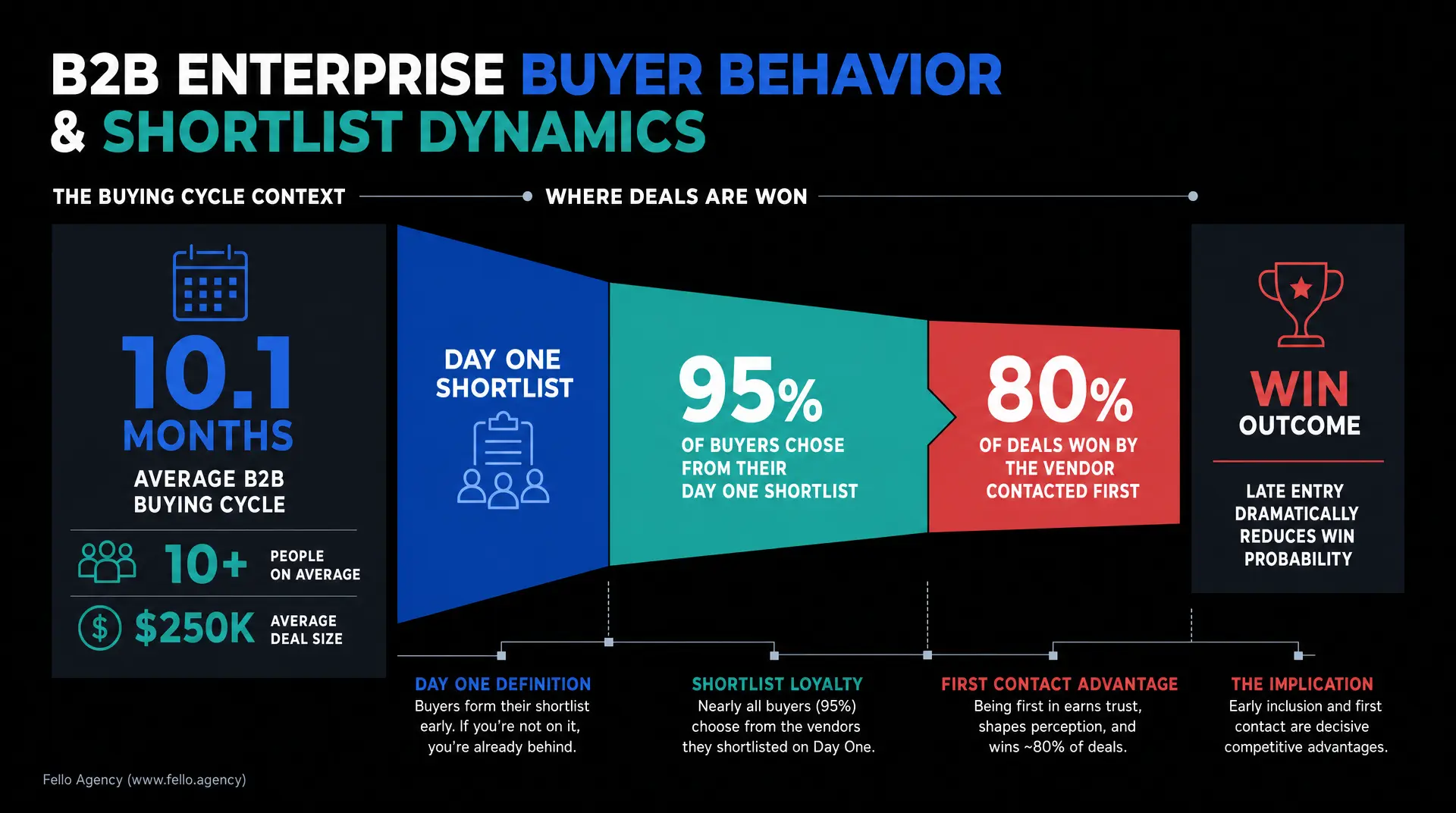
6sense’s 2025 B2B Buyer Experience Report found that buyers chose from their Day One shortlist 95% of the time, and the vendor contacted first won about 80% of deals. That should wake you up pretty quickly. Your website is shaping that shortlist whether you like it or not.
That same report says the average B2B buying cycle sat at 10.1 months in 2025, with buying groups averaging more than 10 people on an average $250,000 deal. Quantum can run even longer. So your website cannot just be pretty. It has to work for the technical evaluator, the business buyer, the internal champion, the partner, and the person who gets dragged into the thread nine months later.
When I look at a quantum homepage, I want the business value up top. I want credibility right away. Then I want proof. Case studies. Strong product or lab visuals. Testimonials. A clear next step. Resource pages should come after that for buyers who want the deeper technical dive.
One of the biggest red flags in B2B tech is a site with no real case study or testimonial section. If you are asking an enterprise buyer to trust you in a high-risk category, and there is nowhere on the site to see proof, you are making sales do extra work for no reason.
And your website has to match what sales is saying. Gartner found 69% of B2B buyers see inconsistencies between a company’s website and what sellers tell them. That kind of mismatch creates mistrust fast. In quantum, that is brutal because skepticism is already high.
You also need pages built for actual stakeholders. We used this strategy for an XR client by creating separate industry pages for factories, medical tech, and defense. Lead generation more than tripled because each audience could finally see itself in the story. Quantum teams need the same discipline. An enterprise operator, a CTO, an investor, and a government stakeholder should not all be dumped into the exact same page and asked to figure it out.
And no, video does not replace copy. Copy still does the heavy lifting for SEO, clarity, and message control. You need both.
Give Your Team a CMS They Can Actually Use
If you don’t have a proper CMS, there is no point of even having a website.
I mean that literally. I’ve seen companies stuck on legacy systems where publishing one guest blog took months because the original developer was gone and nobody could operate the backend. That is insane in deep tech.
My benchmark is simple. Once the copy is ready, your team should be able to publish a blog post in three minutes. If they can’t, the system is broken.
This matters a lot in quantum because content has to keep moving. New papers. New milestones. New hires. New partnerships. Conference follow-ups. Technical explainers. If every update needs a developer, you are moving in months when you should be moving in weeks.
And yes, optimize for mobile last. Big buying decisions are computer buys. The people reviewing your site, your decks, and your technical resources are usually doing it at a desk.
What to Budget for Credibility
Founders ask me about this constantly.
For a Series A or B deep-tech company, a serious rebrand usually sits somewhere between $50,000 and $150,000. A fully editable website system usually lands between $30,000 and $60,000. Roughly half of a branding budget should go into strategy and research. That part matters just as much as the visuals.
When I need CFO buy-in, I frame this as communication strategy and marketing investment. A strong website is lead-generation infrastructure. A real brand system is credibility infrastructure. Those words matter because the board is buying risk reduction and commercial speed, not decoration.
And if budget gets tight, cut deliverables. Do not cut quality. I don’t think it’s a matter of skimping out on quality. I think it’s a matter of skimping out on deliverables.
Show the Invisible Without Looking Fake

Quantum has a weird marketing problem. A lot of the value is invisible.
You are asking the market to care about behavior they cannot see, inside systems they cannot touch, on timelines that can still be long. That is why visual storytelling matters so much.
You need high-fidelity assets that make the future feel tangible. Video helps. CGI helps. Technical animation helps. But all of it has to be grounded in reality.
Too much polish will look like vaporware. I see this all the time in hard tech. A company spends a fortune on beautiful futuristic visuals, but there is nothing real underneath them in the story. Technical buyers smell that right away.
My favorite move is pairing polished visual assets with real-world proof. Show the lab. Show the team. Show the fridge. Show the process. For quantum clients, we’ve even recorded the actual sounds of the fridges and used them in the work. That kind of acoustic branding does more than stock music ever will. It shows you’re actually in the dirt doing the work.
Stay away from AI-generated slop. If your visuals look generic, buyers start asking whether your company is generic too. That is a terrible association in a market built on precision, trust, and high-stakes technical claims.
And be careful with milestone storytelling. Buyers know the category is developing in stages. They are watching roadmaps. They are watching proof. They are watching who overpromises. Respect the stage you are at. Say what is true. Show what is real. Let the work behind the art do its job.
Proof Assets Move the Market

Proof beats promise every time.
If you land an early pilot, a partnership, or a deployment with real learning value, turn it into a story fast. I do not care if the first case study comes from a paid pilot or a heavily supported early user. If the story is real, it has value.
When we build case studies, we tell them from the customer’s side. I want to hear what was frustrating before the product showed up. I want the buyer to recognize their own headache in the story. Your client is your Padawan. Guide them from pain to proof.
We used that approach with Mosaic Manufacturing. On their orthotics work, we built video case studies around the business owner’s experience and the operational upside. We did not bury the story in printer specs. That shift helped drive a 25% increase in inbound leads and a 15% lift in booked meetings within two months.
That lesson applies directly to quantum. Sell the result. Sell the operational shift. Sell the business change. Then earn the right to go deeper technically.
For companies asking for high-six-figure trust, I strongly believe video case studies matter. Early R&D teams can lean on PDFs for a while. Once you have raised a Seed round or landed your first solid deal, you should be investing in proof assets that match the value level of the contracts you want.
Then squeeze the value out of every asset. A strong case study video should become a PDF, a blog post, a deck section, trade show content, and short clips for founder channels. That is real bang for your buck.
There is data behind this too. LinkedIn’s 2025 B2B Marketing Benchmark found that 78% of B2B marketers use video, and teams with mature video strategies are 2.2 times more likely to say their brand is well trusted. In deep tech, trust is the job.
Long Sales Cycles Need a Real Nurture System

Quantum companies do not get to live on one-off campaigns. The cycle is too long. The buying group is too wide. And the people involved are too skeptical.
You need a system that keeps your company in the buyer’s head while they are still figuring out the problem internally. That means technical briefs, downloadable brochures, useful white papers, monthly updates, lab tours, and resource pages that help people keep the conversation alive inside their own organization.
I especially like assets that help buyers write future RFPs. That is where technical content gets really valuable. It stops being a thought-leadership vanity play and starts becoming a tool they can forward around internally.
We use monthly video updates and behind-the-scenes content in long deep-tech sales cycles because they keep momentum alive. They also justify the price. When a buyer can see the engineering environment, the process, and the people, the company feels more solid.
LinkedIn matters here too, but I don’t treat it like a magic lead machine. LinkedIn for me has always been a verification tool. Buyers check it to see if the company is active, credible, and full of real people. Founder posts and technical team posts usually travel further than company-page content anyway, and passion will actually beat hardcore planning a lot of the time.
Most of your market is still not buying today. The 95:5 rule matters here. Most business buyers are out of market at any one time. That is why I care so much about what I call collector pages. Your mission page, about page, partnership page, meet-the-team content, and behind-the-scenes resources build memory. They build connection. They make people feel like part of the club long before they are ready to buy.
Generic outreach ruins this. Gartner says 73% actively avoid suppliers that send irrelevant outreach. So if your nurture is broad, vague, and obviously copied and pasted, people pull away.
And yes, even with AI everywhere, human selling still matters. You still need a driver behind the car.
Your Hiring Brand Matters Too
A lot of founders think of marketing as buyer-facing only. I don’t.
Your first customers are your hires. That matters a lot in quantum because the talent market is tight. QED-C reported more than 7,000 open quantum jobs globally. The competition for serious talent is real.
The best people are judging your seriousness before they ever reply. They look at the brand. They look at the website. They look at who is on the team. They look at whether the company feels like it has momentum.
This is one reason founder visibility matters so much. In sectors like quantum, the reputation of the founder and scientific leadership carries real weight. People want to know who is doing the work. They want to know whether the company has real believers behind it.
Connection matters. Passion matters. Buyers can feel it. Hires can feel it. Partners can feel it too.
Be Careful Who You Hire to Lead Marketing
The bilingual talent gap in quantum is very real.
A lot of marketers will tell you they understand deep tech because they once worked at a SaaS company with a technical product. Be careful with generalists who call themselves B2B tech specialists because they’ve worked at one SaaS company.
If someone needs three months of discovery before they can tell you what is broken, they do not have the playbook for your space. I say this all the time because I’ve seen founders lose whole quarters to the 90-day audit trap. Ninety days of diagnosis is eternity.
Ask a simple question. Who are the last technical buyers they sold to, and what did those cycles actually look like? If they cannot answer that clearly, they are going to spend the beginning of the engagement learning your industry on your dime.
And if your real bottleneck is output, a strategist alone will not save you. Hiring a fractional CMO when you don’t have an execution engine is like hiring a head coach for a team with no players. Founders need speed to clarity and speed to shipping.
The 90-Day Push I Would Make in 2026
First Two Weeks
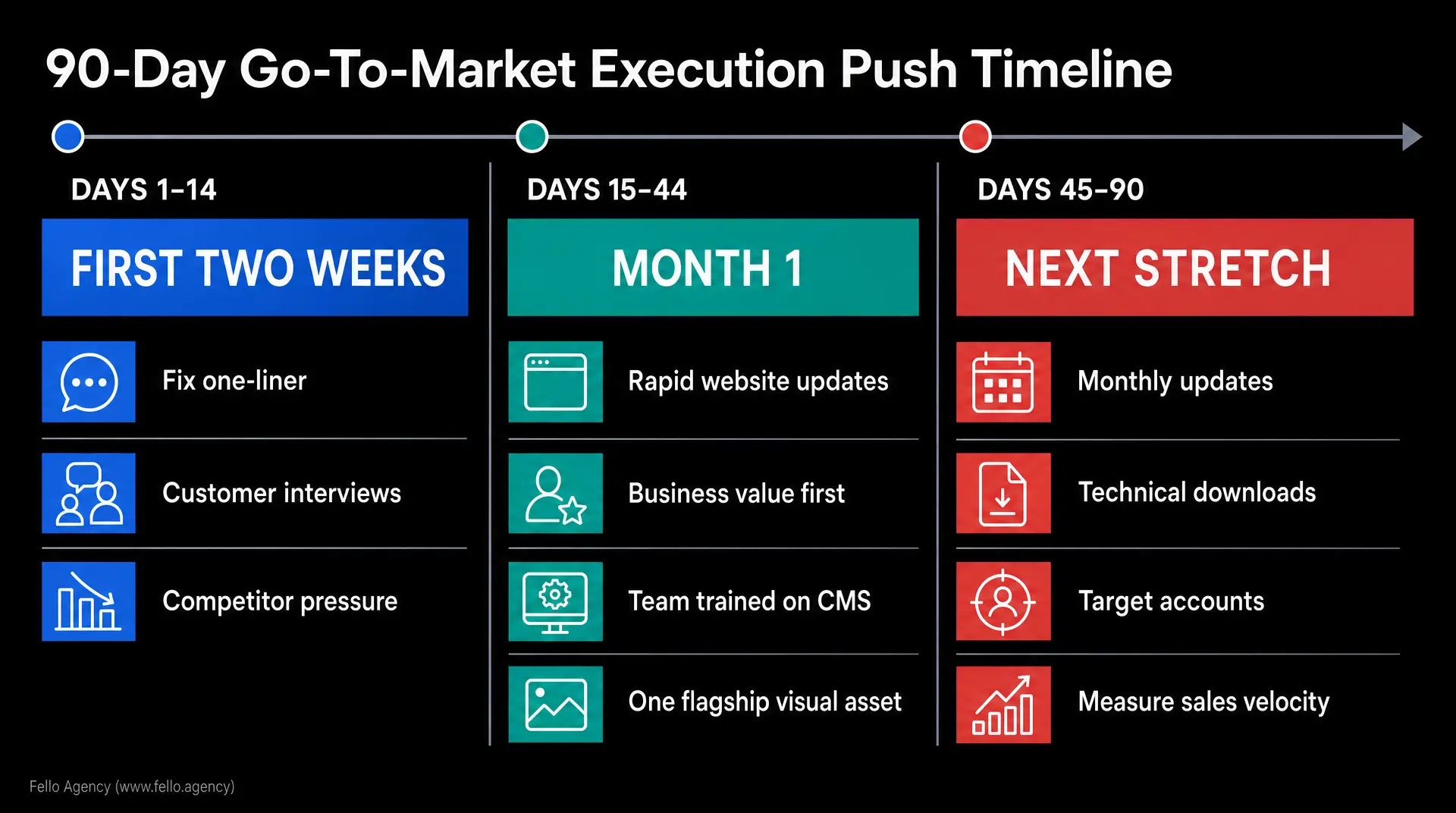
In the first two weeks, I want the one-liner fixed. I want the commercial story tightened until a non-technical executive can repeat it cleanly. I want interviews with customers first, then sales, then marketing, then leadership, because that order tells you where the message is actually breaking.
I also want competitor pressure on the table. Show me the five companies your buyers already respect. Show me how they talk. Show me where you sound too technical, too vague, or too early.
The Next Month
Then I want the website moving fast. The homepage should lead with business value. Proof should show up early. There should be a real case study page, a real resource page, and landing pages for the audiences that matter most.
I want the team trained on the CMS as part of that project. Hard line. If your internal marketers cannot make updates without a developer bottleneck, you are building the wrong system.
I also want one flagship asset in production. Usually that is a grounded video or visual piece tied to a real milestone. Something the sales team can use. Something investors can watch. Something that makes the company feel tangible.
The Next Stretch
From there, I want rhythm. Monthly updates. Founder content. A valuable technical download that captures emails. Outreach into a tight magic list of named accounts. And I want measurement tied to sales velocity, not vanity traffic.
I’m looking for better reply rates, more serious demo requests, more brief downloads, more multi-threaded conversations, and easier movement inside target accounts. Those are the signs the market is starting to trust you.
And move. Please move. We built Fello from the ground up without venture capital, so I have very little patience for teams that spend six months talking about going to market. They want to move in months when they should be moving in weeks. I keep my agency lean for the same reason. Bloated account teams kill speed.
Final Word
Quantum computing marketing in 2026 comes down to a few simple things.
Speak business first. Build proof early. Show the invisible in a way that feels real. Give buyers a website and content system that keeps trust alive through a long cycle. Make sure the company looks as serious as the contracts, hires, and capital you want to win.
Do that well, and people stop treating you like a research problem. They start treating you like a company.
That shift is everything. It is the difference between being admired for the science and being chosen for the business. Create a business, not a research problem.
Frequently Asked Questions
How early should a Series A quantum startup begin commercial brand building?
Start immediately. Waiting for fault-tolerance is a revenue killer. According to the 6sense 2025 B2B Buyer Experience Report, buyers choose from their Day One shortlist 95% of the time. You must build memory and trust long before enterprise buyers formally enter the market.
How do you maintain market momentum while waiting on multi-year hardware milestones?
You sell the roadmap and operational shifts. Look at the IBM Quantum Roadmap PDF. They publicly map processors to specific gate capacities. Break your R&D into consumable business updates. Show the lab. Prove incremental progress so buyers trust your final commercial delivery.
How does a deep-tech marketing strategy address large enterprise buying committees?
You need multi-layered translation. The 6sense 2025 B2B Buyer Experience Report shows buying groups average 10+ members. Your technical founder talks to their CTO, but your marketing must give the CFO a clear ROI narrative. Stop dumping every stakeholder onto one dense technical page.
How do we target early enterprise revenue before our quantum systems fully scale?
Target their internal innovation budgets. The McKinsey Quantum Technology Monitor 2026 found one-third of large companies allocated over $10 million to quantum last year. Position your current-stage tech as an essential sandbox. Help their teams build capabilities today.
How should post-quantum cryptography companies market their solutions to skeptical CISOs?
Stop forcing the urgency and lean on compliance. The NIST Post-Quantum Cryptography Project finalized three standards, including FIPS 203 and 204, in August 2024. Use those mandates as your hook. CISOs do not buy physics experiments. They buy immediate regulatory risk mitigation. Positioning for compliance-driven buyers is the kind of work our deep tech marketing agency does.
Your Creative Partner for Innovation That Matters
From advanced tech to transformative healthcare, Fello helps visionary teams shape perception, launch products, and lead industries.

Let’s keep in touch.
Discover more about high-performance web design. Follow us on Linkedin and Instagram.

