


Every Series A founder hears this advice sooner or later.
Hire a fractional CMO. Let them figure out the strategy. Build the team later.
On paper, it sounds smart. It sounds efficient. It sounds like the safe board-level move.
A lot of the time, it becomes a very expensive stall.
I work with deep tech companies all day at Fello Agency. AI, robotics, quantum, medtech, manufacturing, defense. My whole job is helping technical companies commercialize. So when I look at fractional CMO pricing, I do not just look at the retainer. I look at what actually ships. I look at what gets delayed. I look at what burns runway.
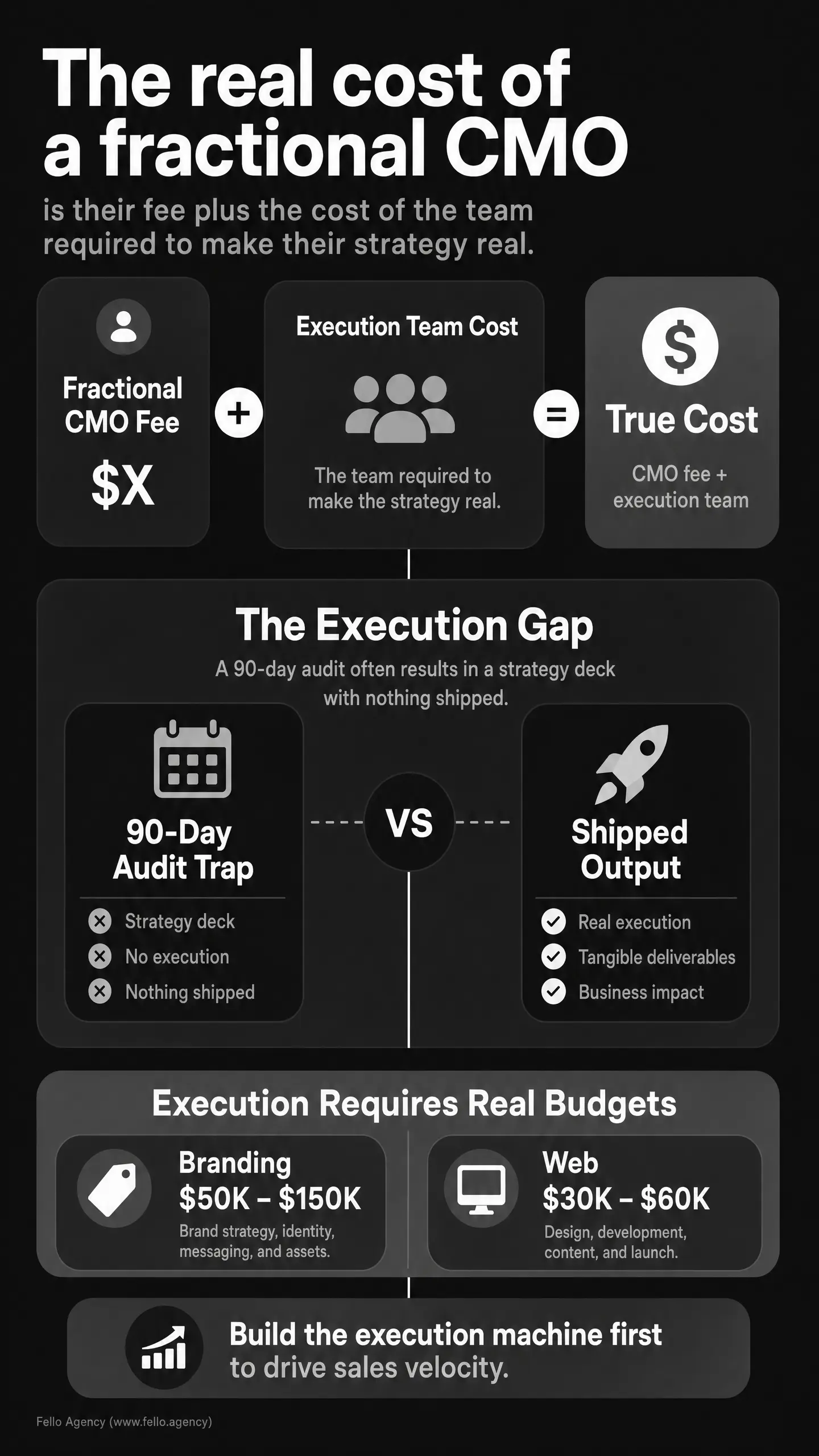
Here's the line I keep coming back to: the real cost of a fractional CMO is their fee plus the cost of the team required to make their strategy real.
That second number is where founders get blindsided.
The Proposal Fee Is Only Half the Bill
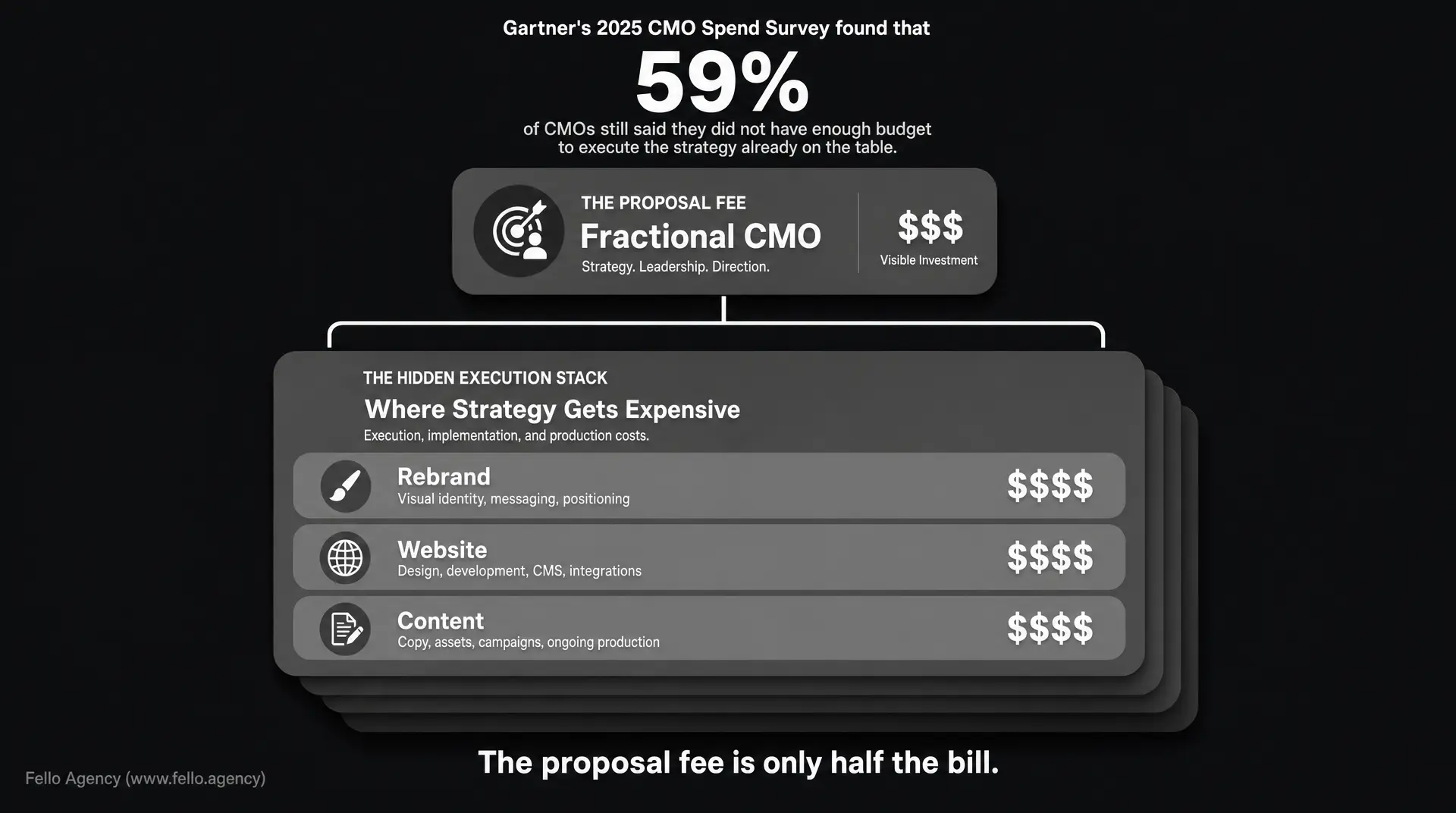
A strong fractional CMO usually costs somewhere around $10,000 to $15,000 a month. I think that can be fair. You are not paying for hours. You are paying for speed to clarity. A senior operator should be able to walk into your company and find the real issue fast.
A good one may only work 15 to 20 hours a month. That does not bother me. If they can diagnose in two weeks what a junior hire would need six months to figure out, that is valuable. If you're counting hours, you're buying the wrong thing.
The problem starts right after that.
The strategy comes in. Now you need the brand refresh. You need the website rebuild. You need landing pages for different buyers. You need proof assets. You need case studies. You need video. You need content. You need sales decks. You need someone to manage the CMS. You need reporting. You need follow-through.
That is where the real bill shows up.
I keep seeing the same mistake. Founders budget for the fractional CMO, then get hit by the execution gap. Gartner's 2025 CMO Spend Survey found that marketing budgets averaged 7.7% of company revenue, and 59% of CMOs still said they did not have enough budget to execute the strategy already on the table. That is exactly the problem here. The plan exists. The fuel does not.
A $5K Fractional CMO and a $15K Fractional CMO Are Different Products

Founders often look at the market and assume they are comparing better and worse versions of the same thing. I don't see it that way. I see different scopes.
At $5,000 a month, you are usually getting an advisor. They sit in on calls. They give direction. They review things. They act like a sounding board. That can be useful if you already have a capable team and just need help steering.
At $15,000 a month, I expect a lot more. I expect ownership. I expect someone who builds the strategy, directs execution, manages vendors, reports to the board, and takes accountability for pipeline movement.
That is a different product.
This is also why I tell founders to ask a blunt question before signing anything: who are the last three technical buyers you sold to, and what did those sales cycles look like? If your fractional CMO cannot answer that clearly, you are paying them to learn your market on your dime.
Deep tech is not generic B2B. A founder in quantum, biotech, robotics, or defense is not selling peanut butter. You are bushwhacking. You are finding a market while building it. Generalists who call themselves B2B tech specialists because they worked at one SaaS company usually struggle here.
The CMO Survey's 2025 topline report shows how execution-heavy the role already is. Marketing owns digital marketing, brand, positioning, marketing technology, and lead generation most of the time. So if your fractional plan only buys meetings, audits, and strategy documents, you have paid for a title and left the real function unfunded.
The 90-Day Audit Trap Burns More Than Money
This is the part that drives me crazy.
A lot of fractional CMOs love the 90-day audit. Big discovery phase. Tons of workshops. Huge Miro boards. Customer journey maps. Endless internal interviews. Then, at the end, a beautiful strategy deck.
And nothing shipped.
So many engagements quietly die at the 90-day mark with a beautiful strategy deck with nothing shipped. That is why I call it the 90-day audit trap. It is designed to protect the strategist more than the company.
If someone tells you they need three months before they can tell you what is broken, I hear one thing very clearly: they do not have the playbook for your space still.
Deep tech companies do not have that kind of time. PitchBook-NVCA's Q4 2025 Venture Monitor put the median U.S. Series A at $15.0 million, with a $49.0 million pre-money valuation. Founders hear that and think they have room. Then a leadership-and-execution stack starts chewing through $40,000 to $65,000 a month, and the quarter disappears fast.
The money hurts, but the opportunity cost hurts more. While someone is still diagnosing, your competitor is shipping the rebrand, improving domain authority, building proof assets, and getting in front of the same buyers.
At Fello, we move a lot faster because you don't wanna be moving slow in tech, you're gonna get killed. We've done a full brand sprint for a haptics company in 14 days. We launched a high-quality website in under two months for a client that needed to hit CES. We helped a dual-use client launch in two weeks when the normal market pace would have dragged for months. Speed matters because go-to-market is not a side quest. It is survival.
Deep Tech Makes This Mistake Way More Expensive
Why does this hit deep tech founders so hard?
Because your buyer is skeptical. Your sales cycle is long. Your deal usually has six to 10 people touching it. And most of them are judging you before they ever talk to you.
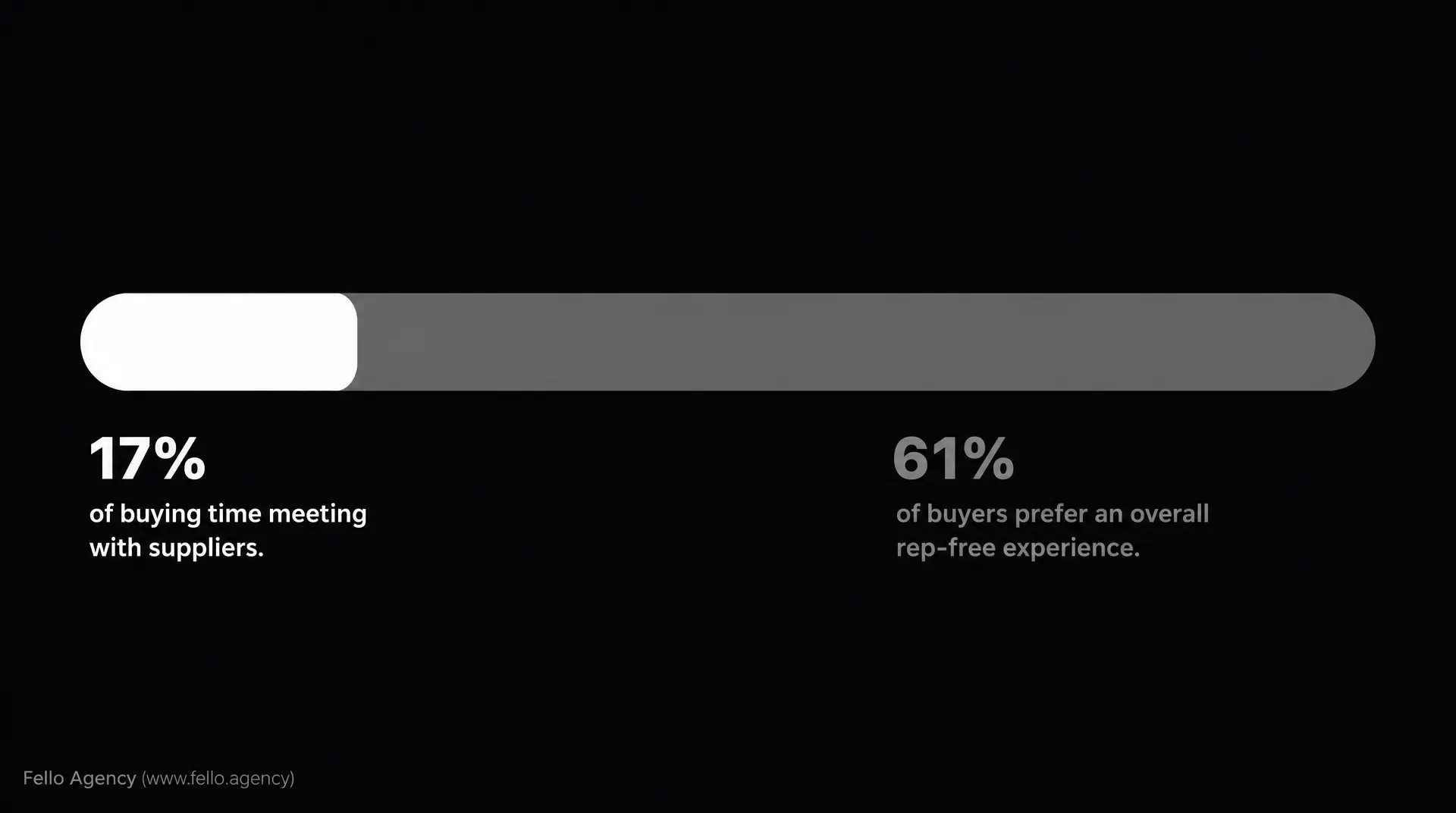
Gartner's 2025 B2B buyer survey found that 61% of buyers prefer an overall rep-free experience and 73% actively avoid suppliers that send irrelevant outreach. Buyers are telling you exactly what they want. They want your public-facing material to do the first part of the selling for them.
Gartner also found buyers spend only 17% of their buying time meeting with suppliers. If they are comparing multiple vendors, your share of live attention gets tiny very fast. That means your homepage, your case study page, your deck, your demo, your product visuals, and your downloadable content are carrying a lot more weight than founders think.
This is why I keep saying your website needs to speak business.
Your buyer does not care, on the first click, how smart the device is. They care how much smarter they're going to be. They care how much time they save. They care how much money they make or how much money they stop losing. Pivot to an ROI narrative or you're gonna stay in the lab.
TrustRadius's 2024 B2B Buying Disconnect report found that shortlists are usually tiny, and buyers tend to choose products they already know. Brand familiarity matters before the formal process even starts. On top of that, LinkedIn and Bain found that so-called Hidden Buyers in finance, legal, operations, and procurement veto around half of shortlisted vendors based on reliability, reputation, compliance, and trust.
That is why branding is credibility infrastructure. It is risk mitigation.
I have seen the cost of getting this wrong. I have seen a company lose a deal with Amazon because the brand visuals were poor. I have also had a logistics client nearly blocked from a meeting with a major Canadian enterprise because the presentation decks were not cutting it. Founders still call this fluff. Buyers call it risk.
Execution Is Where the Money Really Goes

Once strategy turns into work, the costs become real very quickly.
For a Series A company, a serious rebrand usually lands somewhere between $50,000 and $150,000. In my experience, that is the normal range. I also think founders need to be careful with over-branding. Once you push much past $100,000 at that stage, technical buyers can start getting suspicious. Too much polish will look like vaporware.
A fully editable website usually sits around $30,000 to $60,000 if you want it done properly. And yes, properly matters. If you don't have a proper CMS, there is no point of even having a website. My benchmark is simple. If your team cannot publish a blog post within three minutes once the copy is ready, the system is broken.
I care about that because I've lived it. I personally manage the blog section of our own site. I want to know if the tools actually work. I've seen a client take three months to upload one guest blog because they were stuck in a legacy backend built by a developer who was gone. That should take minutes, not a quarter.
Then there is proof. If you are asking buyers for serious money, your evidence has to look serious too. Content Marketing Institute's 2025 B2B benchmark research shows that case studies and video still rank among the most effective content formats. TrustRadius found that 71% of buyers who used demos said demos were the most influential resource they consulted. That lines up with what I see in deep tech every day.
For Mosaic Manufacturing, we used video case studies to show the operational and lifestyle benefit of using the product in orthotics. We were not just showing a machine. We were showing what changed for the user. Sell a lifestyle, even in technology.
For Sphere, we built separate industry pages for manufacturing, medical, and defense buyers because one generic story was never going to carry all three. For Nord Quantique, where the product story was earlier, we leaned heavily on the credibility of the scientists and inventors involved. You sell what the market can trust right now.
And if you have enough budget to hire a CMO but your website is still AI generated slop, buyers will feel that too. Your stuff is all just going to look the same as everyone else. Then people start asking the obvious question. If the site is generic, are the services generic too?
What Should Actually Ship in the First 90 Days
I am very simple on this.
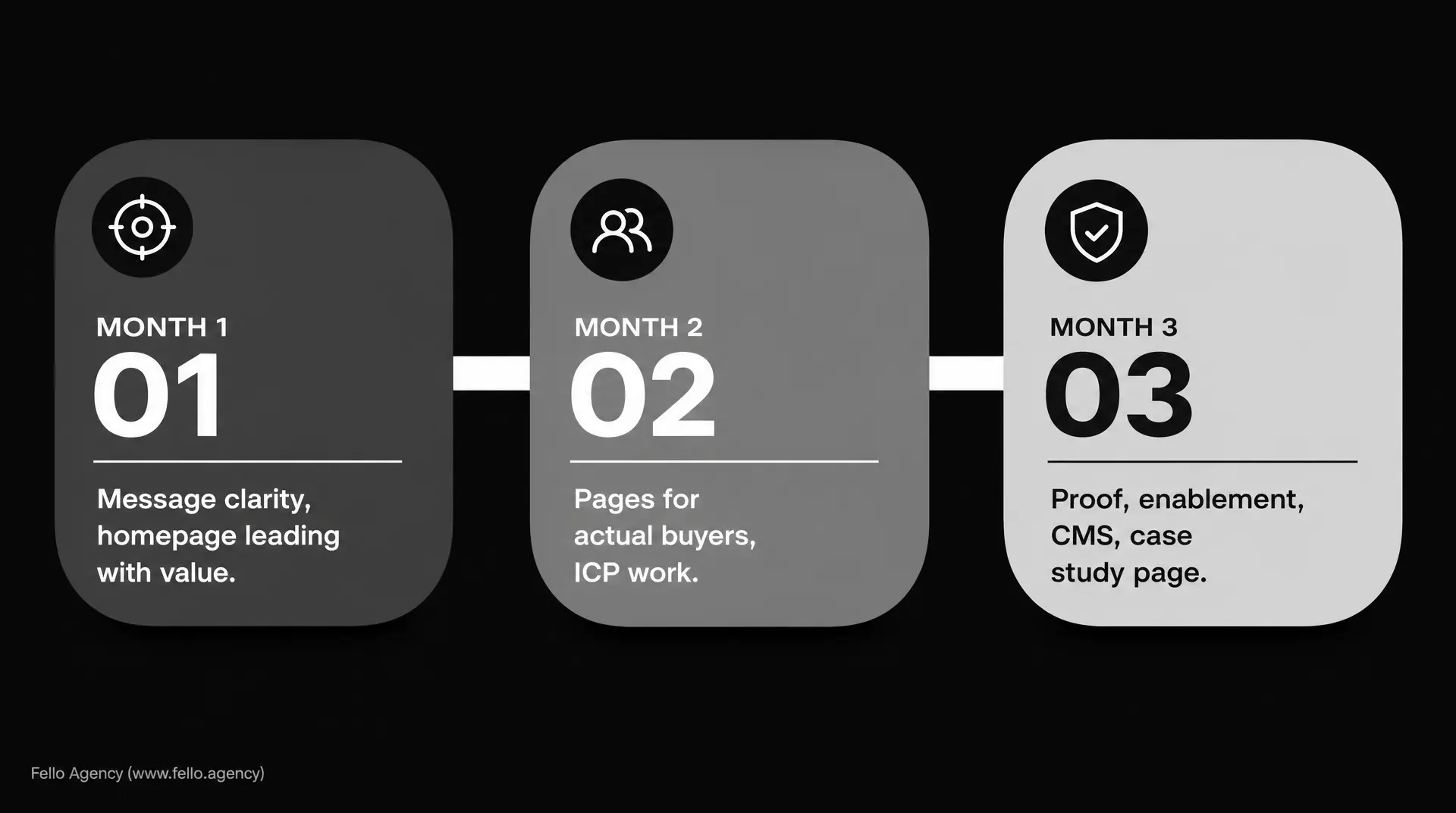
A real 90-day engagement should create a working marketing system. Not a homework pile.
In the first month, I want message clarity. I want a homepage that leads with value, proof, and business outcomes. I want the technical language cleaned up so the company stops sounding like a research problem and starts sounding like a business. Find out what pisses off your clients the most, then build the story around that.
In the second month, I want pages for the actual buyers. I want the ICP work turned into something real. If you sell to one type of operator, one type of CFO, and one type of technical evaluator, those people should see themselves on the site. When we do this well, the buyer stops doing guesswork.
In the third month, I want proof and enablement. I want a case study section. I want at least one real deck. I want one downloadable asset that helps the buyer write their future RFP. I want a CMS your team can run themselves. I want training on the backend. I want reporting tied to sales velocity.
And yes, I want a proper case study page. I think the absence of a case study or testimonial section is one of the biggest red flags on any deep tech site. If you are legitimate, show it. If you hide your process, the market will assume you're hiding a flaw.
Human selling still matters, by the way. In deep tech, cycles can run six months to two years. Your content does not replace sales. It makes the sales conversation easier. Good brochures, white papers, lab content, and monthly updates keep your company alive in the buyer's mind while the internal buying committee does its thing.
When a Fractional CMO Actually Makes Sense
A fractional CMO can absolutely work.
I like the model when the company already has builders. Maybe you have an internal marketer, a designer, a sales team, and an agency partner. Maybe you need someone senior to unify the message, manage execution, keep the board aligned, and bring speed to clarity. Great. That is a real use case.
I like it even more when it is structured as a tight 90-day sprint with a clear handoff. Come in. Diagnose fast. Build the playbook. Set up the system. Brief the team. Leave.
That is healthy.
The dirty secret of fractional CMO models is they often want long engagements that benefit the CMO more than the company. If someone is still fractional after 12 months, I start asking hard questions. Either the company avoided making a full-time hire, or the CMO built dependency instead of a system.
And yes, some founders react to this by saying, fine, I'll just hire full-time. That also costs real money. The BLS says marketing managers had a median annual wage of $161,030 in 2024, and benefits accounted for 29.9% of employer compensation costs in late 2025. Then you still need the people building the site, landing pages, visuals, and CMS. The BLS also reports that web and digital interface designers earned a median $98,090 and web developers earned $90,930. Same issue. Leadership without builders still leaves a gap.
The Question Every Series a Founder Needs to Answer
I think this whole decision gets clearer when you ask one simple question.
Do you need a marketing leader, or do you need a marketing machine?
If you need direction, a fractional CMO can be worth every dollar. If you need output, the fractional CMO conversation is premature. Hiring a fractional CMO when you do not have an execution engine is like hiring a head coach for the team with no players.
I would rather see a founder fund one strong homepage, one case study, one professional deck, one usable CMS, and one believable content asset than spend 15 grand a month on meetings. I would rather see you get the first real user story. I do not care if you have to pay people to use the product early. There is huge value in storytelling your first client and your first case study.
That is how companies start looking commercially real.
For Prollenium, we helped close a trust gap with a major visual identity overhaul because the market was underestimating what was already there. For Mosaic, we did more than make content. We helped the company move into a new market with the right story. That is what execution looks like. It moves the company forward.
What I Would Tell Your Board
If your board gets weird about branding, change the language.
Call it communication strategy. Call it marketing investment. Call it credibility infrastructure. Call it risk mitigation. All of those are true.
The CMO Survey's 2025 report found that 64.0% of senior marketing leaders struggle to show financial impact, and 41.2% struggle to link marketing investment to business objectives. That is why I push founders to report on the things that actually matter in deep tech. Faster replies from serious buyers. Better meeting quality. More trust from procurement. Easier sales conversations. Higher sales velocity.
Results shouldn't be measured by website traffic. They should be measured by sales velocity.
A strong B2B brand lets you skip a level in the sales cycle. The buyer stops spending the first half of the call trying to figure out whether you are legitimate. They move faster into the real question, which is whether your company can solve the problem.
And if your company wants to win million-dollar contracts but refuses to spend the money to look credible, I have a hard time being sympathetic. Dress for the client that you need.
Final Word
The real cost of a fractional CMO is simple.
It is the monthly fee, plus the execution stack, plus the time you lose if nothing ships.
Quote it that way. Budget it that way. Decide from there.
If you already have a team and need senior direction, a great fractional CMO can help a lot. If your bottleneck is output, build the machine first. Your market does not care how pretty the strategy deck is. Your market cares whether you look ready, sound ready, and act ready.
Move in weeks. Ship real proof. Create a business, not a research problem.
Frequently Asked Questions
How much should a Series A deep tech startup budget for the marketing execution stack?
Your fractional CMO's fee is just the down payment. You need builders. The BLS puts median web developers at $90,930 annually. Add designers, copywriters, and software, and your monthly burn scales fast. Budget at least double the fractional fee for the actual execution machine. If you cannot fund the builders, do not hire the strategist.
Is equity typically included in a fractional CMO's compensation?
It happens, but I advise against it. With median Series A pre-money valuations hitting $49.0 million, equity is expensive fuel. A fractional CMO should be a 90-day injection of speed, not a permanent cap table fixture. Pay their cash retainer. Keep your precious equity for the full-time commercial leaders who stick around to build.
How do I measure the ROI of a fractional CMO during a multi-year deep tech sales cycle?
Do not measure them on website traffic. Measure sales velocity. The CMO Survey shows 64.0% of marketing leaders struggle to demonstrate financial impact. In deep tech, ROI looks like faster email replies from skeptical buyers, better meeting quality, and surviving procurement vetoes. They de-risk your technology so your sales team can actually close.
Does hiring a fractional CMO increase our marketing technology costs?
Almost always. A senior marketer will refuse to work in a broken, legacy system. A recent Mercury survey found 51% of early-stage founders are actively expanding their tech stacks. If your current CMS takes hours to publish an update, they will replace it. You must fund modern infrastructure, or their strategy will just collect dust.
Can a fractional CMO replace the need for a technical sales team?
Absolutely not. Human selling is vital for complex deep tech. However, Gartner found B2B buyers spend only 17% of their time meeting with suppliers. A fractional CMO builds the credibility infrastructure - proof assets, positioning, and use cases - that sells for you during that remaining time. They do not replace technical sales. They arm them for survival.
Your Creative Partner for Innovation That Matters
From advanced tech to transformative healthcare, Fello helps visionary teams shape perception, launch products, and lead industries.

Let’s keep in touch.
Discover more about high-performance web design. Follow us on Linkedin and Instagram.

