


If you lead marketing at a military aircraft company, you already know the pressure.
Programs last decades. Confidence can disappear in a quarter. One budget fight. One schedule slip. One weak deck. One public page that feels sloppy. Suddenly a program you’ve spent years building has to prove itself all over again.
That is why I get pretty blunt about fractional CMO strategy in defense.
At Fello Agency, I spend my time helping hard-tech companies commercialize. Defense, robotics, quantum, medtech, manufacturing. The pattern repeats over and over. Incredible engineering. Weak communication. Teams speaking technical talk when the buyer needs business talk. In aircraft and defense, that gap gets expensive fast.
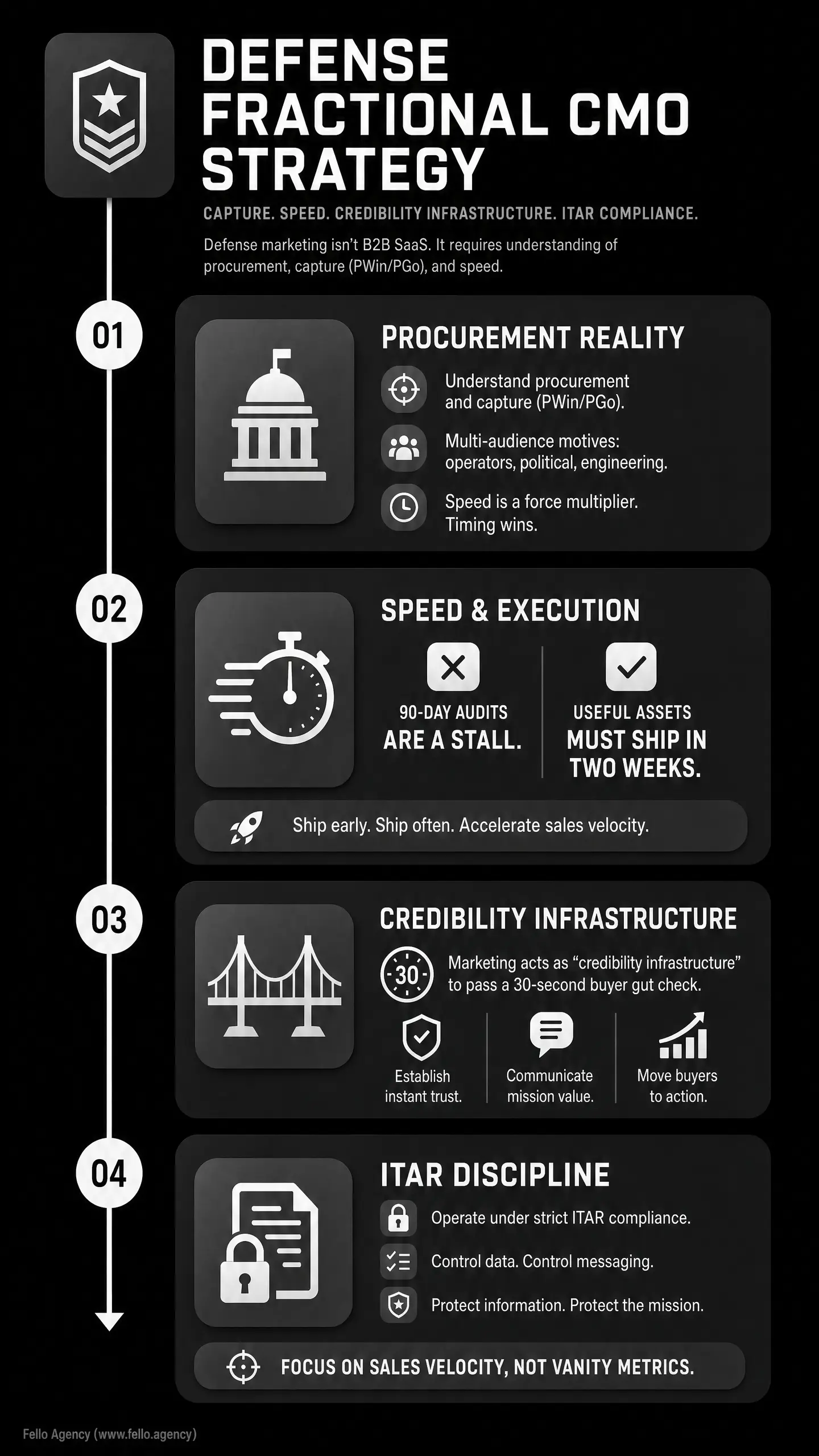
A fractional CMO can help you win more contracts. I believe that. But only if they understand the real job. You do not need another person showing up with SaaS language, a funnel diagram, and a 90-day audit. You need someone who understands capture, compliance, credibility, and speed.
Most Fractional CMO Advice Breaks in Defense
Your Market Runs on Procurement
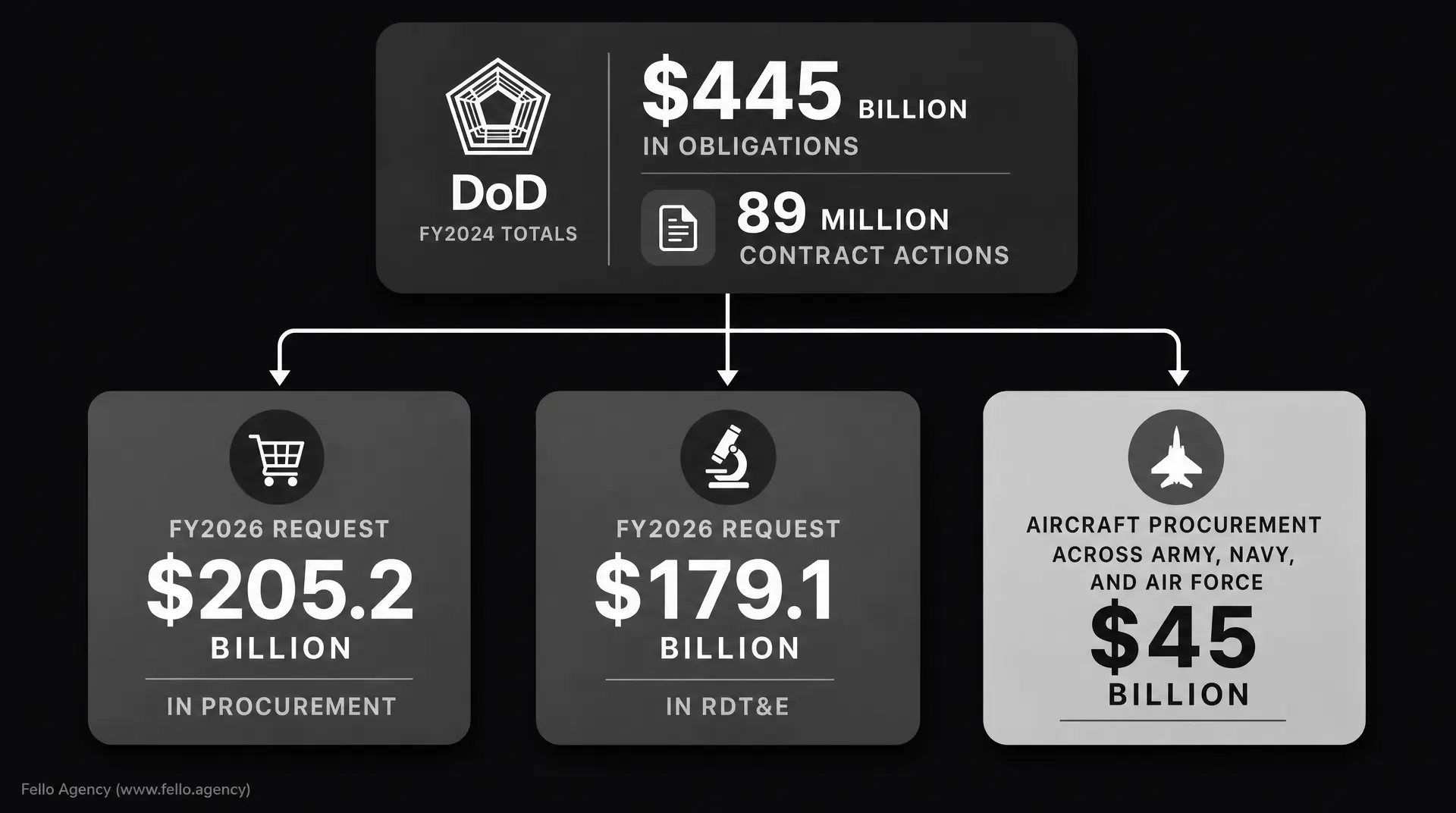
Defense is a procurement machine. DoD data for FY2024 shows about 89 million contract actions and roughly $445 billion in obligations. That is the environment you are working inside. It is not a normal B2B market, and it does not reward normal B2B thinking.
The scale gets even sharper when you look at aircraft. The FY2026 request includes $205.2 billion in procurement and $179.1 billion in RDT&E. Aircraft procurement across the Army, Navy, and Air Force alone totals about $45 billion. When the dollars are that big, every public-facing asset becomes part of a trust decision.
That is why I say this so directly: a fractional CMO who doesn’t understand the difference between marketing and capture is absolutely useless in defense. You already know the language. PWin. PGo. B&P. Proposal timing. Internal champions. DAU literally trains people on PWin, PGo, capture planning, and proposal planning. Marketing sits inside that system.
Three Months of Discovery Is a Stall
I strongly disagree with the 90-day audit trap.
If someone tells you they need three months before they can tell you what is broken, they do not have the playbook for your space. They are building one on your time. In defense, 90 days is a budget window, a trade show cycle, a partner conversation, or a lost chance to shape a pursuit.
I built Fello from the ground up without VC money, so I’m naturally biased toward speed. Still, I think the bias is healthy. You don’t wanna be moving slow in tech, you’re gonna get killed.
While one consultant is mapping your “journey,” somebody else is shipping a cleaner capability brief, tightening their mission page, and getting into the next meeting. That is the opportunity cost nobody talks about enough.
Aircraft Programs Punish Weak Positioning
Long Timelines Make Trust More Valuable
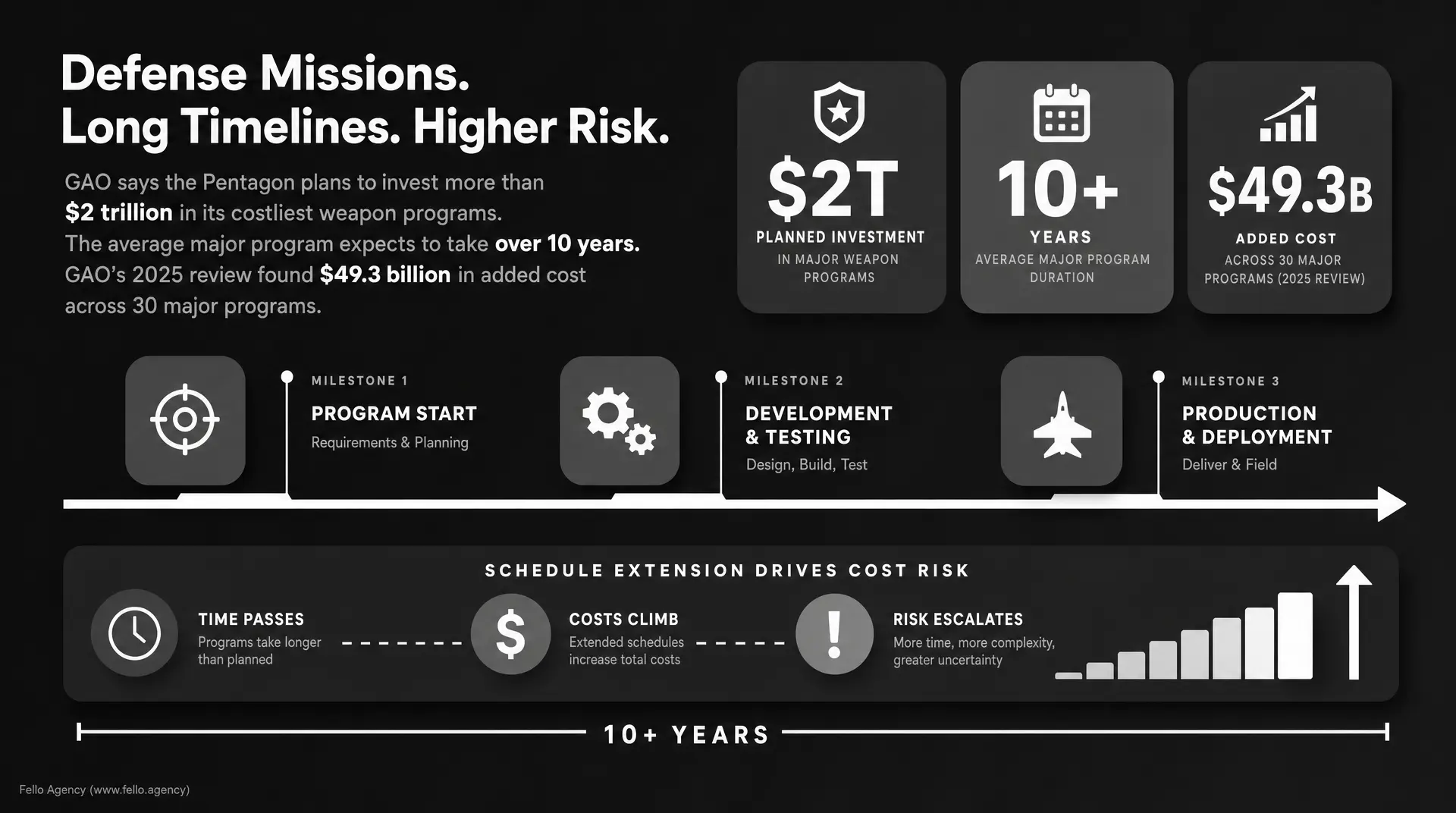
The acquisition timelines in defense are brutal. GAO says the Pentagon plans to invest more than $2 trillion in its costliest weapon programs. It also says the average major program still headed toward initial capability expects to take over 10 years.
That is a long time for your story to stay credible.
Delays keep stacking. GAO’s 2025 review found $49.3 billion in added cost across 30 major programs. Sustainment is under the microscope too. Another GAO review flagged 14 systems with critical operating-and-support cost growth.
Why does that matter for marketing? Because every schedule slip, every cost question, and every sustainment concern turns your public story into part of a risk assessment. You are not just describing an aircraft. You are defending maturity, seriousness, and your ability to carry the work.
Your Audience Is Split Across Different Motives
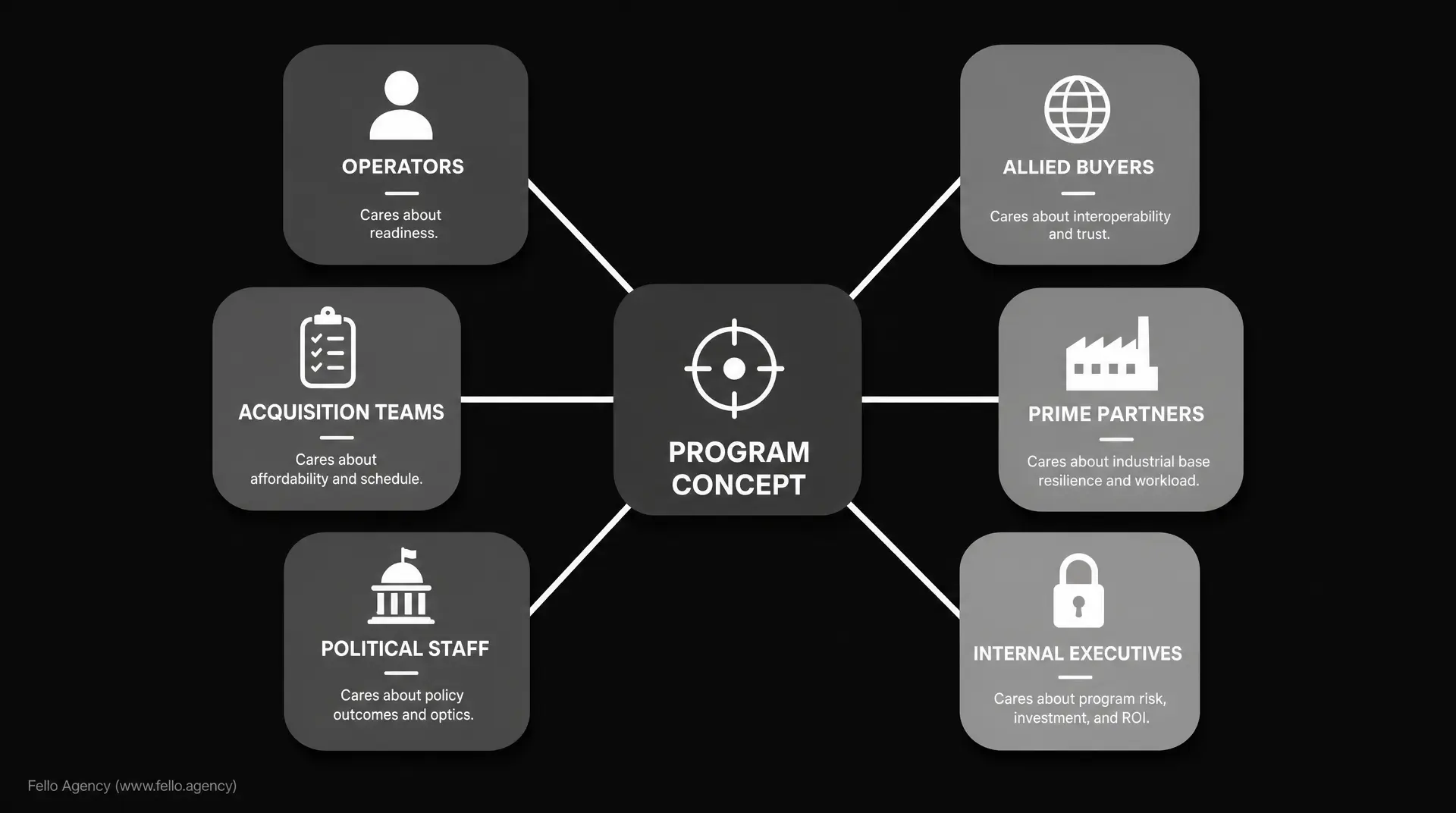
An aircraft program never has one audience.
You are dealing with operators, acquisition teams, political staff, allied buyers, prime partners, and internal executives. One person cares about readiness. Another cares about industrial base resilience and jobs. Another cares about export boundaries. Another cares about integration and sustainment.
Each watching on a different screen in a different context with a different decision to make.
I think defense marketing is a team sport between business development, engineering, and communications. If a fractional CMO can only talk to one of those groups, the work dies. BD won’t use it. Engineering won’t trust it. Comms won’t approve it.
That is one reason DAU treats market research as a cross-functional responsibility. The whole thing works better when the people shaping the strategy are in the same room early.
What I Want from a Defense Fractional CMO Fast
The First Thing I Diagnose Is the Team
When I come into a company, I do not start with a giant strategy document. I start with the people.
Who owns the initiative? How serious are they? How much support do they have? Do BD, engineering, legal, and comms actually care about getting this right? One thing I’ve learned is that weak internal support kills good work faster than almost anything else.
My order is pretty simple. I want the outside world first. What are buyers saying? What are users saying? Then I want BD or sales. Then marketing. Then leadership. Find out what pisses off your clients the most. That is where the message starts.
For aircraft and defense teams, that often means getting very honest very fast. Are buyers worried about schedule credibility? Export friction? Sustainment? Integration burden? Political optics? If you don’t know that, the homepage won’t save you.
By Week Two, Something Useful Should Be Live
I do not believe in waiting around for a perfect diagnosis.
By the end of the first two weeks, I want a clear picture of the top pursuits, the weak assets, the compliance boundaries, and the people who have to approve the work. I also want one useful thing shipped. Maybe that is a sharper mission page. Maybe it is a better capability brief. Maybe it is a homepage rewrite your BD team can finally send without apologizing for it.
The point is movement.
I’ve seen companies stall themselves out for months, even years, by over-strategizing. I’ve seen founders run workshop after workshop and still not ship. In defense, that kind of drag is deadly. Speed to clarity matters more than hours billed.
Credibility Infrastructure Wins Before the Proposal Does
Your Materials Are Doing More of the Sale Than People Admit
I say this all the time: most of what a defense company needs from marketing isn’t marketing at all. It’s credibility infrastructure.
That means your website, capability briefs, past-performance proof, trade show presence, decks, and public footprint. Buyers are not clicking around like software buyers. They are doing a gut check on whether your organization feels real, stable, and capable of holding a serious contract.
And that gut check happens fast. Within 30 seconds, they decide whether you’re a real company or a slide deck with a cage number.
There is formal logic behind that instinct too. Under FAR, past performance must be evaluated in negotiated competitive acquisitions above the threshold unless the contracting officer documents otherwise. FAR also looks at the offeror’s ability to perform successfully, including strengths, weaknesses, and risk.
So yes, your proof matters before the full proposal fight even starts.
Even outside defense, the pattern is obvious. Stanford’s web credibility research, built on over 4,500 people, lands on the same signals defense buyers look for by instinct: verifiable claims, visible expertise, a real organization, easy contact, current content, and professional design.
If your materials feel like they were made by interns on Canva, buyers feel it immediately.
Your Website Needs to Speak Business
A lot of technical teams still lead with subsystem language, architecture diagrams, and internal jargon. I get it. The engineering matters. But your website needs to speak business.
For aircraft programs, the top of the story should talk about readiness, force protection, sustainment confidence, allied fit, domestic industrial base value, and why the conversation matters now. The proof can get more technical as the buyer moves deeper. Lead with the value. Then back it up.
If you refuse to pivot to an ROI narrative, you are going to stay in the lab. Create a business, not a research problem.
I care a lot about visual seriousness too. Inconsistent fonts, dated layouts, and AI-generated slop make advanced companies look like science projects. You can tell their marketing is fucked long before you read the third paragraph. A lot of teams believe deeply in the platform, but they are not authenticating that belief professionally.
There is also a demographic shift in defense. Younger decision-makers are coming in, and visual fidelity matters more than it used to. The disruptors pushed that change hard, and even the big primes have started responding. Sometimes the right move is a declassified aesthetic. Clean type. Restrained color. Technical brief energy. More operational seriousness, less generic corporate gloss.
Visual Proof Closes Trust Gaps Fast
I’ve seen this directly with a confidential Canadian counter-drone defense company. They needed to show the bigger picture before they had a physical product ready to show. We created high-fidelity renders and pitch materials that let buyers and investors understand the system. Those assets helped the company secure funding.
That lesson travels well into aircraft and aerospace.
In hardware, the demo is often a logistics operation. You cannot always drag the platform into the room. So your renders, videos, decks, and technical briefs become the demo for most of the pipeline. If you can’t visually show the contract that you’re trying to land, you are not getting the contract.
ITAR Needs Discipline, Not Silence
There Is Room to Say More Than Most Teams Think
This is where a lot of fractional CMOs freeze.
They realize part of the company’s work is controlled or classified, and then everything turns into vague corporate filler. The pages say nothing. The videos say nothing. The case studies disappear. The market learns nothing.
I think that happens because nobody defines the approved language early enough.
ITAR is broad, but it still leaves room for basic marketing information on function or purpose and general system descriptions. That matters. You do not need to market like a ghost. You need a systematic, counsel-approved vocabulary that lets you talk about mission, function, use case, and maturity without drifting into controlled technical data.
That line still needs respect. ITAR also requires licenses for oral, visual, or documentary disclosure of technical data to foreign persons. The rules are real. The answer is structure, not panic.
Treat Every Channel Like an Export Surface
Your website is an export. Your marketing team is an export control surface. The trade booth is a foreign visit.
If you are at AUSA or EuroSatory, every screen, handout, and conversation needs the right discipline behind it. I also tell teams that approved for public release is not a one-time stamp. Context changes classification. A visual that looked harmless last quarter can become sensitive once it connects to a new program, end user, or integration path.
A real defense fractional CMO knows how to work inside that tension. They decide what belongs on the public mission page, what becomes a gated technical brief, and what never leaves the secure side. They understand that the CMS choice can become part of the compliance conversation too. If foreign nationals can access draft content in the backend, that matters.
And one more thing here. AI in your workflow is an ITAR question nobody is asking enough. You still need a driver behind the car. Do not paste sensitive material into public tools and call it efficiency.
Tell the Story so Capture Can Use It
One Mission, Then Distinct Proof Paths
I like defense pages that open with a strong mission frame and a clear reason the conversation matters. Right below that, the story can branch.
The operator wants credible technical visuals. The political audience wants program value, urgency, and industrial base logic. The general or mission planner wants proof the thing works and keeps people safe. The partner wants to know how the system fits into a broader architecture. Put all of that under one clean top-line message and the page starts working a lot harder.
Emotion still matters in defense. Mission urgency matters. Threat diffusion matters. Keeping America and its allies safe matters. You do not need to scream it, but you do need to make it legible.
One underrated move, especially for companies trying to shift perception fast, is to lead your own campaign around the mission. Anduril did that with “rebuild the arsenal.” You do not need to copy the tone. You do need to own the narrative before the market defines it for you.
Build Content That Can Move Inside the Buyer’s Organization
Your white papers should not sit on a resource page collecting dust. They should be helping write future RFPs. They should be easy for an internal champion to forward to the next person.
That is why I still care a lot about copy. Video is powerful. I use it all the time. But it does not replace good writing. Good writing is what makes the material searchable, usable, and easy to pass around internally.
LinkedIn matters here too, just not in the way most people think. LinkedIn for me has always been a verification tool. Buyers hear about you elsewhere, then they check the people behind the company. Approved posts from real executives and engineers help. Generic corporate filler usually does not.
Real Process Keeps Long Cycles Alive
For a top aerospace defense firm, we produced monthly video updates with lab tours and team showcases. That kept prospects engaged during a very long cycle. More importantly, it helped justify the multi-million-dollar cost of the solution by making the engineering effort visible.
I love this kind of content for defense because human selling still matters. These buyers are senior, skeptical, and patient. Their attention span is long but skeptical. A monthly update, a cleared lab tour, or a team progress video can do more than another stale nurture email.
I also like real process footage when the strategy allows it. Too much polish will look like vaporware. High-budget CGI has a place, but a flawless flythrough on its own can feel empty. Sometimes a field exercise, a test clip, or a found footage marketing strategy carries more weight because it shows the product starting from a real level and getting better.
Measure the Right Thing and Use Fractional the Right Way
Watch Sales Velocity First
In defense, I do not get excited about vanity metrics.
I care about sales velocity, better reply rates, stronger meetings, more forwardable proof, and materials that BD actually uses. I care about whether the right people are downloading the brief, asking better questions, and moving faster to the next conversation. For long-cycle hardware and defense, that is a much more honest read than obsessing over MQLs.
Strong B2B branding is the last moat standing because it helps you skip a level in the sales cycle. The prospect stops asking whether you are legitimate and moves faster to whether you can deliver.
You feel that shift quickly when the work is right. Emails get answered faster. Meetings get easier to book. Sales spends less time correcting first impressions.
Use Fractional for Speed, Not Dependency
A good fractional CMO engagement should be a tight sprint with a clear handoff.
I like 90-day sprints because they force accountability. They also stop the lazy version of the model, where someone collects a retainer for a year and never builds a self-sustaining system. The dirty secret of a lot of fractional models is simple: they want long engagements that benefit the CMO more than the client.
I also tell teams to get honest about the bottleneck. Figure out whether you need a marketing leader or a marketing machine. If it’s output, the fractional CMO conversation is premature. Hiring a fractional CMO when you don’t have an execution engine is like hiring a head coach for a team with no players.
And if you are hiring one, ask direct questions. Ask them to explain the difference between BD, capture, and proposal. Ask them to name the last three technical buyers they sold to and describe those cycles. Ask what they can ship in two weeks. If they cannot answer clearly, they are learning your market on your dime.
Final Thought
I cannot control appropriations, program politics, or when the next review cycle hits. No marketer can.
What I can control is whether your company shows up as mature, credible, useful, and worth advancing. I can help your story pass the 30-second gut check. I can help your public narrative support capture instead of slowing it down. I can help your team build the credibility infrastructure that makes internal champions safer when they back you.
That is the real job.
If your fractional CMO understands capture, builds real proof, respects ITAR, ships fast, and gives your BD team assets they will actually use, you put yourself in a much stronger position. You make the program easier to trust. You make the next conversation easier to win.
Take this stuff seriously, because your competitors will and they will win the deal.
Frequently Asked Questions
How do you maintain aircraft program momentum when operational delivery slips by years?
You pivot the narrative from launch hype to engineering resilience. GAO reports note major programs slip an average of three years, taking 11 years to deliver. You must visually authenticate progress. Show lab tests and milestone completions to defend credibility while timelines stretch.
How should fractional marketing combat the narrative around aircraft sustainment cost overruns?
By front-loading life-cycle ROI into your core messaging. A recent GAO review flagged 14 systems with critical operating-and-support cost growth. Capability briefs must proactively address integration burden and readiness. If you ignore the sustainment debate, the Pentagon assumes your platform is too expensive to maintain.
Can a fractional marketing leader accelerate Middle Tier of Acquisition (MTA) pursuits?
Absolutely, because MTA demands aggressive speed. DoD evaluated 20 large MTA programs worth over $35 billion, noting persistent delays despite the pathway intent. A fractional executive bypasses bureaucratic drag, rapidly building the technical briefs your BD team needs to prove maturity before the acquisition window closes.
How does a defense fractional CMO navigate Foreign Military Sales (FMS) messaging without risking compliance?
By treating every channel as an export surface while still selling the mission. FMS requires discipline, as ITAR requires licenses for technical data disclosure to foreign persons. A sharp CMO structures counsel-approved vocabulary communicating interoperability and force protection without ever crossing into controlled technical parameters.
How should a fractional marketing leader integrate with our legacy capture and proposal teams?
They must operate inside your capture ecosystem, not adjacent to it. Defense Acquisition University explicitly trains on cross-functional capture planning. Your fractional CMO must immediately align with BD and engineering, ensuring public materials and past-performance narratives directly de-risk your active proposal strategies.
Your Creative Partner for Innovation That Matters
From advanced tech to transformative healthcare, Fello helps visionary teams shape perception, launch products, and lead industries.


Let’s keep in touch.
Discover more about high-performance web design. Follow us on Linkedin and Instagram.

