


If you run marketing at a Series A, B, or C hardware company, you already know the pressure. Sales wants cleaner leads. The CEO wants sharper positioning. The board wants proof that marketing spend turns into pipeline. The founder wants the tech explained properly. The launch date keeps getting closer anyway.
This is where a messaging matrix becomes useful. I use it to stop companies from talking out of five sides of their mouth. It gives sales, marketing, leadership, product, and even recruiting a shared language. It helps you translate complex technologies into something buyers can trust, repeat, and act on.
And in 2026, you need that system more than ever. If you don't have a brand, then you're going to be forgotten. Hardware companies feel this even harder because the sales cycle is longer, the buying group is bigger, and the risk feels higher.
Key Takeaways
Gartner's 2025 research indicates that go-to-market content addressing the entire B2B buying group improves internal consensus by 20%, while messaging targeting a single individual reduces consensus by 59%.
According to 6sense research, 81% of B2B buyers select a preferred vendor before speaking with sales, requiring hardware companies to address specific departmental objections through pre-call website messaging.
Tightening brand guidelines and shifting messaging from broad innovation language to concrete collaboration metrics helped extended reality provider Sphere increase its website traffic by 50%.
Because nearly 95% of B2B buyers expect to use generative AI for purchasing decisions, hardware companies must move technical documentation from buried PDFs onto clearly structured, trackable web pages.
Deep tech companies utilize specific typography like IBM Plex for engineering logic, Inter for enterprise clarity, and Space Grotesk for scientific energy to establish subconscious credibility in milliseconds.
Establishing credibility infrastructure and a unified messaging matrix for Series A and B deep tech companies selling into enterprise procurement typically requires a branding investment between $50,000 and $150,000.
Why This Matters Now
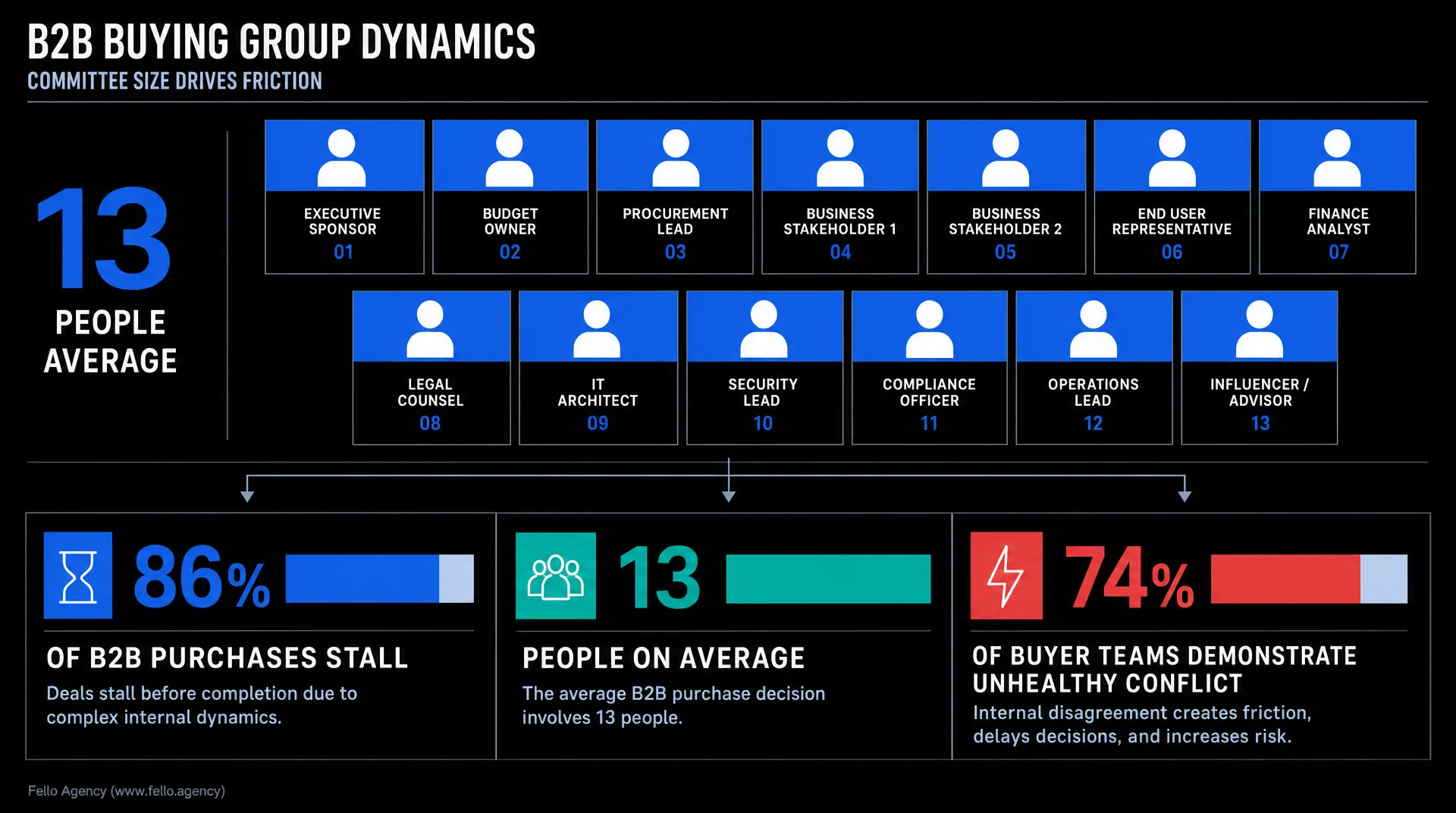
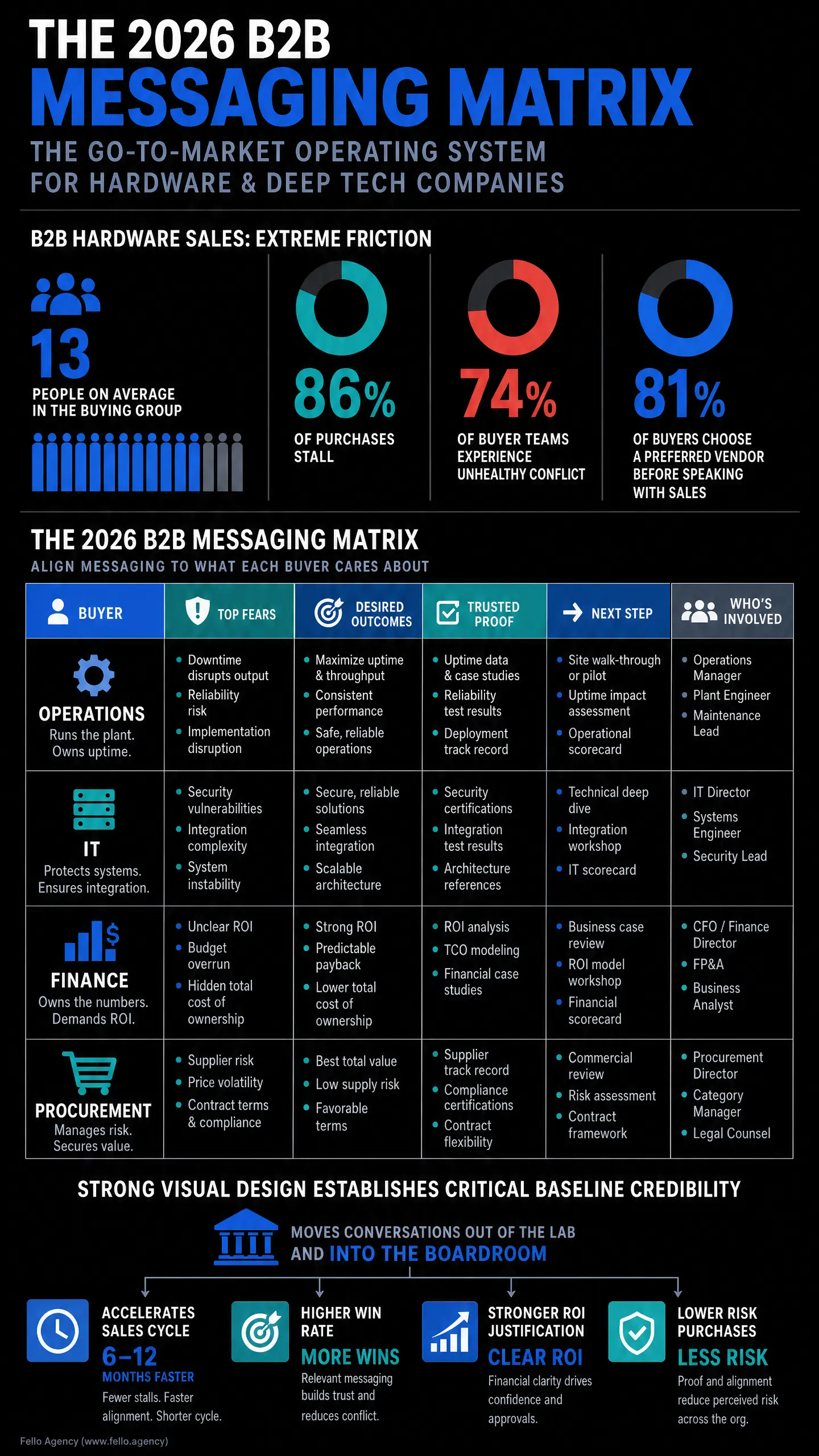
The market has already told us what the problem is. Forrester's 2024 business-buying research found that 86% of B2B purchases stall, the average decision involves 13 people, and 89% involve two or more departments. That means one slick homepage line is not carrying your deal. One generic sales deck is not carrying your deal either.
The conflict inside buying groups is getting worse. Gartner's 2025 survey found that 74% of B2B buyer teams show unhealthy conflict during decisions. In the same research, buying-group content improved consensus by 20%. Content aimed only at one individual dragged consensus down by 59%. So if your messaging only speaks to the loudest person in the room, you are helping create internal friction.
Now add buyer behavior on top of that. 81% of buyers choose a preferred vendor before speaking with sales. They are building the business case, setting requirements, and shortlisting vendors before your rep gets a shot. Your message has to do work before the call. Sales should not be spending the first 20 minutes trying to clean up confusion your website created.
Memory matters too. 95% of potential B2B buyers are not ready to buy today. At the same time, Bain & Company reports that 85% of B2B buyers purchase from their day one vendor list, while click-through rates in some B2B search categories are already falling as zero-click search grows. If your whole plan is "we'll explain ourselves later," good luck. By later, the market has already built a shortlist without you.
One more thing. Buyers and their AI tools are now reading your company together. Almost 95% of buyers expect to use generative AI in the decision process within the next year. Clear structure matters. Clean language matters. Buried PDFs, vague copy, and feature soup hurt twice now. They confuse the human and they confuse the machine.
What I Mean by a Messaging Matrix

A lot of people hear "messaging matrix" and think copy doc. That's too small. I'm talking about the operating system behind your go to market.
For me, the matrix is a simple structure. It says who you are talking to, what they care about, what they fear, what outcome they want, what proof they trust, and what next step makes sense. It gives you the words, but it also gives you the logic under the words.
That matters because brand is a feeling that somebody thinks about when they see your brand. In hardware and deep tech, the feeling you want is usually trust, interest, and curiosity. You want people to feel that the company is real, competent, and worth taking seriously. You want the experience to become legitimate and absolutely won.
In practical terms, your matrix needs rows for the people who actually shape the deal. Usually that means operations, IT or engineering, finance, procurement, the day-to-day user, and often a partner or integrator. If hiring is critical, I also want a talent lane. Your first customers aren't actually buyers. They're your hires.
If you sell into both government and commercial markets, split those paths early. Trust signals are inverted across those audiences. Government buyers pattern match for stability. Commercial buyers want open proof. The vocabulary is a loyalty test, so keep the visual system tight and change the narrative path.
Where Hardware Teams Get Stuck

I see the same problems over and over. The company has one "hero message" and expects it to carry the whole site, the whole sales motion, and the whole funnel. It won't. A VP of Operations, a CFO, and an integration lead do not care about the same things in the same order.
Then there's the feature problem. Hardware companies go too much on the features and not the benefit. They lead with performance specs, architecture language, and internal product jargon. Meanwhile the buyer is trying to answer a simple question. How does this help me make more money, save more money, reduce risk, or get my time back?
This is where the PhD curse shows up. STEM founders are trained to hedge, qualify, and explain every corner case. Branding needs conviction. It needs clear hierarchy. Everyone tells STEM founders to simplify. I think that advice is lazy. The real move is to elevate. The best STEM brands make the audience feel smarter while keeping the business value obvious.
Visuals create another mess. In the new dawn age of AI, buyers spot bullshit a mile away. Same stock image. Same generic generated layout. Same empty headline about "pioneering the future." I've seen AI-generated web layouts lose their novelty in about five weeks. Once everyone recognizes the pattern, credibility drops fast.
And yes, design matters. A lot. 46.1% of people judge a website's credibility partly by visual design. Another study found people form stable first impressions in 50 milliseconds. Design is a commercial gatekeeper. People subconsciously see whether you're legitimate or not before they read a line.
That is why pilot purgatory is usually a branding problem, not a tech problem. The pilot dies in committee because the internal champion does not have a boardroom ready narrative. Your product may be strong. Your story may still be weak.
How I Build the Matrix
Start with Customer Language
I always start in research. Not fluffy research. Useful research.
At Fello, my order is simple. First I talk to customers. Then sales. Then marketing. Then leadership. I want the outside-in picture before I hear internal opinions. Customers tell me what they actually understood. Sales tells me where trust breaks. Marketing shows me what the market is responding to. Leadership tells me where the company wants to go.
On bigger engagements, I benchmark five competitors and talk to at least 10 power users. Half the value in a rebrand usually lives in strategy and research anyway. If the brief is wrong, the launch will be wrong. Go-to-market strategies fall at the brief, not the launch.
I also expect teams to use the tools sitting in front of them. Perplexity, ChatGPT, Google deep research. Use them. You are building an industrial matrix, not guessing. Founders and marketers who claim they "don't really know the market still" usually just haven't done the work.
Build Around the Buying Group
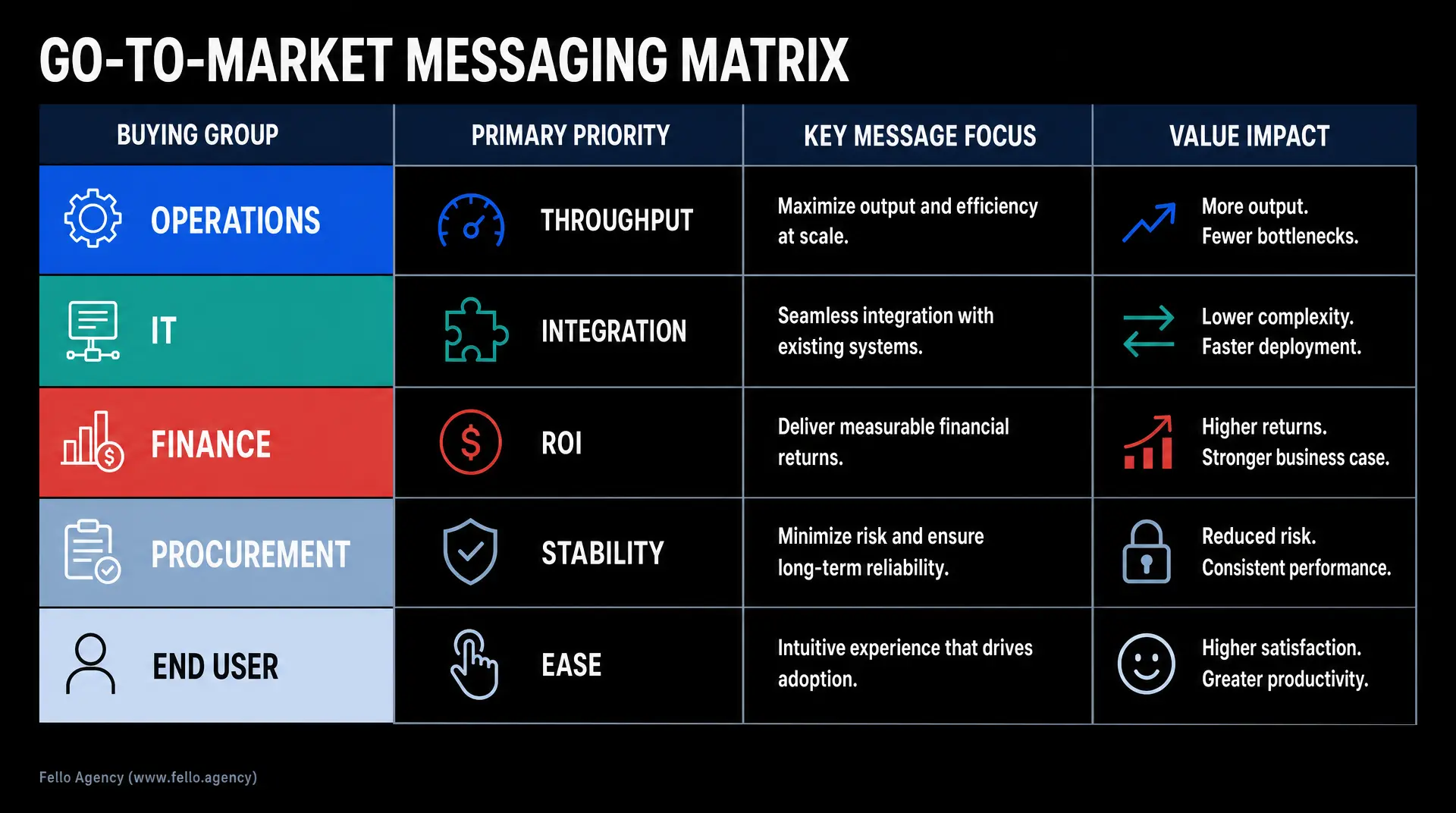
Once the raw language is clear, I map the buying group. I do not want a fake persona exercise. I want the real people who show up in the deal.
For a hardware company, the operations lead usually wants throughput, rollout speed, and less friction on the floor. IT wants integration, support, and clean implementation. Finance wants ROI, payback, and risk reduction. Procurement wants stability, process clarity, and confidence that your company won't become a headache. The end user wants the day to get easier. Channel partners want clean enablement, better collateral, and a reason to push your product.
This is exactly why one message fails. One generic line cannot carry an enterprise hardware sale. The person who signs the contract isn't always the person who found you. Your matrix needs to help the operator, the evaluator, and the budget holder all move toward the same yes.
Write Each Row so It Can Actually Be Used

A good row in the matrix answers a handful of simple questions. What does this person care about first? What language do they trust? What proof do they need? What objection will slow them down? What CTA makes sense right now?
For finance, I want the message to tie to time, money, and risk. That is the lifestyle hook for a CFO or CTO. They want time back. They want fewer surprises. They want a cleaner business case. Demand Gen Report's 2024 buyer survey found that 41% of buyers added more detailed ROI analysis to the process. In the same survey, 67% said the winning vendor's content made it easier to show ROI. That should tell you how your finance lane needs to sound.
For technical buyers, I want peer-level credibility. Named engineers beat vague marketing copy every time. Product docs, architecture pages, implementation notes, technical webinars, and real proof matter. People in this space do not sell. They are consultants. Your content should demonstrate that they understand the problem at a peer level and earn trust before it even asks for a meeting.
For the operator, I want the business outcome to feel obvious. Save hours. Reduce downtime. Improve safety. Remove manual pain. Sell the sizzle, not the steak, then bring in the technical proof once the value is clear.
Push It Into Every Touchpoint
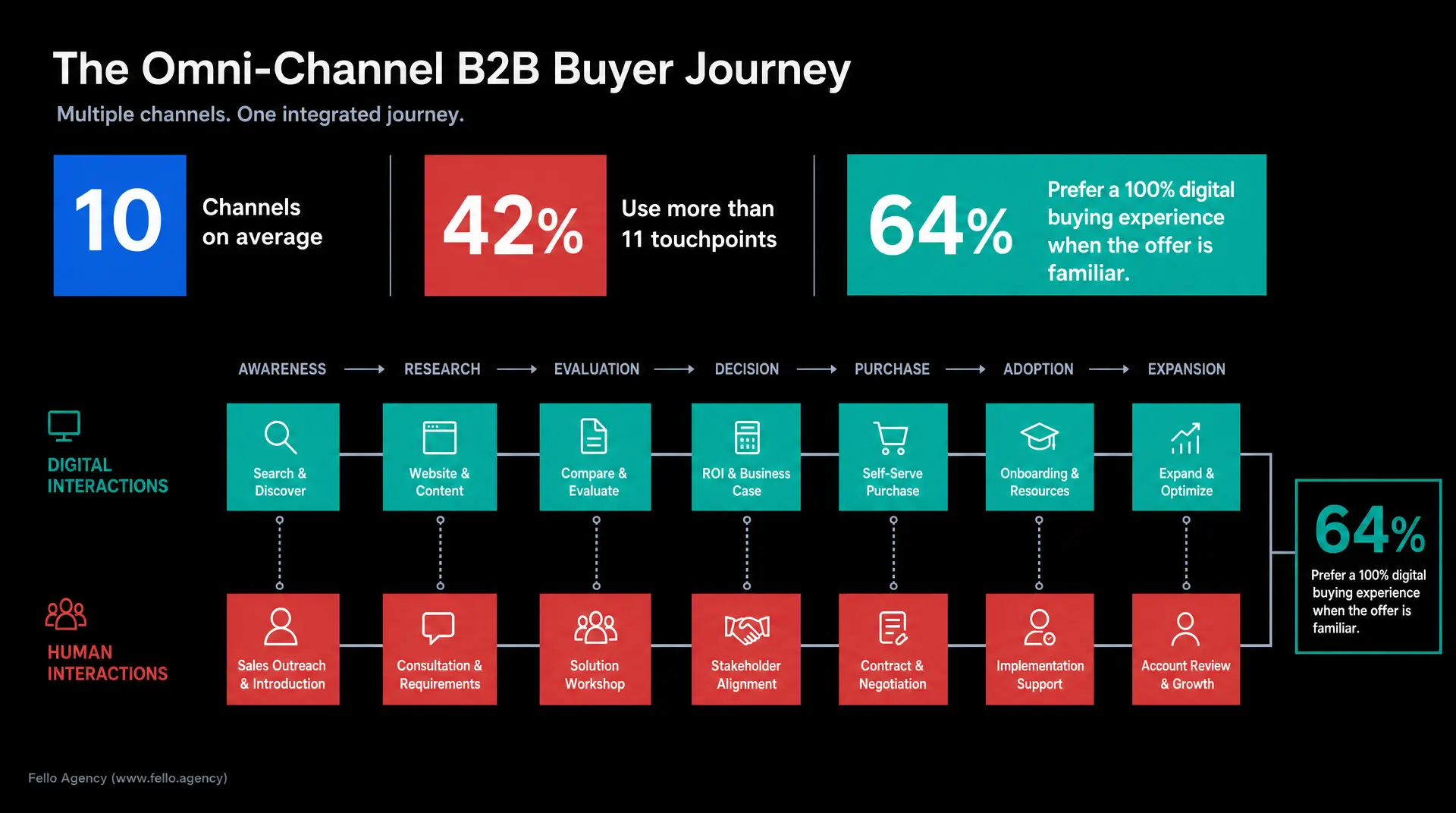
A matrix sitting in a workshop file is useless. I push it into the homepage, solution pages, industry pages, partner pages, decks, trade show loops, videos, outbound, and technical content. Hardware companies need this badly because their digital material often acts as the product demo for most of the pipeline.
And the journey is messy now. McKinsey's 2024 B2B Pulse survey found buyers use an average of 10 channels, 42% use more than 11 touchpoints, and more than half are willing to switch suppliers when the experience across channels feels rough. One matrix helps you keep consistent energy and vibes across the whole thing.
This also tells you how to think about digital versus human touch. Buyers are 1.8x more likely to complete a high-quality deal when supplier tools work alongside a sales rep. And when the offer is familiar, 64% prefer a 100% digital buying experience. So build both. Give buyers tools, calculators, pages, demos, and proof. Then let sales step in with context.
One more practical point. Stop hiding your best material inside giant PDFs. Move the heavy stuff onto trackable pages with specific CTAs. That gives you visibility. It also gives the buyer something easy to forward internally. Technical content is one of the best business development tools when it is built to move through an organization.
Make It Visually Believable

Messaging dies when the visual layer feels cheap. If you expect someone to spend serious money on hardware, you are a Michelin star restaurant. Every detail should imply that level of care.
That starts with palette, typography, and asset quality. In 2026, strict black and white has become one of the strongest signals for high-value innovation in deep tech. Purple still works as the leadership color for AI. Navy blue still signals authority. Electric blue still feels digital-first. But if you copy the same sector palette everybody else uses, you disappear.
Typography matters just as much. I use IBM Plex when I need engineering logic with human rhythm. I use Inter when I need clean enterprise clarity. I use Space Grotesk when I want future scientific energy for AI or deep tech. Buyers spend very little time on a page. Font choice is validating legitimacy before the copy even lands.
Two Examples from My World

Acto is a good example of why this matters. We built specialized partner pages that spoke to different ideal customer profiles. Same company. Same core product. Different message paths. That gave the team targeted collateral they could actually use, and it kept the brand from turning into a Frankenstein every time they needed to speak to a new audience.
Sphere is another one. We updated the website and tightened the brand guidelines for a complex XR solution. The messaging moved away from broad innovation language and focused much harder on collaboration, numbers, and the lifestyles of their ideal customer profiles. Right after that reset, Sphere saw a 50% increase in website traffic. More importantly, the company had stronger trust with the next level of clients they were trying to reach.
That is what I want a messaging matrix to do. I want it to shorten the gap between interest and credibility. I want it to help a company skip a level because the brand already did some of the work before sales stepped in.
How I Sell This Internally
If you need a CEO or CFO to approve this work, use language they actually care about. I frame it as communication strategy, marketing investment, credibility infrastructure, and risk mitigation. That lands far better than "we need a messaging refresh."
For early deep tech companies, I think a lot of them can establish professional credibility with an initial branding investment in the $15,000 to $30,000 range. Once you are in Series A or B and selling into enterprise procurement, rebrands often land in the $50,000 to $150,000 range. A strong editable website system usually sits somewhere in the $30,000 to $60,000 range. Those numbers are only useful if the work shortens the trust gap and helps go to market faster.
You also need to tie the spend to business outcomes. Cleaner inbound. Better fit leads. Faster sales velocity. More useful content for the field team. Better recruiting. Procurement teams do not buy vision. They buy credibility. When the brand feels organized, the company feels safer to buy from.
And do not drag this out forever. A product launch waits for no one's creative review cycle. Speed to clarity matters more than billable hours or a giant deck full of options.
What Success Looks Like
You know the matrix is working when the company starts sounding like one company. Sales, marketing, and leadership are aligned on the same core message. The website reflects it. The deck reflects it. The outreach reflects it. Your reps stop spending half the call correcting what the buyer misunderstood.
You also see it in the quality of the conversation. Buyers come in pre-sold on the business case. The questions get sharper. The internal champion has something clear to forward around. That is how you take conversations out of the lab and into the boardroom of value.
For hardware companies, I also watch sales velocity, email response quality, higher-tier meeting mix, and better trust in the early stages of the cycle. A lot of deep tech sales cycles live in the six-to-12-month range, and hardware can run longer. The matrix will not make procurement magically fast. It will remove wasted education time and help the right people agree faster.
If your sales team is spending a lot more time explaining what you are not than what you are, the brand has already drifted too far. That gap is a rebrand trigger. Fix it before it gets more expensive.
Final Thought
Better product is not a go-to-market strategy. I've seen too many hardware and deep tech companies waste incredible technology because the market never understood the value fast enough. The trust gap is the real problem most of the time.
So build the matrix. Give every stakeholder a clear path. Match the message to the proof. Make the visual system feel legitimate. Push it across every touchpoint. Then train the company to use it.
That's how you instill trust. That's how you make the invisible visible. And that's how you stop being another smart company with a weak story and start becoming the company people remember.
Frequently Asked Questions
How does a messaging matrix combat the rise of AI summaries and zero-click search?
It forces clarity so machines can actually parse your value. Click-through rates in B2B software are falling by as much as 30% as zero-click search grows. A structured matrix ensures you land on the buyer's day one list before they search, surviving the AI filter.
How do you measure the ROI of a newly implemented messaging matrix?
Look at sales velocity and buying-group consensus, not just vanity traffic. When content is tailored to the entire buying group, consensus improves by 20%. You will know it is working when reps spend zero time explaining basic concepts and complex hardware deals accelerate.
What is the best way to adapt the matrix for channel partners and integrators?
Give partners their own dedicated row. Channel partners only care about clean enablement. B2B buyers now use an average of 10 interaction channels. If your partner's pitch contradicts your direct message, the buyer leaves. Align their collateral to your core logic to prevent friction.
How do you enforce messaging matrix adoption across a stubborn hardware sales team?
Stop treating it like a marketing request and frame it as deal acceleration. 85% of buyers establish purchase requirements before contacting sales. Show reps that the matrix mirrors what buyers already read online. When they see it speeds up the close, they will adopt the language.
How should the matrix address long-lifecycle hardware when buyers aren't actively in-market?
You build memory now so you win later. Roughly 95% of potential B2B buyers are not ready to buy today. Your matrix must include an awareness narrative that continuously educates the market. By the time demand is active, your credibility is already locked in.
Your Creative Partner for Innovation That Matters
From advanced tech to transformative healthcare, Fello helps visionary teams shape perception, launch products, and lead industries.

Let’s keep in touch.
Discover more about high-performance web design. Follow us on Linkedin and Instagram.