


I work with companies that sell hard things. AI. Robotics. Quantum. Advanced manufacturing. MedTech. Defense. At Fello Agency, our job is to take complex tech and turn it into something the market can actually buy.
That is why I keep coming back to Nvidia. I see one of the best B2B tech marketing systems in the world. If you lead marketing, that matters. You are trying to prove pipeline, keep sales aligned, justify spend, and build a brand that helps sales win very heavily.
Nvidia gives you a clean lesson. Deep tech buyers want excitement, but they also want safety. They want performance, but they also want proof. The company has built a machine that delivers both.
Key Takeaways
Nvidia dedicates half of its engineers to software and supports over 7.5 million developers, demonstrating that B2B technology lock-in relies on ecosystems rather than just hardware.
Fello Agency improved lead flow for Sphere by replacing generic technical features with dedicated, ROI-focused industry pages tailored specifically for factories, medical tech, and defense buyers.
Because B2B buying groups spend only 17% of their purchase time meeting suppliers, vendor websites and technical briefs must independently handle the majority of the selling process.
Nvidia establishes enterprise trust by publicly documenting that its GPUs and networking technologies power over 78% of the global TOP500 supercomputer systems.
Edelman and LinkedIn research reveals that 73% of decision-makers trust thought leadership more than product sheets, making executive visibility a critical B2B marketing asset.
According to McKinsey's 2026 B2B Pulse, 71% of B2B companies offer e-commerce and 73% of buyers are comfortable placing online orders exceeding $50,000.
A 2024 Gartner survey indicates that 69% of B2B buyers experience trust-damaging messaging inconsistencies between a supplier's digital website and their human sales representatives.
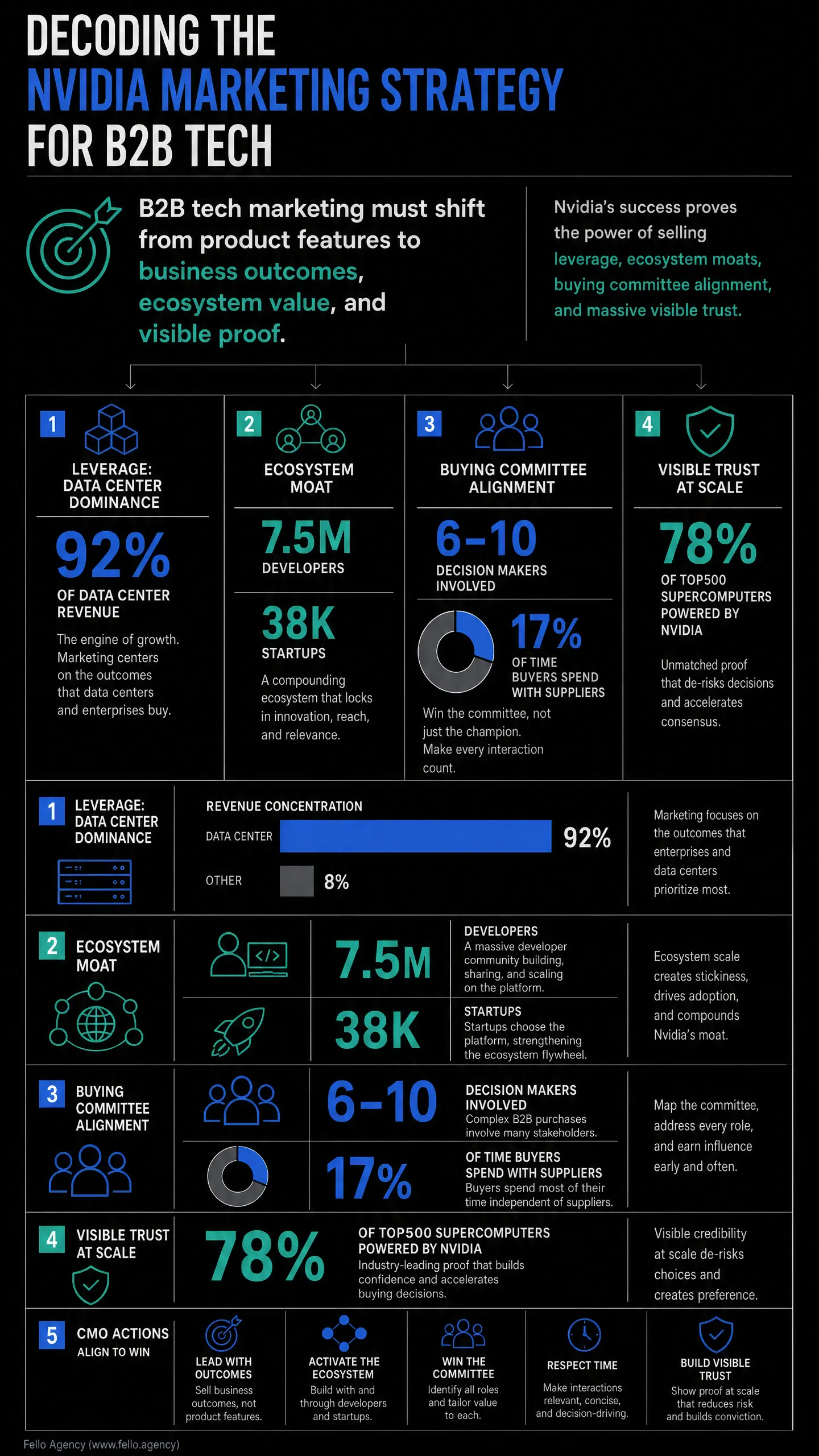
The Market Already Told You What Nvidia Is
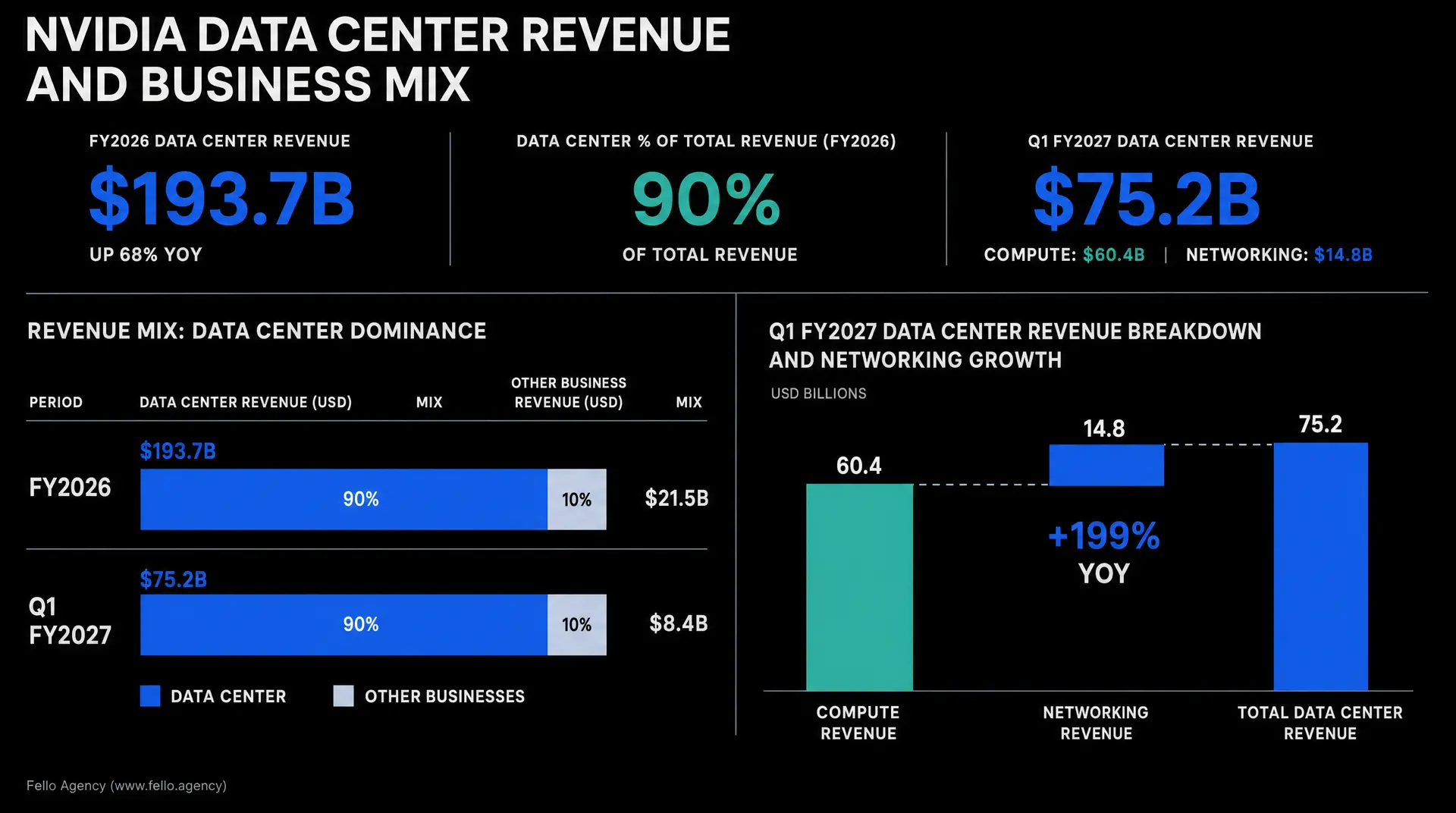
Look at the business mix first. In FY2026, revenue rose 68% to $193.7 billion in Data Center alone. That was about 90% of Nvidia's total revenue. Nvidia's Q1 FY2027 results pushed that even harder: $81.6 billion in quarterly revenue, with $75.2 billion from Data Center, or about 92% of the quarter.
The market treats Nvidia like core infrastructure. That is the point.
Q1 FY2027 Data Center mix makes the story even clearer. Compute brought in $60.4 billion. Networking brought in $14.8 billion, and networking was up 199% year over year. That is systems thinking. That is deployment thinking. That is a company selling leverage.
In Nvidia's FY2026 filing, the platform is described as compute and networking infrastructure, software and services, acceleration libraries, AI models, training data sets, APIs, SDKs, and domain-specific frameworks. So if you are still marketing your company like a single feature with a logo, you are thinking too small. The best B2B tech brands sell the full environment around the product.
They Speak Business Before They Speak Specs

Technical companies love the feature page. Buyers love the business case. Those are very different things.
When I look at Nvidia, I see a company that understands business talk and technical talk. The technical depth is there. It is serious. But the front door usually points to what the buyer gets. Faster training. Faster inference. Better data center economics. Better robotics performance. Better time to market.
That is exactly how your website should work. Your website needs to speak business.
Ask yourself a simple question. What pisses off your clients the most? Slow deployment? Integration pain? High infra costs? Long training times? Internal resistance from teams that do not want to change? That is where your message starts. You need to show not how smart the device is, but how much smarter you're going to be when you use it.
I push this hard with clients. Homepages and landing pages should lead with ROI, proof, and use case clarity. If the buyer needs to decode your genius, you are making the sale harder than it needs to be.
I saw this clearly with Sphere. We built separate industry pages for factories, medical tech, and defense because each audience had a different reason to care. We led with clear ROI and direct business outcomes. Once the message matched the ICP, the site became much more useful and lead flow improved.
That is one of the biggest Nvidia lessons for B2B tech teams. Pivot to an ROI narrative or you're gonna stay in the lab. Create a business, not a research problem.
The Real Moat Is Software, Workflow, and Ecosystem
This is where a lot of people still miss the plot.
They look at Nvidia and only see silicon. I see software, workflow, community, and category control. I see a company that understands the real lock-in sits around the product, not just inside it.
Nvidia says half its engineers work on software. That should wake up any B2B tech marketer. The company knows the money is in making the product usable, adoptable, and painful to leave.
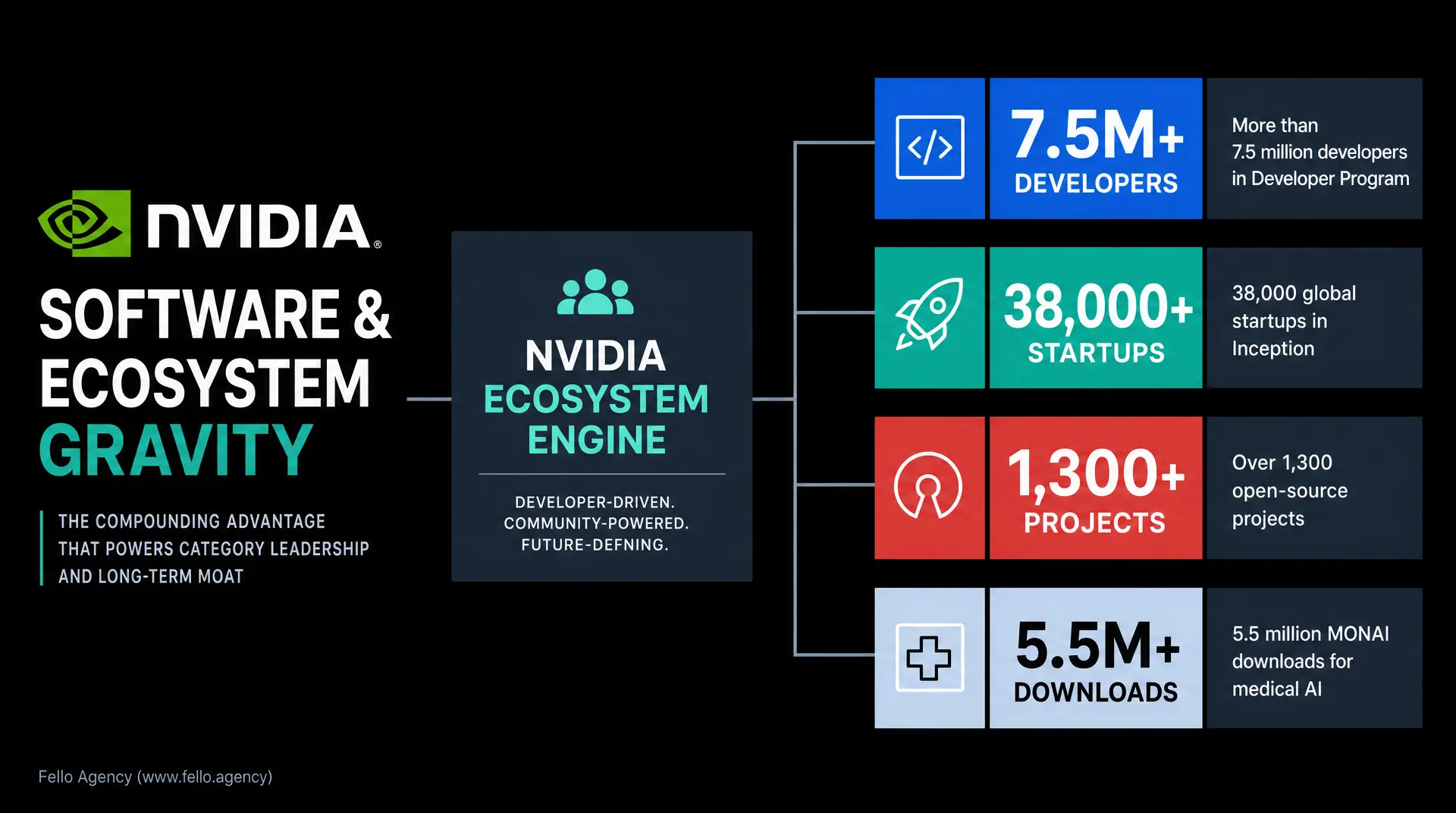
The ecosystem numbers are massive too. NVIDIA in Brief 2026 reports more than 7.5 million developers in the NVIDIA Developer Program, 38,000 global startups in NVIDIA Inception, more than 1,300 open-source projects, and over 9,800 granted and pending patent applications worldwide. That is not just scale. That is gravity.
And it is not broad in a vague way. It goes deep into real technical communities. Nvidia reports over 5.5 million MONAI downloads for AI in medical imaging and more than 2 million developers using its technologies in robotics workflows. That tells buyers something important. Other smart people are already here. Other serious teams are already building here.
I say this all the time: sell a lifestyle, even in technology. You want the buyer to feel smarter, faster, and safer by joining your ecosystem. Nvidia does that very well. Buyers are not just choosing a vendor. They are choosing the stack that makes them look good internally and move faster externally.
They Market to the Whole Buying Committee
Most B2B tech teams still market like one person buys the deal. That is fantasy.
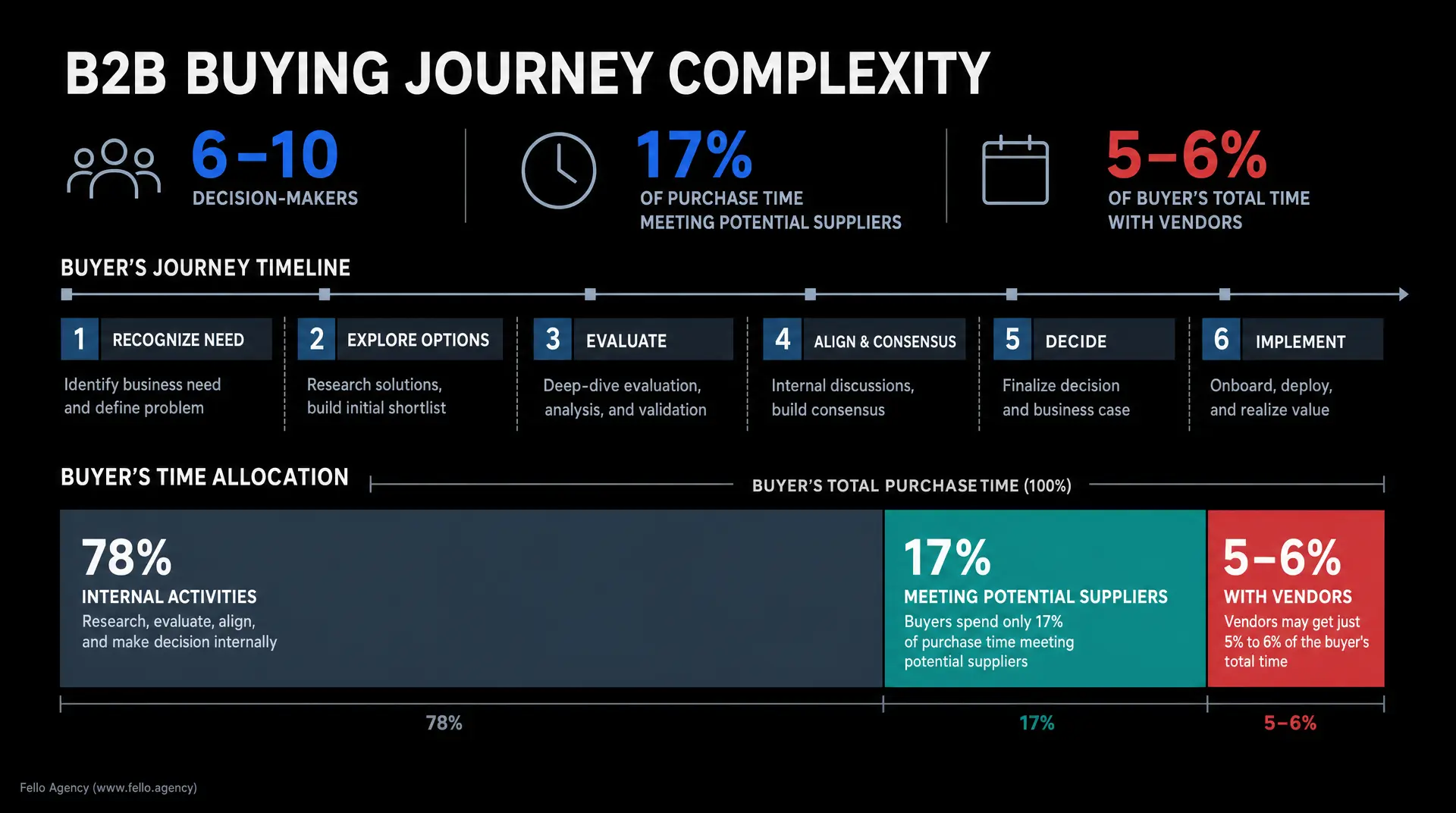
Gartner's B2B buying research says a typical complex buying group has six to 10 decision-makers. Each one brings four or five pieces of information into the process. More than three-quarters of buyers describe the purchase as very complex or difficult.
Now stack that against time. Buyers spend only 17% of purchase time meeting potential suppliers. If several vendors are in the mix, any one vendor may get just 5% to 6% of the buyer's total time. So your website, your proof, your videos, your product pages, and your technical briefs are doing more of the selling than a lot of teams want to admit.
Big buying decisions are computer buys.
Nvidia gets this. It builds for the developer, the engineer, the executive, the partner, and the buyer at the same time. The paths are different, but the story stays tight. That is exactly what strong B2B tech marketing should do.
And the consistency piece matters a lot. A 2024 Gartner survey of 632 B2B buyers found 73% actively avoid suppliers that send irrelevant outreach, while 69% report inconsistencies between what a supplier's website says and what the sellers say. That gap kills trust fast.
McKinsey is saying the same thing from another angle. Buyers now use an average of 10 channels during the journey and expect smooth movement between them. If your site says one thing, your deck says another, and your sales rep says a third, you can tell your marketing is fucked.
Nvidia Makes Trust Visible

Trust in B2B tech is fragile. You can lose it with one bad deck. One weak homepage. One ugly product render. One sloppy case study. Buyers do not give you much room.
Nvidia works hard to make competence visible. The company says NVIDIA computing supports 6,000 applications. It also says its GPUs and networking power over 78% of the systems on the global TOP500 supercomputer list, including nine of the top 10 Green500 systems. That is a serious proof library.
This part matters more than some boards want to admit. If it looks like bullshit, no one's gonna want to work with it. I have seen a company lose a deal with Amazon because the visuals were poor. The trust gap was bigger than the technical gap.
You have to dress for the client that you need. If you are asking for six-figure or seven-figure contracts, your brand needs to look like it belongs in that room. Your decks need to look right. Your videos need to look right. Your site needs to feel current, sharp, and real.
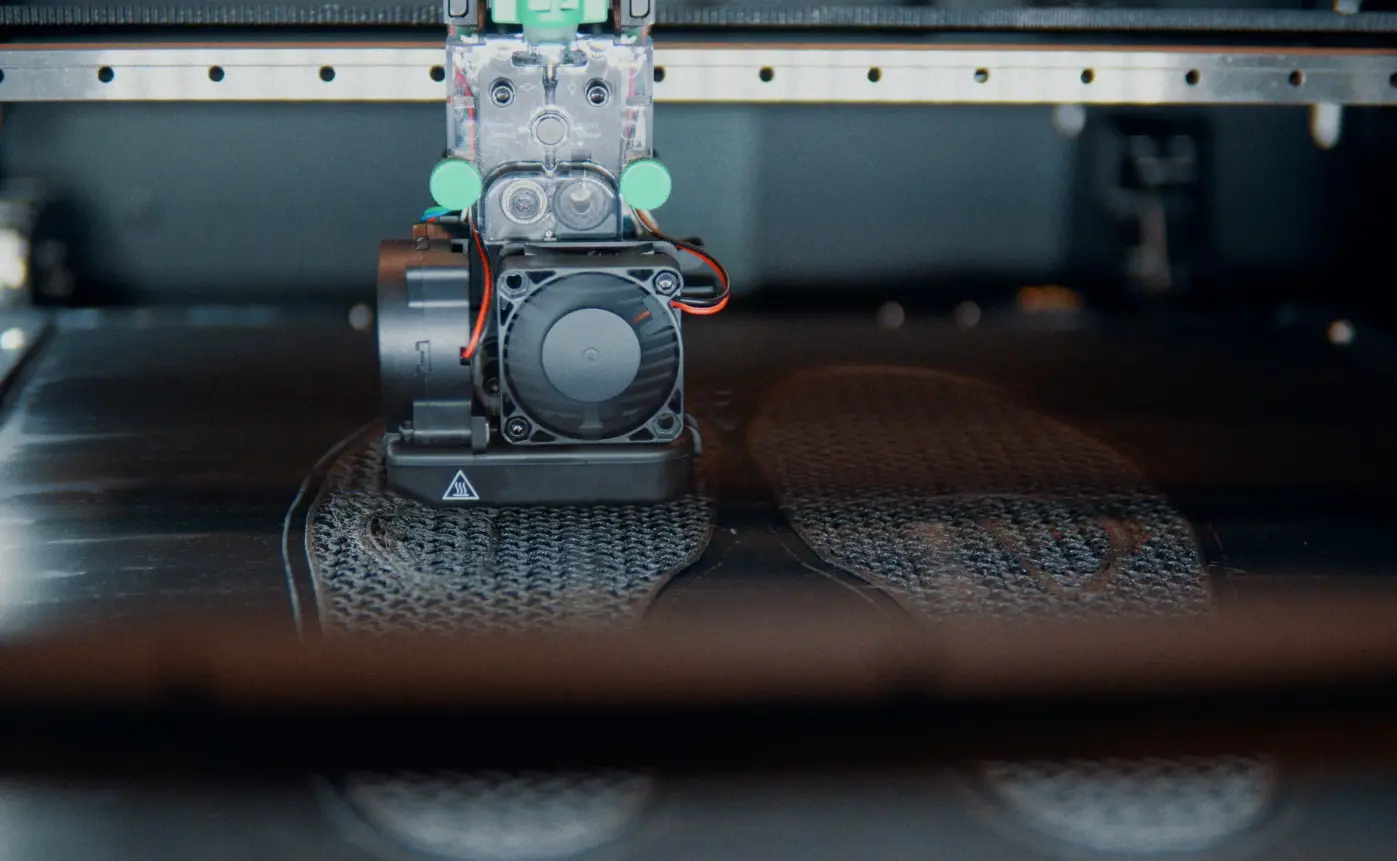
I learned the same lesson with Mosaic Manufacturing. For their orthotics project, we built case study videos from the customer's perspective. We focused on the business owner, the workflow, and the gain to the operation. We did not obsess over printer specs. That gave the market a much cleaner signal of product-market fit.
Competence is the product in a lot of B2B tech categories. Nvidia understands that and shows the work.
They Turn Launches Into Market Events

Nvidia also knows how to make the market stop and look.
GTC is the clearest example. Nvidia said more than 300,000 people were expected to register for GTC 2024, with 900 sessions and more than 300 exhibitors. That functions as a content machine, a sales tool, a partner platform, and a category signal all at once.
Most B2B companies waste their milestones. They put out one press release and move on. Nvidia turns product movement into industry movement. One launch becomes keynotes, product pages, vertical stories, partner content, press coverage, sales decks, and follow-up assets.
That is how you build gravity. Your technical milestones are also brand moments.
I care a lot about this because community and connection matter in deep tech. It is one reason I built Fello Foundry. When the right founders, operators, engineers, and investors are in the same orbit, commercialization gets easier. Nvidia has done that at a global scale. It has made the ecosystem feel like a club serious people want to join.
Jensen Huang Is Part of the Marketing System
People buy from people, especially when the deal is technical and expensive. AI can help. You still need a driver behind the car.
Jensen Huang is a serious brand asset for Nvidia. He explains hard things clearly. He gives the company a human face. He makes the market feel like there is a real operator behind the machine.
That is more valuable than a lot of teams realize. Thought leadership is more trustworthy than product sheets for 73% of decision-makers, according to Edelman and LinkedIn. A 2024 Edelman and LinkedIn study also found 86% would invite a company with strong thought leadership into an RFP process, and 60% would pay a premium to work with that company.
That is a board-level argument for executive visibility.
LinkedIn for me has always been a verification tool. Buyers discover you in different ways, then they go check whether your leadership sounds real. Passion will actually beat hardcore planning there. Generic AI generated slop will not.
What B2B Tech CMOs Should Steal from This
Rebuild the Story Around the Buyer's Gain

Go through your homepage and ask a brutal question. Does it speak business, or does it speak internal product language?
If your top message is all architecture and no payoff, fix it. Lead with ROI, business outcomes, and customer evidence. Put the gain where the buyer can see it fast. In long sales cycles, clarity buys you time and trust.
Give Each Buyer a Clear Path
One generic story will not carry a complex deal. Your user, your budget owner, your technical evaluator, and your partner all need different proof.
Build dedicated pages, assets, and proof points for each one. Some pages should help close the next conversation. Some should build long-term brand loyalty. Both matter. Your client is your Padawan. Help them make the internal case.
Treat Proof Like Commercial Infrastructure
Case studies are core trust assets. If your site does not have a proper case study section, that is a red flag for enterprise buyers right away.
Use video when the deal size justifies it. Use downloadable briefs and brochures to capture contact info and keep your brand alive during long buying cycles. Write technical content that helps buyers write their future RFPs. Video matters a lot, but good copy still matters too. It carries your SEO, your logic, and the story behind the sale.
Make the Website a Real Revenue System

A lot of companies still treat the site like a brochure. That thinking is dead. McKinsey's 2026 B2B Pulse found 71% of B2B companies already offer e-commerce, about one-third of revenue flows through digital channels, and 73% of buyers are comfortable placing orders above $50,000 online.
Your site has to do real selling now. It also has to move fast. If you don't have a proper CMS, there is no point of even having a website. I want a marketing team to be able to publish quickly, update proof quickly, and support sales quickly. They want to move in months when they should be moving in weeks.
And when you measure the impact, stay focused. Results shouldn't be measured by website traffic, they should be measured by sales velocity. Are the right people replying faster? Are technical briefs getting shared? Are demos improving? Is sales facing less resistance because the brand already built trust? That is the scoreboard.
Final Thought
The smartest thing about Nvidia's marketing is the alignment. Product, software, proof, leadership, ecosystem, events, and website all pull in the same direction. That is why the brand feels so strong. It feels clear. It feels credible. It feels ready.
That is the lesson for B2B tech CMOs.
Do not make the market work so hard to understand you. Speak business. Show proof. Build separate paths for different buyers. Turn your experts into real media assets. Move faster than you think you need to.
Strong B2B branding is the last moat standing. Done right, it helps you skip a level in the sales cycle. And in a market this competitive, that edge is everything.
Frequently Asked Questions
How do we translate a free developer ecosystem into enterprise pipeline?
Stop treating developers like a charity. Nvidia has over 7.5 million developers in its ecosystem. That is an acquisition engine. Hooking developers on free frameworks creates bottom-up internal champions who force the enterprise buying committee's hand when it is time to sign six-figure contracts.
How do we eliminate the friction between sales and marketing on complex narratives?
Force a single source of truth. Gartner data shows 69% of buyers report inconsistencies between websites and sales reps. Fix this by making marketing build the actual sales enablement decks. If marketing does not own the narrative all the way to closed-won, you are leaking revenue.
How do I justify executive thought leadership campaigns to a board focused on CAC?
Frame it as pricing power, not lead generation. The board wants margins. An Edelman study proves 60% of decision-makers will pay a premium for strong thought leadership. Executive visibility isn't a vanity play. It is the ultimate lever to shorten sales cycles and command higher contract values.
Can we really sell highly complex infrastructure through digital e-commerce channels?
Yes, and if you aren't, your competitors will. McKinsey found 73% of buyers are comfortable placing orders over $50,000 entirely online. Complex tech doesn't mandate a massive sales headcount anymore. Build a seamless digital purchasing flow that lets educated buyers bypass reps.
How can smaller B2B tech firms mimic this strategy without a massive marketing budget?
You need vertical density, not billions. Nvidia didn't win healthcare by being generic. They built MONAI, which now sees over 5.5 million downloads. Dominate one specific use case, build a hyper-targeted proof library for that exact buyer, and establish category lock-in before expanding.
Your Creative Partner for Innovation That Matters
From advanced tech to transformative healthcare, Fello helps visionary teams shape perception, launch products, and lead industries.

Let’s keep in touch.
Discover more about high-performance web design. Follow us on Linkedin and Instagram.

