


Most agencies fail at complex tech because they never really understand the job.
They think they were hired to make a website, a deck, a launch video, or a content calendar. Then the work goes live. It looks cleaner. Sales still has to explain the company from scratch. The board still asks where the pipeline is coming from.
I spend my time helping companies in AI, robotics, quantum, medtech, manufacturing, XR, logistics, and defense go to market. At Fello, we’ve done more than 50 projects in this world, and I’ve spent close to 10 years learning how to ask the right questions. The market has already decided that brand matters. OpenAI invests in it. Palantir does. Colossal Bioscience does. Anduril does.
Better product is not a go-to-market strategy. I believe that deeply. Brand value is underrated because people keep treating it like decoration, when it is doing a whole slew of commercial work behind the scenes. A brand is a feeling that somebody thinks about when they see your company. In complex tech, that feeling needs to be trust, interest, and curiosity. If buyers do not trust you, the rest of the story barely matters.
If you’re a CMO or VP of Marketing carrying revenue pressure, you feel this problem early. You are dealing with long cycles, skeptical buyers, budget questions, and sales teams that want cleaner conversations. You do not need more activity. You need a system that helps close business.
Most go-to-market strategies fall at the brief, not the launch. Internal technical language gets pushed into market-facing messaging, and then everybody wonders why nothing moves. If you do not have a brand, then you are going to be forgotten. In 2026, forgotten happens fast.
You Know the Problem Within Two Weeks

Look, I think it’s fair that two weeks after you hire an agency, they should understand enough to move the work forward, or at least be asking very sharp questions.
If every meeting still sounds like onboarding, you already have a problem. Your product team is explaining the same acronyms over and over. Your sales team is correcting copy. Your CMO is doing education instead of getting leadership. That is where trust starts slipping.
The best agency-client relationships in complex tech feel like a leading together movement. The agency speaks your language quickly. They know how to ask the right questions. They make your team feel understood instead of drained.
I use a simple test. If your agency cannot explain your product to a stranger in 60 seconds, every asset they produce is going to be surface level. Straight up. I’ve seen this happen in defense. A client under NDA told us their previous agency used language that did not fit how that market buys. The team had written as if they understood the category, but in the room it was obvious they were pretending. In spaces like defense, robotics, quantum, or medtech, buyers can spot bullshit a mile away.
That is the first big reason agencies fail here. They are learning too slowly, or worse, acting like they already know. Complex-tech CMOs are already bushwhacking. They do not need an agency learning the category on their dime.
Pretty Deliverables Do Not Move Pipeline
A lot of agencies sell the service, not the outcome. They sell a website. They sell a rebrand. They sell a deck, a campaign, a video series, or a social calendar. Fine. What does it do to pipeline? What does it do to CAC? What does it do to cycle time? What does it do to how fast a buyer trusts you?
That is the conversation I care about. If marketing is going to stop being treated like a cost center, then brand, web, growth, and sales enablement need to work like one revenue engine. When they line up, you lower confusion, improve conversion, and give sales a cleaner runway. When I talk to CFOs, I do not walk in talking about “making it look nicer.” I frame the work as communication strategy and marketing investment. If a website is a $50,000 line item, it should work like a lead-generation asset. It should bring in better inbound, reduce vendor risk perception, and help the business win larger deals.
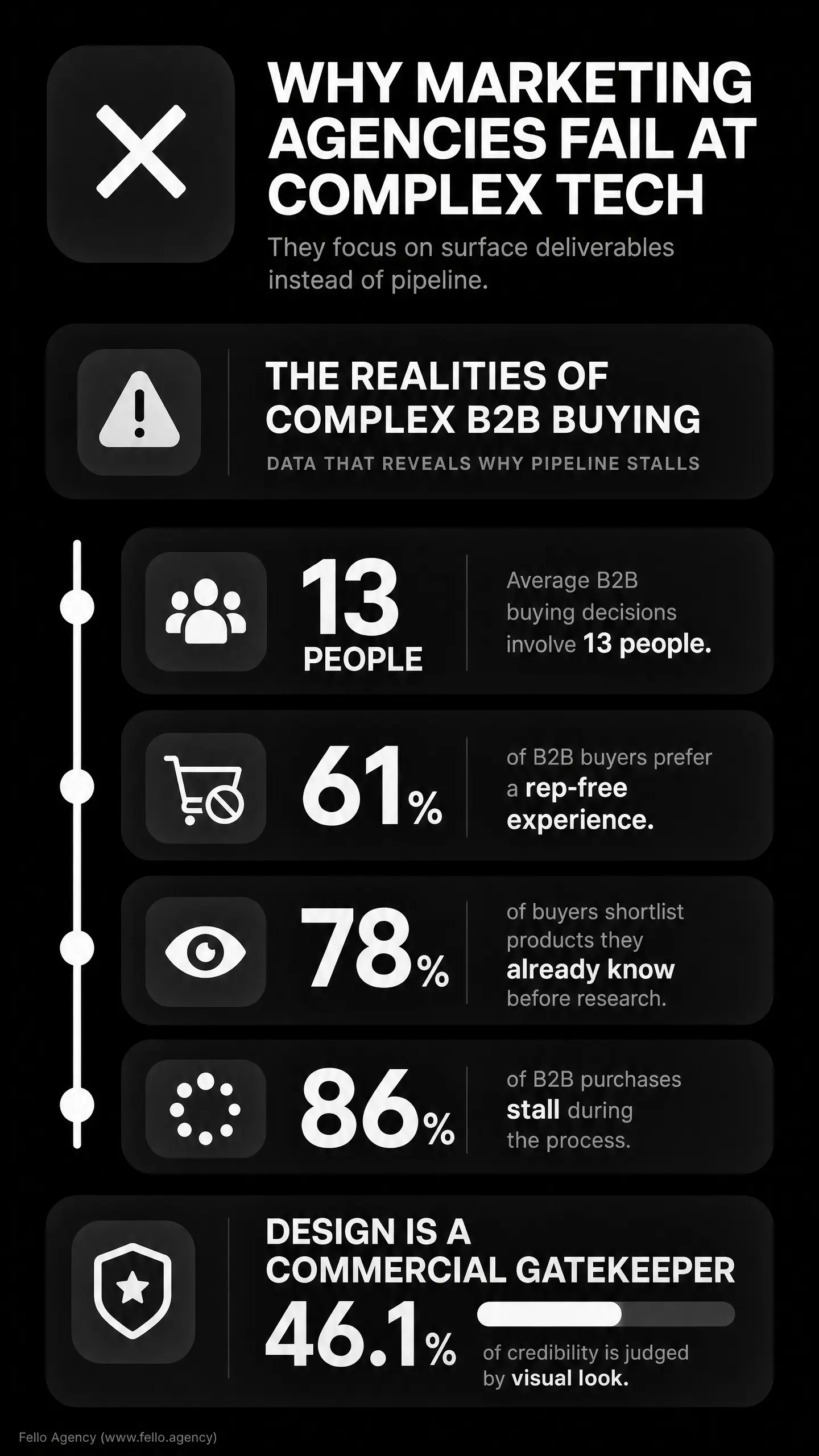
A Gartner survey found that 61% of B2B buyers prefer a rep-free buying experience, 73% avoid suppliers that send irrelevant outreach, and 69% notice inconsistencies between a supplier’s website and what sellers tell them. That should wake up every marketing leader. Your site, your outbound, your sales deck, and your talk track have to line up.
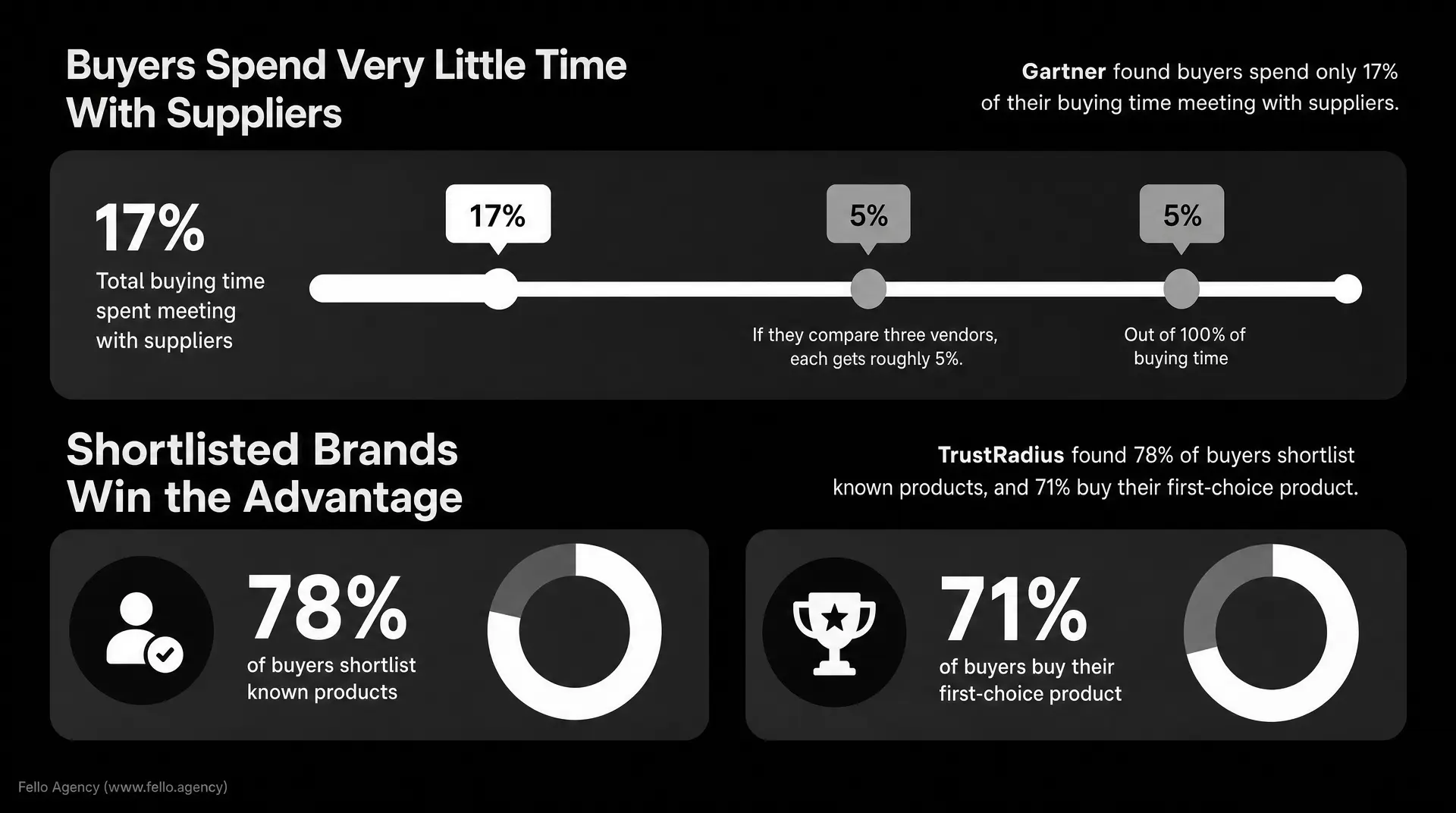
Gartner also found buyers spend only 17% of their buying time meeting with suppliers. If they compare three vendors, each one gets roughly 5% of the buyer’s time. You do not get many swings. Your brand has to do work before the first serious call.
A TrustRadius and Pavilion report found that 78% of buyers shortlist products they had heard of before they even start research, and 71% buy their first-choice product once the shortlist is set. That is why I keep saying brand credibility is a go-to-market accelerant. It gets you into the room earlier. It helps you skip a level once you are there.
You can see the difference when the work is tied to business value. At Sphere, Alexandra Corey, Head of Marketing, said, “The new website has more than tripled our lead generation efforts.” With Mosaic Manufacturing, reframing the story for different market segments helped lift inbound leads by 25% and booked meetings by 15% within two months.
Those are not vanity outcomes. That is what your board wants to hear.
Most complex-tech startups should also stop trying to invent a category too early. Hijack an existing category first. Win the search behaviour that already exists. Then out-execute inside it.
One Message Cannot Carry a 13-Person Buying Team
A lot of agencies still build one hero message and call it strategy. That falls apart the second a real buying group gets involved. A Forrester report says the average B2B buying decision now involves 13 people, and 89% of purchases involve two or more departments. The person who signs the contract is not always the person who found you. The person who found you is not always the person who has to justify you internally.
This is why we start with stakeholder interviews. We talk to customers first, then sales, then marketing, then leadership. That order matters. Customers tell you what they actually understand. Sales tells you where the friction is. Marketing tells you what the market keeps hearing. Leadership tells you where the company needs to go next.
Then you build the message around those truths. I want the VP of Operations to see business fit quickly. I want IT to find support and implementation answers fast. I want the CFO to understand how the solution saves or makes money and gives time back to the team. That is how you say the right amount to the right people without saying too much.
We’ve used that thinking in a whole slew of sectors. With ACTO, segmenting partner pages by ICP helped us balance technical proof with emotional clarity. In robotics, I push hard against one-size-fits-all messaging because floor managers, IT teams, ops leaders, and finance do not buy for the same reasons. I also see companies pivot the product and keep the old brand wrapper. That gap becomes expensive fast. Sales starts spending more time explaining what the company is not than what it is. Once that starts happening, your identity is behind the business.
Why Pilot Purgatory Keeps Happening

This shows up all the time in robotics and industrial tech.
McKinsey found that only 30% of Industry 4.0 pilots reach scale. I think a lot of that pain is a trust and narrative problem. The pilot dies in committee because the internal champion never got a boardroom-ready narrative. I keep seeing companies lead with the tech stack when the buyer needs commercial language. If your homepage opens with SLAM algorithms, you are forcing the buyer to translate. If it opens with preventing pipeline shutdowns, reducing downtime, or protecting production, you are taking conversations out of the lab and into the boardroom of value.
That shift matters because procurement teams do not buy vision. They buy credibility.
Design Is Doing Commercial Work
Look, I do not care if somebody has a PhD in robotics. If they want large contracts, their website, visuals, typography, videos, and product assets need to look serious.
Design is a commercial gatekeeper. Buyers subconsciously see whether you are legitimate or not before they ever get into the fine print. If you expect them to trust you with their biggest money, your brand has to show up like you deserve to be in the room.
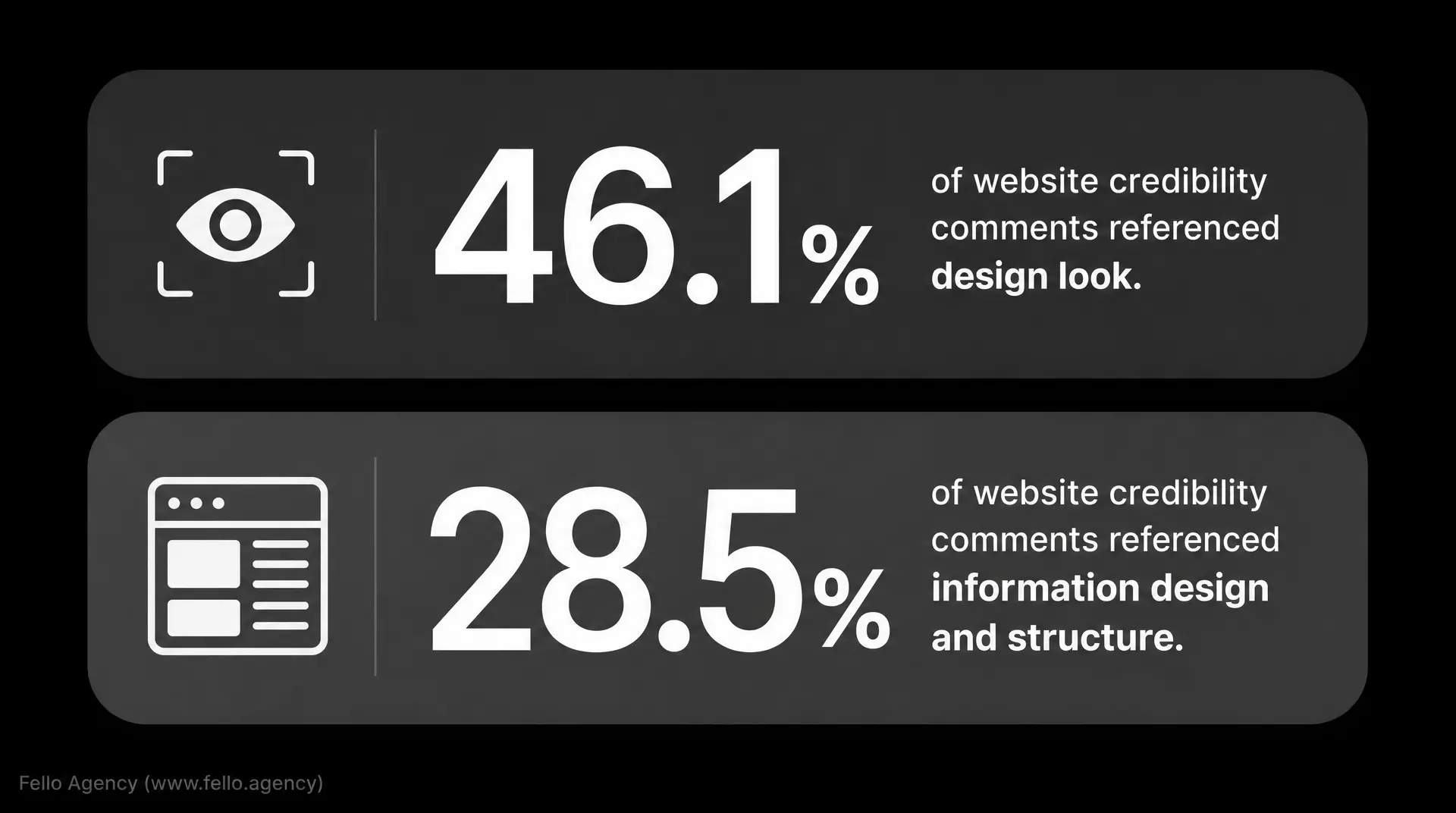
Stanford found that 46.1% of website credibility comments referenced design look. Another 28.5% referenced information design and structure. That tracks with what I see every day.
Nielsen Norman Group says users often leave in 10 to 20 seconds. So yes, typography matters. Color matters. Hierarchy matters. They are validating you before the copy gets a full shot. I saw this with a manufacturing and medical device client. The brand was not landing. The second we applied IBM Plex, the tone snapped into place and started shouting professionalism. Same company. Same capability. Better trust signal.
We did this on our own brand too. Fello used to live in a purple-and-black system. We shifted to white, black, and gray because it created more immediate trust with prospects. In 2026, strict black and white has become one of the strongest signals for high-value innovation. Black works because it is an empty vessel that adapts. It feels premium. It feels steady.
That does not mean every brand should feel cold. For Revanesse, we built a science-first black-and-white system and then added orange light into the lab visuals so the whole thing still had life. Brand serves the buyers, not the founder’s ego. That is the standard.
And in the new dawn age of AI, generic generated design is becoming a credibility problem fast. If buyers recognize the same layout, the same stock image, the same visual rhythm, interest drops. Human design judgment still matters. You are a Michelin star restaurant if you expect someone to spend millions with you. Every detail should imply that level of care.
Your Buyers Still Buy Like Consumers
A lot of agencies still act like B2B buyers live in a separate universe. They do not. You are also selling to humans.
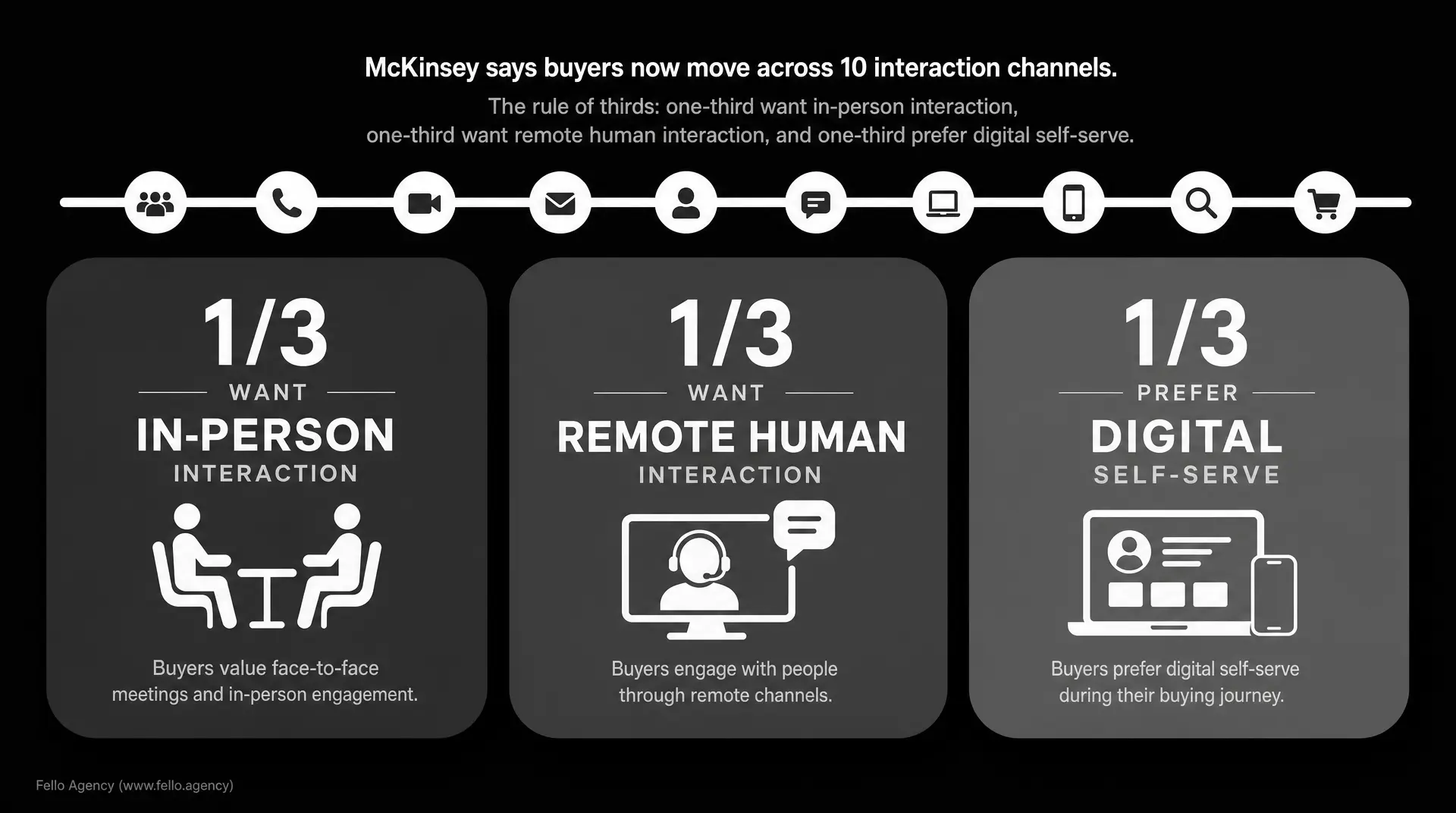
McKinsey says buyers now move across 10 interaction channels in the B2B journey. The same research points to a rule of thirds: one-third want in-person interaction, one-third want remote human interaction, and one-third prefer digital self-serve. So when an agency bets everything on one channel, the plan is already thin.
Your website usually becomes the central hub. I think of it like building the highway: the collectors and the express. Broad traffic comes in at the top. Then the right people get pushed into the paths that match their role, intent, and urgency. LinkedIn often works as buyer verification before it works as lead gen. Founder content matters. Executive visibility matters. The website has to catch all of that traffic and turn it into proof, clarity, and next steps.
This is also why I believe B2B companies need to respect B2C consumption habits. I have seen a B2B client struggle for traction until meet-the-team content on Instagram started building real following and trust. At DeckLinks, Lidia Vijga said social engagement increased by 220% after we built a sharper content strategy and found partnership opportunities that amplified the brand’s voice.
All modern companies are media companies now. Complex tech is no exception.
This reaches beyond demand gen too.
Top engineers and operators quietly judge companies by their brand before they ever apply. That is why Rocket Lab’s content works. That is why Anduril’s recruiting campaigns hit so hard. One aerospace and defense founder told us the concept images we created helped attract engineers to join the team. Brand helps you win talent and trust at the same time.
Slow Process Kills Good Go-to-Market
Look, deep tech CMOs are already bushwhacking. You do not need an agency protecting its internal process while your launch window closes.
Heavy feedback loops kill speed. Agencies batch work around their own workflow. They optimize for their sprint, not your ship date. Then they confuse activity with progress. Posting three times a week, running ads, and redesigning a homepage mean nothing if none of it is tied to pipeline.
Busy agencies are not the same as effective agencies. A product launch waits for no one’s creative review cycle.
That is a big reason we keep Fello lean. We are a small team on purpose. Clients work with the people doing the creative, not a bloated account layer. You get direct access, faster decisions, and better use of budget because the money goes into the output, not the overhead.
I have seen what speed changes. We completed a haptics rebrand in about a month and a half because the company needed OEM meetings at CES. We shipped a high-quality site in under two months for another CES deadline. We helped a dual-use client go to market in two weeks on a launch that usually takes months.
That speed only works if the agency already understands the category. You cannot compress timelines if the team is still trying to figure out what the product does.
Sometimes the fastest path is also the clearest one. I do not love endless option decks. I would rather tell a client what is going to happen, why it fits the market, and how it helps them move 10 times faster than they think they do. Technical teams usually respect that once they see the logic.
Sales Enablement Is Where the Money Shows Up

A lot of agencies stop at awareness because awareness is easy to screenshot. Sales enablement takes more work. It also has a much clearer line to revenue.
A Forrester study found that 86% of B2B purchases stall during the buying process, and 81% of buyers are dissatisfied with the provider they choose. Friction is everywhere. If buyers are not arriving at the discovery call already pre-sold on the business case, your sales team is doing marketing’s job.
The buyer is telling you what they want. A TrustRadius and Pavilion report found that enterprise buyers want transparent pricing, easier ROI calculation, and fewer vendors contacting them before they are ready. A G2 report found that 57% expect positive ROI within three months and 81% look at a vendor’s security history. So your bottom-funnel story has to do real work. Clear value. Clear proof. Clear risk reduction.
This is why I keep pushing companies away from giant PDFs when I can. Those long one-pagers may feel safe internally, but they are dead ends if they live only in email attachments. Put the content on trackable pages. Add calls to action. Capture emails. See what buyers actually care about. Now marketing can measure interest, and sales can follow up with context.
We’ve done this in a whole slew of ways. For a field sales software client, we replaced scattered collateral with a mobile-first toolkit that cut prep time and gave reps more confidence. For Campfire, stronger outbound visuals lifted demo booking conversion by 1.6% and improved activation and retention in the first four weeks by 20%. At ACTO, Wafa Sayeed-Irtiza said both marketing and sales “couldn’t wait to start circulating the videos” because they made market education easier.
If you sell into government or dual-use markets, this gets even more serious. The federal government committed about $755 billion to contracts in fiscal year 2024. In that world, your website is your past performance. Government buyers pattern match for stability, and often it is an engineer or an operator who whispers your name upstream long before procurement gets involved. Give them content they can forward. Give them proof that you belong in the conversation.
What Winning Looks Like Now
So what does success actually look like?
For me, the earliest sign is simple. Sales, marketing, and the C-suite all land on the same concrete message. The website says it clearly. The decks say it clearly. The reps say it clearly. The experience becomes legitimate and absolutely won.
When the job is larger, I want a real system behind it. We benchmark five competitors. We speak to at least 10 power users. We move through discovery and audit, strategy, design and build, migration and launch, then post-launch review. I also like building a brand kill list. Old decks, stale product names, dead pages, confusing language, outdated visuals. If you do not decide what dies, the old confusion survives.
A real brand system also has to scale. The question is whether the logo is good, sure, but I care more about whether the system can support the next 20 touchpoints while looking consistent. Trade show booths, technical briefs, partner pages, proposal templates, videos, sales decks, product launches, the whole shebang. If the system breaks the moment the company grows, it was never built properly.
Then you measure what matters. Better inbound. Larger deals. Cleaner handoff from marketing to sales. Faster conversations. Higher brand recall. In technical products, even developer adoption if the docs or SDK experience changed. I care about the signs that trust is compounding.
You also hear it in the sales calls. Reps stop wasting time explaining what the company is not. Referrals start doing their job because the website no longer undoes them. Buyers come in with a stronger picture of the business case. That is when marketing stops looking like a support function and starts acting like a revenue engine.
In 2026, agencies fail at complex tech because they stay on the surface. They chase assets, channels, and activity. They avoid the hard part, which is translating complex technologies into clear commercial value.
Do that well and you help sales skip a level. Do it badly and the better product gets ignored.
At any given moment, a life-changing deal could come in. Your brand should already be ready for it. Instill trust, make the value obvious, and move with speed. If you do not have a brand, then you are going to be forgotten.
Frequently Asked Questions
How should CMOs measure an agency’s brand impact during long B2B sales cycles?
Look at early shortlist inclusion, not just closed-won deals. According to TrustRadius, 86% of enterprise buyers only shortlist known products. If your agency’s work isn’t lifting inbound branded search and shortening time-to-first-meeting, they are failing the commercial mandate.
Why do agency-led content campaigns often fail to accelerate stalled enterprise deals?
Because they build for top-funnel awareness, not risk mitigation. Forrester reports 86% of B2B purchases stall mid-process. Agencies fail when they deliver generic posts instead of bottom-funnel assets - like clear ROI calculators - that help internal champions defend the purchase to their CFO.
Why do marketing agencies mismanage omnichannel strategies for deep tech?
They over-index on a single digital channel. McKinsey found B2B buyers navigate 10 interaction channels, evenly split across in-person, remote human, and self-serve. Agencies fail when forcing complex software into a purely digital playbook, completely ignoring how buyers actually operate.
Why do outsourced marketing teams consistently underestimate peer validation?
They assume polished copy outweighs technical consensus. TrustRadius shows 71% of enterprise buyers rely on peer conversations, while vendors assume it’s just 34%. Agencies fail by ignoring customer proof and community engagement, leaving your sales team bushwhacking without credible third-party validation.
Your Creative Partner for Innovation That Matters
From advanced tech to transformative healthcare, Fello helps visionary teams shape perception, launch products, and lead industries.
Let’s keep in touch.
Discover more about high-performance web design. Follow us on Linkedin and Instagram.