


I get asked this constantly. How long until an agency engagement actually pays off?
If you’re a CMO, that question is not theoretical. You’ve got a board asking about CAC. You’ve got a CEO asking for momentum. You’ve got sales asking for better leads, better decks, better proof, and better conversion support right now.
At Fello Agency, my job is commercialization. I work with B2B tech companies in AI, robotics, quantum computing, medtech, manufacturing, XR, and defense. I spend my time helping technical companies translate complex products into brands, websites, videos, sales tools, and go-to-market systems that buyers can actually understand.
So here’s my answer. In B2B tech, you should feel ROI in days, see it in weeks, and measure it in quarters.
That probably sounds aggressive. I think it’s realistic.
A lot of teams start by tracking the wrong things. They chase MQL spikes. They screenshot website traffic. They build dashboards full of vanity metrics because those numbers look clean in a board deck. Meanwhile, the real buying friction stays untouched.
I believe results shouldn’t be measured by website traffic. They should be measured by sales velocity.
Why? Because buying is messy now. Forrester’s 2024 Buyers’ Journey Survey found that 86% of B2B purchases stalled during the buying process, the average decision involved 13 people, and 89% involved two or more departments. That is a political process. That is a trust process. That is a communication process.
And buyers are already tired. The same Forrester research found 81% were dissatisfied with the provider they chose. That should tell you something. A lot of companies are making it hard to buy, hard to trust, and hard to explain internally.
This is why I say strong B2B branding is the last moat standing. When your company clearly communicates business value and proof, you skip a level in the sales cycle. You look legitimate before the first call even happens. That changes everything.
Your website plays a huge role in that. Demand Gen Report’s 2024 B2B Buyer’s Survey found that buyers start with web search and then go straight to vendor websites. On those sites, they want pricing, features, relevant content, and proof that you understand their industry. Your website needs to speak business.
Across all the industries I work in, the pattern is the same. My clients are trying to convince a buyer to change the way they operate to either make more money or save more money. That is the real story. If your homepage leads with technical talk and hides the business value, you’re making the buyer do your work for you.
And that’s dangerous, because shortlists are tiny. TrustRadius found 63% of shortlists contain only two to three products. The same research found 78% of buyers shortlisted brands they had heard of before they even started research, and 71% bought the product that was their first choice. Brand memory matters early. It also matters late.
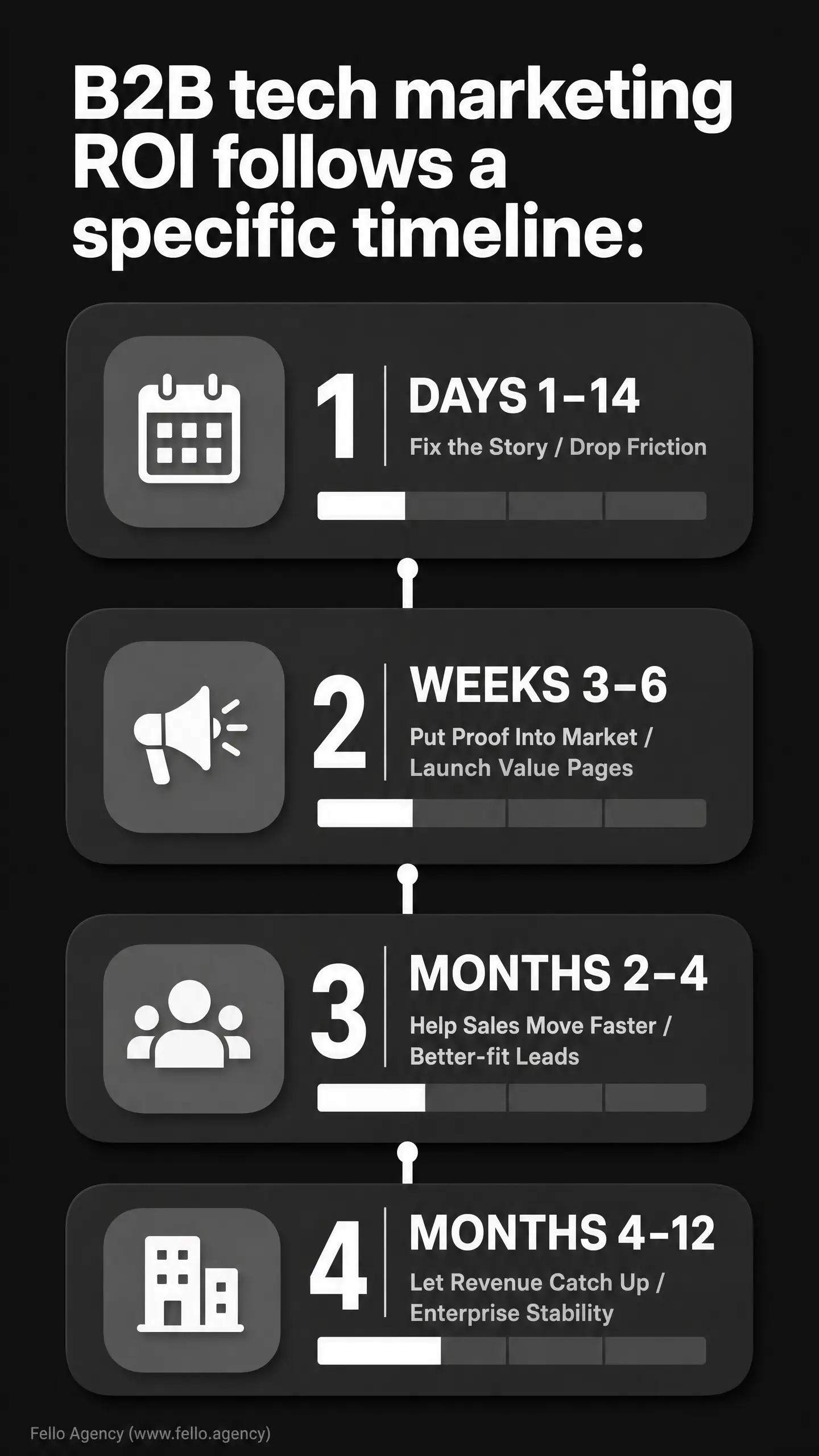
The Timeline I Actually Use
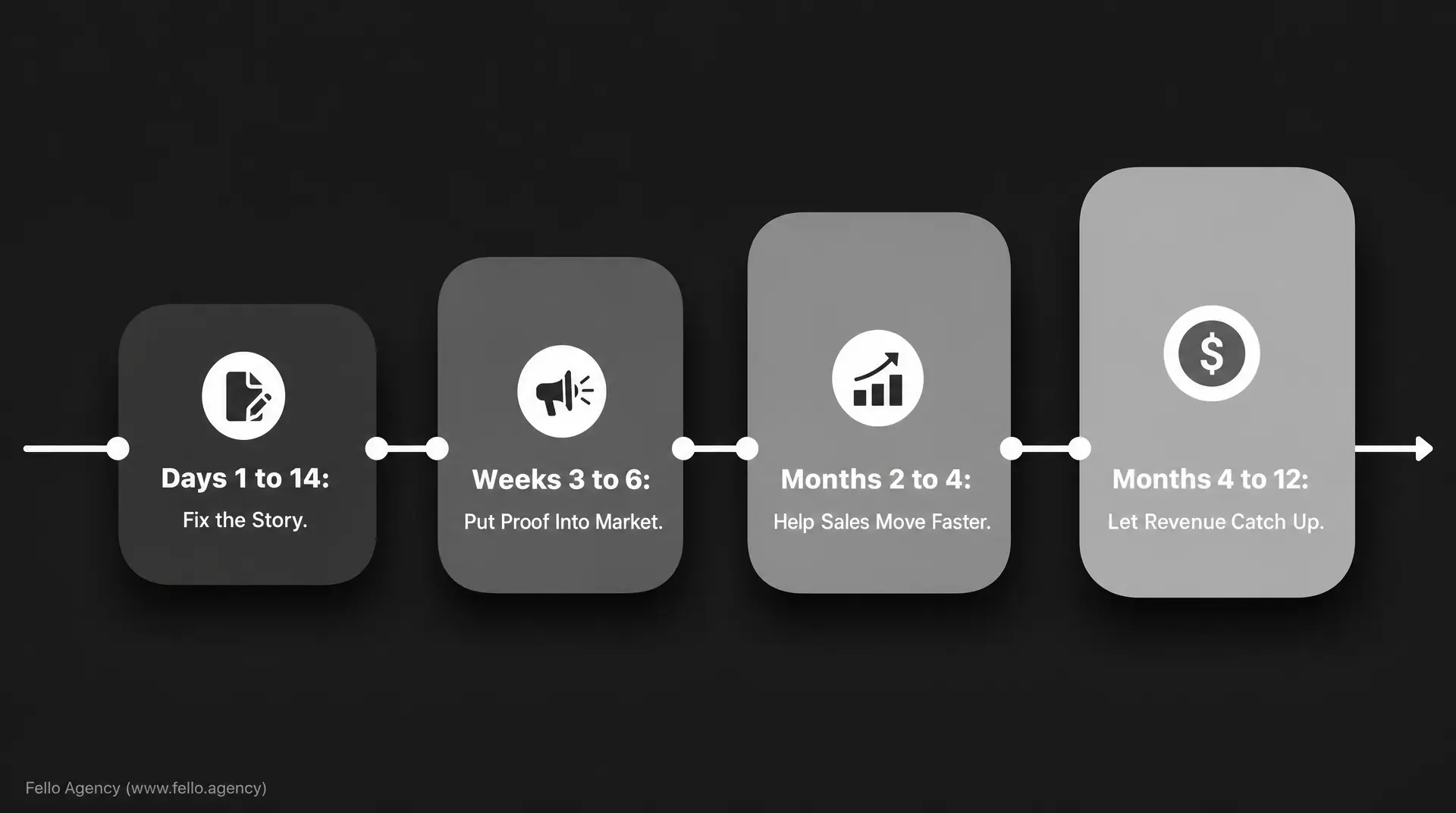
Days 1 to 14: Fix the Story
I am very hard on the 90-day audit trap.
If an agency or fractional leader tells you they need three months before they can make a recommendation, I get worried. In tech, 90 days of diagnosis is eternity. Your competitors are shipping. They are updating the site. They are tightening the message. They are getting meetings while you are still inside a workshop.
We cap that early strategy phase hard because speed matters. When you know the space, you do not need months to understand the basics. We’ve marketed across photonics-based quantum, traditional quantum computing, and quantum security. We’ve done work in medtech, XR, advanced manufacturing, and defense. That category context lets us move quickly.
At Fello, we start outside in. We talk to customers first. Then sales. Then marketing. Then leadership. I want the market truth before I hear the internal version. I want to find out what pisses off your clients the most. I want to hear what sales keeps repeating on calls. I want to know where the confusion is. That is the standard our tech marketing agency works to on every engagement.
Then I do a very simple check. Can we explain the company to a stranger in 60 seconds?
If the answer is no, the market is definitely struggling too.
This is usually where the first ROI shows up. The team starts speaking the same language. Sales gets sharper lines. The homepage gets clearer. The deck stops sounding like a research problem. You start hearing better reactions. Email replies come back faster. Meetings feel easier to book. Those are not fluffy signals. Those are early signs that friction is dropping.
I saw this very clearly in a 14-day sprint for a haptics company. We moved that fast because we understood the category, templated what made sense, and took charge on internal decisions. You cannot sprint with 14 people arguing over every word. You need to move in weeks, not months.
And buyers are demanding more proof than they used to. Demand Gen Report says 41% of buyers are doing more detailed ROI analysis, 34% are spending more time researching, and 33% are leaning more on peer recommendations and reviews. If your story is still vague after the first two weeks, the rest of your quarter gets more expensive.
Weeks 3 to 6: Put Proof Into Market

Once the message is right, proof has to hit the market fast.
I want your homepage and landing pages leading with value, proof, and outcome. I want case studies near the top. I want strong visuals. I want testimonials. I want clean calls to action. Technical specs still matter, but they come after the buyer understands why the conversation matters.
This is where a lot of technical founders get stuck. They want to lead with features. I get it. They’re proud of the work. But the market does not buy features first. The market buys confidence, relevance, and upside. Sell the sizzle, not the steak.
When we worked with Sphere, we created distinct industry pages for factories, medical tech, and defense. That was important because each ICP needed a different entry point. One generic innovation story was never going to do the job. After that broader brand and web refresh, lead generation increased 3x. The site started talking directly to the people who actually mattered.
Nord Quantique is another good example. Their story is dense. It’s technical. It’s easy for that kind of company to sound early and inaccessible. We turned that into a stronger website, a flagship video, and sharper investor materials. In six weeks, traffic climbed 80%, social shares doubled, and the work got picked up by five major industry publications. More important than those numbers, the company started looking commercially ready.
When the product is still early, I do not like pretending it is more finished than it is. For pre-revenue deep tech, I would rather lean on the credibility of the scientists, inventors, and team than oversell the product. Buyers can smell vaporware quickly.
Proof is also where content starts earning its keep. Content Marketing Institute’s 2025 B2B research says video is the top-performing content type, with case studies right behind it. TrustRadius found demos were the most influential resource for 71% of buyers who used them. That matches what I see every day. Buyers want to see the thing. They want to hear it. They want to understand the business case quickly.
This is why I push video case studies so hard. But the story has to come from the customer’s side. I want to hear what was frustrating before your solution came in. I want to hear what changed in their operation, in their day, in their pressure. Not how smart the device is, but how much smarter you’re going to be.
I also want one asset doing multiple jobs. A strong video case study should become a PDF, a blog, landing page proof, deck support, and social clips right away. That’s bang for your buck. In long-cycle B2B, you need content that keeps working after the first launch.
And let me be blunt about infrastructure. If you don’t have a proper CMS, there is no point of even having a website. I set a hard benchmark here. Your team should be able to publish a blog in around three minutes once the content is ready. I’ve seen a company with a legacy backend take three months to upload a single guest blog. That is pipeline damage disguised as a website problem.
We’ve built high-quality editable sites in under two months when clients had serious deadlines, including CES timelines, because autonomy was built into the system from day one. That matters. Even small performance improvements move conversion. A 0.1-second improvement in site speed was tied to a 21.6% uplift from form step one to submission on lead-gen pages.
Months 2 to 4: Help Sales Move Faster
This is where sales starts to really feel the difference.
The big shift here is simple. Your reps stop spending the first half of every call proving the company is legitimate. They spend more time on fit, deployment, scope, and economics. That is a huge gain. That is what I mean when I say branding can help you skip a level.
Mosaic Manufacturing is one of my favorite examples. We worked closely with them to identify a new market, build the visuals and video for it, and support the go-to-market move. Within two months, inbound leads jumped 25% and booked meetings rose 15%. Those numbers came from making the company easier to understand for the buyer it was trying to reach.
I’ve also worked with a manufacturing company under NDA that sold devices around the $100,000 mark. They were getting leads that could not even afford a fraction of the solution. Once the messaging shifted toward thought-leading content and the right business problem, the conversation quality moved upmarket. It took time, but it was the right kind of time.
This is a huge lesson for CMOs. More leads is not always the win. Better-fit leads are the win.
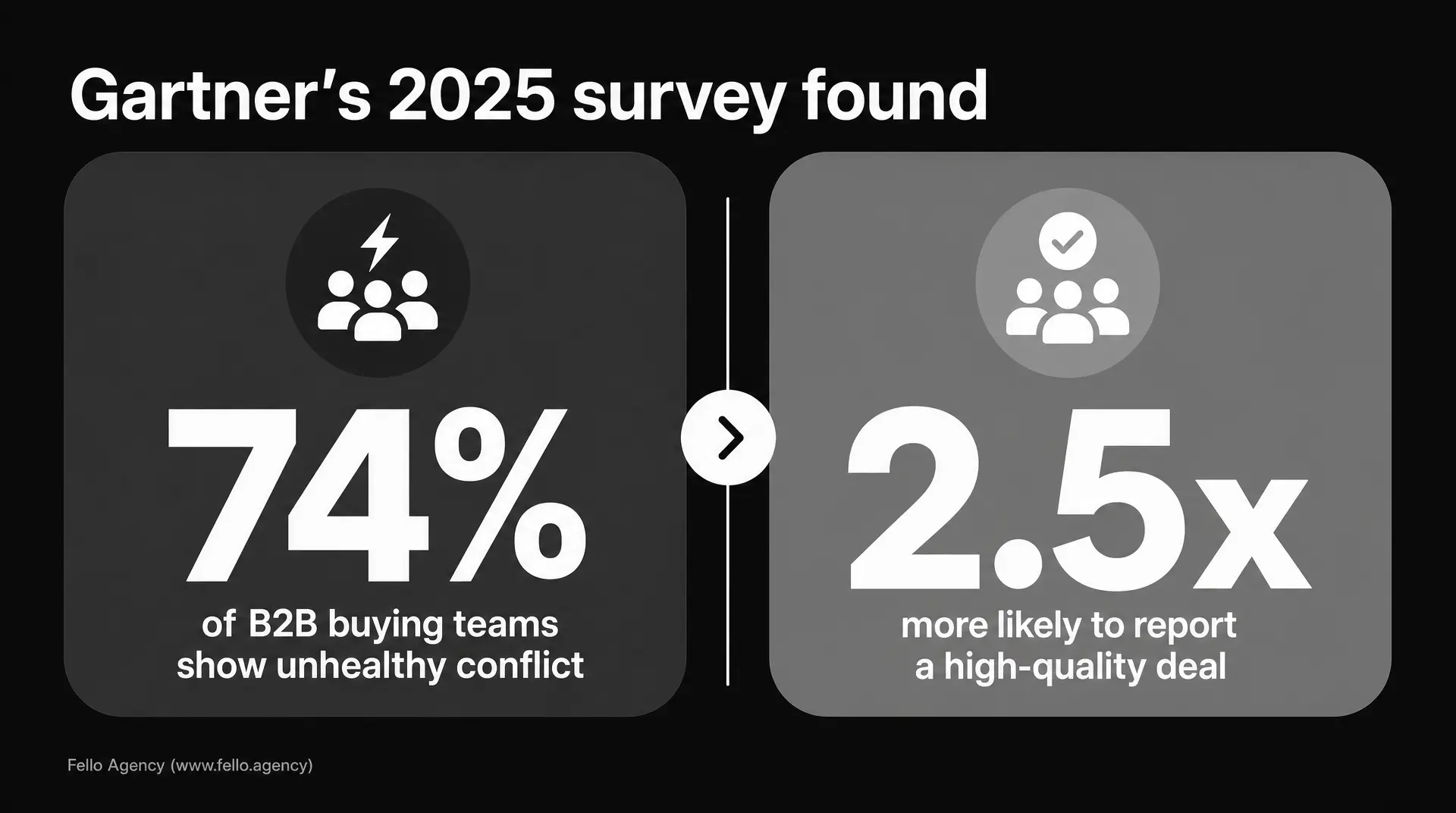
Buying groups are under pressure too. Gartner’s 2025 survey found that 74% of B2B buying teams show unhealthy conflict during the decision process, and teams that reach consensus are 2.5 times more likely to report a high-quality deal. Your content has to help your champion build that internal alignment. Your client is your Padawan. Help them make the case.
That is why I still care a lot about brochures, white papers, and resource content. In long cycles, those pieces are not filler. They are helping write future RFPs. They are giving your buyer something forwardable. They are keeping your brand alive in rooms you are not sitting in.
Months 4 to 12: Let Revenue Catch Up
Here’s the part I always say straight. Enterprise and B2G take months and months and months.
If you are selling into procurement-heavy environments, your site is past performance. Your deck is past performance. Your case studies are past performance. Buyers pattern-match for stability before they ever let you near a serious contract.
The broader data supports that pace. TrustRadius found that 65% of enterprise buyers completed purchases within six months, while enterprise buying reached 87% completion by 12 months. So yes, your board should look at first-quarter movement. But if you sell complex solutions, you also need a 12-month view.
This is where brand compounds. The 95-5 rule says most of your market is not in buying mode at any one time. That means your content is building memory long before it captures demand. All companies are media companies now, especially in long-cycle B2B.
I separate landing pages from collector pages for this reason. Landing pages help close the immediate opportunity. Collector pages like mission, about, partnership, and meet-the-team pages build loyalty, trust, and familiarity over time. Buyers want to know who they are dealing with. They want to know you give a shit.
I also use LinkedIn mostly as a verification tool. Buyers discover you through search, referrals, events, or content. Then they go look at leadership, the team, and whether the company feels alive. Raw, useful posts from executives usually do more here than polished corporate filler.
And even with all this digital behavior, human selling still matters. Gartner’s technology-buyer research found buyers are 1.8 times more likely to complete a high-quality deal when they use supplier digital tools together with a sales rep. When familiarity is high, some buyers want a fully digital path. When familiarity is lower, they want help. They want context. You still need a driver behind the car.
How I Would Explain This to the Board

If I were sitting in your chair, I would not sell this internally as branding spend. I would frame it as communication strategy, credibility infrastructure, and risk mitigation.
That language matters because it’s accurate. In a real rebrand, around half the value is strategy and research. The logo alone is not carrying your sales motion. The goal is to build a consistent system that translates your company clearly across the website, landing pages, decks, sales tools, and content.
I use competitor comparison a lot with CFOs and boards. Look at the companies winning the partnerships you want. Look at the ones getting into the enterprise accounts you want. Then look at your own materials honestly. If your company wants high-six-figure or million-dollar deals but your visuals look weak, the market notices.
I’ve seen a client lose a deal with Amazon because the brand visuals were poor. I’ve seen a logistics client nearly get excluded from a meeting with a major Canadian enterprise because the presentation deck was not cutting it. Take this stuff seriously because your competitors will and they will win the deal.
There is also a budget reality. For many Series A and Series B companies, a strong rebrand lives somewhere between $50,000 and $150,000. A fully editable website often lives between $30,000 and $60,000. Spend too little and you still look half-baked. Spend way beyond what the category expects and you can start to look suspicious to technical buyers. They may read it as over-funded, over-polished, and thin underneath.
I’ve managed this trust-gap problem directly. With Prollenium Medical Technologies and the Revanesse brand, we handled a major visual overhaul at roughly the $100,000 level because better engineering was being overlooked behind weaker branding. That work was about credibility. It was about closing a trust gap.
And I’d report the timeline in the same order the market feels it. Early on, I’d show faster response rates, sharper sales conversations, more engagement on proof pages, and better reactions from target accounts. Then I’d show better-fit meetings, stronger demo motion, higher quality inbound, and more content that gets forwarded around buying groups. After that, I’d show influenced pipeline, proposal progression, and revenue trendlines. That is the collectors and the express. You need both.
What Slows the Timeline Down
A lot of ROI problems have very little to do with creative quality.
Slow approvals kill momentum. Missing decision-makers kill momentum. A disengaged internal owner kills momentum. I can control the work. I can’t control a board that changes direction every week or a client team that disappears in the middle of a sprint.
Weak proof kills trust too. If your website has no real case study or testimonial page, that is a red flag. If you’re asking for high-six-figure deals and all you have is written praise, you are underinvested in proof. Professional visuals are a prerequisite for risk mitigation in these markets.
I’m also very blunt on AI generated slop. Use AI for research or ideation if you want. Fine. I do that too. But if the final website or visual system feels generic, buyers make the obvious leap. They assume your services feel generic too. If it looks like bullshit, no one’s gonna want to work with it.
And one more thing. Strategy without execution slows the clock immediately. A fractional CMO without a creative partner is just a consultant with a better title. The gap between strategy and execution is where most engagements quietly die.
Final Thought
A good agency should help you create a business, not a research problem.
So here’s the timeline as I see it. In days, credibility should improve. In weeks, the market should start responding differently. In months, sales velocity and lead quality should move. In quarters, revenue should catch up.
That’s the goal. Compress the time between credibility and cash.
You don’t want to be moving slow in tech. You’re gonna get killed. Pivot to an ROI narrative, make the market trust you faster, and give sales the tools to win very heavily.
Frequently Asked Questions
How can a marketing agency accelerate ROI when enterprise buying committees are gridlocked?
Agencies must build assets that force alignment. Gartner notes 74% of buyer teams face unhealthy conflict. We deploy business-case content - like ROI calculators - so your champion can build consensus. That directly shortens sales cycles.
Should agencies prioritize rep-free digital journeys to speed up revenue realization?
Not entirely. While self-serve matters, Gartner data proves buyers are 1.8x more likely to close high-quality deals when digital tools are paired with a rep. We build the digital proof, but sales still must drive.
How do we measure early agency ROI if the vast majority of our tech market isn’t actively buying?
You measure early momentum through brand memory. The B2B Institute shows 95% of buyers aren’t in-market today. We look for increased branded search and collector-page engagement to prove we are capturing future demand.
What is the fastest way an agency can unblock a stalled B2B pipeline?
Unblock them by giving champions financial justification. Demand Gen Report found 67% of buyers choose vendors making ROI easiest to show. We quickly deploy outcome-focused decks so they can defend the purchase internally.
Can emotional brand positioning actually accelerate ROI timelines for technical B2B products?
Absolutely. Founders over-index on features, but buyers buy confidence. Google found B2B buyers are eight times more likely to pay a premium with a personal connection. Emotion protects your pricing power during procurement.
Your Creative Partner for Innovation That Matters
From advanced tech to transformative healthcare, Fello helps visionary teams shape perception, launch products, and lead industries.


Let’s keep in touch.
Discover more about high-performance web design. Follow us on Linkedin and Instagram.

