

The committee deciding your seven-figure deal is not evaluating your technology. Each of them is quietly calculating whether putting their name on your recommendation gets them fired.
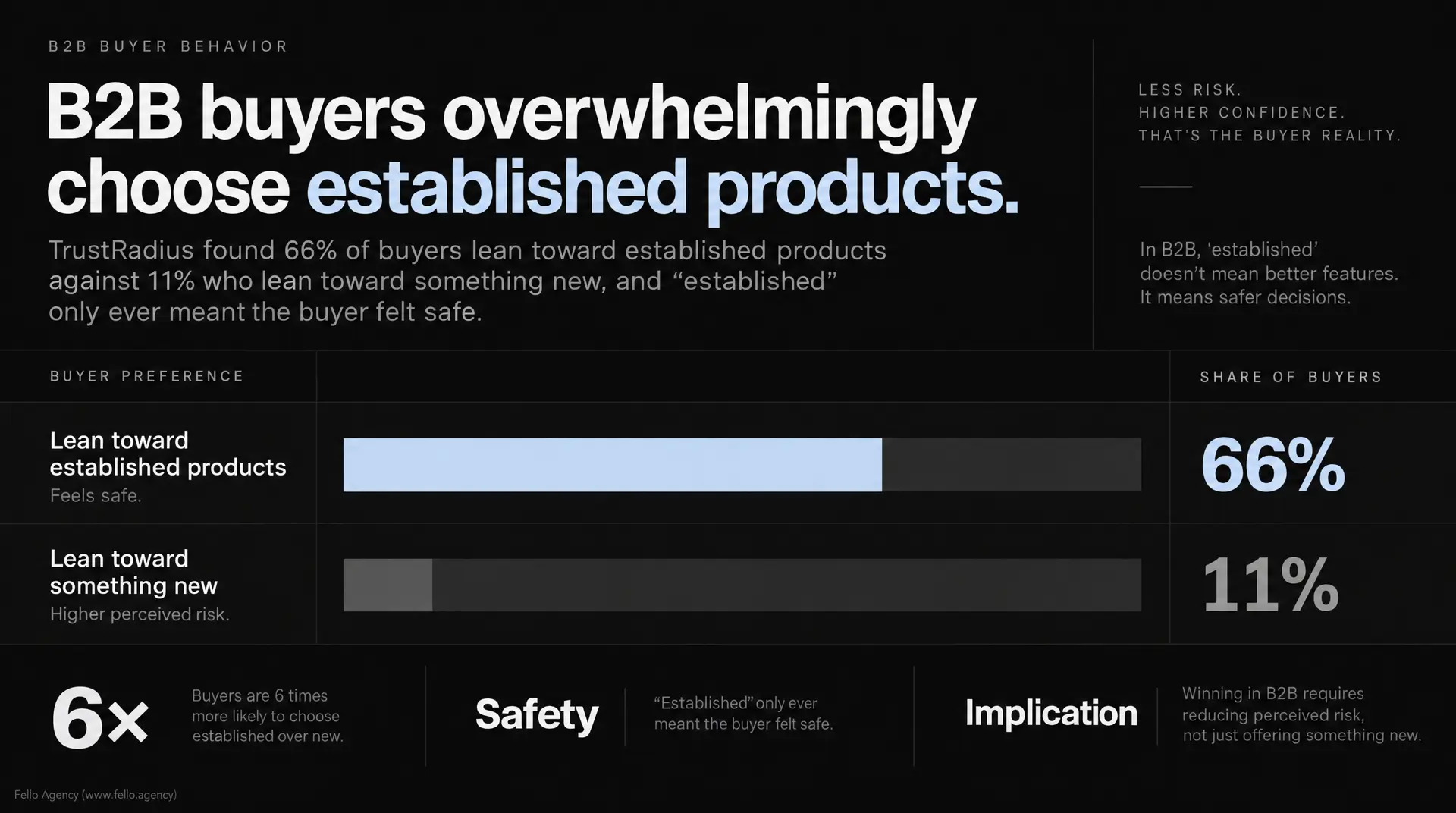
TrustRadius found 66% of buyers lean toward established products against 11% who lean toward something new, and "established" only ever meant the buyer felt safe.
A brand that can't supply that safety never appears on a finance report. It surfaces as the champion who declined to spend their credibility on you, and the competitor with the weaker product whose story was safe enough to repeat.
Key Takeaways
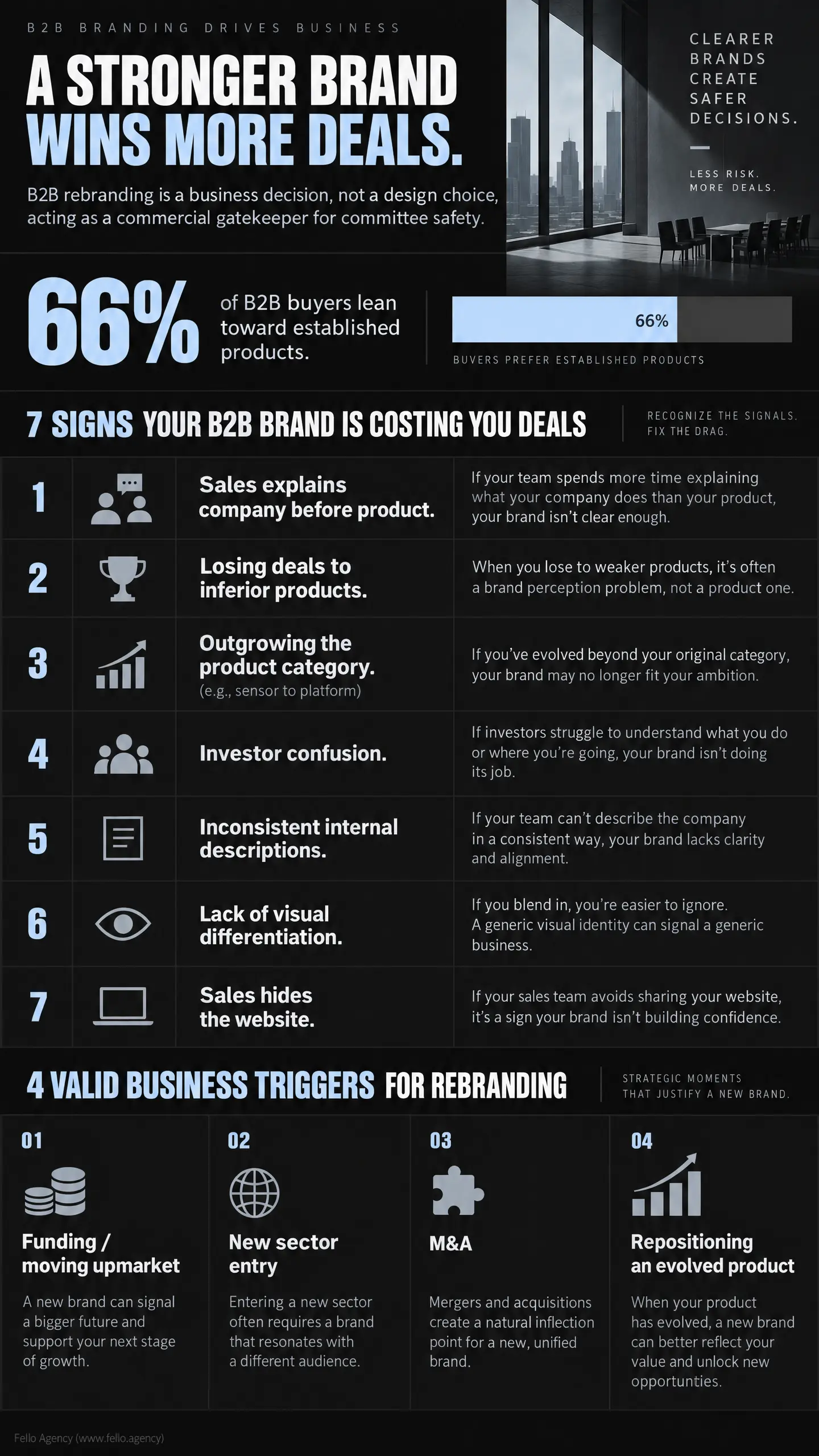
A TrustRadius survey shows that 66% of B2B buyers favor established products over new alternatives because established brands provide perceived safety for internal procurement committees.
According to a 2025 6sense study, 95% of B2B purchases are awarded to vendors on the buyer's initial shortlist before direct sales contact occurs.
Sales representatives spending the first five minutes of introductory calls explaining core company functions indicates a critical failure in pre-call brand positioning.
Technology companies that evolve from hardware components to software platforms face commodity-level unit pricing if their legacy branding triggers traditional hardware procurement routing.
Stanford web credibility research indicates that design appearance drives 46% of early credibility judgments, functioning as a commercial gatekeeper before enterprise buyers evaluate technical copy.
When sales teams default to emailing PDF pitch decks instead of sharing company website links, the digital brand has failed to establish enterprise credibility.
Inconsistent positioning between a Series B investor deck and a legacy website can force expanding B2B software platforms to close funding rounds at lower hardware valuations.
Why Is a B2B Tech Rebrand a Business Decision Rather Than a Design Choice?
The question is never "do we like the logo." I honestly don't care whether you like the logo, and your CEO's opinion of it matters even less.
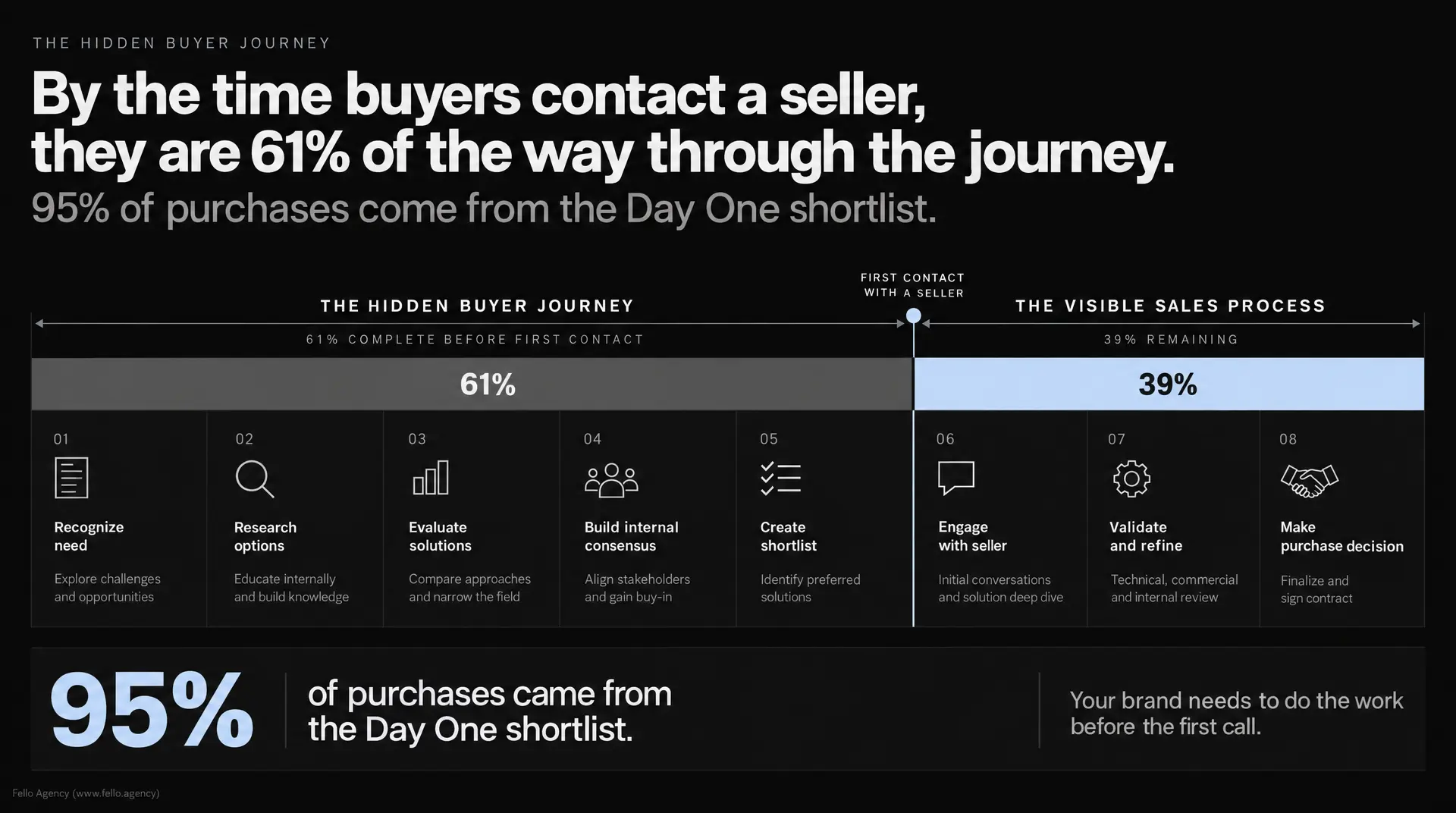
The only question that counts is whether the brand is doing its job. In B2B tech, that job is making a group of careful people confident enough to say yes. 6sense's 2025 study of nearly 4,000 buyers puts that group at 10 or more people, and your rep will meet maybe two of them.
Those people also don't wait for you. The same report found buyers first contacted a seller 61% of the way through the journey, 95% of purchases came from the Day One shortlist, and four out of five deals went to the favorite the buyer already had before anyone spoke to sales.
So by the time your rep gets the meeting, most of the decision is made. It got made on whatever the buyer saw alone: your site, your LinkedIn, a deck a champion forwarded. That is the brand doing the job with nobody in the room. I call it skipping a level. When the brand has already sold the fit, sales starts at negotiation instead of explanation.
If your brand produces that, leave it alone and put the money into demand. If it doesn't, the logo is the smallest part of the problem. You've got a positioning problem wearing a design costume.
Think about what you're asking a buyer to do. Commit seven figures. Change how their plant runs. Put their own name on the recommendation. At that point you are a Michelin star restaurant, and every detail of the digital presence has to imply the meal is worth it. Design is a commercial gatekeeper whether your engineers like that or not.
What Are the Seven Signs a B2B Tech Company Needs to Rebrand?
We've spent close to a decade doing immersion with deep tech companies. We sit on sales calls, read the email threads that follow, and talk to the customers they won and the buyers they lost. The same signs come up over and over, roughly in this order.
How Does Sales Explaining the Company Before the Product Signal a Need to Rebrand?

A first call with a technical buyer is 30 minutes with someone who took the meeting off an intro or a cold email. They have a problem, a budget they may or may not admit to, and a committee behind them they need to convince. The value of that half hour is finding out whether your product fits, and giving them something to carry back to that committee. That's it.
If the rep spends the first five minutes on what the company does, who it serves, and why it exists, that's five minutes the brand was supposed to handle before the call. Whatever the prospect skimmed to decide to take the meeting didn't land. So the rep is doing the brand's job live, badly, under time pressure, and the real conversation shrinks to 25 minutes.
Then it compounds. The buyer explains you to their boss using whatever they retained from a rushed summary. A secondhand paragraph from a rep who was improvising becomes the version of your brand that reaches the decision-maker.
And reps don't add a preamble for fun. They add it because they got burned. Some buyer got 20 minutes in and said, wait, you're not a software company? Every one of those preambles is scar tissue from a deal where the brand let the buyer walk in with the wrong picture. When I hear one, I don't think the rep is a bad communicator. I think the company never decided what it is, or decided years ago and grew past it, and sales is quietly compensating.
Why Does Losing B2B Deals to Competitors with Inferior Products Indicate a Need to Rebrand?
Go ask your head of sales who you lose to and why. If the answer is any version of "they just seemed more established," close the feature matrix. Nobody outvoted you on features. The buyer could repeat their story to their boss and could not repeat yours.
Sales has the numbers on their side here. TrustRadius surveyed over 2,000 tech buyers and found 66% leaned toward established, leading products, against 11% who leaned toward something new. "Established" in that survey means the buyer felt safe. It has very little to do with whose product benchmarks better.
I've had clients in conversations with Amazon who straight up could not get a champion inside the company to recommend them. The brand didn't look like something a mid-level manager could safely put in front of their director. That's what losing on brand looks like in real life. The champion protects their own credibility first, and your brand gave them nothing to protect it with.
When we sit down with a CEO and CFO to map their landscape, the top three competitors in almost any deep tech category have top-tier marketing and design. Almost without exception. Inferior technology with superior storytelling beats the reverse far more often than any engineer wants to hear.
How Does Outgrowing a Product Category Signal a B2B Tech Company Needs to Rebrand?

The expensive version of this is a company that becomes a platform and keeps the name of a component.
We worked with a company that started life as a single sensor. The name was the sensor. The logo was a stylized version of it. Domain, tagline, every case study, all sensor. Over four years the product grew into a full sensing and analytics platform. The sensor became one of six things they sold, and the software was the highest-margin part of the business. Nobody touched the brand because revenue was up, and it's hard to argue with a chart going the right direction.
None of what it cost them appeared on that chart. Every enterprise deal started with the buyer assuming they were talking to a hardware vendor. Procurement routed them through the hardware buying process, which meant competitive bids on unit price against commodity sensors. The software, the entire reason to choose them, never got evaluated because the buyer had them in the wrong box before the first call. Sales spent a full year recategorizing the company one deal at a time. Some worked. Most didn't.
Then hiring. A software engineer turned down their offer and told the recruiter, honestly, that he didn't want to work at a sensor company. He never got far enough to learn that half the engineering team wrote software. Top engineers judge you by your brand long before they look at the comp, and most companies never find out because nobody tracks the candidates who quietly dropped.
A brand is a claim about what the company is. When the company changes and the claim doesn't, the market keeps buying the old company.
Why Does Investor and Partner Confusion About Offerings Indicate a Need to Rebrand?

Same sensor company, Series B. The deck said platform. The website said sensor. Two investors asked the identical question in the same week: are you a hardware company with a software feature, or a software company that ships a device? The founders had an answer. The brand had a different one.
The round closed later than planned, at a valuation that priced them like hardware. After we finally did the rebrand, the founders summed up the cost the same way in every pitch: two years of hardware pricing, one slow round, one lost engineer. Brand was shaping the cap table conversation, and nobody in the room called it brand.
My rule is that if a Series B investor needs the deck explained twice, the market needs it explained 10 times. Investors are the most motivated audience you'll ever have. They're paid to understand you. If they can't, think about the procurement lead at a 40-year-old manufacturer with 11 other vendors to get through this quarter.
How Do Inconsistent Internal Company Descriptions Signal a Need for B2B Repositioning?
Try this before your next leadership meeting, and don't warn anyone. Ask five people across sales, engineering, and marketing what the company does, in one sentence.
If you get five answers, there is no brand. There's a logo and a shared Slack. Engineering describes the architecture, sales describes the benefit, the founder describes the 10-year vision, and the buyer gets a Frankenstein. Three partial stories that never add up to one they can carry into a committee.
This sign also tells you where the real problem lives. In my experience the sentence was never written because the founder or CEO never decided what the company is. We charge somewhere between $30,000 and $50,000 to compress a technical founder's explanation into one sentence, and honestly, most of that time goes into getting a decision made rather than writing. If that budget isn't there, have the founder write the long version, a Founder's Thesis, and cut from that. What you can't do is skip the decision. A lot of rebrands stall right here, because the decision is hard and the logo is easy.
Why Does Lacking Visual Brand Differentiation From Competitors Signal a Need to Rebrand?
Open a tab for each of your competitors and put yours next to them. Same dark mode, same abstract network graphic, same three adjectives, same hero line about pioneering the future of something.
We rebranded a space tech company that came to us struggling to look legitimate to enterprise buyers. Somewhere around 90% of that sector uses dark navy, electric blue, and white, so the palette communicated nothing. We replaced it, and the brand became one people actually remember. Recall is the whole point. TrustRadius found 78% of buyer shortlists included products the buyer had heard of before research started, and 86% among enterprise buyers. If they can't tell you from the tab next to you, you were never on the list.
It's gotten worse in the age of AI, and I'll be specific. A website layout generated by Claude turns into a recognizable template after about five weeks of everyone using it. A buyer sees the same stock robot arm on four sites in one afternoon and files all four under low credibility. Stanford's web credibility research found design look was the most cited factor, showing up in 46% of all credibility comments. That judgment happens in seconds, before a word of your copy gets read.
I call this the uncanny valley of tech branding: too technical for normal people, too polished and empty for the technical community. I'd take a scrappy brand over a professional one that says nothing, because scrappy at least signals someone real is behind it. And when a buyer can't tell you apart, you're competing on price, which in deep tech means a unit-cost bid against a commodity vendor.
Why Does Sales Hiding the Company Website From Buyers Indicate a B2B Rebrand Is Necessary?

This is the most honest signal of all, because nobody says it out loud.
We were doing immersion with a Series A advanced manufacturing client selling a production system into aerospace suppliers. About four calls in, the pattern was obvious. After every call the rep sent a PDF. A 20-page deck, a spec sheet, a case study. Never a link.
We asked the head of sales why, and he was completely matter-of-fact about it. The website made them look like a startup. Their buyers were procurement leads at companies with 40-year histories, and those people would open a homepage with a hero video, a tagline about the future of manufacturing, and a stock photo of a robot arm that wasn't even the product. His words: "The deck looks like a real company. The website looks like a pitch competition."
The marketing lead was sitting right there. She'd built that site 18 months earlier for the seed round, and it did exactly what it was designed to do, which was get investors excited. Now the company was selling into a market that found it embarrassing and nobody had told her. Sales never raised it as a problem. They treated it as a workaround and moved on.
That site wasn't losing deals directly, because nobody was seeing it. It lost them indirectly. No inbound. No way for a champion to forward something to their boss. Every buyer touchpoint depended on a rep being in the room with a PDF. For a CMO who has to prove pipeline contribution, a PDF is a black hole. You can't see who opened it, who forwarded it, or where they stalled. And G2 found 69% of buyers only engage a salesperson after they've already decided, so when the site is hidden, the deciding happens on nothing you control.
We rebuilt the brand around the buyer they actually had, not the investor they used to pitch. Spec tables on the product page. Certifications up front. Named customers. A photo of the real machine on the real floor. Less exciting, and engineers respect it. The first thing sales did after launch was start sending links.
If you want to know whether your brand is working, do not ask marketing. Look at what sales attaches to their emails.
What Are Invalid Business Reasons for a B2B Tech Company to Rebrand?
Rebrands pay a B2B branding agency's rent, so I'll be honest here in a way plenty of agencies won't. There are reasons people rebrand that have nothing to do with the business, and we've turned down work over most of them.
A new CMO who wants their mark on the company is the most common. I get it. You inherited someone else's brand and it doesn't feel like yours. But positioning is a CEO decision, and a CMO-led refresh without the CEO deciding what the company is gives you decoration. It'll look better and lose the same way.
Boredom is the second. You look at your homepage every day. Your buyer looks at it once, for less time than it takes to read this paragraph, and decides whether to take your call. Internal fatigue is a terrible proxy for market fatigue.
A competitor rebranding isn't a reason either. I'm genuinely unbothered when a competitor launches first, because speed of execution beats monitoring, and half the time their rebrand is the new-CMO problem from two paragraphs ago. Watch what happens to their pipeline before you react to their fonts.
And a designer telling you the logo is dated is a designer doing their job, which is noticing. Ask whether the buyer noticed. The inverse happens too. I see younger founders cling to a personal research-lab aesthetic against all evidence, while seasoned, well-funded founders understand instinctively that design is a commercial gatekeeper. Neither taste is a business reason.
A rebrand that isn't tied to a business trigger produces a prettier version of the same problem. You get a beautiful version of a story nobody can repeat, and you lose the next deal the same way with better fonts.
What Four Business Triggers Justify a Full B2B Tech Company Rebrand?
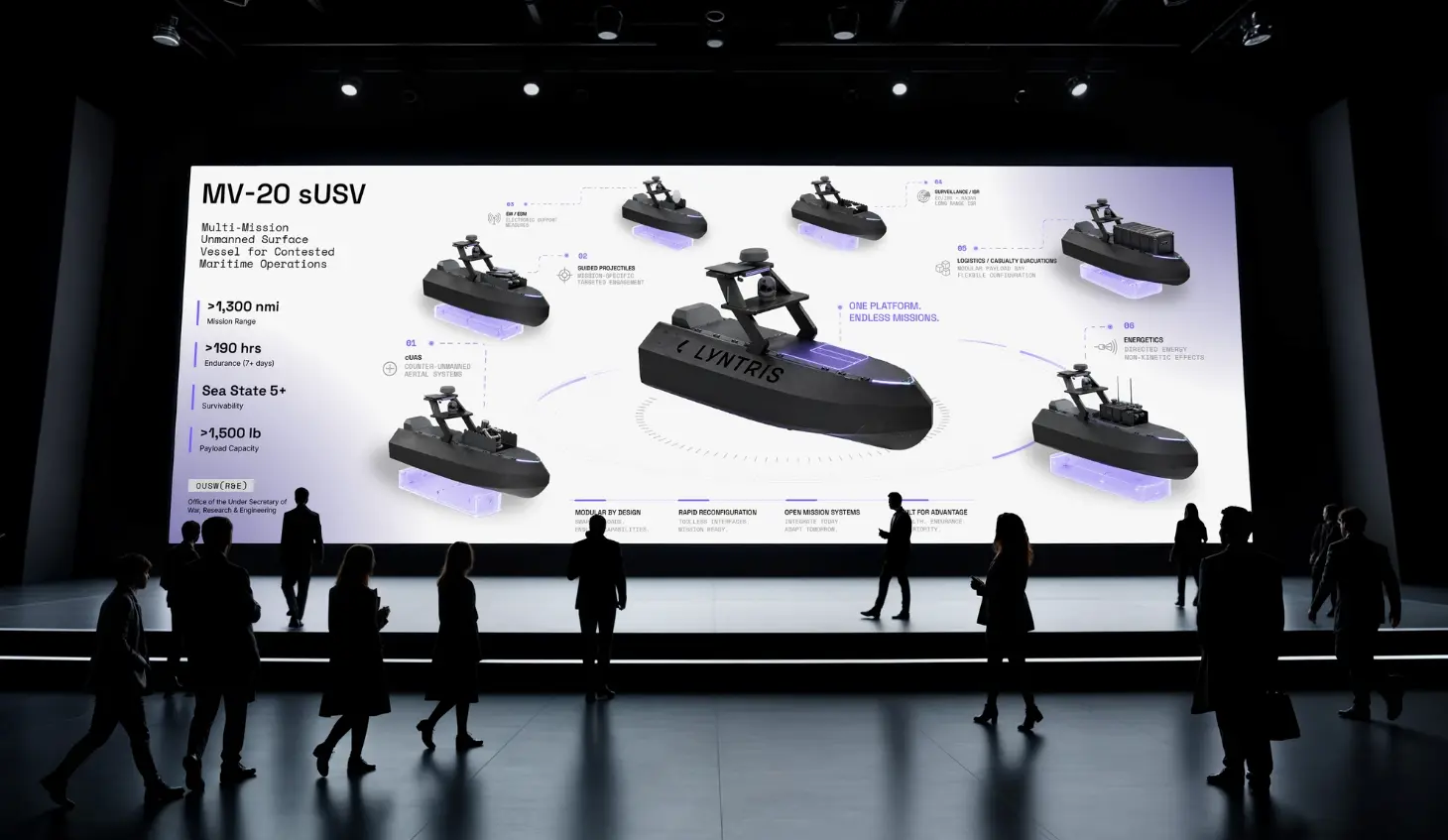
Four triggers do justify it, and almost every one involves a change in who you're selling to or what you're selling.
The first is a funding round or a move upmarket. Early brands are built to sell vision to investors. Then you start selling into enterprise procurement, and procurement buys credibility because their careers depend on not being wrong. The gap between the brand you raised on and the brand your buyer needs is a rebrand trigger, and if a round is coming, remember the brand is part of what's being priced.
The second is entering a new sector. Vocabulary that wins in commercial manufacturing loses in defense, and the reverse holds just as hard. We told an additive manufacturing client that mixing defense and commercial language was causing them to fail in both markets, and they saw it the moment we said it. Dual-use companies should budget higher than a standard deep tech firm for exactly this reason. You're resourcing two separate trust architectures.
The third is a merger or acquisition. Two companies, two claims, one confused buyer. M&A is one of the most common catalysts for compressed branding timelines we see, right alongside a product launch with a hard date. A launch waits for no one's creative review cycle. We delivered a full brand and website for a haptics company in about a month and a half because CES wasn't moving, and their OEM conversations started on time.
The fourth is a repositioning where the product changed and the story didn't. The sensor company. Any single-tool startup that quietly became a platform. Revenue looks fine, so nobody touches it, while every deal gets routed into the wrong buying process.
If one of those applies to you, that is when to bring in a B2B branding agency rather than a freelancer.
What Is the Difference Between a B2B Brand Refresh and a Full Rebrand?
Let me define the terms, because people use them interchangeably and then budget wrong.
A refresh keeps the name and the positioning. It updates the visual system and the messaging so the brand can carry the story it already has. Weeks, not months. When we moved Fello from purple and black to white, black, gray, and light blue, the positioning didn't change at all. The visual system grew up, immediate trust with prospects went up, and a completely different caliber of deal started walking in. I use that story with CFOs because it's the cleanest before-and-after I have.
A full rebrand revisits positioning, often the name, then rebuilds the identity and rolls it out. Months. When holo|one became Sphere, that was the whole shebang: a new name, a narrative rebuilt around collaboration and hard numbers instead of generic innovation, a new site, a promo video, and templates for everything down to the tradeshow booth.
Most companies that think they need a full rebrand actually need a refresh plus a positioning fix. And most companies that think they need a refresh have a positioning problem a new logo won't touch.
The way to tell is simple. Write the positioning first. One sentence: what the company is, who it's for, why it wins. Then look at your current identity and ask whether it can carry that sentence. If the name still fits and the visuals just need to grow up, refresh. If the name actively contradicts the sentence, the way sensor contradicted platform, you already know the answer.
What Are the Key Phases of a Successful B2B Tech Rebranding Process?
Roughly half of what you pay a B2B branding agency for is strategy and research. The visuals are the other half. Any agency that flips that ratio hands you a pretty brand nobody can repeat.
Immersion comes first, and it's the part clients try to shorten. We do a technical deep dive with the engineering team, and for industrial clients that means physically going to the plant in the first month. We interview customers and, more usefully, the buyers of the last five lost deals. Ask what the competitor said that landed. Ask what they told their boss about you. The answer is usually mortifying and always useful. We benchmark five direct competitors, talk to at least 10 power users, and listen to recorded sales calls and the email threads after them, which is exactly how the PDF pattern surfaced. If we can't explain your product to a stranger in 60 seconds after two weeks, immersion isn't finished.
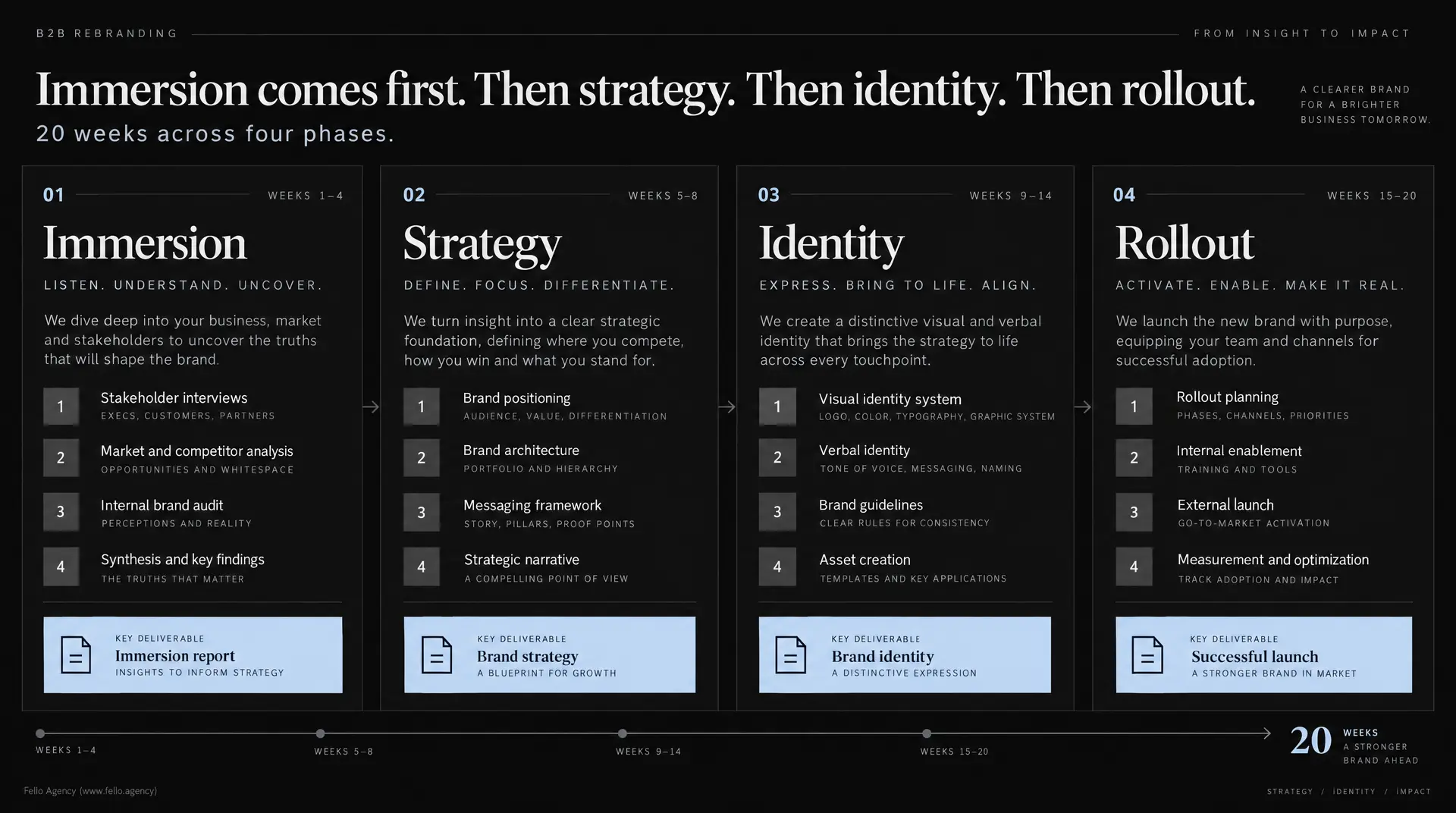
Then strategy. Category definition, brand platform, messaging architecture. This is where the one sentence gets written and tested against two gatekeepers. Sales confirms it's true in the market. Engineering confirms it's true about the product. Most positioning fails at one of them, either a marketing claim engineering rolls their eyes at or something technically precise that nobody outside the building can follow. The CEO signs off here, in person, because this is a leadership job. We also write a brand kill list, every legacy asset getting retired, so nothing lingers to confuse a buyer six months later.
Then identity. Visual language, logo, typography, guidelines. Typography does more work than anyone budgets for. One manufacturing and medical device client couldn't get their brand to land no matter what we tried, until we applied IBM Plex and the whole thing suddenly read as serious. Buyers spend very little time on a page, so type is the subconscious filter that clears you before the copy gets its chance.
Then rollout, which is where most rebrands fail. The agency ships a brand book and leaves. Six months later the website is half-migrated, the deck is still the old one, and the reps are back to sending PDFs. We sequence the homepage first because that's what a champion forwards to their committee, then the deck, then everything else. We also train the marketing team on the backend so nobody waits on a developer to change a headline. On our builds, a finished blog post goes live in about three minutes.
The biggest threat to a rollout usually sits inside the building. We watched a massive pharmaceutical company stall for two years on stakeholder feedback loops until the private equity firm behind it took the product offline. So during scoping we ask how many decision-makers are involved and use that headcount to forecast the timeline, and we charge penalty fees when revisions stall. It sounds harsh. It keeps the launch on the date.
Alexandra Corey, Head of Marketing at Sphere, put the payoff plainly: "The new website has more than tripled our lead generation efforts." That happens when the sales tools catch up to the brand instead of trailing it by a year.
That is the sequence we run at Fello and you can see how it works on our B2B branding process page. When your CFO's first question is about rebrand cost, give them the honest range: Series A and B deep tech companies usually land between $50,000 and $150,000, and pushing well past $100,000 starts to look like over-branding to a technical buyer. I never say the word rebrand in that meeting, by the way. I say communication strategy, I say marketing investment, and I put an inbound number next to the website line.
What Are Common Questions About Executing a B2B Tech Rebrand?
How Long Does a B2B Tech Company Brand Refresh and Full Rebrand Take to Execute?
A refresh runs in weeks. A full rebrand with strategy and naming runs in months. Our standard framework is 20 weeks across five phases, and the sensor company took one month of strategy plus one month of identity. Rollout runs alongside, never after, because a homepage shipping six months behind the brand book is how you end up at sign seven.
How Can a B2B Tech Company Prevent a Rebrand From Negatively Impacting SEO?
Not if it's handled properly. Any B2B branding agency worth hiring maps every URL, sets the 301 redirects, and updates the third-party listings buyers use to verify you, like G2 and Crunchbase. Then communicate the change as momentum rather than a reset. "We grew into what we already were" reads very differently to a buyer than "we're starting over," and we came out of our own rebrand owning our keyword.
Should a B2B Tech Company Execute a Rebrand Before or After a Funding Round?

Usually before, because the brand is part of what's being priced. The sensor company learned that the expensive way, with a deck that said platform and a website that said sensor costing them a slower round and a hardware valuation. If you're weighing when to rebrand against a raise, ask what the investor's browser tab is saying about you while they read the deck.
How Can Leadership Align Internal Teams and Stakeholders During a B2B Tech Rebrand?

Involve engineering in immersion from day one, so the positioning is theirs and every technical claim on the site has an engineer's sign-off behind it. Show the lost deal evidence, in the buyer's own words if you can get them on the phone. Then frame the rebrand as fixing a sales problem rather than a design preference. Your CFO will fund a shorter sales cycle. They will never fund a nicer logo.
Frequently Asked Questions
How does an outdated brand impact enterprise sales cycles?
It kills deals in the dark. McKinsey found 69% of buyers make purchases of $500,000+ completely remotely. If your brand looks risky, they don't call your rep for clarification. They quietly disqualify you and move to the competitor whose story felt safe enough to present to the CFO.
Does rebranding matter if our revenue is driven strictly by outbound sales?
Absolutely. Outbound gets you the initial attention, but buyers don't wait for your pitch. 6sense reports that 95% of B2B purchases go to vendors on the Day One shortlist. If your outbound email lands but your website contradicts the claim, they won't take the meeting. The brand sells the fit while sales is asleep.
How do we actually measure the ROI of a B2B tech rebrand?
Stop looking at website traffic and start looking at your CRM. The true ROI of a rebrand shows up in shorter sales cycles, higher win rates against legacy competitors, and reps sending actual links instead of PDFs. You measure it by tracking marketing-sourced pipeline and the speed at which enterprise deals move from discovery to close.
Can a rebrand help win over a large B2B buying committee?
It's the only way to scale your narrative. 6sense found B2B purchases involve 10+ people on average. Your rep meets maybe two. A sharp, established brand gives your champion the exact vocabulary and visual credibility needed to defend your technology to the other eight skeptics in the room.
Why is website design considered a commercial risk rather than just cosmetic?
Buyers subconsciously equate design with operational competence. A Stanford study found visual design is the most cited factor for web credibility, driving 46.1% of all judgments. If your site looks like a neglected startup, enterprise buyers assume your software is equally unstable. Design is a ruthless commercial gatekeeper.
Your Creative Partner for Innovation That Matters
From advanced tech to transformative healthcare, Fello helps visionary teams shape perception, launch products, and lead industries.

Let’s keep in touch.
Discover more about high-performance web design. Follow us on Linkedin and Instagram.

