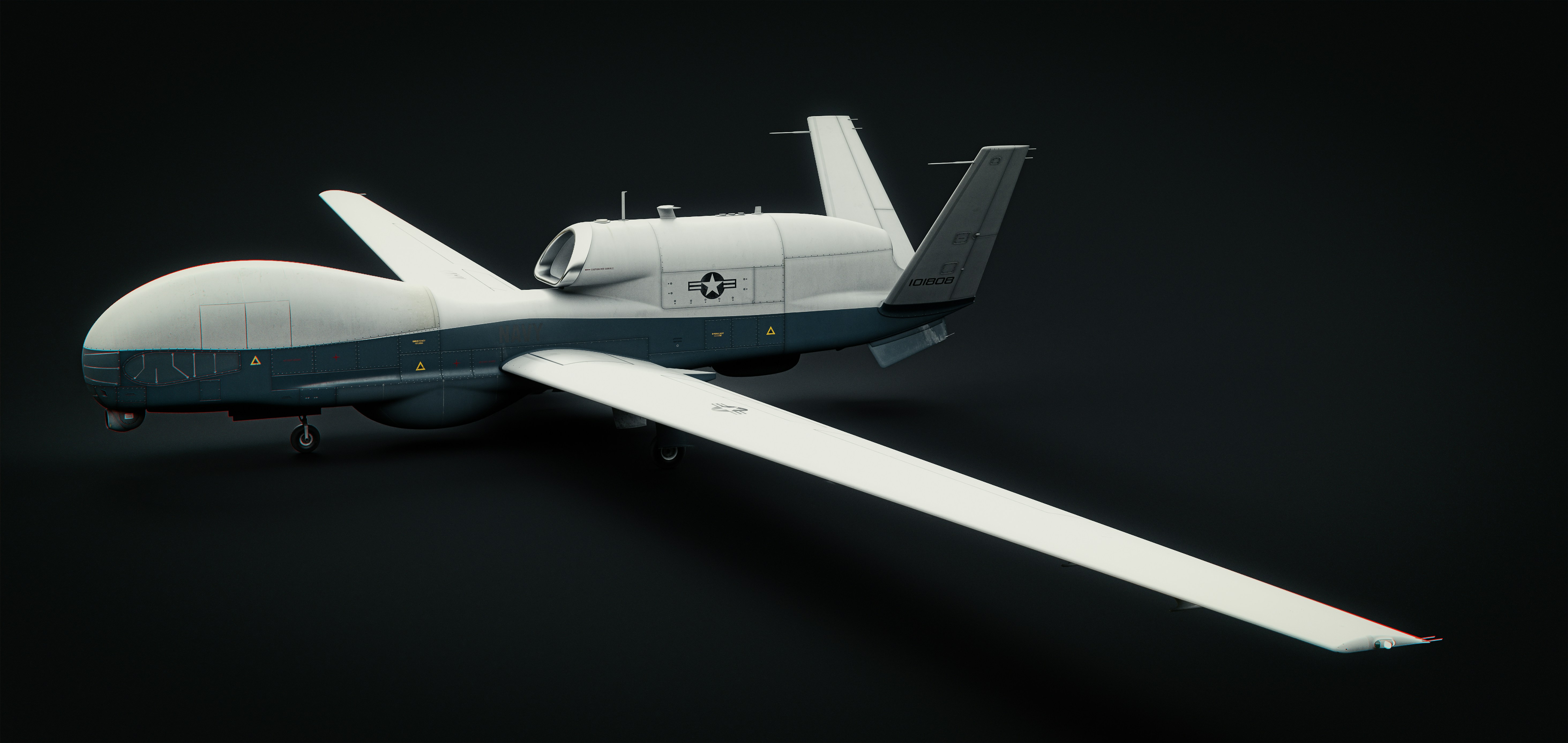


If you lead marketing, business development, or government relations at a military aircraft manufacturer, you already know the public is rarely the real audience. You are speaking to program managers, prime teams, congressional staffers, appropriators, allied buyers, and internal champions. Small room. Huge consequences.
That is why I take defense video so seriously. In my world, it sits much closer to procurement than to awareness. A strong video can shift an evaluator’s perspective, hold attention at a booth, and make a program stick in someone’s mind when 10 other decks are fighting for the same budget line.
I’ve spent nearly 10 years working across deep tech and defense, and a lot of the sharpest examples stay under NDA. Still, the pattern is clear. In 2026, visual trust is carrying more weight. If you can’t visually show the contract that you’re trying to land, you are not getting the contract.
Why 2026 feels different
Legacy reputation still helps. Relationships still matter. But they do not carry the whole load anymore.
The sector has shifted. Younger decision-makers are coming into the system. They grew up in a visual internet. They notice fidelity fast. They notice when a company feels modern, clear, and buttoned up. They also notice when something feels bloated, vague, or overproduced.
I keep pointing to Anduril because the market already got the message. When a disruptor hits $1 billion in 2024 revenue, everybody pays attention. I’ve also watched established defense players start copying the visual strategies of newer entrants once they saw the response. That tells you the market changed.
Speed matters more now too. A Deloitte example showed procurement timelines can move from years down to weeks when the system gets reworked. If acquisition can move faster, your content cycles need to as well. They want to move in months when they should be moving in weeks. I see that over and over.
For aircraft manufacturers, this matters because your programs live through political turnover, budget pressure, public scrutiny, and long sustainment horizons. You are not just selling a platform. You are keeping a platform legible and fundable over time.
Pick the job before you pick the camera
One mistake I see all the time is trying to make one hero film do every job. That usually ends badly.
At Fello, I keep coming back to six formats because they each solve a different problem. There is the program capability overview. There is the trade show reel. There is the congressional brief. There is pre-prototype CGI. There is field test documentation. And there is the white paper companion video.
Once you get honest about the decision you are trying to influence, the production plan gets a lot easier. Are you trying to help a prime understand integration? Are you trying to keep a Hill office focused on urgency? Are you trying to increase booth dwell time at a defense event? Are you trying to make an early system feel real before you can show full footage? Those are different jobs.
Program capability overview
This is the workhorse. It is usually a two- to four-minute unclassified overview of the system’s mission role, core features, and operational value. In a lot of cases, it is the first thing an evaluator watches.
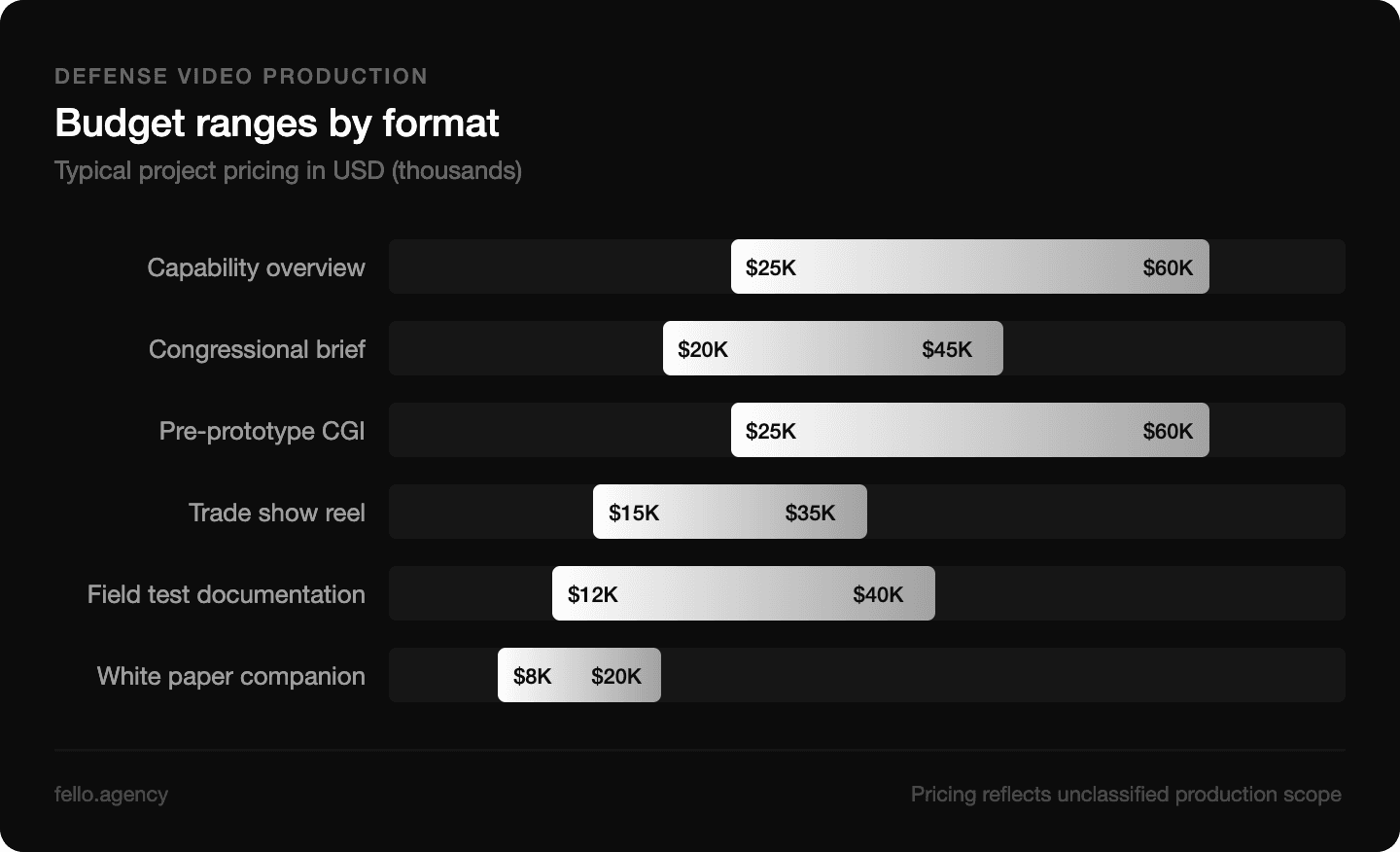
I use this format for business development, RFP support, and prime contractor briefings. The normal range is about $25,000 to $60,000 USD. For an aircraft manufacturer, this is where I want the room to understand the mission role fast. Then I layer in maturity, integration logic, and why the system belongs in the program of record.
The trap here is over-explaining. Technical teams love to front-load detail. I get it. But if your first minute feels like a spec dump, you are making the audience do translation work you should have already done.
Trade show reel
Trade show video is pure attention math. A lot of exhibitors put over 30% of their marketing budget into live events, and the average exhibitor spends about $1.4 million per year showing up. Then the attendee gives you about 3 seconds to make an impression. So the reel needs to do real work, fast.
I keep these in the 60 to 90-second range. No narration. All atmosphere. Optimize for attention. Big visuals. Strong motion. Minimal text. Easy to understand from 20 feet away.
Typical pricing lands around $15,000 to $35,000 USD. If your loop opens with a slow logo animation or tiny copy, you already lost the room. People will keep walking.
Congressional brief
This one is built for Hill staffers, appropriators, and other political stakeholders who need clarity quickly. These videos usually sit in the $20,000 to $45,000 USD range.
I keep them short. Under three minutes is usually the sweet spot. The goal is emotional anchoring. You want the system to feel urgent, legible, and tied to something bigger than engineering pride.
For aircraft manufacturers, that means force protection, readiness, allied support, and industrial-base strength. It also means timing. Why is this conversation important now? Put that statement right near the front. If you bury the stakes, the piece loses punch.
Emotion over specs matters here. The appendix can carry the detail. The video needs to carry the why.
Pre-prototype CGI animation
For classified programs, export-controlled systems, or anything you simply cannot film still, CGI is one of the most useful tools you have. It lets you show form, function, and operational environment without crossing the wrong line.
I’ve used this kind of approach for a confidential Canadian drone defense company that needed to secure funding early in the Ukraine-Russia conflict. They did not have a physical prototype ready to show. We built product renders and supporting visuals so the idea could be understood in a serious way. That work helped them get traction.
But CGI only works when it feels grounded. Defense buyers can spot bullshit a mile away. If it looks like vaporware, trust drops immediately.
That is why I usually pair high-fidelity 3D work with real-world proof. Cleared lab footage. Team presence. Manufacturing sequences. Sanitized interface shots. I also like the declassified aesthetic when it fits. Clean black and white. Dossier energy. Sometimes mono typography. In 2026, that controlled look often feels more credible than glossy sci-fi animation.
Field test documentation
Field test footage gives you the highest authenticity you can get. It also gives you the most logistics to manage.
A live shoot at a range, exercise, or demonstration event means coordinating with the facility, public affairs, escorts, and often security officers on set. Pricing usually runs from $12,000 to $40,000 USD, depending on scope.
When it is done right, this is powerful because it shows you are actually in the dirt doing the work. I am a big believer in what I call a found footage marketing strategy for this kind of asset. A shaky cam moment. A thermal clip. A rough edge that proves the test was real. Too much polish can look suspicious. A little grit can carry more trust than a perfect render.
White paper companion video

(Photo by Miguel A Amutio on Unsplash)
This is one of the most underrated assets in defense. It is usually a 90-second to two-minute explainer that sits beside a technical white paper, SBIR submission, STTR package, or deep brief. Pricing usually falls between $8,000 and $20,000 USD.
I like this format because it turns dense material into something people will actually circulate. Your internal champion can send it around. Your BD team can use it. A reviewer can understand the gist without digging through pages first.
It also helps with long-cycle selling. In a lot of cases, these pieces are quietly helping write future RFPs. That matters.
Compliance starts before scripting
Most of the cost gap between defense video and commercial video comes from the work behind the art. Security portals. Clearance coordination. Review cycles. Travel to controlled sites. Internal approvals. Those hidden multipliers are real.
That is why I usually scope defense video in a 10- to 16-week window. The first phase is discovery and OPSEC intake. I want the audience, the use case, the approval chain, and the show-versus-no-show boundary settled early. If security, legal, or program leadership arrive late, the schedule starts slipping for bad reasons.
What usually survives review? Publicly disclosed program names and mission roles. CGI representations of form and function. Sanitized dashboards and interfaces. Training environments. Simulations. Specs already in the public domain. Manufacturing and assembly footage. Cleared personnel who have consented to be on camera.
What gets blocked every time? Serial numbers. Tail numbers. Hull identifiers. GPS coordinates, including metadata baked into camera files. Operational tactics and engagement sequences. Specific frequencies and RF signatures. Facility layouts, perimeter security, access points, undisclosed performance data, and uncleared faces or badges.
I run a hard line on this. A cool shot is never worth the downstream pain.
For aircraft manufacturers, this becomes even more important because you are often managing multiple story layers at once. Public story. partner story. Government story. Export-controlled story. Sometimes the smartest move is to create separate cuts and host some of them in controlled environments. I would rather use a password-protected page than force everything into public view just because the internet makes that easy.
Build for three audiences, because they are not watching the same thing
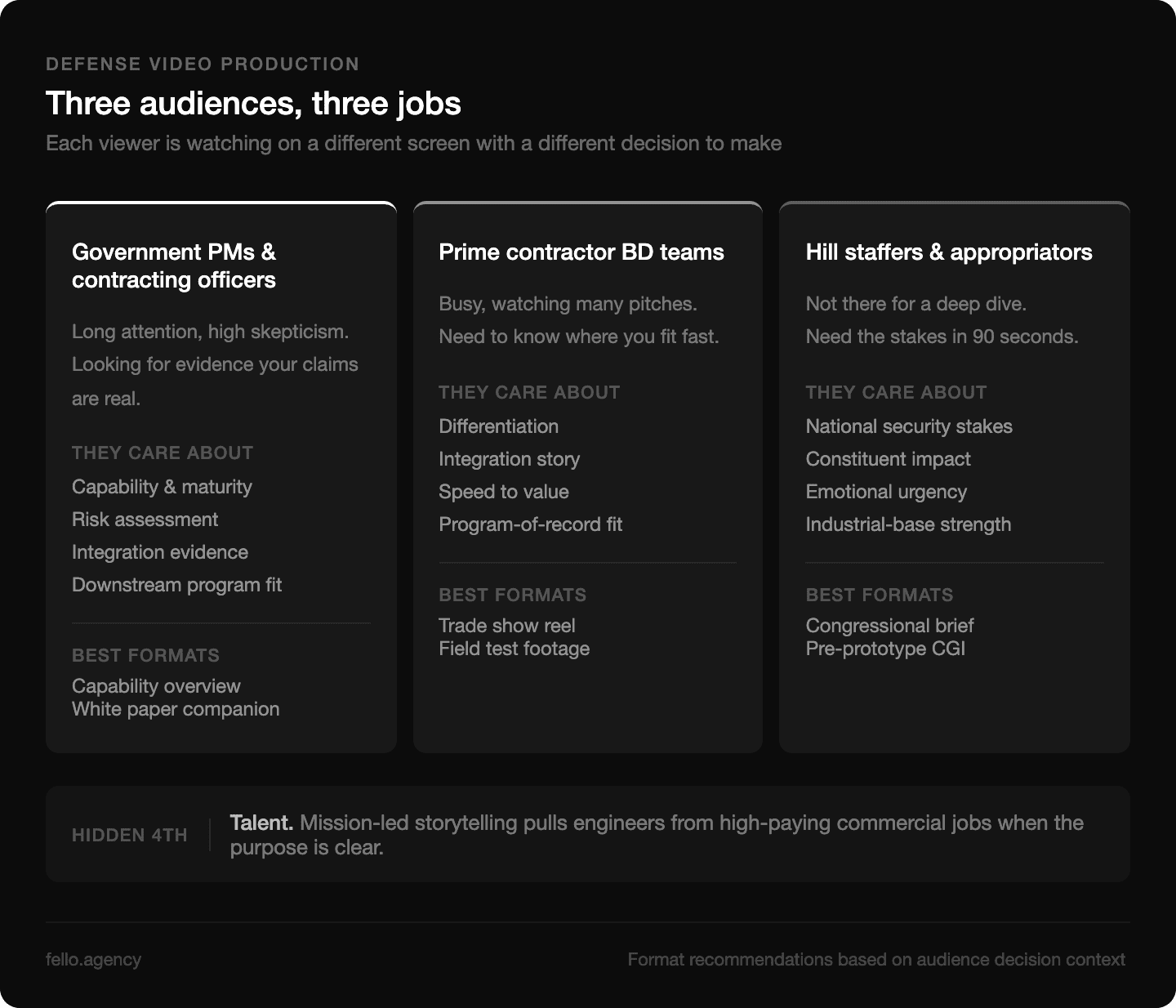
I keep telling clients the same thing. There are three real audiences here, and each one is watching on a different screen in a different context with a different decision to make.
The first group is government program managers and contracting officers. These people are looking at capability, maturity, and risk. Their attention span is long but skeptical. They want evidence that your claims are real. They want a sense of integration. They want to know you are not creating downstream pain for the program.
The second group is prime contractor business development teams. These teams are busy. They are watching a lot of content. Differentiation matters. Integration story matters. They need to know where you fit and how quickly you can create value.
The third group is congressional staffers and appropriators. They are not there for a deep dive on your technical stack. They need to understand why the system matters to national security and to their constituents. This is where I lean into the emotional narrative around service member safety and the speed of threat diffusion. If your system helps reduce exposure, improve readiness, or keep allied forces safer, say it clearly.
There is also a fourth audience sitting in the background. Talent. I have seen mission-led defense storytelling pull engineers away from very high-paying commercial jobs because the bigger purpose was clear. Keeping America and its allies safe is a serious recruiting message when it is real.
Lead with mission value, not engineering ego
One of the biggest mistakes technical teams make is focusing too hard on features and forgetting the benefit. I see this across deep tech. Defense is no different.
Your video should answer the room’s first question fast. Why does this matter? Why now? What changes if we fund this, integrate it, or field it? Your audience cares about the mission, the timeline, the risk, and the downstream outcome.
When I work on messaging, I always want to find out what pisses off your clients the most. In your world, that may be integration drag, sustainment burden, slow response time, crew exposure, or budget inefficiency. Start there. Show the pain. Then show the shift.
I am doing this right now with a US-based defense company on the CMS and messaging side. The move is away from pure technical specs and toward a broader mission story. The reason is simple. Your website needs to speak business, and your video needs to do the same. If you keep everything in technical talk, you make the company feel like a research problem instead of a serious business.
I also care a lot about authenticity. We worked with an ex-US Marine founder in drone defense, and the mission landed harder because it was tied to his real experience of losing comrades on the battlefield. That truth changes the room. You cannot fake that kind of weight.
And when proof exists, I want the story told from the customer’s side. Operator. Unit. Partner. Integrator. I ask about the frustrating times before the product showed up because that is where emotional resonance lives. People remember a before-and-after shift much better than another list of features.
Timeline, budget, and what happens after the first cut
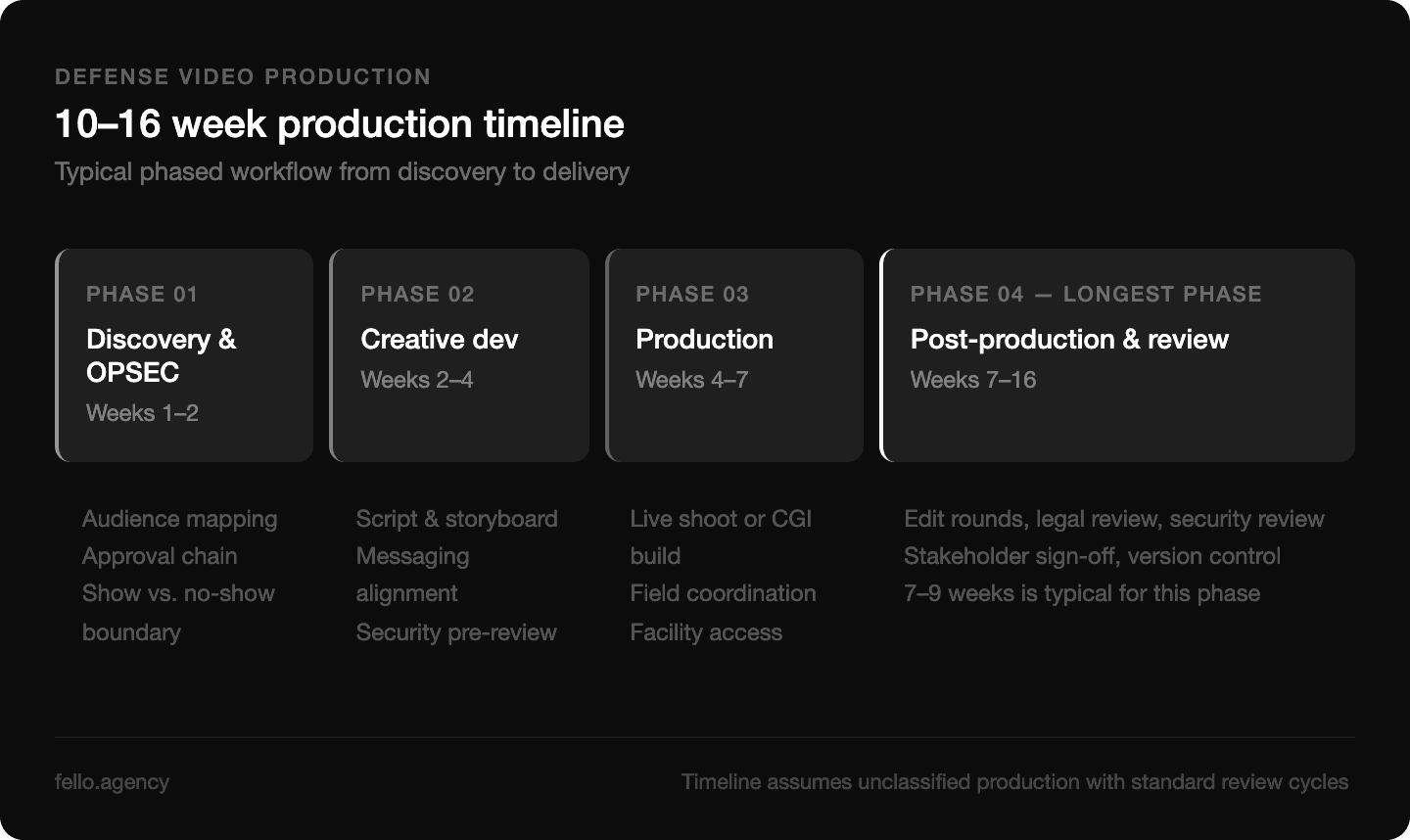
A realistic defense video timeline usually lands between 10 and 16 weeks. Discovery and OPSEC come first. Creative development can take two to four weeks. Production may be quick for a live shoot or longer for a CGI build. Post-production is usually the long pole, and seven to nine weeks is normal once edits, legal review, security review, and stakeholder comments start stacking.
Budget follows the format and the complexity. Capability overviews usually sit between $25,000 and $60,000 USD. Trade show reels land around $15,000 to $35,000. Congressional briefs usually range from $20,000 to $45,000. Field test documentation often falls between $12,000 and $40,000. White paper companion videos usually sit between $8,000 and $20,000. The spend is not just about cameras. It is the work that goes behind the art.
Once the asset is done, distribute it with intent. Put the capability overview into RFP support and prime briefings. Use the booth reel as a silent loop. Put the congressional cut on a controlled landing page if needed. Send monthly video updates and lab tours during long cycles so prospects feel like internal stakeholders, not outsiders waiting in the dark.
I also repurpose hard. One strong piece should feed decks, landing pages, short clips, PDFs, and follow-up emails. That is how you get bang for your buck.
LinkedIn, for me, has always been a verification tool. It helps prove you are real. It can point the right people toward the right page. But these deals still need human selling. Older demographics, long decision cycles, and sensitive buying environments all demand personal connection. You still need a driver behind the car.
Final thought
In 2026, defense video sits inside trust, compliance, and procurement all at once. For aircraft manufacturers, every frame has to carry weight. It has to help an evaluator understand the program. It has to help a staffer remember it. It has to help a prime believe you can integrate. It has to help your own team sell with more confidence.
Move fast. Stay clean on compliance. Lead with mission value. Dress for the client that you need.
Take this stuff seriously because your competitors will, and they will win the deal. This is the video and content side of what our B2G marketing agency builds for defense companies.
Frequently Asked Questions
Can defense video actually accelerate the slow government acquisition process?
Yes. Video cuts through bureaucratic text to establish operational clarity fast. U.S. Special Operations Command recently cut procurement timelines from years to weeks. High-fidelity, mission-focused visual assets align perfectly with this agile shift, helping skeptical evaluators reach consensus faster.
How do legacy aerospace primes use video to counter agile tech disruptors?
You stop acting like a slow institution. Disruptors like Anduril doubled revenue to $1 billion in 2024 by weaponizing modern visual storytelling. Legacy primes must adopt this aggressive, high-fidelity aesthetic, proving rapid software integration instead of resting on old reputations.
How do we leverage video for Foreign Military Sales (FMS) without violating ITAR?
You build a modular narrative. We create a master unclassified cut, then use high-fidelity CGI to swap out sensitive payloads or export-controlled specs for allied audiences. This lets you market the platform’s strategic value aggressively while keeping your OPSEC completely airtight.
What is the best visual strategy to justify funding during program cost overruns?
Shift the focus from the balance sheet directly to the warfighter. When facing intense congressional scrutiny, your video must unapologetically anchor the aircraft’s capability to national security stakes. Show the human cost of losing air superiority. Emotion always outlasts budget math.
How can visual assets sustain support for an aircraft program over a 30-year lifecycle?
By treating the aircraft as a living platform. Your visual cadence must constantly show modernization. Document rapid software pushes, new weapon integrations, and multi-domain interoperability. If you do not visually prove the airframe is adapting to tomorrow’s threats, appropriators will defund it.
Your Creative Partner for Innovation That Matters
From advanced tech to transformative healthcare, Fello helps visionary teams shape perception, launch products, and lead industries.

Let’s keep in touch.
Discover more about high-performance web design. Follow us on Linkedin and Instagram.

