

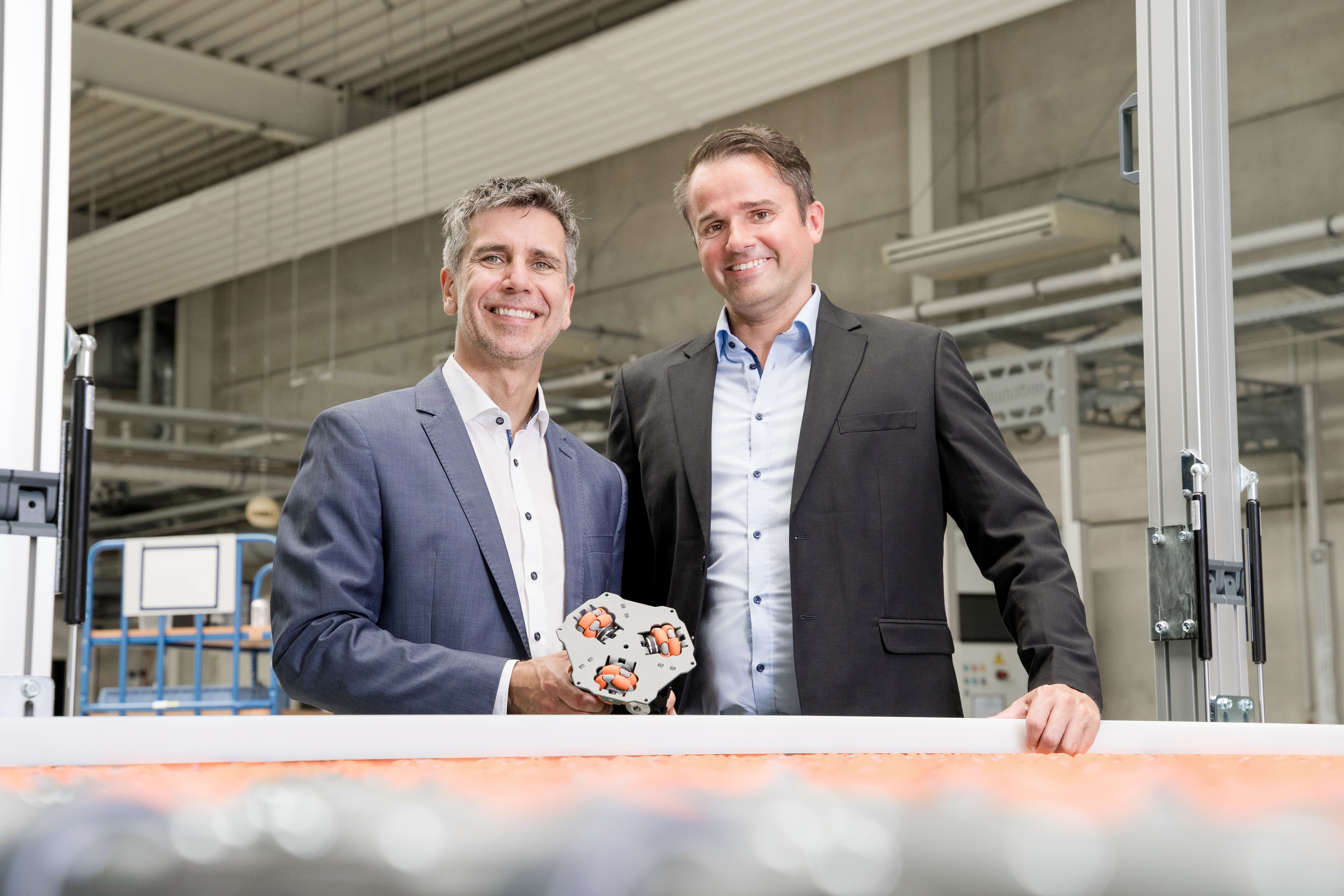
On Tuesday Symbotic announced it has acquired cellumation, a 70-person company in Bremen, Germany that makes the celluveyor. Terms were not disclosed. cellumation keeps its name, its Bremen headquarters and both co-founders, and Symbotic says it will keep selling the product to other integrators, including the ones Symbotic competes with.
Read Symbotic’s full announcement here.
If you haven’t seen the celluveyor, watch the 18-second clip on Symbotic’s LinkedIn post. A honeycomb of hexagonal cells replaces the conveyor belt. Each cell has three small omnidirectional wheels, each driven on its own. Spin them in different combinations and a box slides sideways, turns to face the right way, and pulls clear of the pile behind it. No belt, no pusher arm, no guide rail. The hardware never changes. Software decides what the floor does.

Cellumation says the smallest version takes 1.2 square metres and the system runs up to 10,000 parcels an hour. The company’s own claim is up to 95 percent less floor space than the conveyor it replaces. It started as a university spinout from BIBA in Bremen, won a DHL innovation award in 2016 and ran a pilot in a DHL warehouse, then got picked up by integrators like Daifuku, which built a robotic depalletizing cell around it. Nine years from lab bench to strategic exit.
Their video is that good. More on that below. But the deal sent my head somewhere else.
Nothing about this machine looks like a robot. It’s a floor. And a company sitting on $1.75 billion in cash just bought it.
Four robots, four shapes, zero bodies
Look at what is actually running in warehouses right now, at scale, with customers paying for it.
Locus Robotics builds a cart that follows a human picker around. It passed 6 billion picks in October 2025, runs at more than 150 brands across 350 sites, and the last billion took 24 weeks. It’s a cart with a screen. Nobody is making a movie about it.
Symbotic’s own system is a storage structure with small bots driving through it at speed. Seventy-seven systems in deployment, $22.5 billion in backlog, $720 million in revenue last quarter. It looks like a parking garage for boxes.
Fox Robotics, which Symbotic bought earlier this year, makes an autonomous forklift that unloads trailers. Walmart signed up for 19 of them across four distribution centres. It’s a forklift.
And now cellumation. A floor.

Four companies, four completely different shapes, and none of them resemble a person. Each one started from the job. What does a picker actually do all day? Walk. So build the thing that walks for them. What does a trailer need? Something that lifts pallets out of it. What does a parcel sorter need? A surface that can move boxes in any direction at once. The creativity went into the shape of the problem, not the shape of the operator.
The celluveyor is the purest example. cellumation’s founders were watching robot soccer, turned the robots upside down and moved the field on their wheels. That’s a weird idea. It’s also the reason a 70-person company in Bremen got acquired by a Nasdaq company this week.
The humanoid bet is real. It’s just a different bet
I’m not here to dunk on humanoids. The case for them is serious and I buy most of it.
The world is built for humans. Doors, stairs, shelves, truck beds, tool handles. A machine shaped like us can drop into all of it without rebuilding the building. And if the hardware and the models get good enough, one platform does every job a person does and then some, instead of one machine per task. That’s a huge prize and the money knows it. Humanoid startups raised $6.1 billion across 139 deals in 2025, four times the year before. Figure closed a round at $39 billion. Agility is going public at $2.5 billion with more than $300 million in Digit orders. BMW is moving Figure 03 into a real logistics job at Spartanburg after an eleven-month pilot. These are not toys.
But it’s a bet on generality. Generality is expensive, and it’s late. Look at who is doing the buying. GXO, one of the biggest contract logistics operators on earth, has run 45 humanoid pilots with five vendors. It expects close to 20,000 robots in its network by the end of 2026. Number of humanoids in production: zero. The CEO says ROI is about two years out and the blockers are hand dexterity and speed. DHL’s North American IT lead said the company has no humanoid pilot across 550 warehouses because it has not found a use case that helps a customer.
Even Tesla tells the story. Giga Texas is one of the most automated car plants on earth: giga presses, robot arms at every station, autonomous floor-cleaning robots running the aisles, and a four-storey Optimus factory going up on the same site. The X Takeover factory tours this past week walked people through the Model Y and Cybertruck lines and the early stages of Optimus manufacturing. Not Optimus building cars. Optimus being built. On the July earnings call Musk called it the hardest product Tesla has ever tried to scale, and the production lines were still being installed. Every car that rolled out of that building this week was made by machines that don’t look like a person.
That’s the point. It doesn’t have to be human. It has to do the job the best.
Why weird wins
There’s a commercial reason to get creative, not just an engineering one. The more unique the hardware, the more you can charge for it, the harder it is to copy, and the more a strategic will pay to own it.
Run the CFO test. A humanoid’s pitch is no retrofit: it works in the building you already have. The celluveyor’s pitch is 95 percent less floor space and no changeover time when the parcel mix changes. One of those shows up on a spreadsheet this quarter. Floor space in a parcel hub is money. Throughput per square metre is money. A warehouse manager can measure both before lunch. Nobody can measure what a humanoid will be able to do in 2028.

Then there’s the moat. A humanoid startup is competing with Tesla, Figure, Agility, Apptronik, 1X, Boston Dynamics and a dozen Chinese labs on roughly the same form factor, and the winner is probably decided by who has the best model and the most training data. That’s a brutal place to be a 70-person company. A hexagonal omnidirectional floor with a patent on the single-wheel control has no direct competitor. It’s not better at the thing everyone else does. It does a thing nobody else does.
Symbotic is now buying that kind of thing on purpose. Fox is a forklift. ARMS is orchestration software that decides where people and robots go. cellumation is a floor. Three standalone products in nine months, each one odd, each one sold to Symbotic’s own competitors as well as inside Symbotic’s system. Rick Cohen is assembling a shelf of strange, specific machines, not one general-purpose body. That’s the strongest signal in the deal: the people writing the biggest cheques in warehouse automation are paying for specificity.
The floor sold itself
Here’s the marketing part, and it matters more than it looks.
A humanoid gets attention for free. It looks like us. Every demo is a movie trailer. A floor does not get that. Nobody’s heart rate goes up for a conveyor. So how does a 70-person company in Bremen end up with a Nasdaq buyer and its clip on Interesting Engineering?
They showed the thing working. That’s it. That’s the whole strategy.

Go back to the clip. Top-down camera. Real boxes, real factory floor, cables visible. No voiceover. No render. No stock footage of a warehouse at golden hour. Eighteen seconds of parcels sliding, turning and spacing themselves out on a honeycomb. You understand the product before you understand the words for it. Their video is better than most companies with ten times the budget, because they figured out that their product demos itself and then got out of the way.
That’s the lesson for everyone building task-shaped hardware. Weird is a disadvantage on the first look and a massive advantage on the second. The first look, the buyer doesn’t know what they’re seeing. The second look, they can’t unsee it. Your job is to get them from one to two as fast as possible. Show it running. Show it from the angle that makes the mechanism obvious. Cut everything else.
Most hardware companies do the opposite. They hide a strange product under familiar language so it feels safe. Then the buyer files it next to the familiar thing and moves on. cellumation did the reverse. They leaned into the honeycomb, named it the celluveyor, and let the weirdness carry the pitch. Symbotic’s own release calls the product a game-changer and Cohen stapled “physical AI” to it, and fine, that’s what acquirers do. But the floor got bought before anyone put a label on it.
If you’re building it, get weird
I’d put it this way to any hardware founder right now.
The humanoid bet might pay off. If it does, it pays off huge, and it pays off for about three companies. You’re probably not one of them. That’s not an insult, it’s a count.
The other bet is open to everyone. Pick a job. Stare at it until you see the shape it actually wants. Then build that shape, even if it looks ridiculous. A cart that follows a person. A garage for boxes. A forklift with no driver. A floor made of wheels.
The unique ones are the ones that get bought. Rodney Brooks, who’s been building robots for 40 years, said last fall that the successful robots of the next 15 years will have wheels, multiple arms and specialized sensors. Flip the celluveyor over and that’s exactly what it is.
So lead with the job. Make the machine fit it. Then point a camera at the thing and let it run.
It doesn’t have to be human. It has to do the job the best.
Published in Fello Foundry by Fello
