Few Canadian founders have carried a harder bet for longer than Christian Weedbrook. Xanadu, the Toronto company he founded, is building quantum computers that run on light: photonic systems that, if they scale, could change how drug discovery, climate modelling and even AI are done.
When Xanadu went public, it was a validation of a decade of work that most people couldn't explain at a dinner party. We sat down with Christian to talk about the parts of the journey that don't make it into the headlines: the detours before the company, the decisions that looked strange from the outside, and how he picks the people who have to stay the course with him.
A path that didn't run in a straight line
Christian's route into quantum computing went through film school, early-morning shifts stocking shelves and a stint making heat packs. None of it looks like preparation for founding a quantum hardware company. He sees it differently.
"That path really taught me grit and resilience," he told us. What he took from those years was a question he kept returning to: why not me? In hindsight, he says, it's a big part of what entrepreneurship asks of you, a willingness to believe you can build something meaningful "even if your path isn't linear."
For founders who don't fit the expected profile, it's a useful reminder. Comfort with uncertainty isn't a soft skill in deep tech. It's the job.
Why Toronto, and why it matters
Toronto isn't Silicon Valley, and Christian doesn't think it should try to be. What the city gives Xanadu is a particular mix of ambition and talent.
"There's always been a sense that we have something to prove compared to places like San Francisco, and that drives people to build differently."
That chip on the shoulder is paired with something more practical: Toronto pulls in top researchers internationally, and in a discipline as narrow as quantum computing, that talent pool is decisive. For Christian, that combination is hard to find anywhere else.
The milestone that would make it worth it
Ask most people what quantum computing is for and you'll get a list: new drugs, better climate models, faster AI. Christian's answer is more specific. The moment that matters is when quantum becomes an industrial technology rather than a laboratory one.
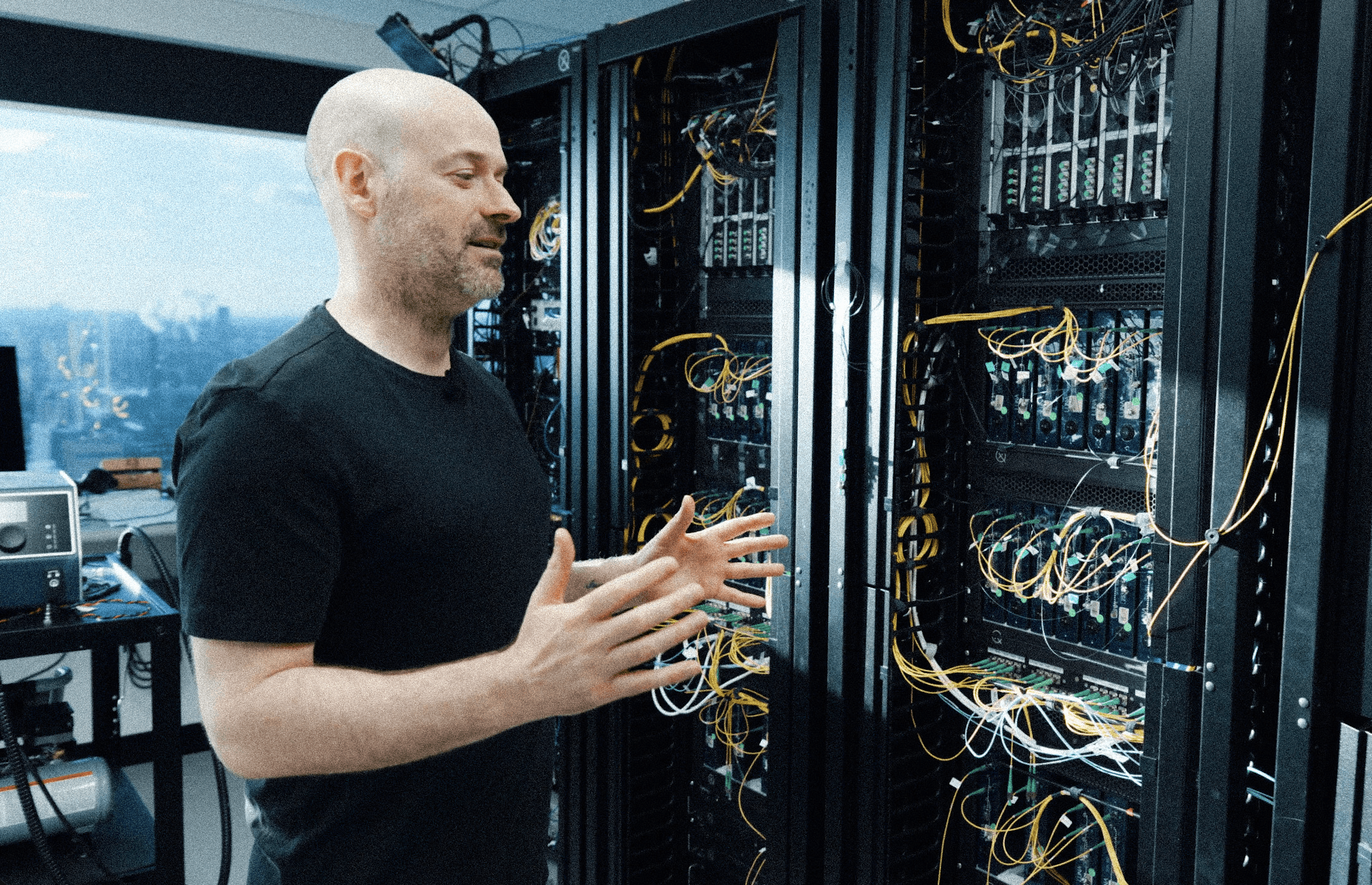
He pictures quantum machines installed in racks and operated at scale, the way data centres run today. Once that's solved, the applications follow. He compares it to the early internet, where the real impact came from what people built on top of the infrastructure, not from the infrastructure itself.
It's a telling way to frame a hard-tech company: not as a product, but as a platform others will build on.
Giving the software away
One of Xanadu's most notable decisions was making PennyLane, its quantum software framework, fully open source and hardware-agnostic. It runs across the industry, including on competitors' systems.
To an outsider that can look like giving away an advantage. Christian sees it as the fastest way to move the whole field forward. "Open-source is often where the best ideas come from, because you're not limiting who can contribute," he said. In a field this complex, he believes no single company can push the technology fast enough on its own. The aim was for PennyLane to be something the whole field builds on, rather than a tool tied to Xanadu's machines.
Going quiet on purpose
After launching Borealis and opening cloud access, Xanadu did something counterintuitive. While competitors raced to sign up users, it pulled back from public access and went heads down.
Christian describes it as a deliberate choice to build the right product for the long term instead of optimising for short-term attention. The focus now is the next generation of fault-tolerant systems, which is where he believes the real breakthroughs will come from.
It's a hard call for any company to make, and harder still for one that depends on investor patience. It also says a lot about how Xanadu thinks about time.
Where the problem is actually hardest
People tend to assume the main barrier to quantum computing is the science. Christian points to something less glamorous. "The hardest part is definitely the hardware, especially when it comes to fault tolerance."
Quantum hardware is easily disturbed, and producing dependable results again and again remains a central challenge. What gets underestimated, he says, is the sheer amount of engineering and systems integration needed to make it work at scale. Xanadu isn't building one new thing. It's building an entire computing stack from scratch.
Leading after the IPO
Going public brings a much larger audience and a new kind of accountability. Christian says it hasn't changed how the company is led. The approach that got Xanadu here is the one it will keep.
The team has grown to nearly 300 people, and he talks about them first. He sees public funding as a means to an end: a way to reach scalable quantum computing faster, while still enjoying the process of building something meaningful with people who care about it.
Who gets hired
In a company where results can take years, Christian looks for one thing above everything else: passion paired with a long-term mindset. Xanadu needs people who are driven by the purpose and at ease with work whose payoff may be years away. Curiosity, collaboration and a willingness to keep learning matter too.
And he's clear about the deal-breaker. However strong someone looks on paper, if they don't genuinely care about what Xanadu is building, it isn't the right fit.
What we took away
The Xanadu story is often told as a win for Toronto, and it is. But the more useful lesson for founders is in the decisions underneath it: staying in a city that doesn't always get the credit, giving away software to grow the field, going quiet when everyone else was going loud, and hiring for patience as much as brilliance.
Those choices don't show up on a stock ticker. They're the reason there is one.
This piece draws on our full conversation with Christian Weedbrook. Read the complete interview on the Fello blog.
Interview lightly edited for length and clarity.