


A lot of people in life sciences talk about pharma and biotech like they're basically the same thing. I don't see it that way.
Yes, both are scientific. Both are regulated. Both are expensive. Both need trust. But the marketing job is different. The buyer journey is different. The pressure points are different. And if you use the wrong playbook, you burn time, money, and credibility fast.
The trust problem is already sitting right in front of you. A Graphite Digital survey found 80% of HCPs do not trust pharma digital content. That number should bother every pharma marketing leader. Then look at the economics. Deloitte's 2024 analysis puts the average cost to take a drug from discovery to launch at about $2.284 billion, says the top 20 pharma companies spent $145.5 billion on R&D in 2023, and projects average peak sales per pipeline asset at only $362 million.
So when I talk about story, visuals, or digital experience, I'm not talking about fluff. I'm talking about commercialization.
At Fello Agency, we spend our time helping companies translate complex technology into something the market can understand and trust. We've done that in quantum, XR, industrial 3D printing, medtech, biotech, and advanced manufacturing. Different sectors, same lesson. Hard science does not excuse bad communication. If the market has to work too hard to understand you, you lose people who were already willing to listen.
Scientific buyers still need clarity
One mistake I see all the time is teams assuming scientific buyers want to start in the weeds.
They don't.
They want rigor, absolutely. They want proof. They want data they can trust. But they also want relevance fast. They want to know why this matters before they spend energy decoding it. If your first touchpoint feels like a regulatory appendix, you've made the experience heavier than it needs to be.
And these people are searching constantly. A JMIR study found 88.5% of HCPs search for medical information daily or several times a week. It also found 92.6% of physicians search for new clinical information at least weekly. That means your content is not being read in some perfect, patient, controlled setting. It's getting scanned between meetings, clinics, inboxes, and 20 other demands.
This is why I'm always saying your website needs to speak business. In life sciences, that means practical clinical meaning. Where does the therapy fit? Why should this HCP care right now? What problem gets easier to solve? What changes in the treatment decision? You can go deep right after that. You should go deep. But you need to orient people first.
I've said this for years in deep tech. Too many companies lead with features instead of benefit. Life sciences teams do the same thing when they lead with dense mechanism language before the audience understands the payoff. You don't need to dumb anything down. You need to sequence it better.
Biotech sells the science before the product
Here's the cleanest way I can put it.
Biotech sells the science before the product. Pharma markets the outcome.
That one line explains a lot.
In biotech, the product often isn't fully here still. You're selling the mechanism, the platform, the future state, the pipeline, the credibility of the science, and the people behind it. I say this to clients all the time: you're marketing a pipeline, not a pill. That changes the whole content strategy. The buyer journey starts with education, not emotion. A lot of biotech marketing looks much more like academic publishing than consumer advertising.
Pharma usually has something more tangible to commercialize. There's an approved product. There's an outcome. There is a behavior you need to change in the market. The job is getting physicians, patients, and systems to adopt, trust, and use that therapy. Pharma optimizes for prescription behavior. Biotech optimizes for belief.
That doesn't mean pharma can ignore education. Far from it. If you're launching a first-in-class therapy, a novel mechanism, or anything that needs real scientific orientation, part of your job starts looking a lot more like biotech. You have to build understanding before you can drive adoption. A lot of pharma teams miss that and go too hard on p-values before the audience is anchored in why the mechanism matters.
You can feel the difference in the way the story is built. Biotech is often saying, "Here is what this science could unlock." Pharma is saying, "Here is what this therapy can do now, and here is why it belongs in care."
Both need truth. Both need proof. But the order is different.
Pharma and biotech answer to different masters
There's another major split here.
Pharma usually serves two main masters in its marketing. Patients and physicians. Biotech often serves three. Patients, physicians, and capital markets. Every biotech company campaign is simultaneously an IR exercise.
That's not a throwaway line. It matters.
A phase announcement, a disease-awareness asset, a mechanism video, a founder interview, a scientific poster recap, all of it is doing double duty. The physician may be reading it for scientific seriousness. The investor is reading it for momentum. A potential partner is reading it for platform value. A recruit is reading it for credibility. One asset is carrying all that weight.
That's why I say pharma has brand loyalty and biotech has investor loyalty. The center of gravity is different.
For a pharma leader, this still matters. Why? Because certain pharma launches start acting like biotech whether the team admits it or not. If the science is new, if the mechanism needs a lot of explaining, if the market is skeptical, if the product is early in its lifecycle, you're in belief-building mode too. You may have a commercial asset, but part of your content still needs to create confidence before it creates scripts.
Compliance changes the creative room
This is where people love to shrug and say, "Well, pharma is regulated."
Of course it is. But that doesn't end the conversation.
I look at it this way: regulatory asymmetry creates creative asymmetry. Pharma creative is boxed in hard by fair balance requirements, approved claims, disclosure language, and MLR review. Biotech, especially pre-approval, often operates in a gray zone where disease awareness and unbranded campaigns give you more room to tell a bigger story.
That's real. But compliance is not a free pass for blandness.
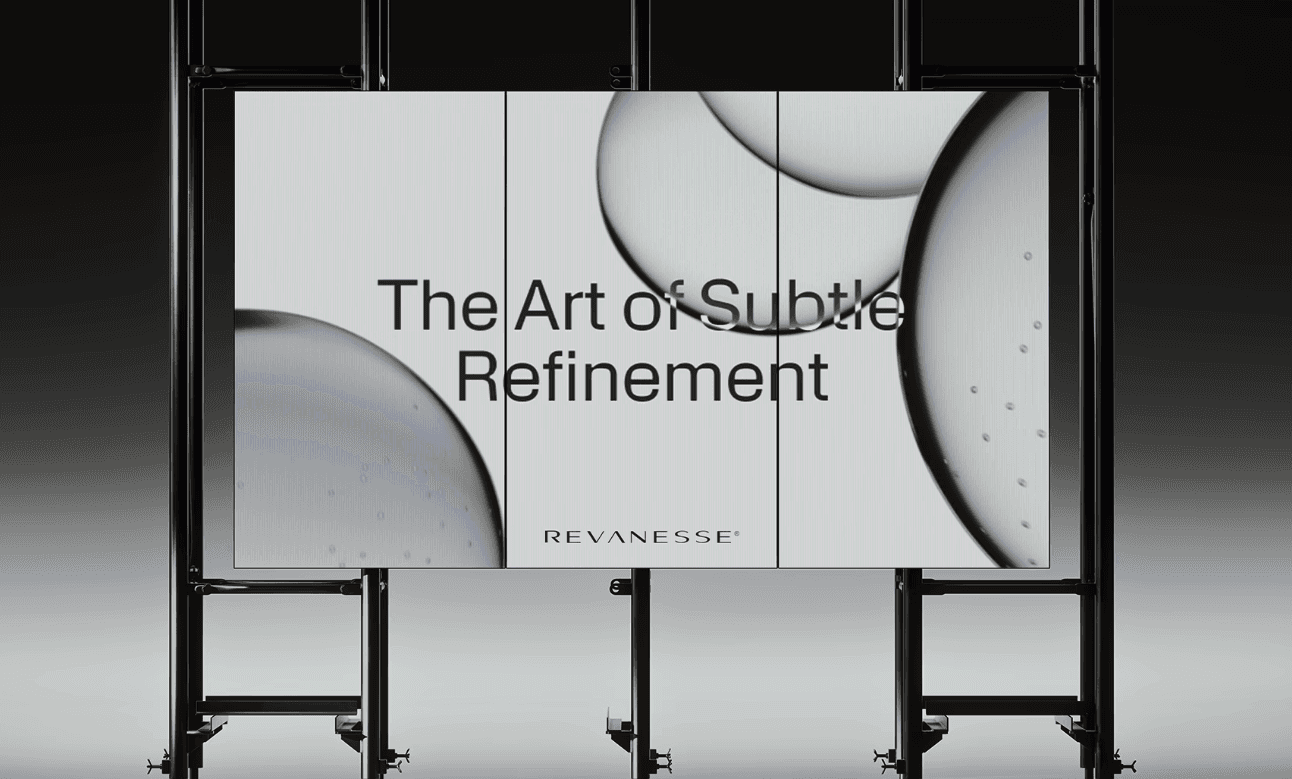
At Fello, we learned a lot about the FDA line while working with one of the largest medical device manufacturers in North America. On the Revanesse brand with Prollenium, the job was to move the brand away from beauty language and toward science-backed medical device credibility. We used custom CGI, macro photography, and a tighter visual system built around clinical seriousness. Kaitlin Daley, Prollenium's CMO, put it simply: "Fello delivered smart, strategic creative that elevated our brand."
That's the point. Science-first branding can survive compliance review when it's built on technical fluency and real evidence.

Too many pharma teams assume anything memorable will get destroyed in MLR, so they start with weak creative before the review even begins. That's a mistake. If you send generic work into review, you usually get more generic work back. And in a crowded therapeutic area, generic is expensive.
The fastest way to lose trust in either world is still the same. Oversell and under deliver. That kills credibility fast.
Scale changes everything
Pharma also scales horizontally. Biotech scales vertically.
That difference changes almost every marketing decision you make.
A pharma brand may run across broad markets, large HCP groups, multiple geographies, and big field teams. The system has to be consistent. The message has to travel well. You need a machine that can move across channels and territories without losing itself.
Biotech often lives in a much tighter universe. That can mean a tiny specialist community, a very narrow investigator pool, or a rare disease audience where every touchpoint feels almost one-to-one. In the U.S., a rare disease affects fewer than 200,000 people. There are 5,000 to 8,000 rare diseases worldwide. So yes, some programs are speaking into very small, very specialized circles.
You cannot use a broad-market engine the same way in that environment. You waste money and you dilute the message.
I'm big on segmenting the story when the audience shifts. We did that with Sphere by building distinct pages for different industries so the message spoke directly to factories, medical tech, and defense buyers. Same platform. Different proof. Different pain points. Clearer path. That discipline matters in life sciences too. Medical affairs, commercial, patients, partners, and investors do not all need the same story told the same way.
Trust comes from different places
Trust is built differently in pharma and biotech.
The biotech brand is founder. Pharma brands are institutional.
Nobody cares who runs Pfizer's oncology division the same way they care about a biotech founder, a Chief Scientific Officer, or the scientist tied to the mechanism. In biotech, the founder's credibility, publication history, and public presence can be inseparable from the brand. That can be a huge strength. It can also become a serious liability when leadership missteps. I often point to MindMed as a cautionary example. The founder's mistakes hit the company hard, the stock got hurt, and the whole brand fell into a state of shock.
Pharma carries trust differently. The institution, the evidence package, the medical organization, the field force, and the brand system do more of the heavy lifting. That gives pharma a different kind of stability. But it can also make the communication feel cold if the team isn't careful.
You see the same split with KOLs. In pharma, KOLs often validate an existing product story. In biotech, they can help shape the narrative itself. Sometimes the person closest to the discovery is effectively a co-author of the brand story. That means the line between endorser and architect gets blurry.
If I were leading a pharma launch with a novel mechanism, I'd bring scientific voices in earlier. Don't wait until the message is frozen and then ask for a stamp of approval. Let the right people shape the educational structure from the start.
Visual trust is part of the science
A lot of life sciences teams still believe the data should do all the work and the aesthetic barely matters. I don't buy that for a second.
Branding is the act of authenticating what you claim. A lot of companies believe in their science. They haven't authenticated that belief professionally. That gap is where trust starts leaking.
I've seen this directly with medical and healthcare brands. In one medical aesthetics engagement, we managed a visual identity overhaul of roughly $100,000 because the company's superior engineering was being overlooked. The issue wasn't the quality of the product. The issue was the trust gap around it. The market wasn't reading the company as serious enough, even though the science was there.
That happens more than people admit.
If your visual system is inconsistent, if the hierarchy is weak, if the typography feels off, if the animation looks fake, if the website looks like it's 2009 trying to sell really impressive materials, people feel that. They may not say it out loud. They still feel it. And if it looks like bullshit, no one's gonna want to work with it.
That is especially dangerous in a category where trust is already fragile. If HCPs already distrust pharma digital content, every bad visual cue makes the problem worse.
I'm not arguing for empty polish. Too much polish can look fake too. Technical audiences smell that quickly. The sweet spot is professional, clear, and grounded. Cinematic, but clearly real.
Digital assets now carry more of the sale
Diminishing HCP access means your digital assets have to do more work than they used to.
That's one of the biggest shifts in life sciences marketing right now. If the rep gets less time, your website, MOA content, HCP portal, interactive aid, and approved video need to pull far more weight. They can't just sit there looking compliant. They need to teach.
MOA visualization matters more than most teams think
This is exactly why I care so much about MOA visualization.
When the science is invisible, the visual is not decoration. It is the explanation. Good CGI and technical animation can make a biological process feel understandable in seconds. That matters when a clinician is moving fast. It matters even more when rep access is limited.
And there's real support for this. In medical education research, 8 of 10 studies showed better learning outcomes with animations than static content.
This is a huge opportunity for pharma and biotech teams. You don't need more generic talking-head videos. You need visual assets that make the mechanism tangible, credible, and useful.
At Fello, we built our name translating extremely hard stories. We helped Nord Quantique turn dense quantum concepts into a clearer visual narrative and saw website traffic jump 80% in six weeks. We helped Mosaic Manufacturing reframe a highly technical product around real operator value, and inbound leads jumped 25% while booked meetings rose 15% within two months. If we can explain quantum error correction to investors, we can explain biologics to doctors.
That's not me being cute. It's the same job. Make the hard thing easier to trust.
Ease of use is a trust signal
The other part people miss is usability.
A JMIR survey found 75.6% said ease of use is one reason they frequently use medical websites and apps. That should hit home for every team building HCP content. If the portal is clunky, the tool is slow, or the navigation makes people hunt for what matters, you are actively pushing them away.
I care a lot about this because I've seen how strong digital experience changes behavior in complex markets. For Sphere, our overhaul of the website and digital experience helped more than triple lead generation. Alexandra Corey, their Head of Marketing, said exactly that: "The new website has more than tripled our lead generation efforts."
Different industry. Same principle. When the experience is clear, fast, and useful, the platform starts doing real commercial work.
The same goes for video content that sales and marketing can actually use. When we worked with ACTO, Wafa Sayeed-Irtiza, their VP of Marketing, told us both teams "couldn't wait to start circulating the videos." That's the standard. The asset should be ready to move through the organization, not sit in a folder because it's too vague or too polished to help.
And let me say one more thing here. Video is powerful. It still does not replace good copy. You need both. Search, structure, and clarity still depend on strong writing. You also need systems your team can manage quickly once content is approved. If your organization finally gets through review and then needs a developer for every basic update, you've created an operational bottleneck for no reason.
Patient stories do different jobs
Patient stories also behave differently in pharma and biotech.
In pharma, they often sit lower in the funnel. They humanize the outcome. They help the physician or patient connect the data to real life. They create emotional relevance around an approved therapy.
In biotech, patient stories can do much more than that. They can help draw regulatory attention, support the case for accelerated pathways, and pressure payers. They become policy tools disguised as content marketing.
That's a very different job.
When I talk about humanizing the data, I'm not talking about stock footage and sad piano. I'm talking about showing the actual care ecosystem. For a home healthcare project, we created a visual narrative around nurses managing medication through tablets, family members checking vitals remotely, and AI alerts helping guide preventative care. We weren't just showing product features. We were showing how the whole system of care feels when it works.
That's what strong life sciences storytelling should do. It should connect the science to a lived reality.
What I would tell a pharma CMO right now

(Photo by Louis Reed on Unsplash)
If you lead pharma marketing, the first thing I'd push you on is sequencing.
Stop assuming more science up front automatically means more credibility. Start with orientation. Show why the therapy matters in practice. Then explain the mechanism. Then let the data prove it. You still need the depth. You just need to stop making the audience dig for the point.
I'd also push you to find out what pisses off your audience the most. Usually it's not "too much emotion." Usually it's clunky access, generic content, vague relevance, and digital experiences that feel built for internal review instead of real use.
Next, I'd segment harder. One message for everyone is lazy. If your medical team, brand team, field team, and HCP audience all need different proof, build for that reality. We do this all the time in deep tech because one broad story usually waters itself down. The same discipline belongs in life sciences.
I'd get very serious about visual trust too. If you're asking the market for attention, prescribing confidence, partnership interest, or premium positioning, you need to dress for the client that you need. This is not vanity. This is risk mitigation. If you can't get internal buy-in for that language, stop calling it branding and start calling it communication strategy and marketing investment. That usually lands better in the boardroom.
I'd also put real pressure on the digital layer. Your HCP tools should feel useful on demand. Your MOA assets should teach fast. Your portals should be simple. Your content should be easy to find and easy to understand. If it takes forever to update approved content, fix the system. Speed after approval still matters.
Then I'd look at alignment. At Fello, our research process starts by talking to customers first, then sales, then marketing, then leadership. I like that order because the market usually tells you where confusion lives faster than the boardroom does. In pharma, internal misalignment is expensive. The medical story, the commercial story, and the field story need to feel connected.
And finally, I would move faster where you actually can. I've seen companies stall themselves out with endless workshops, too many revisions, and months of strategy loops. You already have enough friction in regulated marketing. You do not need extra indecision on top of it. Be obsessed with getting the right story into market.
None of this means replacing human relationships with software. Human selling still matters. KOL trust still matters. Peer influence still matters. AI can help research. It can speed up process. It can support the team. You still need a driver behind the car.
Final thought
Pharma and biotech share science, but they do not share the exact same marketing job.
Pharma is usually driving adoption around something real and approved. Biotech is often building belief around science that is still becoming real. Pharma markets the outcome. Biotech sells the mechanism and the future. Pharma scales broadly. Biotech often goes deep into very small circles. Pharma leans on institutional trust. Biotech leans hard on founder and scientific credibility.
If you understand those differences, your strategy gets sharper fast.
And if you're in pharma launching something novel, pay attention. Parts of your job will start looking a lot more like biotech. That means stronger education, better mechanism storytelling, tighter visual trust, and digital assets that can carry more weight on their own.
At the end of the day, the goal is simple. Build trust. Make the science easier to understand. Move the market.
That's how you turn a brilliant therapy into a real commercial story.
Frequently Asked Questions
Why do traditional pharma launch playbooks fail for first-in-class therapies?
They assume the market already understands the underlying science. If you're launching a novel mechanism, you're essentially doing a biotech marketing job. You can't just push p-values and outcomes. You have to build belief and orient the HCP first, or your massive launch budget is completely wasted.
What is the most effective digital strategy to combat diminishing HCP access?
Stop making clinicians hunt for relevance. With reps getting less time, your digital assets must act as the explanation. Research shows 75.6% of HCPs prioritize ease of use. If your portal is a clunky regulatory maze, busy physicians will bounce. Speed, clarity, and utility win.
How can marketing leaders prove ROI when shifting spend from field sales to digital?
Stop measuring digital like a billboard. Measure it as clinical utility. Deloitte projects pipeline assets average only $362 million in peak sales. To protect margins, digital must prove it accelerates prescribing confidence better than an isolated field force by tracking engagement depth and CRM integration.
How should messaging shift when a drug is nearing its patent cliff in a crowded market?
You stop competing purely on the clinical profile and start competing on the care ecosystem. Everyone has data. You need to market the friction you remove. Highlight patient support programs, seamless access, and institutional reliability. When science gets commoditized, the operational experience becomes your primary commercial differentiator.
What is the most reliable way to rebuild HCP trust in digital campaigns?
Authenticate claims visually and structurally. Data shows 80% of HCPs distrust pharma digital content. You fix that by killing the fluff. Use rigorous MOA animations, clear hierarchies, and front-load practical clinical meaning. When your digital experience respects an HCP's time, trust naturally follows.
Your Creative Partner for Innovation That Matters
From advanced tech to transformative healthcare, Fello helps visionary teams shape perception, launch products, and lead industries.


Let’s keep in touch.
Discover more about high-performance web design. Follow us on Linkedin and Instagram.

