


I want to start with an acknowledgment.
There is a long-running joke in the business world about executives who compare their projects to military operations. The consulting firm that calls their strategy sessions a "war room." The startup that describes their product launch as "mission critical." The agency founder who reads a book about Cold War aerospace engineering and immediately sees his own reflection in it.
I am aware that I am about to be that guy.
It's the story of Lockheed's legendary Advanced Development Programs division, a secretive unit that during the Cold War produced some of the most consequential aircraft ever built. The U-2. The SR-71 Blackbird. The F-117 Nighthawk. Technologies so advanced they still feel like science fiction decades later. It's the same DNA you see in modern defense-tech companies like Lyntris, who are building the next generation of autonomous maritime systems. You can pick up the book here.
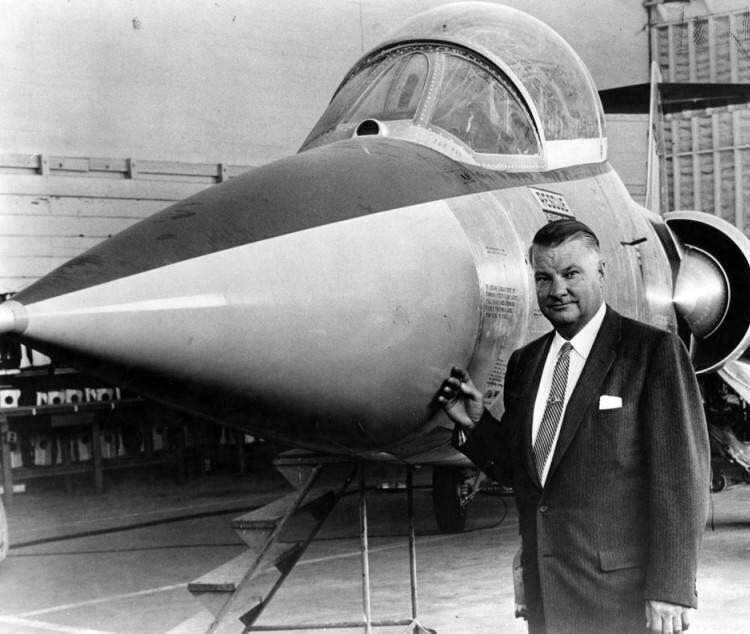
Image: Los Angeles Public Library
The man behind it all was Clarence "Kelly" Johnson: aeronautical engineer, systems thinker, and one of the most effective team leaders in the history of American industry. He designed over 40 aircraft in a 50-year career at Lockheed. He built a unit that operated at a fraction of the size of conventional programs and consistently outran, outbuilt, and out-thought everyone else in the room.
What made Kelly special wasn't just his technical genius. It was his operating philosophy. He ran Skunk Works by 14 rules, a set of management commandments that defined how his teams were structured, how decisions were made, how money was spent, and how work got done.
I've been in marketing for nearly a decade now. Fello has worked with some of the most ambitious companies in the world. We've worked with startups fighting to get off the ground and enterprise teams trying to move like they're still a startup.
Reading Kelly's rules, I kept stopping and thinking: I've lived this. Not in classified hangars at Burbank, obviously. But in client calls, creative sprints, late-night handoffs, and every high-stakes launch we've ever run. His philosophy maps almost perfectly onto what separates the marketing projects that actually win from the ones that slowly die in a chain of approval emails.
Here's what Kelly's rules mean to me, and what I've learned running Fello for the last 10 years. These rules are addressed in chapter 2 of the book and hit me like a train.
1. Own the Program
"The Skunk Works manager must be delegated practically complete control of his program in all aspects. He should report to a division president or higher."
The projects that move fastest are almost always the ones where we have direct access to someone with real authority.
When a founder or CMO is genuinely engaged, decisions happen quickly. Feedback is substantive. We understand the business context behind every creative choice and our work is better for it.
But I want to be careful here, because this rule can be used as a convenient excuse and I've seen agencies do exactly that. Not every CEO has time to sit in on creative reviews. Not every enterprise client can restructure their internal approvals just because an agency prefers it that way. If a project goes sideways and the agency's first response is "well, we didn't have C-suite access," that's deflection, not analysis.
The real lesson isn't that clients need to reorganize around us. It's that we need to be honest during scoping about what kind of access genuinely changes outcomes, make a clear case for why, and then own the result regardless. Leadership access helps. It's not a liability waiver.
2. Keep Both Sides Lean
"Strong but small project offices must be provided both by the military and industry."
Kelly's point was that both sides of the engagement need to be lean and empowered. We coach clients on this because we've seen what happens when they aren't.
Twelve stakeholders in a feedback thread produces twelve opinions that partially contradict each other, and whoever is most senior wins regardless of whether they're right. We've been in that situation. It produces mediocre work and it's partially on us when it happens, because we should have structured the engagement better from the start.
A strong client-side lead, one or two people with real context and real authority, is one of the biggest predictors of a good outcome. We've gotten better at having that conversation upfront instead of discovering the absence of it three weeks into a project.
3. Small Teams Win
"The number of people having any connection with the project must be restricted in an almost vicious manner. Use a small number of good people (10% to 25% compared to the so-called normal systems)."
Some of our best work has come from the leanest teams. Tight crew, clear mission, everyone actually doing something. The thinking is faster and the decisions stick.
Fello is built this way. Around ten core people. No account management layer between you and the people doing the work. When we need a specialist, we bring one in for that purpose and the team stays lean.
Here's what I'll also say honestly: running lean is hard to sustain. The same quality that makes a small team exceptional, the fact that every person carries real weight, is also what makes it exhausting if you're not careful. We've had stretches at Fello where the intensity was too high for too long and people paid for it. Kelly's rules say nothing about recovery time, and that's a gap worth naming.
Small teams work. They also need breathing room or eventually the performance you're rewarding starts to erode.
4. Build for Change
"A very simple drawing and drawing release system with great flexibility for making changes must be provided."
Your process needs to move when the work demands it.
We scope everything. Timelines, deliverables, milestones, dependencies. But what separates a functional agency from a rigid one is what happens when reality doesn't match the plan, because it never fully does.
Scope shifts. Launches get pulled forward. Founders change positioning after a key investor conversation. We build contingency in because the plan is a starting point, not a contract with the universe. The teams I've seen struggle most are the ones too locked into the original document to adjust when the ground moves.
5. Document What Matters

"There must be a minimum number of reports required, but important work must be recorded thoroughly."
Internally we move fast. We don't document for the sake of documentation.
But at handoffs, at key milestones, during production briefings, we document with precision. Full context. No assumptions. Everything the next person needs to pick it up cleanly.
We learned this the hard way on a project a few years back where a verbal brief between two internal team members never got written down, the context got lost in a transition, and we ended up rebuilding a significant chunk of work that should have carried forward. That cost us time and client trust that didn't need to be spent.
The discipline isn't about paperwork. It's about knowing which moments require it and not skipping them when you're in a rush.
6. No Financial Surprises
"There must be a monthly cost review covering not only what has been spent and committed but also projected costs to the conclusion of the program."
Money is a conversation, not a surprise.
The most uncomfortable client moments in this business almost always trace back to the same thing: nobody said the quiet part out loud early enough. We've been guilty of this too, especially earlier in the agency's life when we were conflict-averse about budget conversations. The result was always worse than if we'd just been straight about the numbers from the start.
We talk about money early and we talk about it regularly. No client likes a surprise invoice. No client should ever receive one.
7. Contract for Speed
"The contractor must be delegated and must assume more than normal responsibility to get good vendor bids for subcontract on the project. Commercial bid procedures are very often better than military ones."
I'd rather have a tight network of excellent specialists on contract than carry a roster of generalists who are comfortable but not sharp.
Commercial contracts move. Good contractors move quickly because their reputation is on the line with every engagement. That urgency is real and it flows into the work.
This is also why clients hire us. Not for a slow-moving internal department substitute, but for a team that knows how to coordinate specialists and move at commercial speed. It works well when we get it right. When we get it wrong, usually by moving too fast on a vendor choice or underestimating coordination overhead, the cost shows up in quality and schedule. We've made both of those mistakes.
8. Push Quality Down
"The inspection system meets the intent of existing military requirements and should be used on new projects. Push more basic inspection responsibility back to subcontractors and vendors. Don't duplicate so much inspection."
Quality control works best when it lives closest to the work.
The instinct on complex projects is to add review layers. More checkpoints, more approvals, more sign-offs. The result is usually a slower project, not a better one. Nobody owns the call and the work gets watered down by the process meant to protect it.
We push quality ownership to the people doing the work. Contractors are accountable for what they deliver before it reaches us. We're coordinating excellent inputs into a coherent output, not re-inspecting work that should have been right the first time.
9. Let Us Fly It
"The contractor must be delegated the authority to test his final product in flight. He can and must test it in the initial stages. If he doesn't, he rapidly loses his competency to design other vehicles."
Give us room to work. Actually let us work.
The clients who get the most from Fello are the ones who brief us thoroughly, align on direction, and then let us move. They push back when something is genuinely wrong. They don't rewrite the creative before we've had a chance to find out if the direction actually works.
The clients who struggle are usually the ones who hire a creative team and then do the creative themselves. Every layer of pre-approval before the work has had a chance to breathe produces safer, blander output. It also, over time, degrades the agency's ability to take real creative risk because the muscle atrophies.
We need the reps. We need to test things, learn from them, and bring that forward. When that loop gets interrupted, everybody loses.
I'll also say this: we've had projects where we were given full creative latitude and still got it wrong. The room to work isn't a guarantee of the right answer. It's just the condition under which good answers are most likely to happen.
10. Align Before You Start
"The specifications applying to the hardware must be agreed to well in advance of contracting. State clearly which important specification items will not knowingly be complied with and reasons therefore."
Know what you're building before you build it. And be honest about what you're not going to do.
We spend real time in discovery. Not because we're stalling but because a brief that's 20% clearer saves 40% of the revision cycles downstream. We've rushed this step before under client pressure to "just get started" and paid for it every time.
The second part of this rule is the one most agencies skip. Be explicit about what's out of scope and why. Scope creep doesn't usually come from bad intentions. It comes from things nobody clearly excluded. We write tight scopes. We name what's in and what's out. When something is out of scope we say so early and explain it, not defensively, just clearly.
11. Keep the Money Moving

"Funding a program must be timely so that the contractor doesn't have to keep running to the bank to support government projects."
An agency managing its own cash flow crisis cannot manage your project at full capacity. That's just true.
We structure engagements with milestone-based billing and clear payment terms. Not because we don't trust clients, but because the work moves better when the financial mechanics aren't creating drag on either side. We've had projects where payment delays created real tension that bled into the working relationship. It's avoidable with the right structure upfront.
12. Build Real Trust
"There must be mutual trust between the military project organization and the contractor, the very close cooperation and liaison on a day-to-day basis. This cuts down misunderstanding and correspondence to an absolute minimum."
The best client relationships feel like partnerships, not vendor engagements.
We share thinking early before it's polished. We flag risks when we see them. We tell clients when we think something is wrong and we expect the same in return. That requires trust built over consistent behaviour, not just a good kickoff call.
The projects that struggle are usually the ones where communication is formal and infrequent, where both sides are performing for each other rather than working with each other. By the time a real problem surfaces the relationship doesn't have enough bandwidth to solve it quickly. We've been in that situation. It's fixable but it costs time and goodwill that didn't need to be spent.
13. Protect the Work
"Access by outsiders to the project and its personnel must be strictly controlled by appropriate security measures."
Not every stakeholder needs to be in every conversation, especially early ones.
Good creative work needs a contained environment in the early stages. When too many voices enter before a direction is set, the work gets pulled apart before it has a chance to become something. We control the feedback aperture deliberately. Small early. Wider as the work matures. By the time a broader group sees it the concept is strong enough to survive scrutiny.
This isn't about excluding people. It's about sequencing their input correctly. We've gotten this wrong before by opening feedback too wide too early and watching a strong direction dissolve into a compromise nobody was actually happy with.
14. Pay for Performance
"Because only a few people will be used in engineering and most other areas, ways must be provided to reward good performance by pay not based on the number of personnel supervised."
When you run lean every person on the team has to be exceptional. Exceptional people don't stay if they're not recognized for the quality of their output, not their title or tenure.
This shapes who we hire and who we bring in as contractors. We're not looking for people who want to grow a team beneath them. We're looking for people who want to do excellent work.
I'll close this one with the same caveat I gave for Rule 3. Rewarding performance in a lean high-intensity environment is necessary but not sufficient. You also have to build in the conditions that make sustained high performance possible: rest, reasonable load, genuine support. The Skunk Works mythology makes the intensity sound romantic. Living it year-round without those conditions is a different story.
Kelly Johnson never ran a marketing agency. Comparing a brand launch to the SR-71 program is still a bit absurd and I know it.
But the underlying question his rules answer is universal: how do you build a small team that consistently does work better and faster than a much larger one? How do you protect the conditions that make excellent work possible? How do you run an honest, high-trust operation in an environment that constantly creates incentives to do the opposite?
Those questions don't belong to aerospace. They belong to anyone trying to build something worth building.
We haven't gotten every one of these rules right every time. We've had projects that drifted, clients we frustrated, and decisions we'd take back. But the framework holds. The closer we've operated to these principles, the better the work has been.
That's enough for me to keep the book on the desk.
Your Creative Partner for Innovation That Matters
From advanced tech to transformative healthcare, Fello helps visionary teams shape perception, launch products, and lead industries.


Let’s keep in touch.
Discover more about high-performance web design. Follow us on Linkedin and Instagram.

