

Canada's defence industry is changing, and it's happening fast. Global tensions are up, supply chains are a mess, and people are finally talking seriously about building our own defence capabilities.
But here's the thing: we keep hearing what the government is going to do. Procurement reforms. Industrial strategies. Billion-dollar announcements. What we don't hear enough about is what the companies actually building this technology are doing.
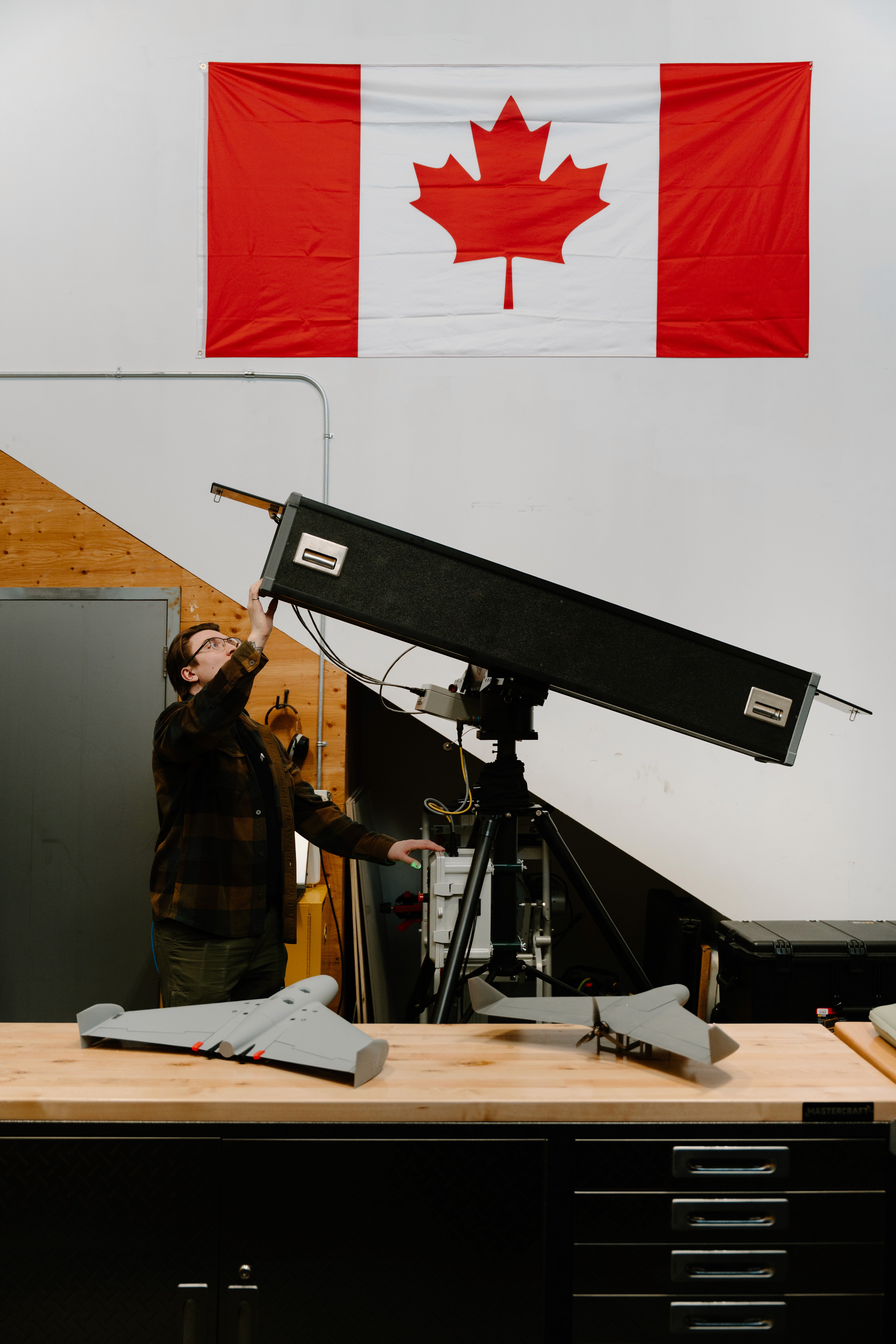
So we talked to Paul Ziadé, CEO of North Vector Dynamics. His team is building autonomous counter-drone systems and precision interceptors in Canada, with Canadian engineers. They're not waiting for Ottawa to figure it out.
Ziadé is blunt about the problems, the years when no one would fund defence startups, the procurement system that still moves like molasses, the challenges that haven't gone away. But he's also clear about why, despite everything, this might be the moment for Canadian defence tech.

1.Building in Canada’s Aerospace and Defence Ecosystem
North Vector Dynamics is building innovative aerospace and defence technologies in Canada. What have been the biggest challenges and the greatest opportunities you have encountered while scaling an advanced tech company in this space within the Canadian ecosystem?
Paul: Until six to eight months ago, it was almost impossible to get a serious conversation with Canadian investors about a seed-stage defence tech company. Capital was the biggest challenge - there simply wasn’t a defence playbook in Canada. That’s changed dramatically. Canada is finally waking up to the reality that a credible defence industrial base matters. Investment restrictions have been lifted, sentiment has shifted, and while building truly kinetic systems - rather than comfortable dual-use tech - was a hurdle early on, we now have strong support from Canadian and allied investors. We’ve assembled a highly strategic group of firms and angels, with growing interest behind them.
The harder and still unresolved challenge is the customer. Canada needs a procurement pathway that can move at the speed of startups and actively champion domestic innovators. Capital is forming, industry is ready, and talent is here. What’s missing is a modern entry point into defence procurement. Other countries have figured this out (DIU and OTAs in the US is a good example) but Canadian startups are still waiting on the Defence Industrial Strategy, which was supposed to be released in November 2025, that reflects how innovation might actually happen. Large primes can survive decade-long sales cycles; startups can’t. So, while we advocate strongly at home and engage closely with DND and the CAF, we’re also pursuing faster-moving opportunities and partnerships in allied markets.
The greatest opportunity, without question, has been talent. I spent nearly a decade as an engineering professor, and Canadian STEM talent is exceptional. I have former students in senior roles across aerospace, automotive, and tech in the US, and many openly acknowledge the strength of their Canadian peers.
Our people have always been our greatest asset - we just haven’t built the environment to keep them. Young engineers are hungry for meaning and mission-driven work with real-world consequences, not another incremental ad-tech product. At North Vector Dynamics, we’re giving Canadian talent a reason to stay, build, and work on things that truly matter.
2.Strategic Focus and Differentiation
How does North Vector differentiate itself from other players in counter drone systems, autonomous platforms, and defence technology? What core technologies or capabilities do you believe will give you a sustainable competitive edge over the next three to five years?
Paul: Precisely intercepting a fast, maneuvering threat that you can barely see from kilometres away is hard. Doing it autonomously, reliably, in a contested environment, in a miniaturized form factor, and at low cost is much harder. That’s the gap North Vector Dynamics exists to fill.
We’re building scalable, precision air-defence and force-protection systems. While much of the autonomous systems space is crowded with relatively low barriers to entry, missile-based counter-drone systems are fundamentally different. Autonomously controlling a guided interceptor in severe crosswinds, under real operational constraints, is not something you prototype over a weekend. The execution moat is deep.
Our differentiation comes from vertical integration and first-principles engineering. We design and build critical subsystems in-house: large portions of the airframe, guidance, navigation and control, computer vision and machine-learning algorithms, launch systems, power systems, and our own flight-controller hardware. On top of that, we’ve developed a robust internal toolchain - hardware-in-the-loop testing, high-performance aerodynamics frameworks, and advanced modeling and characterization methods. This lets us achieve high performance using inexpensive, scalable COTS components rather than exquisite and cost prohibitive systems.
Over the next three to five years, our competitive edge will come from pushing that integration even further. We plan to bring solid rocket motors, warheads, and fuzes in-house to de-risk the supply chain and enable rapid, sovereign production. The goal is simple: systems that are effective, affordable, and manufacturable at scale - on our timeline, and on our terms.
3.Talent, Culture and Growth

You often talk about growing a small but mighty team of strong engineering talent. As you scale, how do you maintain that high performance culture while also building the structure and processes of a larger company?
Paul: This is one of the core challenges for any mission-driven startup, and it’s why the early team matters so much. We were very intentional with our first hires - they set the bar and the culture. I strongly believe that excellence compounds. When new people join a team that is sharp, driven, and deeply accountable, they either rise to that standard or it becomes clear very quickly that it’s not the right fit.
We hire for extreme ownership and leadership potential. We don’t hire people who need to be managed minute by minute - there’s no time for that. And we don’t rush to scale just to hit arbitrary and meaningless headcount KPIs. We’d rather stay small and lethal than grow fast and dilute performance.
On the process side, our rule is simple: structure must earn its keep. What worked when we were three people doesn’t work at sixteen, and building real aerospace and defence systems is very different from tinkering in a garage. We introduce process only when it materially improves execution, safety, or reliability. For example, you don’t run a flight test without a rigorous test plan, clear objectives, contingencies, and safety protocols.
Defence inevitably brings compliance and reporting requirements - that’s the cost of operating in this space. The discipline is being ruthless about everything else. Every new process gets challenged: does it serve a real purpose, is it as lightweight as possible, and does everyone need it? That’s how we scale without losing the high-performance culture that got us here.
4.Market and Geopolitical Headwinds
You have written about navigating tariffs, supply chain pressures, and cross border challenges. How do you see the current geopolitical environment impacting the aerospace and defence tech sector, and how are you positioning North Vector in response?
Paul: We’re clearly entering what I’d call interesting times. There’s a lot of premature certainty right now about whether the current geopolitical reordering is “good” or “bad.” My view is more pragmatic: the outcome isn’t preordained, but the direction of travel is clear.
Across the US, Canada, and Europe, there’s a renewed push for self-sufficiency and sovereign capability. That creates real friction - tariffs, export controls, supply-chain disruption, domestic content considerations - but it also creates opportunity. Defence and aerospace are fundamentally about reliability, and the 2020 pandemic exposed just how externally fragile our supply chains have become, particularly in Canada. For a sector tied directly to national security, that’s no longer acceptable.
The opportunity now is for governments to finally become credible, long-term customers of domestically owned and produced technology. Historically, Canada has struggled here. If export markets are being reorganized, procurement policy has to evolve with them. We’re advocating very strongly for change here in Canada.
For North Vector Dynamics, this environment demands deliberate positioning. The chessboard is shifting, and the next moves are less predictable than they’ve been in decades. Our response is to think in years, not weeks. We’re building sovereign capability while maintaining deep partnerships in the US and Europe. We’re not closing doors - but we’re being intentional about resilience.
If you can operate through uncertainty, this is a moment of genuine opportunity for defence tech builders.
5.Partnerships, Customers and Go to Market

For a company like yours, go to market is not just about selling hardware. It is about supporting mission success for operators. How are you structuring your partnerships, customer engagements, and value propositions to reflect that mindset?
Paul: For us, go-to-market starts with the operator, not the product. In defence, you’re not selling hardware - you’re taking responsibility for a mission outcome. You’re selling capability. That fundamentally shapes how we engage customers and partners.
On the customer side, we work closely with end users early and often. We focus on understanding how systems are actually employed in the field: constraints on training, logistics, sustainment, and rules of engagement. We leverage our network as much as possible to get those insights. That feedback directly informs our design choices.
Our partnerships reflect that same philosophy. We’re deliberate about working with primes, integrators, and allied partners who understand operational realities and can help us deploy at scale without diluting performance. In many cases, we position ourselves as a capability provider rather than a standalone hardware vendor - integrating into existing command-and-control, sensor, and logistics ecosystems instead of forcing customers to adapt to us.
Ultimately, our go-to-market strategy is built around being a long-term partner in mission success. If the system isn’t usable, sustainable, and trusted by the people relying on it, then we haven’t done our job - regardless of how good the technology is on paper.
6.Future Horizons and Innovation Vision
Looking ahead, what is the next major opportunity in aerospace or defence that excites you the most? Is there a future capability or technology that North Vector is not building today but you believe will become essential soon, and how are you preparing for it?
Paul: Today, North Vector Dynamics is focused on short-range air defence and force protection - countering everything from rockets, artillery, and mortars to the rapidly evolving drone threat. Looking ahead, though, the next inflection point in aerospace and defence is impossible to ignore: hypersonic weapons.
Hypersonics – loosely speaking, vehicles travelling at more than five times the speed of sound - aren’t just an exciting technical challenge; they represent a fundamentally different threat that shouldn’t be ignored. At those speeds, detection windows shrink, new physical phenomena appear, structural and thermal loads become extreme, and defensive decisions have to be made in seconds. There’s very little margin for error.
While we’re not productizing hypersonic defence systems today, we’re deliberately positioning for that future. We have deep in-house expertise in hypersonics and are already working on a significant government hypersonics program. That work is allowing us to build the underlying models, tools, and operational understanding needed to transition from research to deployable capability.
Our strategy is disciplined: win and scale in counter-drone and force protection first, then leverage that foundation - autonomy, guidance, sensing, and high-speed aerodynamics - into more advanced threat classes. Hypersonics will be central to the next generation of air defence, and we intend to be there in a major way.
Fello's Thoughts.
We need more of these companies.
Not just North Vector—though what Paul and his team are building is exactly the kind of thing Canada should be backing. We need more founders willing to tackle hard problems in aerospace and defence. More engineers staying in Canada instead of heading south. More investors who understand that defence tech isn't some niche play anymore.
For years, building a defence startup in Canada meant you were either brave or crazy. The capital wasn't there. The customers moved too slow. The ecosystem barely existed. A lot of talented people looked at that landscape and just left.
But things are starting to move. The money is showing up. The conversation is shifting. And companies like North Vector are proving you can actually build serious technology here—if you're willing to push through the friction.
The question now is whether we're going to support these founders or just watch them build somewhere else. Because the opportunity is real, but it won't wait forever.
If you're working on something in this space, or thinking about it, reach out. We want to hear your story.
Your Creative Partner for Innovation That Matters
From advanced tech to transformative healthcare, Fello helps visionary teams shape perception, launch products, and lead industries.

Let’s keep in touch.
Discover more about high-performance web design. Follow us on Linkedin and Instagram.

