

I'm Zach Ronski, Marketing Director at Fello Agency in Toronto. We build B2B tech brands and go-to-market systems for companies in SaaS, AI, robotics, quantum, MedTech, advanced manufacturing, defense tech - the heavy stuff.
Founders ask me one question on repeat:
"What's the average branding cost in 2026?"
You're not asking because you love design. You're asking because you're staring at runway, board pressure, and a pipeline that needs to be more predictable. You're trying to decide if branding is a smart investment or a distraction.
Here's my answer, from the work we do every day.
Why "average branding cost" is a trap question (but you still need a number)
"Average" sounds clean. Real life isn't.
Branding cost depends on how hard your story is to tell, how many ICPs you sell to, and how much proof you're allowed to share. It also depends on how serious your company is about going to market. Some teams move like it's life or death. Other teams move like they've got unlimited time because they raised VC money.
And budgets are not getting easier.
Nearly 60% of B2B marketers reported budgets were flat or being cut. That pressure doesn't magically go away in 2026. It forces one big shift.
You stop buying "branding." You start buying assets that create trust and drive commercialization.
That's where the real numbers live.
What branding actually means in 2026 (for Series A - C SaaS founders)
A lot of founders still hear "branding" and think logo, colors, fonts. That's the smallest piece.
In 2026, branding is the system that makes a skeptical buyer believe you're competent, stable, and worth the risk. Your website, your story, your proof, your sales decks, your content - every touchpoint has to line up.
I say this all the time: your website needs to speak business.
Deep tech teams love technical talk. Enterprise buyers buy business outcomes. If your site reads like a research abstract, you're making your own sales cycle harder.
This matters even more now because trust is the whole game. Forrester is blunt about it: strong trust in a vendor is essential and often determines purchase intent.
And when buyers think "trust," they're not thinking "nice logo." They're thinking consistency, competence, and proof. In that same Forrester study, competence ranked #1 for a huge chunk of buyers.
Your brand is how you show competence before your sales rep even speaks.
The 2026 numbers founders actually need (the ranges I see in-market)
If you're a Series A - C SaaS founder and you want a real answer, you need to price three buckets. Most startups who are serious end up investing in some mix of all three.
Bucket 1: A real rebrand (strategy + positioning + identity)
If you've raised money, especially Series A, and you're trying to look like a category leader, the range I see over and over is $50,000 to $150,000 for a rebrand.
That's not a "make it pretty" project. That's strategy, messaging, positioning, and a visual identity system that can scale. It's also the internal alignment work most teams don't want to admit they need.
I've said it publicly and I'll say it again: for a Series A company, $50K - $150K is the real zone, depending on what's involved.
If you're seeing quotes way below that, expect shortcuts. If you're seeing quotes way above that, be careful. In deep tech and technical SaaS, spending significantly over $100K can start to look suspicious to technical buyers. They sometimes read it as "over-branding."
Bucket 2: A fully autonomous, editable website system
A startup website that your team can actually manage, update, and scale usually lands in the $30,000 to $60,000 range.
That number surprises founders until they've lived the alternative.
A cheap site often turns into a trap. You can't edit it. You can't add pages without breaking things. Marketing becomes dependent on a developer for every move. Speed dies. Pipeline follows.
We build a lot in Framer because we can engineer custom templates with SEO structure and blog systems baked in. The goal is simple: your team can move without begging someone for help. The return on that autonomy is massive.
Bucket 3: Proof assets that close enterprise (especially video)
If you're selling high six-figure contracts, proof is not optional.
A flagship video case study often sits around $15,000 to $20,000 when it's done properly and built to repurpose into a full content ecosystem. That's the "bang for your buck" strategy we push hard.
And the market data backs it up. A Brightcove/Ascend2 survey found 95% of enterprise B2B buyers say video played an important role in moving them toward a purchase. That same survey found 93% say video builds trust.
So when founders ask me, "Do we really need video?" my answer is simple.
If you're asking for enterprise money, you need enterprise-grade trust.
The "all-in" reality for Series A - C teams
When you combine those three buckets, a serious brand system often lands somewhere between $95,000 and $230,000 all-in.
That's not a mandatory package. That's the real math when a team says, "We need the story, we need the website, and we need proof."
If that number makes you uncomfortable, good. It should. You're measuring it against runway. That's the right instinct.
Now let's make it practical.
When DIY branding stops being "scrappy" and starts killing deals
Founders can feel the moment it flips.
It usually happens when better leads start showing up, and you start losing them. The product might be fine. The team might be strong. But the brand creates a silent doubt.
I've seen this in real life. I've even talked about a specific scenario where a company lost an Amazon deal because the brand visuals looked terrible. That's not a "branding problem." That's a revenue problem.
The hard truth is this: if it looks like bullshit, no one's gonna want to work with it.
Enterprise buyers don't have time to do forensic analysis on your legitimacy. They're scanning for signals. Your brand is one of the loudest signals you control.
Where the money actually goes in a $50K - $150K rebrand
Founders love to stare at the logo. That's normal. It's the most visible output.
But the real value sits in the strategy.
At Fello, we treat strategy and research like half the work. Roughly 50% of the budget goes into figuring out the right story and the right positioning. The other half goes into the visual system that expresses it.
That strategy work isn't guessing. We follow a sequential stakeholder approach. We start by interviewing customers, then sales, then marketing, then leadership. We do it that way because customers tell you what actually matters, and sales tells you what actually converts.
One of my favorite lines in our process is: find out what pisses off your clients the most.
Not because we want drama. Because frustration is where urgency lives. It's where you find the emotional hook that turns a technical solution into a business decision.
And once the strategy is right, the visuals get easier. Faster. Cleaner. More consistent.
Consistency is the part founders underestimate. It's the quiet force that makes a company feel real. Without it, every deck, every landing page, every LinkedIn post feels like a different company.
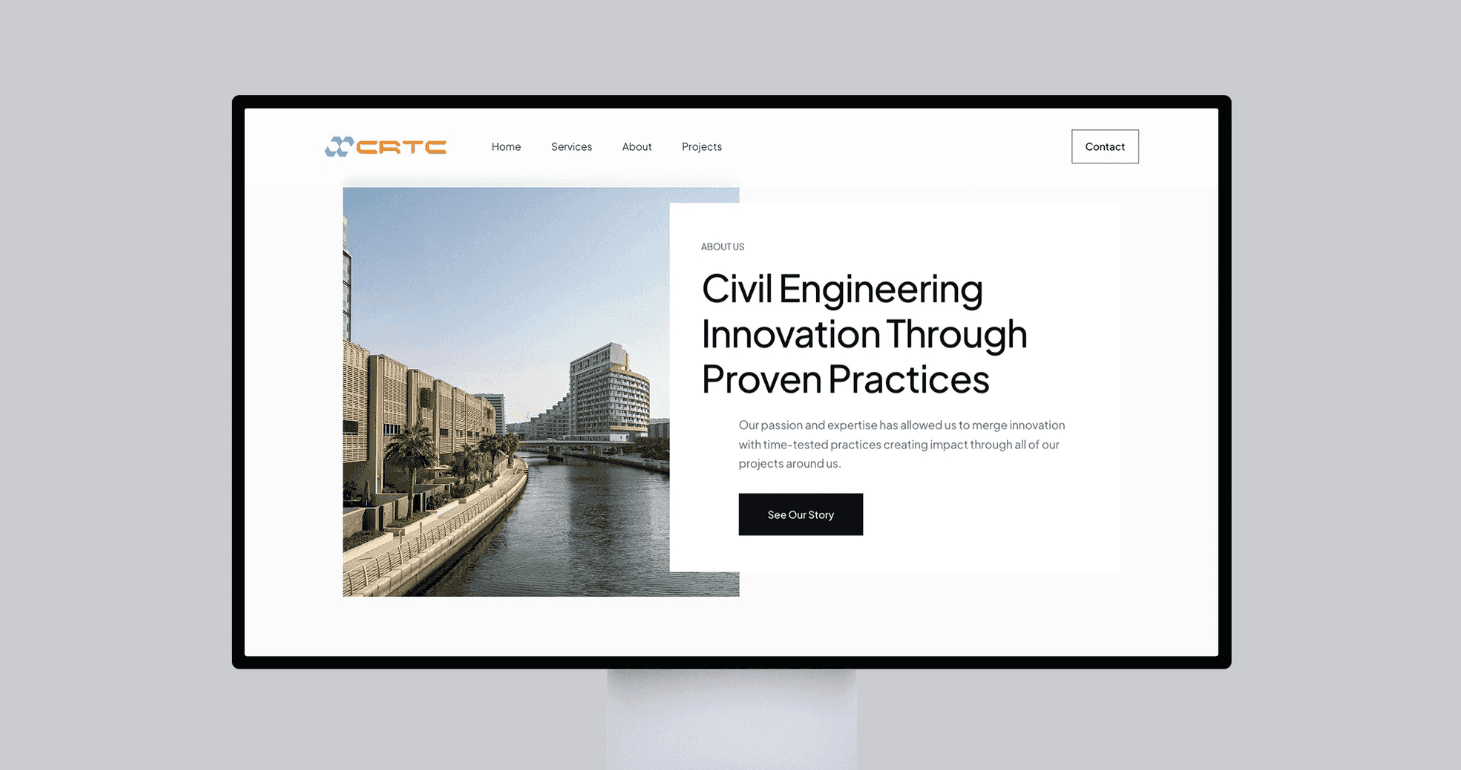
Websites in 2026: the fastest way to waste money is building something you can't run
I'm blunt about websites because I've watched too many teams suffer.
A website is not a brochure. It's your best salesperson. It's working while you sleep. It's also the first place a serious buyer goes to verify you're legit.
And here's the mistake technical teams make all the time.
They lead with specs.
Your homepage and landing pages need to lead with ROI, outcomes, and proof. You can layer in specs after you earn attention. Most buyers won't even read the technical section if the business story isn't clear.
This is where "technical talk vs business talk" matters. Deep tech websites fail when they prioritize technical language. They win when they speak business first.
We've done this kind of segmentation work with Sphere, an XR platform. We built distinct industry pages so factories, medical tech, and defense prospects each saw themselves immediately. That's what good branding looks like in a real go-to-market environment.
And the results matter. Sphere's Head of Marketing, Alexandra Corey, said: "The new website has more than tripled our lead generation efforts."
That's why I push for a fully editable system. Your team needs to be able to create pages, iterate messaging, and ship updates without a bottleneck.
Skipping autonomy feels cheaper. It's not. It taxes you every month in speed.
Proof is a budget line item because deal cycles are long
In B2B SaaS, you're not selling peanut butter. You're asking a company to change how they operate.
That's why deal cycles can stretch six months, a year, sometimes two. You're dealing with buying committees, older demographics, and real risk.
I still believe human selling matters even with all the AI tools in the world. You still need a driver behind the car.
So what keeps trust alive during a long cycle?
Proof assets that feel real.
One thing I look for on a website is simple: a dedicated case study or testimonial page. When it's missing, it's a red flag. It tells me the company either doesn't have proof, or they don't understand what buyers need to see.
If you want enterprise contracts, written testimonials alone often don't match the value you're asking for. Video changes the game because it shows reality. It shows customers. It shows confidence.
We've used video case studies for Mosaic Manufacturing to demonstrate lifestyle and operational benefits in a way engineers don't naturally write. That kind of proof travels. It ends up on landing pages, in investor decks, in trade shows, in outbound sequences.
And in 2026, distribution matters too. Gartner reported YouTube is the top social platform informing B2B purchase decisions. That same Gartner survey found buyers value third-party endorsements 1.4× more than supplier content.
That means your branding system needs two things at once. It needs your own story, and it needs credibility outside your own mouth.
AI in 2026: it lowers some costs, then it makes your life harder
AI tools can speed up parts of production. They can help a designer explore faster. They can help a strategist draft faster.
They don't replace taste. They don't replace positioning. They don't replace judgment.
I've said it before and I'll say it again: "AI generated slop" is real. I've seen it all over the market. It looks generic. It reads generic. And it makes good companies look average.
The Incredibles quote nails it: "If everybody's super, then nobody is."
I saw a VC brag online about building a whole website in a couple of days with AI. When you landed on the site, it looked like the most generic thing ever. Sure, it existed. But it didn't help their reputation. It hurt it.
So yes, AI can reduce certain costs. But differentiation becomes more expensive, because now you're fighting sameness.
That's why strategy and high-fidelity creative still matter. You still need a driver behind the car.
How to justify branding to your board without sounding like you want a "prettier logo"
If you walk into a board meeting and pitch, "We want to refresh the brand," you're going to get cooked.
You need to frame it as communication strategy and commercialization.
When we're securing CFO buy-in, we don't position a website as a "branding" project. We position it as a lead generation tool with measurable ROI. It lands better because it's true.
If you want a simple way to make the argument, do competitor analysis. Pull up the companies winning the deals you want. Look at their strategy. Look at their visuals. Look at how clear their story is.
I win deals all the time by doing this. It's direct. It's obvious. You can point at the market leaders and say, "They look like they belong in the room. We don't still."
Then you back it with numbers you already understand as a founder. Pipeline quality. Demo requests. Win rate. Sales cycle length. Sales team ramp time. Those are branding outcomes when branding is done properly.
And if your board wants examples, use real ones. We've seen Sphere triple lead generation after a brand and website overhaul. We've seen Mosaic Manufacturing increase inbound leads by 25% and booked meetings by 15% in two months. We've seen Nord Quantique's web traffic surge 80% in six weeks after narrative and visual work that made their story land globally.
That's not vibe. That's traction.
The line between "necessary polish" and "over-branding"
Founders worry about looking too glossy. I get it.
Technical buyers can sniff fluff fast. Overselling and under delivering kills trust immediately.
But under-investing also kills trust. You just die slower.
For most Series A to Series B companies, I like the $50K - $100K zone for a serious brand upgrade. Above $100K can look weird in some technical markets unless there's a clear reason, like a huge multi-product ecosystem or a regulated enterprise environment.
There are also industries that overspend for the politics of the words. Big pharma, aerospace, defense. They have budgets they're expected to burn. That's not the startup game.
Your job is simpler. Spend enough to look competent and consistent. Spend enough to tell the truth clearly. Spend enough to prove you're real.
A practical way to set your 2026 branding budget (without wasting six months)
Start with one question: what problem are you actually trying to solve?
If you're preparing for Series B or C, you probably need an investor-ready narrative and a deck story that feels inevitable. If you're trying to escape founder-led sales, you need sales enablement so your team can pitch with your clarity. If you're trying to lower CAC and build inbound, you need a website and funnel that converts, plus proof content that keeps trust alive during long cycles.
Once you know the problem, the budget becomes easier to accept. You're not buying "branding." You're buying the assets that solve the specific bottleneck.
Then be honest about speed. If you move slowly, every month costs you runway anyway. Canada is a great place to build tech, but we're terrible at going to market. I've heard founders say they moved to the US because in America people say "why not," and here people say "why." The teams that win are the ones that push commercialization like it's urgent.
That's my bias. I'm proud of it.
Closing thought: branding cost is the price of trust, clarity, and speed
In 2026, branding is not a luxury. It's a commercial requirement.
It's how you convince serious buyers to change how they operate. It's how you help your sales team win without you on every call. It's how you show investors you're not just building tech - you're building a company that can dominate a category.
If you want the clean takeaway, here it is.
A serious Series A - C SaaS branding investment often includes a $50K - $150K rebrand, a $30K - $60K autonomous website system, and a $15K - $20K flagship proof asset like a video case study. You might not need all of it at once. But you'll need most of it if you want to win very heavily in enterprise.
And if you're tempted to skip it, remember what usually happens.
You still pay. You just pay in lost deals, slower cycles, and a story that never lands.
Frequently Asked Questions
How do I justify branding costs to a skeptical board?
Don't pitch a 'brand refresh' - you'll get cooked. Frame it as commercialization infrastructure required to fix pipeline leaks. Focus on revenue metrics like win rates and sales cycle length. If your competitors look like category leaders and you don't, you are losing deals to 'silent doubt.' Make the argument about risk and revenue, not aesthetics.
Is video production actually worth the investment for B2B?
Yes, especially for enterprise deals. Trust determines purchase intent, and 95% of B2B buyers say video plays an important role in their decision-making. Video case studies prove your solution is real in a way text cannot. If you are asking for six-figure contracts, you need enterprise-grade proof assets.
Why should a Series A website cost $30k to $60k?
You aren't paying for pages. You're paying for autonomy. Cheaper sites often become 'developer traps' where marketing cannot edit text or ship landing pages without coding help. A scalable system allows your team to execute go-to-market strategies instantly. The ROI comes from speed - you stop paying a 'time tax' on every update.
Can we reduce branding costs by using AI tools?
AI lowers production cost but increases the 'cost' of differentiation. Most AI output results in 'generic slop' that makes unique deep tech companies look average. While tools help draft concepts, relying on them for strategy or final polish risks trust. If your brand looks synthetic, skeptical buyers will assume your product is too.
Is there such a thing as spending too much on branding?
Absolutely. For technical SaaS, spending significantly over $150,000 on identity can backfire. Technical buyers are allergic to 'fluff' and may view excessive polish as a signal that you are over-marketing a weak product. The goal is to look competent and stable, not like a pharmaceutical giant burning budget on politics.
Your Creative Partner for Innovation That Matters
From advanced tech to transformative healthcare, Fello helps visionary teams shape perception, launch products, and lead industries.


Let’s keep in touch.
Discover more about high-performance web design. Follow us on Linkedin and Instagram.

