


I work with companies building the heavy stuff. AI. Robotics. Quantum. Advanced manufacturing. MedTech. Defense. I love being around life-changing technology, but I care just as much about helping it commercialize.
In defense, that job gets serious fast.
If you lead marketing, business development, or government-facing communications in aerospace and defense, you already know the audience is small. It is not the public. It is a tight circle of procurement teams, operators, program offices, political stakeholders, prime partners, and allied buyers. A Day One startup walks into that world with no old programs of record, no old political capital, and no legacy trust.
So the brand has to do real work.
When I talk about branding here, I am not talking about making a startup look cool. I am talking about making it look credible on day one. The website, the deck, the renders, the videos, the copy, the typography, the case studies, all of it has to lower risk for the buyer. That is the whole game.
Credibility is the first sale
A lot of founders believe in what they built. That is great. The problem is they are believing but not authenticating it.
That is how I think about branding in B2B. It is the act of authenticating your claims in a way the market can trust. In defense, that matters even more because every buyer is asking a quiet question in the background: would I risk my name on this company?
Your brand starts answering that before the first meeting.
At Fello, we have seen that a high-trust brand lets sales skip a level. Instead of spending the first call proving you are real, you get to talk about fit, mission, and timing. In long defense sales cycles, that is a huge advantage.
The buyer is changing too. The old network-driven culture still matters. Relationships still matter. Human selling still matters. But there is a younger generation of decision-makers coming into defense, and they care a lot more about visual fidelity than founders think. They notice whether the company feels current. They notice whether the deck looks disciplined. They notice whether the product visuals feel real.
ecision-makers coming into defense, and they care a lot more about visual fidelity than founders think. They notice whether the company feels current. They notice whether the deck looks disciplined. They notice whether the product visuals feel real.
Anduril is the obvious public example. Axios reported a roughly $1.1 billion autonomous naval systems deal in 2025. The company also raised $2.5 billion at a $30.5 billion valuation, and by early 2026 it was reportedly seeking roughly $4 billion at a $60 billion valuation. The lesson is clear. A newcomer can force its way into serious conversations when the technology and the brand both look ready.
I bring up Anduril for another reason. They showed the industry that you do not need to copy how the older primes present themselves. You can be creative. You can be strategic. You just need to do it in a way that feels serious.
That is the standard.
Your website needs to speak business
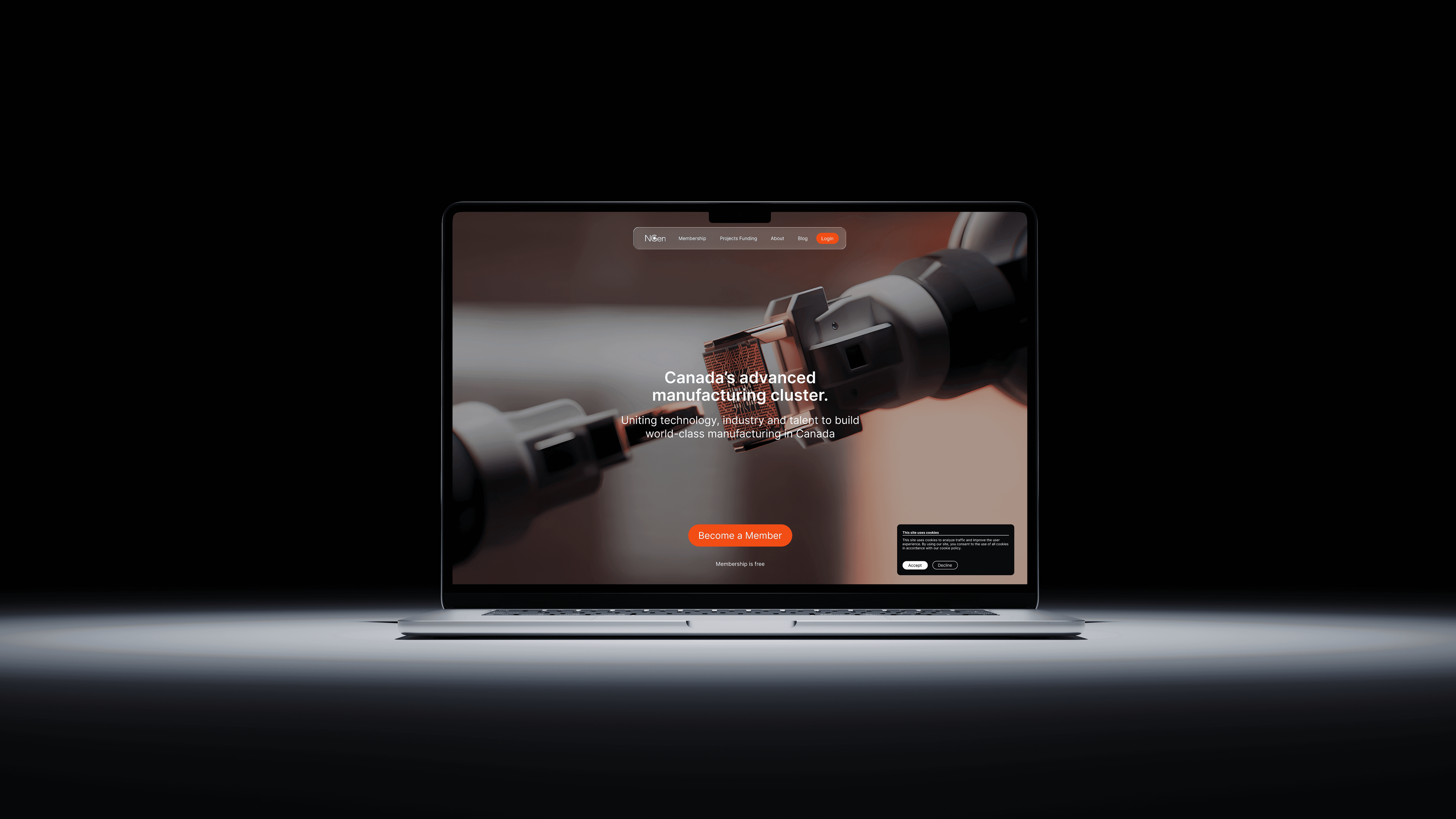
One of the biggest mistakes technical founders make is leading with technical talk. They love the specs. They love the architecture. They love the science. The buyer usually starts somewhere else.
Your website needs to speak business.
For defense, that means the mission outcome has to come first. If you are selling into aircraft programs, that could be faster threat detection, lower pilot workload, better sortie readiness, stronger interoperability, cleaner sustainment logic, or safer operations. The exact message changes by product, but the principle does not.
Lead with the value. Then support it with proof.
I say this all the time: homepages and landing pages need to lead with ROI, case studies, and business value. Put the reason this matters right at the top. If the first thing I see is a dense block of technical explanation, I already know the company is still speaking lab language. Pivot to an ROI narrative or you’re gonna stay in the lab.
That does not mean the specs are unimportant. It means they cannot do the whole job alone. Your buyer is trying to convince other people inside a chain of command. They need language that travels.
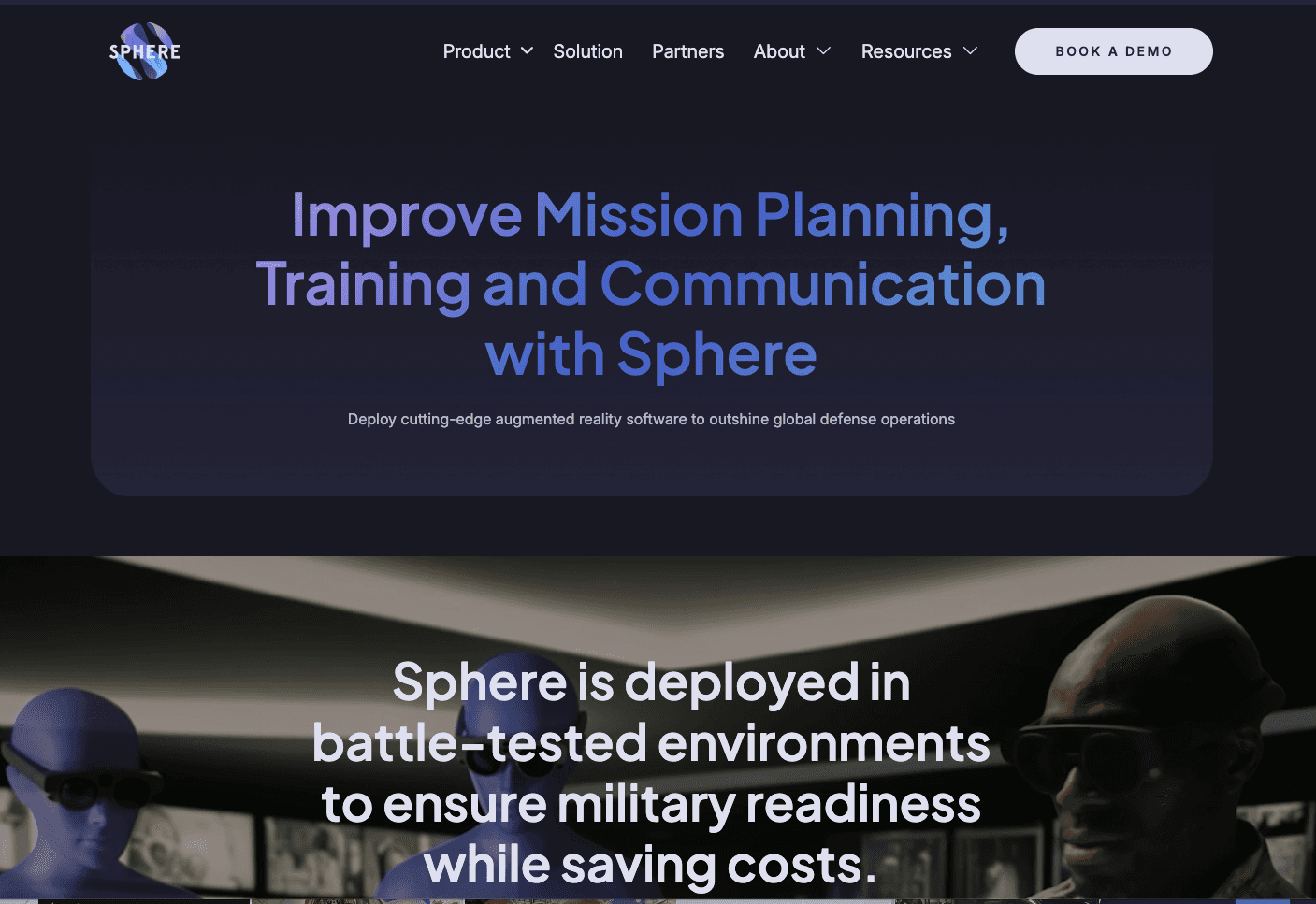
I have seen this across deep tech, not just in defense. For Sphere, an XR company, we built distinct industry pages for different ICPs in factories, medical tech, and defense instead of forcing one generic innovation story. The buyer saw their own world faster, and that site went on to generate 3x more leads.
Same principle. Speak to what the buyer can believe today.
I also think B2B tech needs to learn from B2C. You still need to sell a lifestyle, even in technology. I do not mean fake lifestyle photography. I mean the future state. What does life look like after adoption? What changes for the user?
When we built content for Mosaic Manufacturing, the strongest case study angle was not just the machine. It was the business owner’s reality. How did the workflow feel? What got easier? What became possible? In defense, that same move matters. Show how the operator gets safer. Show how the maintainer gets faster. Show how the champion inside procurement looks smarter for backing you.
I like to put it this way: not how smart the device is, but how much smarter you’re going to be.
Look mission-ready from the first second

Use the declassified aesthetic
A lot of startups think credibility means high gloss. In defense, too much polish will look like vaporware. You can kill a deal by making the company look overproduced.
That is why I keep talking about the declassified aesthetic.
One of the smartest creative moves for an early defense company is to make the brand feel closer to a high-level technical briefing than a startup mood board. That means restrained palettes. Clear structure. Typography that feels engineered. Fonts like IBM Plex Mono or JetBrains Mono can work really well when used properly. The brand should feel mission-led. It should feel like somebody serious prepared it.
I also love the technical dossier approach. Instead of a generic pitch deck, build something that feels like a briefing packet. If you are printing it, use heavy stock and simple folders. If it is digital, build layouts that borrow from redacted reports and internal documents. The credibility hack here is restraint. It tells the buyer you are focused on the hardware and the mission, not trying to distract them with startup theater.
We have even seen a version of this on our own side. Fello originally had a louder purple-and-black identity. When we moved into a cleaner black-and-white system with softer accents, trust changed almost immediately. The response got better. People felt the difference faster. That taught me something simple: restraint can make a company look more serious very quickly.
I have used the same discipline in other sectors too. On the Revanesse work for Prollenium, we built the “In the Lab” content around a black-and-white clinical look with very controlled orange accents in the molecular visuals. It kept the brand scientific without making it feel dead. Defense teams can learn from that. You want precision. You want control. You want enough edge to be memorable, but not so much polish that people start wondering whether the product is real.
Consistency is what separates a company from a science project
A brand is a system. First the communication strategy. Then the brand elements. Then the logo. Then the visual assets. Then the website.
A lot of teams jump straight to the logo or the homepage. That is backwards. If the strategy is weak, the rest of the work floats.
I can usually tell in five minutes when the marketing is off. The fonts drift. The deck feels different from the site. The landing page says one thing and the brochure says another. The email signature looks homemade. Buyers may not say it out loud, but they feel the instability immediately.
That is how companies end up looking like science projects.
In deep tech, poor visuals cost real money. I have seen a client lose a deal with Amazon because the visuals were weak. I have seen another client almost get left out of a major enterprise meeting because the deck was “not cutting it.” For defense contracts in the $10 million to $100 million range, the standard gets even harsher. If you cannot visually propose the technical aspects through strong decks, video, and product assets, the competitor who took that work seriously will win very heavily.
Dress for the client that you need.
Prove what you can without exposing what you can’t
The hardest part of defense marketing is that your best proof is often the thing you cannot show. Fine. That does not remove the need for proof. It changes the format.
At Fello, we have helped confidential defense clients move serious conversations forward using high-fidelity 3D renders and pitch materials when there was no physical product available to show. In one confidential Canadian drone context, renders helped visualize the design at a moment when timing mattered. In another counter-drone engagement, renders and decks helped the client secure funding without a physical prototype in hand.
That is why I push 3D so hard in defense. It lets you show the bigger picture when the real footage is restricted.
But I never want a render floating around by itself. That is where startups get into trouble. Pair the futuristic asset with something real. Show the team in the lab. Show a bench test. Show a controlled exercise. Show the hardware in somebody’s hands. High-fidelity renders plus live-action lab footage is one of the best ways to avoid the vaporware problem.
I have used that thinking in dual-use work too. With an XR company we represented that had heavy defense relevance, we often had to generate visuals internally to show how the system fit into the larger environment without exposing restricted material. The point was not to fake reality. The point was to make the buyer understand the use case.
Show the ugly side of R&D
I also love what I call a found footage marketing strategy.
High-budget CGI videos are a hallmark of legacy contractors. They scream, this doesn’t exist still. That is why I often prefer rougher proof for serious technical buyers. A shaky clip from a field exercise. Thermal imaging. A failed stress test. A drone crashing during a stretch run with a note about what failed. That kind of content is often more persuasive than a perfect animation.
It shows you’re actually in the dirt doing the work.
Technical buyers relate to that. Operators relate to that. Procurement people who have seen enough polished nonsense relate to that too. The ugly side of R&D can be a credibility asset if you package it honestly.
If you can film specific exercises, do it. If the real operational footage cannot go public, use controlled testing and reenactments. Ground the render in reality. Ground the narrative in engineering.
Sound matters here too. Acoustic branding is underrated in defense. The click of a battery housing. The lock of a mount. The startup tone of a UI. The notification frequency in a command interface. Those little cues create a subconscious sense of readiness. When the demo sounds engineered, the whole experience feels tighter.
And do not underestimate behind-the-scenes content. Lab tours, internal process clips, and controlled views of the engineering environment help justify serious price tags. They let the buyer see the complexity behind the ask.
Build the site for the real buying committee
Most defense sites get muddy because they try to talk to everybody at once. That never works.
Your real audience is a handful of people with different agendas. The operator cares about safety, speed, and usability. The military leader cares about readiness and capability. The political or oversight audience cares about funding logic, domestic jobs, allied value, and whether the company can actually deliver. The site has to respect that without turning into soup.
At the top of the page, I want it simple. A serious hero asset or video. A one-line mission statement. A clear CTA that tells the visitor why this conversation matters right now. Put the urgency close to the hero. Do not make the buyer hunt for relevance.
Below that, segment the proof.
Show the technical visual and capability story for the person who will actually use or evaluate the system. Then show the broader mission and program logic for the leadership layer. Then give the political and oversight audience the funding and industrial-base signals they need. If you can show who you work with, do it. If you can show the missions or exercise contexts, do it. Keep it clean. Keep it useful.
This is also where technical briefings help. Put the downloadable dossier, PDF, or secure brief right into the page flow so the serious visitor can forward it internally. A lot of the time, you are not just educating them. You are helping them carry your story into a room you are not in.
Palantir is one public company that does a strong job of speaking to multiple audiences without flattening the message. The lesson is not to copy Palantir word for word. The lesson is to stay clear while the proof gets more specific lower down the page.
If the company is dual-use, split the path immediately. We do this often. On dual-use sites, I want the visitor to self-select fast. Defense buyers should not have to wade through commercial messaging, and commercial buyers should not have to decode government-heavy copy. Different audiences need different journeys.
Sometimes the smartest move is to show less. Not everybody needs to see what you’re working on. A password-protected site or limited-access landing page can increase seriousness in defense. Even a strong “coming soon” page can do that if the visuals are right. Controlled access creates intrigue and signals discipline.
I also think companies need both landing pages and what I call collector pages. Landing pages help drive the deal. Collector pages build loyalty over time. Mission pages, team pages, about pages, and partnership pages let the buyer feel the company. I look at it like building a highway. You need the collectors for the near-term turns, and you need the express for long-term brand recall.
One more thing. If I open a deep-tech site and there is no case study page or testimonial page, I see that as a red flag right away. Somebody trusted you before this buyer does. Make that easy to find.
Give your champion something to carry
A lot of companies obsess over the homepage and forget the internal champion.
Your client is your Padawan. They need tools. They need language. They need something they can forward, present, and reuse when you are not in the room.
That is why I like serious white papers, dossiers, brochures, and downloadable PDFs. In long sales cycles, those assets help the buyer structure the story internally. In many cases, you are helping write their future RFPs.
The format matters, but the narrative matters more. When I build a case study, I do not want the company telling the story in its own voice the whole time. I want the customer’s perspective. I want to know what the frustrating times looked like before the product. Where was the pain? What was slow? What felt risky? What changed after adoption?
That is where the story lives.
We used that kind of thinking on Mosaic Manufacturing. The strongest content was not just machine footage. It was the operator and business reality around the machine. In defense, I want the same thing. Show me the operator’s day. Show me the maintainer’s stress. Show me the internal champion who finally got the approval because the proof was strong enough.
And if you are early, get obsessed with earning that first real story. I do not care if the first pilot is scrappy. I care that it is honest and useful. One real exercise, one real evaluation, one real testimonial beats a hundred slides of ambition.
Once a company has a Seed round or a strong first deal, I push video case studies much harder. If you are asking for high-six-figure commitments or more, written testimonials alone feel thin. Get the proof on camera. Show the environment. Show the outcome. Then squeeze that asset for everything it is worth. One strong video should become a PDF, a blog post, social cutdowns, deck slides, booth content, and sales follow-up.
That is bang for your buck.
To keep momentum during long cycles, I often prefer monthly video updates over standard nurture emails. Show the team. Show the progress. Show what changed this month. Let the buyer feel like they are part of the club instead of sitting outside waiting for a generic drip sequence.
Human selling still matters in B2B. In defense, where the cycle can run six months to two years and the buyer is often older and more skeptical, it matters even more. People can tell which companies care. Show that you give a shit.
Founder authenticity matters too. I have worked on a drone defense narrative with an ex-US Marine founder whose mission was grounded in real battlefield loss. That kind of truth lands differently. Buyers can spot borrowed mission language a mile away.
Use AI for speed, not for your face
I am pro-AI in the right place.
Use AI to speed up research. Use it to sharpen ICP work. Use it to organize market data and find patterns faster. A survey covered by ITPro found nearly 65% of B2B sales leaders saw positive ROI within one year from AI-driven engagement and outreach tools. ITPro also summarized survey data showing 19% saw ROI in under three months and another 27% saw it within six to twelve months. Buyers also expect faster and more concise responses now.
Good. Use AI where it helps.
Do not let it become the public face of the company.
If you have a CMO, you never should be using AI generation for your website. I am very hard on that point. AI-generated slop makes everything look the same, and that creates a bad psychological association. If the visuals feel generic, the buyer starts wondering whether the capability is generic too.
I have watched people brag about spinning up websites in two days with AI. I think it damages their reputation. Fast is great. Generic is brutal. You still need a driver behind the car.
Move fast with a system your team can actually run
The companies that win in deep tech get obsessed with going to market. They move. They do not spend a year workshopping themselves into a coma.
We built Fello from the ground up, so I care a lot about speed. We have launched a high-quality site in under two months to hit CES. We have helped a dual-use client launch in two weeks when the normal timeline would have dragged out much longer. That speed is possible, but it comes from clear decisions, not shortcuts.
Inside the company, branding problems are usually communication problems. The board wants one thing. Engineering wants another. Marketing is trying to keep the peace. Then the website comes out confused because the company is confused. Get the right decision-makers aligned on the communication strategy early. Then move.
Passion matters too. If your own team treats the launch like a side quest, the market feels it. You can tell when the initiative matters and when it does not.
A proper CMS is part of credibility
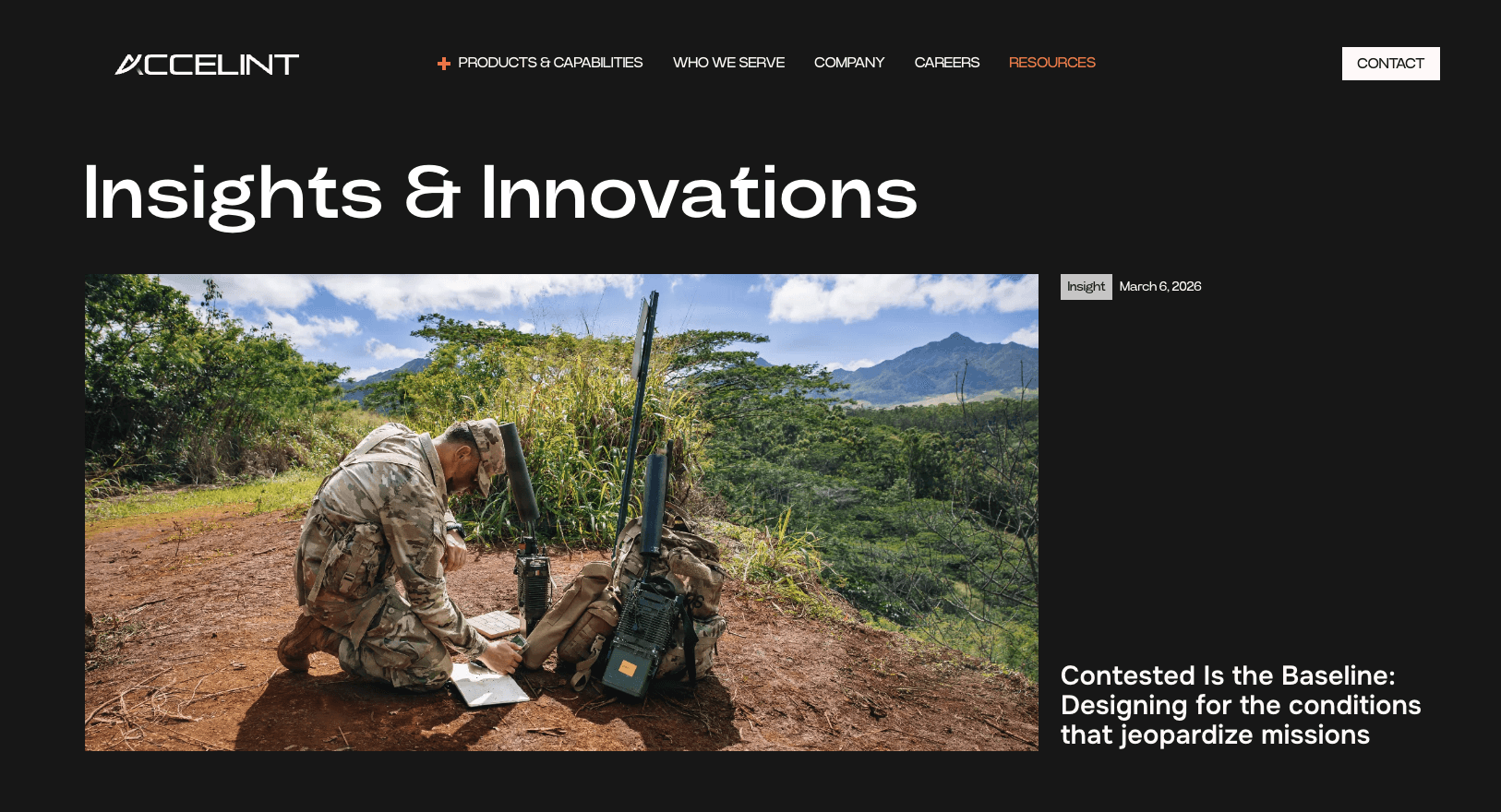
This is one of my strongest opinions. If you don’t have a proper CMS, there is no point of even having a website.
Your team has to move. They need to publish updates, partner content, blog posts, case studies, event pages, and resource materials without begging a developer every time. My benchmark is simple: once the content is ready, the team should be able to launch a blog post in about three minutes. If it takes weeks, the system is broken.
I care about this because I have seen the opposite. I have seen companies trapped in legacy backends where a guest blog took months to upload. That is insane. Your site should help you move, not hold you hostage.
For public-facing deep-tech sites, I like tools that give the client real autonomy. We use Framer a lot because it lets us move fast and keep the design quality high. Once you get the hang of it, you can really do some damage. But I am also realistic. In classified environments, self-hosting and code control matter. Some defense teams cannot accept a setup where the site lives and dies on somebody else’s server. In those cases, pick the secure path.
And train the internal team. I make that a hard line. The website should not turn into a developer bottleneck the second the agency leaves.
For B2B defense, I also optimize for mobile last. The serious review still happens on desktop, in decks, and in stakeholder meetings. Start there.
Budget for trust
When I need internal buy-in for a brand investment, I do not frame it as vanity. I frame it as communication strategy and risk mitigation. That is what it is.
If you need to justify the spend to a board or CFO, compare your materials against the companies winning in your category. Put your deck beside the category leader. Put your site beside the disruptor getting attention. The gap usually explains itself fast.
I do not tell startups to light money on fire. Over-branding can look suspicious to technical buyers. A glossy shell with no substance underneath is a bad look. But underinvesting is not noble either. If you want to win serious conversations, you need to look the part.
For Series A and Series B deep-tech companies, I usually talk about $50,000 to $150,000 for a real rebrand, with roughly half of that going into strategy and research. A fully editable website usually lands somewhere in the $30,000 to $60,000 range. That is not agency fluff if the work is done properly. That is table stakes for serious commercialization.
And when budget pressure shows up, I do not like cutting quality. Cut deliverables first. Keep the strategy. Keep the core visual system. Keep the site manageable. Quality is the trust layer.
Final thought
A Day One defense startup does not need to look like a legacy prime.
It needs to look serious enough that a risk-averse buyer is willing to keep moving.
That comes from clear business language. It comes from visuals that feel disciplined, not overcooked. It comes from proof that feels grounded. It comes from case studies and briefs that help your champion sell internally. It comes from a CMS your team can actually use. And it comes from moving faster than most companies are comfortable moving.
If you are leading marketing in aerospace and defense, you already know how unforgiving the room can be. People are weighing mission risk, budget risk, political risk, and career risk all at once. Your brand has to make that decision easier.
So take this stuff seriously because your competitors will, and they will win the deal. Your website needs to speak business. Your proof needs to feel real. Your company needs to look like it belongs in the room on day one.
Frequently Asked Questions
How can defense tech startup branding accelerate Foreign Military Sales (FMS)?
FMS relies entirely on allied trust and interoperability. Your brand must signal seamless integration with existing coalition forces, not just technical superiority. When foreign procurement officers review your dossiers, the narrative must articulate domestic industrial base stability and shared mission readiness to expedite regulatory approvals.
Can aerospace marketing teams leverage AI outreach tools given strict defense compliance?
Yes, for unclassified engagement. Buyers expect speed. In fact, 65% of B2B leaders see ROI within a year using AI tools. Use AI to synthesize market data and accelerate responses, but keep human operators commanding the final narrative.
How should our platform’s brand narrative counteract public scrutiny over defense budgets?
You stop selling the machine and start selling the economic and strategic impact. Defense branding must highlight domestic job creation, taxpayer cost-efficiency, and allied deterrence. When oversight committees look closely, your materials must systematically defend the long-term ROI and the absolute necessity of the mission.
How does a defense tech startup brand prove 30-year viability for a Program of Record?
You engineer trust through financial gravity. Look at Anduril - they won a $1.1 billion autonomous naval deal by acting like a neo-prime. Your brand must project institutional permanence, backed by robust supply chain messaging and adaptable architecture that easily survives administration changes.
How do we adapt our brand messaging to survive shifting congressional defense priorities?
By decoupling your core value from a single administration’s talking points. Serious defense tech startup branding anchors itself to undeniable, bipartisan threat vectors. Your strategic communications must prove that canceling your aerospace program introduces unacceptable national security risks, regardless of who controls the budget.
Your Creative Partner for Innovation That Matters
From advanced tech to transformative healthcare, Fello helps visionary teams shape perception, launch products, and lead industries.


Let’s keep in touch.
Discover more about high-performance web design. Follow us on Linkedin and Instagram.

