


I’m Zach Ronski. I run brand strategy for high level clients at Fello Agency in Toronto’s Art & Design District.
We work with B2B tech companies doing the heavy stuff. AI, robotics, quantum, advanced manufacturing, medtech, XR, defense. The kinds of companies that are changing industries, raising real money, and trying to land contracts that can change the trajectory of the business overnight.
So let me say this clean.
Most rebrands fail because they get treated like a design project. The team picks a new logo. They clean up the website. Everyone claps. Then the pipeline stays the same, sales keeps making their own decks, and the board still thinks marketing is a cost center.
If you’re a CMO or VP of Marketing, you don’t have time for that.
You need a rebrand that creates trust fast, makes your story obvious, and turns into sales assets your reps actually use. You want momentum. You want recall. You want your company to be the one buyers remember when they’re finally ready to pull the trigger.
Because if you don’t have a brand, then you’re going to be forgotten.
What I mean when I say “brand”
Branding isn’t soda cans and sneakers. It’s not “make it pretty.” It’s not a vibe exercise.
A brand is a feeling that somebody thinks about when they see your brand. That’s the simplest definition I’ve ever found that still holds up in enterprise.
And yes, that feeling comes from your logo and colors. But it also comes from your UX, your pitch deck, your sales emails, your product UI, your docs, your videos, your hiring page, your case studies, your socials, and the way your leadership team talks in public.
This is why I don’t take “we have a name and a logo, we’re done with branding” seriously. That mindset tells me the company is still thinking like a lab. The lab is very different than the boardroom.
In the boardroom, buyers are measuring risk. They’re deciding if they can defend you internally. They’re deciding if you look legitimate. They’re deciding if you’ll make them look smart.
That’s the game.
Why rebranding hits revenue (and why CMOs get boxed in)
If you’re leading marketing in B2B tech, you’re living inside a few realities.
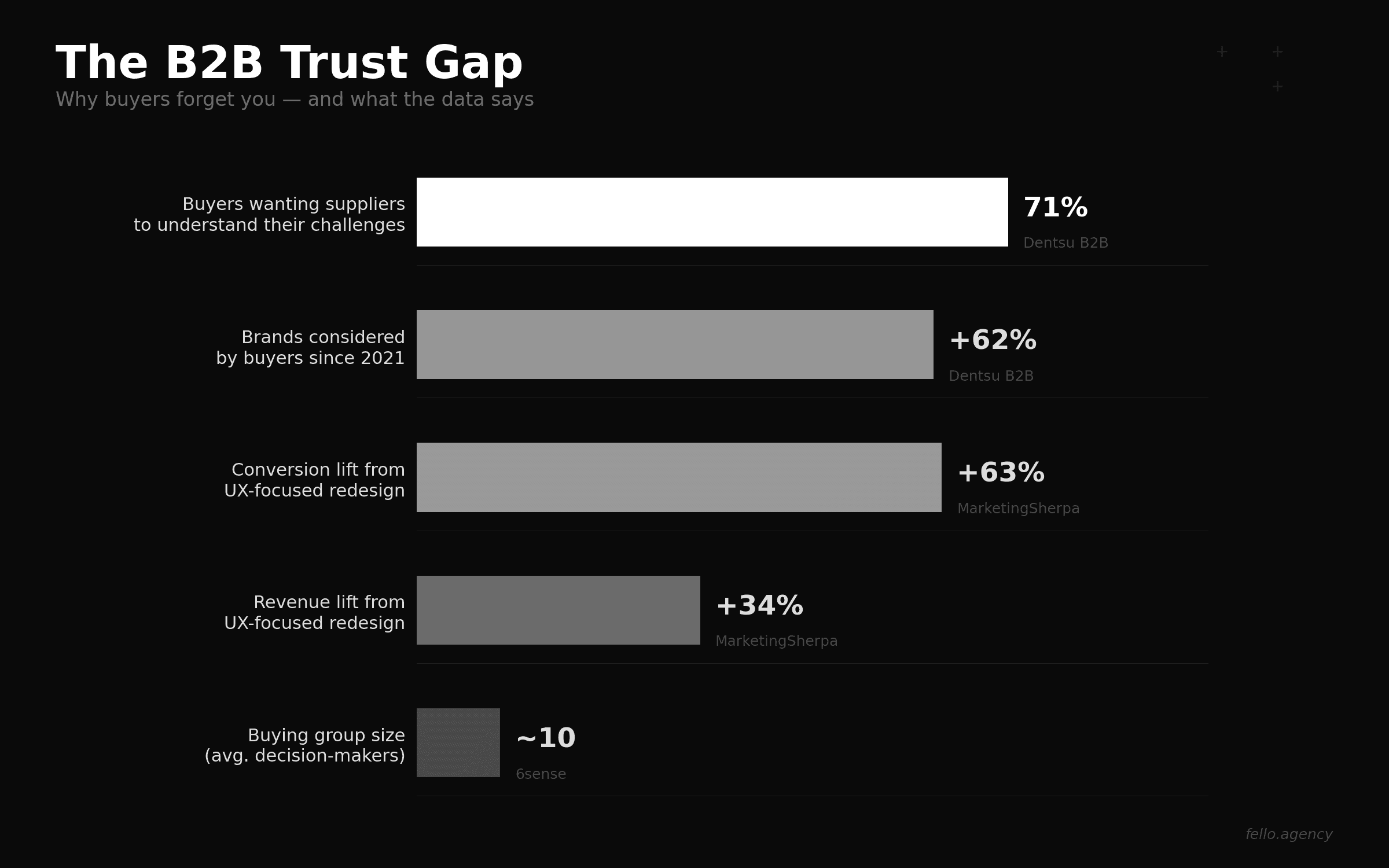
First, you’re selling into committees. It’s rarely one buyer. A 6sense report describes buying groups “hunting in packs of nearly 10” and roaming the internet for nearly a year. That’s your world. Long cycles. Lots of voices. Lots of people who can kill the deal.
Second, your buyers don’t trust your sales rep. They trust other buyers. A Forrester study found B2B buyers overwhelmingly trust peers and existing customers, and trust vendor salespeople way less. That means your brand has to carry the trust. Your website has to carry the trust. Your proof has to carry the trust.
Third, the market got crowded. Dentsu’s B2B work shows brand building jumped to the top priority for B2B buyers in 2024. Buyers also consider more options than they used to. That same research shows the number of brands considered is up 62% since 2021.
So when your CEO says, “Our product is the best, why aren’t we winning?” you already know the answer.
A “best product” doesn’t automatically win attention. It doesn’t automatically win trust. It doesn’t automatically get remembered. At the scale you’re talking about, there really isn’t a best product in the world that isn’t investing in brand. Look at OpenAI’s rebrand and the commercials and the videos. Of course they stand out.
In deep tech specifically, I see sales cycles in the 6 to 12 month range all the time. A high-trust brand compresses that cycle because it removes the initial “prove you’re real” step. You’re kind of skipping a level. Sales gets to spend time on fit and numbers, not legitimacy.
That’s why I call design a commercial gatekeeper. It’s not decoration. It’s a filter.
Key data points for your business case:
DATA POINT | DETAIL | SOURCE |
Buying group size | Nearly 10 decision-makers per deal | 6sense |
Research cycle | Buyers roam the internet for nearly a year | 6sense |
Trust gap | Buyers trust peers over vendor salespeople | Forrester |
Brands considered | Up 62% since 2021 | Dentsu B2B |
Buyer expectation | 71% want suppliers to understand their day-to-day | Dentsu B2B |
UX impact | 34% revenue lift, 63% conversion lift from redesign | MarketingSherpa |
When you should rebrand (and when you should stop pretending)
Rebrand when your business has outgrown your story. You feel it in the room. Deals stall. Champions go quiet. You keep getting “looks interesting” instead of “send the contract.”
You should also rebrand when you’re moving upmarket, launching a new category, changing your ICP, merging products, changing your name, or trying to recruit serious talent against giants like Meta and OpenAI.
Now the part people don’t like hearing.
Don’t rebrand to cover up a weak product. Buyers can spot bullshit a mile away. So can your competitors. So can your own team.
And don’t rebrand if leadership won’t align on a real communication strategy. A rebrand without buy-in becomes a folder of assets nobody uses. It becomes a new logo living on an old sales deck. That’s wasted money and political pain for you.
REBRAND WHEN... | DON’T REBRAND WHEN... |
Your business has outgrown your story | Your product is weak and you’re trying to cover it up |
You’re moving upmarket | Leadership won’t align on a real communication strategy |
You’re launching a new category | You just want a new logo and nothing else changes |
You’re changing your ICP | You have no plan for sales enablement |
You’re merging products or changing your name | You expect branding alone to fix pipeline problems |
You’re recruiting against Meta and OpenAI |
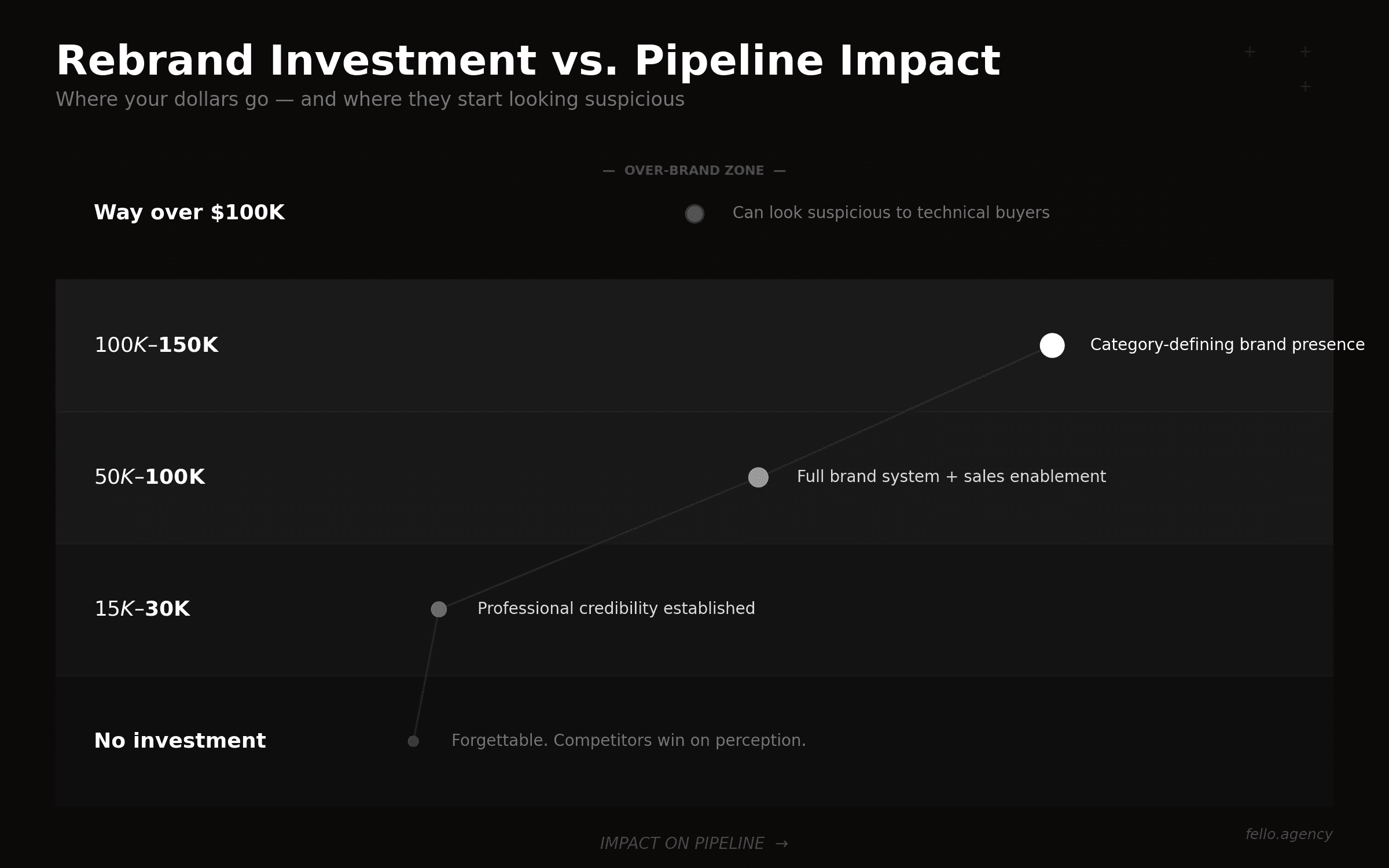
If you want numbers, here’s what I’ve seen. Deep tech startups can establish professional credibility with an initial branding investment in the $15,000 to $30,000 range. Once you’re Series A or B and you’re selling enterprise, the band is usually $50,000 to $150,000 for a proper rebrand. Spending way over $100K can even look suspicious to technical buyers in some categories. Over-branding is a real thing.
And yes, strategy is half the work. People underestimate that. They want to jump into design because it feels like progress. Strategy is the progress.
COMPANY STAGE | INVESTMENT RANGE | WHAT IT GETS YOU |
Deep Tech Startup | $15,000 – $30,000 | Professional credibility; foundational brand identity |
Series A / B Enterprise | $50,000 – $150,000 | Full rebrand: strategy, design system, sales enablement, launch |
Over-Branding Zone | Way over $100K | Can look suspicious to technical buyers in some categories |
The checklist I use: 25 tasks, 5 phases, about 20 weeks
This is the same structure we’ve used for years at Fello. It’s built for B2B tech teams who need speed, clarity, and an outcome you can defend to a board.
The flow is simple. Discovery and audit runs weeks one to three. Strategy and architecture runs weeks four to six. Design and build runs weeks seven to twelve. Migration and launch runs weeks thirteen to sixteen. Post-launch measurement and cleanup runs weeks seventeen to twenty.
You can compress it when you have deadlines. I’ve had a haptics company where finishing a rebrand in 1.5 months mattered because they needed OEM meetings at CES. The checklist didn’t change. We just moved faster and got ruthless.
If you’re reading this as a CMO, here’s the promise. This is built to get you alignment, ship cleanly, and show impact without hand-wavy brand theater.
PHASE | NAME | TIMELINE | GOAL |
Phase 1 | Discovery & Audit | Weeks 1 – 3 | Truth. Not opinions. |
Phase 2 | Strategy & Architecture | Weeks 4 – 6 | Make it a business tool. |
Phase 3 | Design & Build | Weeks 7 – 12 | Build the system. |
Phase 4 | Migration & Launch | Weeks 13 – 16 | Ship like a pro. |
Phase 5 | Post-Launch & Measurement | Weeks 17 – 20 | Prove impact. |
Phase 1 (Weeks 1 – 3): Discovery & Audit
The goal in Phase 1 is truth. Not opinions. Not internal politics. Truth.
1) Run a brand perception survey, internal and external
We start here because your company already has a brand. Even if you never designed one.
You need to know how it feels from the outside. You also need to see the gap between what leadership thinks the brand is and what customers actually experience.
When those two aren’t aligned, you’ll feel it in the sales cycle. Messaging gets messy. Demos get long. Deals drag.
2) Audit every digital footprint you own
Most teams only audit the marketing website. That’s a miss.
You need a full sweep: site, product UI, app, docs, PDFs, decks, social channels, developer portal, SDK pages, changelogs, email templates, trade show booths, third-party listings. All of it.
The reason is simple. Your buyers don’t enter through one door. They bounce around. They screenshot. They forward links internally. In a 6sense world where committees roam for months, every touchpoint becomes part of the decision.
DIGITAL FOOTPRINT AUDIT — TOUCHPOINTS TO REVIEW | |
☐ Marketing website | ☐ Developer portal / SDK pages |
☐ Product UI / App | ☐ Changelogs |
☐ Documentation / PDFs | ☐ Email templates |
☐ Sales decks | ☐ Trade show / booth materials |
☐ Social channels | ☐ Third-party listings (G2, Crunchbase, etc.) |
☐ App marketplaces | ☐ Partner pages / directory profiles |
3) Benchmark five competitors on positioning and visual language
We typically benchmark five competitor profiles because it forces clarity. You’ll see the same buzzwords repeated. You’ll see the same stock imagery. You’ll see the same “secure, scalable, AI-powered” soup.
This is where you decide what you’re going to own. You’re looking for the white space. You’re also looking for what you must match to meet category expectations. Sometimes you can’t break the rules until you’ve earned the right.
4) Interview at least 10 power users
I like power users because they’re honest. They know what the product does. They also know what still hurts.
We’re listening for language. The words customers use become your copy. The way they explain value internally becomes your sales narrative.
This ties directly to trust. Buyers want relevance. Dentsu’s work shows 71% of B2B buyers want suppliers to invest more time understanding their day-to-day challenges. Your interviews are how you earn that.
5) Inventory brand assets, licenses, and trademark status
This sounds boring until it breaks your launch.
You need to know what you actually own, what you’re licensed for, what domains are locked down, what trademarks exist, and what naming landmines you’re stepping on.
Clean inventory now saves you legal and technical pain later.
Phase 2 (Weeks 4 – 6): Strategy & Architecture
Phase 2 is where the rebrand becomes a business tool. This is the part that makes sales easier.
6) Define the brand narrative, mission, vision, and voice pillars
This is where you stop talking like a spec sheet.
Technical founders often want to lead with features. I get it. The product is impressive. But buyers don’t buy features first. They buy outcomes first. They buy the risk profile. They buy the story they can repeat inside their company.
When I’m working with technical leaders, I simplify the lifestyle hook down to one thing they actually care about. Time. The ability to reclaim time because your solution saves money or makes money.
You need a narrative that a CFO can repeat in one sentence without cringing.
7) Map brand architecture and get it approved
If you have multiple products, you need structure.
What’s the master brand? What’s a sub-brand? What’s a feature? What’s a tier? What’s a campaign?
If you skip this, naming becomes chaos. Sales decks become inconsistent. Product marketing becomes a patchwork. Buyers feel that instability, even if they can’t explain it.
8) Create a brand kill list
This is one of the highest-leverage moves in the whole process.
A kill list is a document that says what dies. Old decks. Old landing pages. Old product names. Old visuals. Old taglines. Anything that will confuse the market during the transition.
If you don’t kill the old stuff, it keeps resurfacing. It shows up in partner portals. It shows up in outbound. It shows up in the one rep who “likes the old deck better.”
Then your rebrand turns into two brands fighting each other.
9) Set naming conventions for products, features, and tiers
Naming conventions are where clarity becomes operational.
You need rules. Capitalization rules. Tone rules. How technical is the language allowed to be? Do you name features like engineers or like buyers?
In one engagement with ACTO, segmenting partner pages by ICP helped balance technical specs with emotional brand. The structure matters. It keeps you from writing one generic page that makes nobody feel understood.
10) Align sales, customer success, and engineering on the why and the timeline
If you want the rollout to be smooth, you have these conversations early.
Sales needs to know what changes in their flow. Customer success needs to know what customers will ask. Engineering needs to know what assets change inside product.
This is also where you prevent internal sabotage. People don’t resist rebrands because they hate design. They resist because they’re scared of disruption. Your job is to show them the plan and give them replacement assets before you flip the switch.
Phase 3 (Weeks 7 – 12): Design & Build
Phase 3 is where you build the system. You’re making consistency easy.
11) Design the logo system, only if it truly needs to change
Not every rebrand needs a new logo. Sometimes the logo is fine. The story isn’t. The typography isn’t. The web experience isn’t.
If you do rebuild the mark, treat it like a system with rules. You need primary, responsive versions, dark and light usage, and icon standards. Your team should never be guessing.
12) Build the token system for colors and type
This is where you create consistent energy and vibes across the entire brand.
We’ll have a design engineer build tokens for color and type space on Ratty. The point is speed and control. Tokens keep the brand stable when multiple people are shipping assets every week.
This also helps you avoid the “every deck looks different” problem. It kills drift.
13) Develop a component library and UI kit
If you’re SaaS, your brand lives inside product.
A component library makes the brand usable. It lets product teams ship without reinventing buttons, spacing, typography, and UI patterns. It also reduces debates because the system is already defined.
This is one of the most practical forms of brand governance you can build.
14) Write brand voice guidelines people will actually follow
Make it tight. Make it specific. Give examples.
You want do’s and don’ts. You want tone boundaries. You want the “spectrum” so writers know how bold they can be without going off the rails.
This is also where you protect your company from AI sameness. In the new dawn age of AI, generic generated assets and generic generated copy are credibility killers. Buyers see the same patterns everywhere. They tune out fast.
15) Produce hero assets that signal trust immediately
This is where the Michelin star restaurant analogy hits.
If you expect clients to spend millions, every detail of your digital presence should imply a top-tier experience. Your hero visuals, OG images, templates, and video assets do a lot of the heavy lifting before anyone reads a word.
This is also where I push teams away from stock. If your buyer sees the same imagery across three competitors, you’ve already lost differentiation.
The design layer that most tech CMOs underplay
A lot of teams treat design as aesthetic. I treat it as risk control.
When your champion shares your site internally, they’re betting their reputation. When procurement reviews your materials, they’re scanning for anything that looks sloppy. When an investor clicks your deck, they’re measuring whether your team understands how the world works outside the lab.
Typography matters here more than people want to admit. Buyers spend very little time on a page. Fonts act as a subconscious filter. People subconsciously see whether you’re legitimate or not before they even read.
I’ll give you a practical map I use. Inter is a workhorse for SaaS clarity. IBM Plex is a man-machine super family that balances engineering logic with human rhythm, and it’s great for quantum, infrastructure, and global enterprise tone. Space Grotesk signals future scientific energy and innovation, so I’ll use it for AI and deep tech. JetBrains Mono is built for scanning code, which makes it ideal for developer documentation and technical blogs. Helvetica Now blends institutional authority with modern precision, and it’s a strong move for defense brands.
TYPEFACE | BEST FOR | WHY IT WORKS |
Inter | SaaS clarity | Workhorse for clean, readable SaaS interfaces and marketing |
IBM Plex | Quantum / Infrastructure / Global Enterprise | Man-machine super family balancing engineering logic with human rhythm |
Space Grotesk | AI / Deep Tech | Signals future scientific energy and innovation |
JetBrains Mono | Developer Docs / Technical Blogs | Built for scanning code; ideal for developer-facing content |
Helvetica Now | Defense / Institutional | Blends institutional authority with modern precision |
I’ve seen typography fix a brand deadlock on its own. We had a confidential manufacturing and medical device client where nothing felt right until we applied IBM Plex. The tone snapped into place. It immediately shouted professionalism.
Color is the same story. Black can be an empty vessel that adapts, and it signals premium. Purple has become a leadership color for AI. Navy blue signals authority. Electric blue signals digital-first innovation. For dual-use brands where defense wants black and agriculture wants green, we’ll often land on a neutral deep tech blue to bridge both worlds.
COLOR | SIGNAL | STRATEGIC USE |
Black | Premium, adaptable | Empty vessel that adapts to context; signals premium positioning |
Purple | AI leadership | Has become a leadership color for AI and advanced tech |
Navy Blue | Authority, trust | Signals institutional authority and reliability |
Electric Blue | Digital-first innovation | Signals cutting-edge, digital-native energy |
Deep Tech Blue | Neutral bridge | Bridges dual-use brands (e.g., defense + agriculture) |
Phase 4 (Weeks 13 – 16): Migration & Launch
This is where teams either look like pros or look chaotic.
16) Map and implement 301 redirects, then fix SEO metadata
If you change URLs, you need redirect maps. If you’re rebuilding pages, you need clean titles and descriptions. If you’re migrating content, you need to preserve what already ranks.
This is also where you protect your inbound engine. MarketingSherpa has shown that better UX can drive real money. One redesign case study reported a 34% revenue lift and a 63% conversion lift after a website overhaul. Your mileage will vary, but the point stands. UX affects conversion. Conversion affects pipeline.
17) Migrate docs, changelogs, and developer portals
If you sell anything developer-adjacent, your docs are part of the brand. If your SDK branding changes, your dev portal needs the same level of care as your homepage.
This is also where you reduce friction for adoption. Developers don’t want mystery. They want clarity, consistency, and a system that looks maintained.
18) Coordinate a real launch sequence across channels
Launch isn’t one LinkedIn post.
You need an internal rollout first so your team speaks in one voice. Then you need external sequencing across social, email, PR, and sales outreach.
Your goal is recall. You want the market to remember you. You want buyers to feel trust, interest, and curiosity the first time they interact with the new brand.
19) Update third-party listings and “hidden” trust pages
Buyers check third-party sources because they don’t trust you by default.
That means G2, Crunchbase, app marketplaces, partner pages, directory profiles, and anything else that shows up on page one of Google. Clean it up. Make it consistent. Make it match the new story.
20) Deploy brand switch features for gradual rollout where needed
If you have a software product, your rollout can be staged.
We’ll coordinate with engineering to ship brand switch features so you can control the transition. That reduces risk. It also reduces the chance of breaking things in product UI at the worst possible time.
Phase 5 (Weeks 17 – 20): Post-Launch & Measurement
Most teams stop at launch. That’s why rebrands fade.
Post-launch is where you prove impact and protect the system.
21) Run post-rebrand perception surveys and compare to baseline
Go back to Phase 1 and re-run the perception work.
You want to see if clarity improved. You want to see if differentiation improved. You want to see if trust improved. You want to see if the market actually understands what you do now.
A lot of marketing teams avoid this because they’re scared of the answer. Don’t be. The answer tells you what to fix.
22) Monitor traffic quality, bounce rate, and branded search volume
Don’t obsess over vanity traffic. Watch quality signals.
Watch bounce. Watch time on key pages. Watch branded search. Watch conversion paths.
I’ve seen this show up fast when the work is done properly. For Sphere, re-establishing brand guidelines and updating the website drove an immediate 50% traffic increase, and their Head of Marketing, Alexandra Corey, said, “The new website has more than tripled our lead generation efforts.”
That’s the kind of result you can walk into a board meeting with.
23) Track developer adoption metrics if you changed API or SDK branding
If you changed dev-facing assets, measure dev behavior.
Look at doc engagement. Look at SDK downloads. Look at activation metrics that show adoption. Don’t guess.
This matters because your developer experience is part of your conversion path, even when the buyer is a VP.
24) Run an internal retro and document what broke
Every rebrand breaks something. The question is whether you learn from it.
We run a retro and document what broke, what surprised the team, and what should be repeated. This becomes a playbook. It makes the next launch faster and calmer.
25) Set a governance cadence and escalation path
Branding never ends.
You need a regular review cadence, template libraries people actually use, and a clear escalation path for exceptions. Otherwise the brand drifts and you’re back where you started in a year.
Full 25-Task Checklist Reference (fill in Owner + Status for your team):
# | TASK | OWNER | STATUS |
PHASE 1: DISCOVERY & AUDIT (Wk 1–3) | |||
1 | Run a brand perception survey (internal + external) | ||
2 | Audit every digital footprint you own | ||
3 | Benchmark 5 competitors on positioning & visual language | ||
4 | Interview at least 10 power users | ||
5 | Inventory brand assets, licenses & trademark status | ||
PHASE 2: STRATEGY & ARCHITECTURE (Wk 4–6) | |||
6 | Define brand narrative, mission, vision & voice pillars | ||
7 | Map brand architecture and get it approved | ||
8 | Create a brand kill list | ||
9 | Set naming conventions for products, features & tiers | ||
10 | Align sales, CS & engineering on the why + timeline | ||
PHASE 3: DESIGN & BUILD (Wk 7–12) | |||
11 | Design the logo system (only if it truly needs to change) | ||
12 | Build the token system for colors & type | ||
13 | Develop a component library & UI kit | ||
14 | Write brand voice guidelines people will actually follow | ||
15 | Produce hero assets that signal trust immediately | ||
PHASE 4: MIGRATION & LAUNCH (Wk 13–16) | |||
16 | Map & implement 301 redirects, fix SEO metadata | ||
17 | Migrate docs, changelogs & developer portals | ||
18 | Coordinate a real launch sequence across channels | ||
19 | Update third-party listings & hidden trust pages | ||
20 | Deploy brand switch features for gradual rollout | ||
PHASE 5: POST-LAUNCH & MEASUREMENT (Wk 17–20) | |||
21 | Run post-rebrand perception surveys vs. baseline | ||
22 | Monitor traffic quality, bounce rate & branded search volume | ||
23 | Track developer adoption metrics (API/SDK branding) | ||
24 | Run an internal retro & document what broke | ||
25 | Set a governance cadence & escalation path | ||
The “B2C-in-B2B” layer most tech teams miss
Here’s the elephant in the room.
B2B buyers bring B2C consumption habits to work. They scroll. They skim. They watch video. They judge fast.
So if your rebrand is only “enterprise serious” and doesn’t include human trust signals, you’re leaving leverage on the table.
Meet-the-team content matters. Behind-the-scenes content matters. Lab tours matter. Monthly updates matter. It’s not fluff. It’s how you keep deals warm over long sales cycles, especially in aerospace and defense where timelines can stretch.
I validated this personally when an anonymous client struggled with traction until they started posting meet-the-team content on Instagram. The following grew significantly. The brand became real. People stopped treating them like vaporware.
And yes, the same logic applies to public deep tech. Stockholders are a primary consumer audience for some of these firms. That means your content strategy needs to mirror the best consumer tech brands, even if you sell into enterprise.
If you want a simple benchmark, look at Rocket Lab’s weekly content cadence. It’s a strong example of how consistent, high-quality output can attract engineering talent. People want to join companies that feel alive.
How I justify rebranding to CFOs and boards without getting laughed out of the room
If you walk into a CFO conversation saying “we need a new brand,” you’re asking for pain.
Use initiative language. Talk like an operator.
Talk about communication strategy. Talk about marketing investment. Talk about risk mitigation. Talk about pipeline and conversion.
A clean way to frame it is the website example. If you’re spending $50,000 on a site, you’re not buying pixels. You’re building a lead generation tool. You’re building credibility. You’re building a system sales can use.
And if you want external proof that digital experience matters, MarketingSherpa has documented rebrands driving measurable lifts in traffic and audience growth. Again, your numbers will be your own. CFOs don’t need promises. They need a clear plan tied to outcomes.
This is also where I frame design as risk mitigation for the buyer’s internal stakeholders. Your champion needs to defend you. If your materials look inconsistent, they lose confidence. They stop pushing. Deals stall.
I’ve had clients talking to Amazon where weak branding made it hard to get champions inside the company to recommend them. That’s a brutal way to learn the lesson.
What “success” looks like when the rebrand is working
You’ll feel it, and you’ll see it.
Internally, success looks like buy-in. Sales, marketing, and the C-suite use the same story. People stop rewriting decks. Customer success gets fewer “wait, what do you guys do?” questions. Engineering understands the rollout plan and doesn’t feel blindsided.
Externally, success looks like clarity. Better leads. Faster early calls. Shorter sales cycles. More confident champions. Better talent inbound.
We’ve seen real performance changes when the brand and GTM system are built together. For Nord Quantique, turning dense quantum messaging into a clear visual narrative drove an 80% website traffic surge in six weeks and doubled social shares. For Mosaic Manufacturing, reframing value with cinematic content and landing pages drove a 25% jump in inbound leads and a 15% rise in booked meetings within two months. For Revanesse / Prollenium, shifting from beauty marketing to a science-backed medical device position created traction with high-value clinics globally. Their CMO, Kaitlin Daley, put it simply: “Fello delivered smart, strategic creative that elevated our brand.”
That’s what you’re building. A system that makes the company easier to buy.
INTERNAL SUCCESS SIGNALS | EXTERNAL SUCCESS SIGNALS |
Sales, marketing & C-suite use the same story | Better quality leads |
People stop rewriting decks | Faster early calls |
CS gets fewer ‘what do you guys do?’ questions | Shorter sales cycles |
Engineering understands the rollout plan | More confident champions |
Org-wide buy-in on brand direction | Better talent inbound |
The mistakes that waste quarters
I’ll keep this tight, because you already know the pain.
One mistake is letting rebranding become a committee sport. Too many opinions. Too many rounds. No decision. That’s how timelines double. At Fello, we move fast because we remove the traditional feedback loop. We’re not presenting five options and hoping for alignment. We’re telling you what’s going to happen based on technical expertise.
Another mistake is going too feature-heavy. Deep tech teams love specs. Specs matter later. Early-stage messaging needs benefits first. Sell the sizzle, not the steak. Then you earn the right to go deep.
Another mistake is skipping sales enablement. If your reps don’t have the assets on day one, your rebrand stays on the website and dies in outbound.
This is why I care so much about bottom-of-funnel creative. When it’s done right, sales actually wants to use it. Wafa Sayeed-Irtiza, VP of Marketing at ACTO, said, “Both marketing and sales teams couldn’t wait to start circulating the videos in campaigns and outreach.” That’s the reaction you want.
And the last mistake is drifting after launch. If you don’t set governance, the brand degrades. Fast.
MISTAKE | WHY IT HURTS |
Rebranding by committee | Too many opinions, too many rounds, no decisions. Timelines double. |
Going too feature-heavy | Specs matter later. Early-stage messaging needs benefits first. |
Skipping sales enablement | If reps don’t have assets on day one, the rebrand stays on the website and dies in outbound. |
Drifting after launch | Without governance, the brand degrades fast. You’re back where you started in a year. |
If you’re a CMO, here’s how to use this tomorrow
Take the 25 tasks. Put an owner next to every one. Put dates next to every one. Then ask the question that actually matters.
Where are we losing trust today?
Because brand is trust. Brand is recall. Brand is the feeling people get when they see you.
When your website matches your decks, matches your product, matches your content, and matches your sales narrative, the whole experience becomes legitimate and absolutely won. You’ll see it in pipeline quality. You’ll feel it in the early calls. You’ll watch sales skip the boring credibility dance and get straight to the deal.
And look – move 10 times faster than you think you do. The market isn’t waiting.
Frequently Asked Questions
How do we ensure sales actually uses the new brand assets?
Make sales enablement a priority from day one. In B2B, a brand lives and dies in outreach. If reps don’t have new assets immediately, the rebrand dies. As one VP of Marketing noted, when done right, both marketing and sales can’t wait to circulate videos in campaigns.
Should we rebrand if our product is weak?
Absolutely not. Do not rebrand to cover up a weak product. Buyers have a finely tuned radar for nonsense, as do competitors and your own team. A new logo and colors won’t mask fundamental product issues.
Does a rebrand actually impact the sales cycle?
Yes. In deep tech, a high-trust brand compresses long sales cycles by answering the ‘are you real’ question upfront. Sales gets to spend time discussing fit and numbers instead of proving legitimacy.
How much does a proper B2B tech rebrand cost?
For Series A or B enterprise companies, a proper rebrand typically costs between $50,000 and $150,000. Spending far over $100K can actually look suspicious to technical buyers. For early deep tech startups, $15,000 to $30,000 can establish solid credibility.
How should we handle rebranding if we sell to developers?
If you sell developer-centric products, your developer portals, docs, and SDK pages are a core part of your brand. They require the exact same level of attention as your homepage. Developers despise mystery – they want consistency, clarity, and a maintained system.
Your Creative Partner for Innovation That Matters
From advanced tech to transformative healthcare, Fello helps visionary teams shape perception, launch products, and lead industries.


Let’s keep in touch.
Discover more about high-performance web design. Follow us on Linkedin and Instagram.

